
Why Structured Mentorship Accelerates Professional Growth
TL;DR:
- Structured mentorship involves purposeful systems that turn good intentions into measurable growth through clear goals and accountability. It outperforms informal mentoring by maintaining engagement, tracking progress, and fostering long-term relationships. Formal programs boost promotion, retention, and leadership development for professionals and entrepreneurs.
Structured mentorship is defined as a purposeful, system-driven relationship between a mentor and mentee built around clear goals, defined meeting cadences, and measurable accountability. Unlike informal mentoring, which relies on goodwill and availability, structured mentorship treats development as a process with inputs and outputs. 98% of Fortune 500 companies use official mentoring programs. That adoption rate signals one thing: the world’s most competitive organizations treat mentorship as a business system, not a casual perk. For professionals and entrepreneurs who want real growth, why structured mentorship matters comes down to one fact: structure is what turns good intentions into measurable results.
Why structured mentorship produces better outcomes
The most direct answer to why structured mentorship outperforms informal mentoring is accountability. When goals, timelines, and success criteria are defined from the start, both parties stay focused. The relationship has direction, and progress is visible.
The numbers back this up. Employees with mentors are five times more likely to get promoted than those without. That gap does not come from luck. It comes from the consistent feedback, skill development, and visibility that structured relationships create over time.
The business case is equally strong. Structured mentorship programs deliver nearly a threefold return on investment for companies. That return shows up in reduced turnover, faster leadership development, and stronger team performance.
The benefits extend beyond career advancement. Mentorship addresses psychological barriers that hold professionals back, including imposter syndrome and what psychologists call the “Jonah complex,” the fear of achieving one’s own potential. Growth-centered mentorship focuses on self-actualization, not just skill training. That distinction matters for entrepreneurs who face both external business challenges and internal confidence barriers every day.
Mentorship also benefits the mentor. Reciprocal mentorship relationships promote value sharing rather than one-sided advice. Mentors sharpen their thinking, refine their communication, and often gain fresh perspectives from mentees who are closer to emerging trends.
Key benefits of structured mentorship programs include:
- Promotion acceleration: Mentored professionals advance faster and with greater consistency.
- Retention improvement: Companies with formal programs see lower turnover among high-potential employees.
- Leadership pipeline: Structured programs build the next generation of decision-makers intentionally.
- Psychological growth: Mentees overcome self-limiting beliefs with consistent support and honest feedback.
- Mutual development: Mentors grow alongside mentees through reciprocal exchange.
How does structured mentorship differ from informal mentoring?
Informal mentoring relies on organic connection. Two people meet, share advice over coffee, and check in when schedules allow. That model has real value, but it also has a predictable failure mode: without structure, engagement fades.
The most common pattern in unstructured mentoring is what practitioners call the “three-session slump.” Enthusiasm peaks in the first meeting, continues into the second, and then drops sharply as both parties return to their daily priorities. Workflows, documentation, and measurable outputs prevent this drop-off by creating accountability that does not depend on motivation alone.
The table below shows where the two approaches diverge most clearly.
| Element | Informal mentoring | Structured mentorship |
|---|---|---|
| Goal setting | Vague or absent | Specific, written, and reviewed regularly |
| Meeting cadence | Ad hoc | Defined schedule with agendas |
| Accountability | Relies on personal commitment | Built into the program design |
| Progress tracking | Rare | Documented and measured |
| Relationship longevity | Often fades within months | Sustained by clear expectations |
Structured mentorship also sets expectations early. Clear expectations for meeting frequency, goals, and success criteria agreed upon within the first six months are essential to long-term success. Without that foundation, even well-matched pairs drift apart.
Pro Tip: Write a one-page mentorship agreement at your first meeting. Cover meeting frequency, communication preferences, and three goals you want to achieve within six months. Revisit it at the halfway point.
What are the essential components of an effective structured mentorship program?
A structured mentorship program is only as strong as the systems behind it. Good intentions without design produce informal mentoring by another name. The components below are what separate programs that deliver results from those that stall after a few sessions.
1. Clear, measurable goals tied to real objectives
Goals must connect to something that matters. Mentoring goals linked to business objectives such as retention, leadership development, or revenue growth produce stronger outcomes than vague personal development targets. A goal like “improve my leadership presence” becomes useful only when it is defined as “lead two cross-functional projects and receive structured feedback by Q3.”
2. Intentional mentor-mentee pairing
Pairing based on demographics misses the point. Shared attitudes and values predict relationship quality far more accurately than age, gender, or industry background. The best pairings happen when both parties share a growth mindset and a similar approach to accountability.
3. Defined meeting cadence and agenda templates
Meetings without agendas become conversations without direction. A simple template covering progress since the last session, current challenges, and next steps keeps every meeting productive. Bi-weekly or monthly meetings work for most professional relationships, but the key is consistency.

4. Accountability mechanisms and progress tracking
Accountability is the feature that separates structured mentorship from friendly advice. Progress tracking does not need to be complex. A shared document updated after each session is enough to create visibility and momentum.
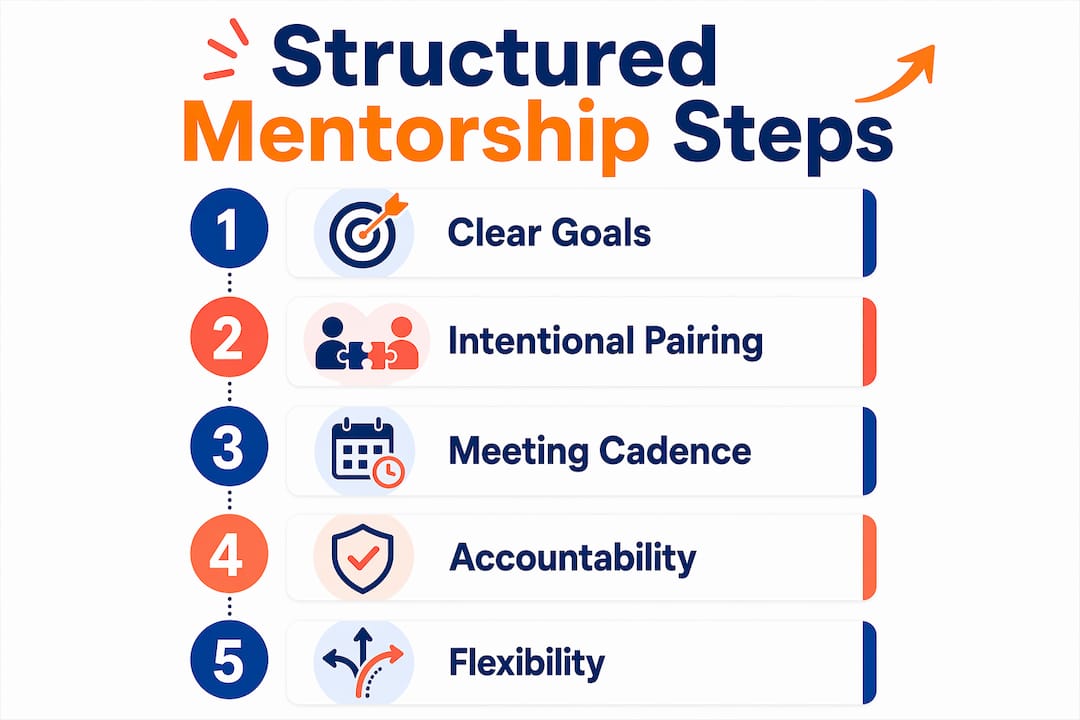
5. Flexibility within the framework
Structure should support the relationship, not constrain it. The best programs build in room for honest conversation, unexpected challenges, and course corrections. Effective mentors provide scaffolding, helping mentees set realistic goals, recognize progress, and work through setbacks without abandoning the overall plan.
How can professionals apply structured mentorship for measurable growth?
Applying structured mentorship principles does not require a formal corporate program. Professionals and entrepreneurs can build their own structured learning relationships with the right approach.
Start with these practices:
- Define your goals before seeking a mentor. Know what you want to achieve in the next six to twelve months. A mentor can help you refine your path, but you need to show up with direction.
- Build a diverse support network. Career mentors, technical mentors, and peer mentors each serve different functions. Relying on one person for all guidance creates a single point of failure in your development.
- Use a written agreement. Document expectations, communication preferences, and goals at the start. This single step prevents most of the misalignment that kills informal mentoring relationships.
- Track progress consistently. After each session, write down what you discussed, what you committed to, and what you will report back on. This creates a record that keeps both parties honest.
- Review and adjust regularly. Goals change. Business conditions shift. A structured mentorship relationship should adapt without losing its accountability framework.
The mentorship process for entrepreneurs often requires balancing structure with genuine relationship dynamics. The goal is not to run every session like a performance review. The goal is to create enough structure that progress happens even when motivation dips.
Pro Tip: Schedule your next three mentorship sessions at the end of each current session. Leaving scheduling to email follow-ups is how meetings disappear from calendars for weeks at a time.
For entrepreneurs specifically, the benefits of having a business mentor extend beyond skill development into decision-making speed, risk assessment, and network access. A mentor who has built and sold a company brings pattern recognition that no course or book can replicate.
Key Takeaways
Structured mentorship is the most reliable path from good intentions to measurable professional growth, because it replaces goodwill with systems, goals, and accountability.
| Point | Details |
|---|---|
| Structure prevents drop-off | Defined workflows and documentation stop the common “three-session slump” that kills informal mentoring. |
| Promotion impact is real | Mentored professionals are five times more likely to be promoted than those without a mentor. |
| Pairing on values matters | Shared attitudes and values predict mentorship success better than demographic similarity. |
| Goals must connect to outcomes | Mentoring goals tied to business objectives produce stronger, more measurable results. |
| Reciprocity strengthens both parties | Effective mentorship is a two-way exchange that develops both the mentor and the mentee. |
What I’ve learned from watching structured mentorship succeed and fail
I have seen professionals enter mentoring relationships with genuine enthusiasm and exit six weeks later with nothing to show for it. The pattern is almost always the same. The relationship started strong, the first conversation was energizing, and then life got in the way. No agenda. No written goals. No next meeting on the calendar. The relationship quietly dissolved.
What separates the mentorships that actually change careers from the ones that fade is not the quality of the mentor. It is the presence of a system. When you treat mentorship as a relationship alone, you are betting on sustained motivation from two busy people. When you treat it as a system with inputs, checkpoints, and outputs, you remove motivation from the equation entirely. The structure carries you through the weeks when neither of you feels like showing up.
The other thing I have noticed is that entrepreneurs tend to underestimate the psychological dimension of mentorship. Skill gaps are visible and easy to address. But the fear of success, the reluctance to charge what you are worth, the tendency to shrink in rooms where you feel like an outsider: those barriers do not disappear through skill training alone. A mentor who has navigated those same fears and can name them clearly is worth more than any technical advisor.
My advice is simple. Commit to the structure before you commit to the relationship. Find someone whose values align with yours, write down your goals together, and put three months of meetings on the calendar before you leave the first session. That one act of structure will do more for your growth than any amount of goodwill.
— Amichai
How Nomadexcel builds structured mentorship into entrepreneurial growth
Nomadexcel’s Online Entrepreneurship Bootcamp is built around the same principles that make structured mentorship effective: clear goals, direct guidance from experienced operators, and daily accountability that keeps participants moving forward. The program brings together early-stage founders and gives them access to mentors who have built real businesses, not just theoretical frameworks. Participants work through defined sprints, receive structured feedback, and leave with a peer network that continues to hold them accountable long after the program ends. For entrepreneurs who want mentorship that actually produces results, the bootcamp offers the structure that informal relationships rarely provide. You can also learn more about why joining a bootcamp accelerates growth in ways that self-directed learning cannot match.
FAQ
What is structured mentorship?
Structured mentorship is a formal learning relationship built around defined goals, regular meeting schedules, and measurable accountability between a mentor and mentee. It differs from informal mentoring by treating development as a system with clear inputs and tracked outcomes.
Why does structured mentorship matter for entrepreneurs?
Structured mentorship gives entrepreneurs access to pattern recognition, honest feedback, and accountability that accelerates decision-making and reduces costly mistakes. Mentored professionals are five times more likely to be promoted, and the business ROI of formal programs is nearly threefold.
How long should a structured mentorship program last?
Most effective structured mentorship relationships run for six to twelve months, with expectations set and reviewed at the midpoint. Setting explicit expectations within the first six months is the single most reliable predictor of long-term success.
How do you match mentors and mentees effectively?
Match on shared attitudes and values rather than demographics. Shared values predict relationship quality and longevity more accurately than age, gender, or industry background.
What is the biggest risk of informal mentoring?
The biggest risk is engagement drop-off. Without structured workflows and documented goals, most informal mentoring relationships fade after three sessions, producing goodwill but no measurable development outcomes.
Comments are closed.