
Why execution matters most in entrepreneurship success
TL;DR:
- Most startup failures are due to poor execution, not bad ideas.
- Building strong systems, leadership, and community accelerates effective execution.
- Rapid learning, feedback, and accountability are essential for startup success.
Most startups don’t fail because the idea was wrong. They fail because the team couldn’t turn the idea into results. Startup failure research consistently points to execution gaps, not idea quality, as the primary culprit behind collapsed ventures. Yet most aspiring founders pour their energy into perfecting the concept, the pitch deck, or the product roadmap, while neglecting the operational discipline that actually drives growth. This article breaks down what execution really means, which frameworks make it repeatable, why community accelerates it, and how you can build the habits and systems that separate thriving founders from the ones who almost made it.
Table of Contents
- What does execution mean in entrepreneurship?
- Core elements of effective execution
- Frameworks and systems that drive execution
- Why community and accountability supercharge execution
- Execution in real life: Pitfalls, pivots, and learning loops
- Editorial perspective: Why execution done right is the ultimate entrepreneurial leverage
- Level up your execution: Guided programs, mentorship, and community
- Frequently asked questions
Key Takeaways
| Point | Details |
|---|---|
| Execution trumps ideas | The best ideas fail without strong, consistent execution. |
| Systems and frameworks matter | Use proven tools like OKRs and Agile to structure execution and track progress. |
| Community accelerates growth | Accountability, mentorship, and peer support help entrepreneurs improve and persist. |
| Rapid learning wins | Quick feedback and willingness to pivot lead to higher startup success rates. |
What does execution mean in entrepreneurship?
Execution is one of those words that gets used often but rarely defined well. At its core, business execution means converting strategy into real, measurable results through consistent, organized action. It is not just about working hard. It is about working with intention, structure, and feedback loops that tell you whether you are actually moving forward.
Many founders believe that if they have a brilliant idea and enough passion, success will follow. That belief is costly. Ideas are abundant. The real scarcity is in the people and teams who can take an idea from concept to cash flow with discipline and speed.
Here is a breakdown of the five core components that make up strong execution:
- Strategy: Knowing where you are going and why, with clear priorities.
- Leadership: Setting direction, making decisions, and modeling the standards you expect from your team.
- Accountability: Owning outcomes, not just activities, and following through on commitments.
- Systems: Repeatable processes for product development, marketing, sales, and finance.
- Culture: The norms and behaviors that determine how your team responds to pressure, failure, and opportunity.
“Most startup failures stem from poor execution, not bad ideas. Factors like no market need, running out of cash, and poor timing are all execution problems in disguise.”
| Common failure reason | Execution connection |
|---|---|
| No market need | Skipping customer validation |
| Ran out of cash | Poor financial planning and forecasting |
| Wrong team | Leadership and hiring failures |
| Outcompeted | Slow product iteration and weak positioning |
| Poor marketing | No structured acquisition or testing system |
Understanding these failure modes reframes how you think about building a business. Every one of them is preventable with stronger execution. If you want a deeper foundation, the execution-focused growth guide from Nomad Excel covers how to connect execution habits to long-term business growth, and exploring why invest in business education helps frame why developing these skills early pays off.
Core elements of effective execution
Knowing what execution is matters less than knowing how to build it. Effective execution requires strategic alignment, clear team structures, defined processes, strong leadership accountability, scalable systems, and a culture that supports continuous improvement.
Here is how each element shows up in real early-stage businesses:
- Strategic alignment: Every team member understands the top three priorities for the week, month, and quarter, and can connect their daily tasks to the broader vision.
- Leadership accountability: The founder or team lead owns outcomes publicly, not just effort. They model the behavior they expect from others.
- Systems for core functions: Product, growth, finance, and team management each have documented, repeatable systems that reduce decision fatigue and increase speed.
- Feedback culture: Errors are treated as data, not failures. Retrospectives happen weekly, not just at quarter-end.
- Delegation: Founders who refuse to delegate become the bottleneck. Intentional delegation is not weakness; it is a growth multiplier.
One practical way to see this in action is to compare founder-led execution styles:
| Factor | Founder-led execution | Managed execution |
|---|---|---|
| Decision speed | Fast, intuitive | Slower, process-dependent |
| Adaptability | High | Moderate |
| Consistency | Variable | More predictable |
| Accountability | Direct | Distributed |
| Best stage | Early-stage | Scaling phase |
The goal is not to pick one style permanently. Strong founders know when to lead from the front and when to build systems that let the team operate independently. Exploring mastering entrepreneurship aspects gives you a broader map of the skills involved, while hands-on entrepreneurship explains why practical experience accelerates this learning far faster than theory alone.

Pro Tip: Run a 15-minute weekly team standup where each person names one win, one blocker, and one priority for the coming week. This single habit builds alignment, surfaces problems early, and reinforces accountability without consuming significant time.
Frameworks and systems that drive execution
Having the right mindset and team structure is essential, but without proven frameworks, execution tends to drift. Three methodologies stand out as particularly effective for early-stage founders.
OKRs (Objectives and Key Results) help you set ambitious goals and define the specific, measurable results that confirm progress. You set an objective (where you want to go) and attach two to four key results (how you will know you got there). The power is in the weekly review, not just the quarterly plan.
Agile and SCRUM break work into short sprints, typically one to two weeks, with clear deliverables and retrospectives at the end of each cycle. This approach forces you to ship, learn, and adjust continuously rather than waiting for a perfect version.
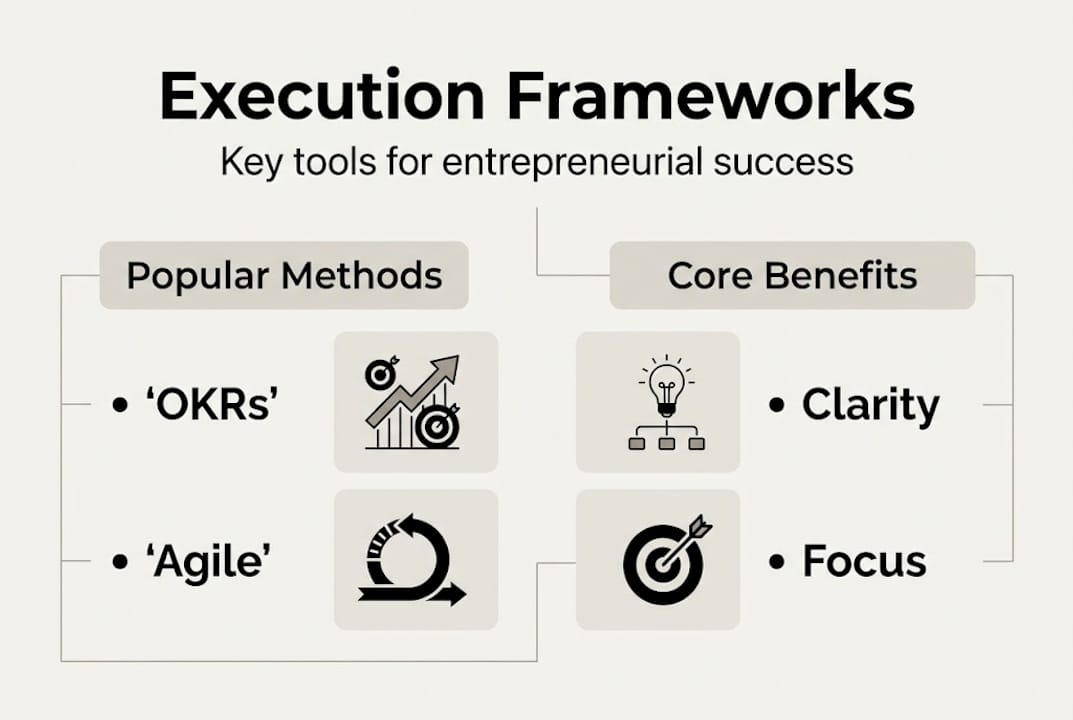
SMART goals (Specific, Measurable, Achievable, Relevant, Time-bound) serve as a foundation for any individual or team objective. They convert vague intentions into commitments that can be tracked. These frameworks are proven execution tools for startups at every stage.
Here are practical execution routines you can start this week:
- Set three to five OKRs per quarter and review them every Monday morning.
- Use a shared dashboard or simple spreadsheet to track key metrics in real time.
- Schedule a weekly 30-minute retrospective to identify what worked and what did not.
- Find one accountability partner, ideally another founder, and check in every Friday.
- Block two hours each week for deep work focused solely on your highest-priority deliverable.
The data on weekly check-ins is hard to ignore. Goal completion rates jump from 38% with monthly reviews to 74% with weekly OKR check-ins. That is nearly double the output from one simple habit change.
Pro Tip: Start with just three OKRs for your first quarter. Iterate weekly, and make sure at least one OKR requires you to talk directly with users or customers. The conversation always reveals something the data alone cannot.
The entrepreneurship bootcamp frameworks at Nomad Excel are built around exactly this kind of structured, iterative execution, and experiential entrepreneurship explains why learning by doing accelerates these habits faster than classroom study.
Why community and accountability supercharge execution
Even the best framework fails when a founder is isolated. Community is not a soft benefit. It is a structural advantage that directly improves execution quality and speed.
The importance of community for entrepreneurs is well documented. Peer feedback helps you spot blind spots in your strategy before they become expensive mistakes. Mentors who have navigated similar challenges can compress your learning curve dramatically. Accountability partners create external pressure that keeps you honest when motivation dips.
Here is how community-based execution support shows up in practice:
- Accountability partners: Weekly or biweekly check-ins with another founder who holds you to your stated commitments.
- Mastermind groups: Small, curated groups of four to eight entrepreneurs who share challenges, review metrics, and offer honest feedback.
- Transparent OKRs: Sharing your goals publicly within a peer group raises the stakes and invites real input.
- Mentorship sessions: Regular access to an experienced operator who has built what you are trying to build.
- Accelerator cohorts: Structured programs that combine curriculum, mentorship, and peer pressure in a single environment.
Community and accelerators like Y Combinator provide execution coaching and structured accountability that meaningfully increase a startup’s odds of survival and growth.
That said, community support works best when it supplements rather than replaces individual accountability. The risk is using group discussion as a substitute for action. Strong founders use community to pressure-test their thinking, not to delay decisions. The community support benefits are most powerful when you show up to each interaction having already done the work.
Execution in real life: Pitfalls, pivots, and learning loops
Systems and community provide the structure, but real execution happens in messy, unpredictable conditions. Knowing where founders typically stumble is just as valuable as knowing the best practices.
The most common execution pitfalls include:
- Over-planning: Spending weeks refining a strategy document instead of testing the core assumption with real users.
- Perfectionism: Holding a product or offer back until it feels ready, which often means it never ships.
- Avoiding user feedback: Assuming you know what customers want without actually asking them.
- Ignoring metrics: Running on gut feel instead of tracking the numbers that reveal what is actually working.
- Losing focus: Chasing new ideas before the current ones have been fully tested and optimized.
Persistence and rapid learning matter more in execution than intelligence or elaborate planning. The founders who win are not always the smartest. They are the ones who launch faster, learn from real feedback, and keep iterating without losing momentum.
The numbers back this up. Founder-led execution drives startup valuation growth of 22.4% compared to just 4.7% for management-led execution in early stages. Founders who stay close to the work, especially in the first two years, move faster and make better decisions.
Here is a simple four-step process for building an adaptive execution culture:
- Launch a minimum viable version of your product or offer as quickly as possible.
- Collect structured feedback from at least five real users within the first week.
- Identify the single biggest barrier to progress and address it before moving on.
- Run a retrospective every two weeks to capture lessons and adjust your approach.
Blind execution without learning wastes resources and accelerates failure. Speed matters, but only when paired with honest reflection on what the results are actually telling you.
Pro Tip: Schedule one 20-minute customer conversation every single week. This habit alone will surface product issues, reveal unmet needs, and guide pivots before they become expensive course corrections. The must-have founder skills section covers how to build this discipline, and the startup success guide offers a broader roadmap for putting it all together.
Editorial perspective: Why execution done right is the ultimate entrepreneurial leverage
After working with hundreds of founders across bootcamps and retreats, the pattern we see most often is not a lack of ambition or talent. It is the gap between knowing what to do and actually doing it consistently.
Execution frameworks are widely available. The real differentiator is the mindset that makes them stick. Founders who win get comfortable with ambiguity and imperfect information. They launch before they feel ready, gather real feedback, and treat discomfort as a signal that they are moving forward rather than standing still.
The conventional advice is to “plan less and do more.” We think that misses the point. The goal is to plan just enough to move, then let reality shape the next move. Execution-focused entrepreneurship is less about willpower and more about building an environment where action is the default. Community, accountability, and structured sprints are not nice-to-haves. They are the infrastructure that makes sustained execution possible when motivation is low and uncertainty is high.
Level up your execution: Guided programs, mentorship, and community
If you are ready to move from understanding execution to actually building it into your daily practice, Nomad Excel is designed exactly for that transition. Our online entrepreneurship bootcamp gives you the frameworks, accountability structures, and peer community that make consistent execution achievable, not just theoretical. Pair that with a structured mentorship program to get guidance from founders who have already navigated the pitfalls covered in this article. The Nomad Excel community connects you with driven entrepreneurs who challenge your thinking and support your progress long after any single program ends. Take the next step and build execution into your business from the ground up.
Frequently asked questions
What is the difference between execution and strategy in entrepreneurship?
Strategy is the process of choosing priorities and mapping the direction you want to go. Execution turns that plan into real, measurable outcomes through consistent, organized action.
Which execution frameworks work best for early-stage startups?
OKRs paired with weekly reviews deliver the highest impact for most early-stage founders, with Agile approaches and clear accountability partners close behind. Weekly OKR check-ins nearly double goal completion rates compared to monthly reviews.
How can entrepreneurs avoid common execution pitfalls?
Prioritize fast learning over perfect planning, collect user feedback frequently, and resist the urge to hold your product back until it feels finished. Rapid feedback loops are what separate founders who adapt from those who stall.
Why does community matter for execution?
Peer accountability, honest mentorship, and real-time feedback from a trusted community improve both the quality and consistency of your execution. Community and mentorship have a measurable impact on startup survival and long-term growth.
Comments are closed.