
Startup ideation explained: frameworks, validation, results
TL;DR:
- Successful startups focus on solving urgent, real-world problems validated through user feedback.
- Structured, disciplined validation accelerates ideation and prevents wasting time on implausible ideas.
- Mentorship and early testing are crucial for refining ideas and increasing startup survival chances.
Successful startup founders rarely brainstorm their way to success. Instead, they spot problems people genuinely suffer from and then test whether their proposed fix actually works. Most early-stage entrepreneurs waste months chasing ideas that feel exciting but solve problems nobody urgently needs solved. Validating urgent, real-world problems separates founders who build businesses from those who build decks. This guide walks you through the frameworks, validation steps, and mentorship strategies that move you from fuzzy concept to a focused, testable startup idea. If you have been stuck in the “I have a great idea” phase longer than you would like to admit, this is for you.
Table of Contents
- What startup ideation really means
- The disciplined ideation process: From problem to proposal
- Avoiding common traps: Filtering real demand from ‘sitcom ideas’
- Mentorship and iteration: Accelerating ideation success
- A perspective you won’t hear in most startup guides
- Turn your startup idea into action with the right support
- Frequently asked questions
Key Takeaways
| Point | Details |
|---|---|
| Root ideation in real problems | Successful startup ideation begins with spotting and validating urgent needs, not endless brainstorming. |
| Test assumptions quickly | Defining a hypothesis and checking with real users fast increases your chances of finding a workable idea. |
| Avoid ‘sitcom’ traps | Steer clear of plausible but unwanted ideas by letting user demand guide your direction. |
| Mentorship accelerates progress | Seeking expert feedback and support helps refine your idea and prevents avoidable mistakes. |
| Real-world feedback is essential | Listening to users and iterating rapidly is more impactful than aiming for the perfect initial idea. |
What startup ideation really means
Most people treat startup ideation like a creative brainstorming session. They gather a whiteboard, a group of friends, and a timer, and they try to generate as many ideas as possible. That approach is fine for marketing campaigns. It is not how sustainable businesses are built.
Real startup ideation is a disciplined process rooted in pattern recognition and problem finding. It starts with observation. You notice friction in your own life or in the lives of people around you. You ask whether that friction is common, painful, and currently underserved. Only then do you move toward imagining a solution.
“Good ideation is rooted in recognizing and validating urgent problems, not just generating ideas.”
This distinction matters enormously. A brainstormed idea starts with “what could I build?” A problem-first idea starts with “what do real people desperately want fixed?” The second question is far harder to answer, but it leads to businesses people actually pay for.
Urgency is the keyword here. Not every problem is worth solving. The problems worth building businesses around share a few traits:
- People experience them frequently, not once a year
- People have already tried to solve them with workarounds
- The cost of not solving the problem is real, whether in time, money, or stress
- A specific, identifiable group of people faces the problem right now
Startup ideation also means accepting that validation is not a separate step that comes after you develop your idea. It is woven into the process from day one. The moment you notice a problem, you start testing your assumptions about who has it, how badly they feel it, and whether they would pay someone to remove it.
When you approach validating startup ideas this way, you stop treating your idea as something precious to protect and start treating it as a hypothesis to stress-test. That mental shift alone puts you ahead of most early-stage founders.
The disciplined ideation process: From problem to proposal
Knowing what ideation really means is one thing. Executing it in a structured way is another. The most effective founders follow a repeatable sequence that moves them from raw observation to a testable proposal without wasting months on development.
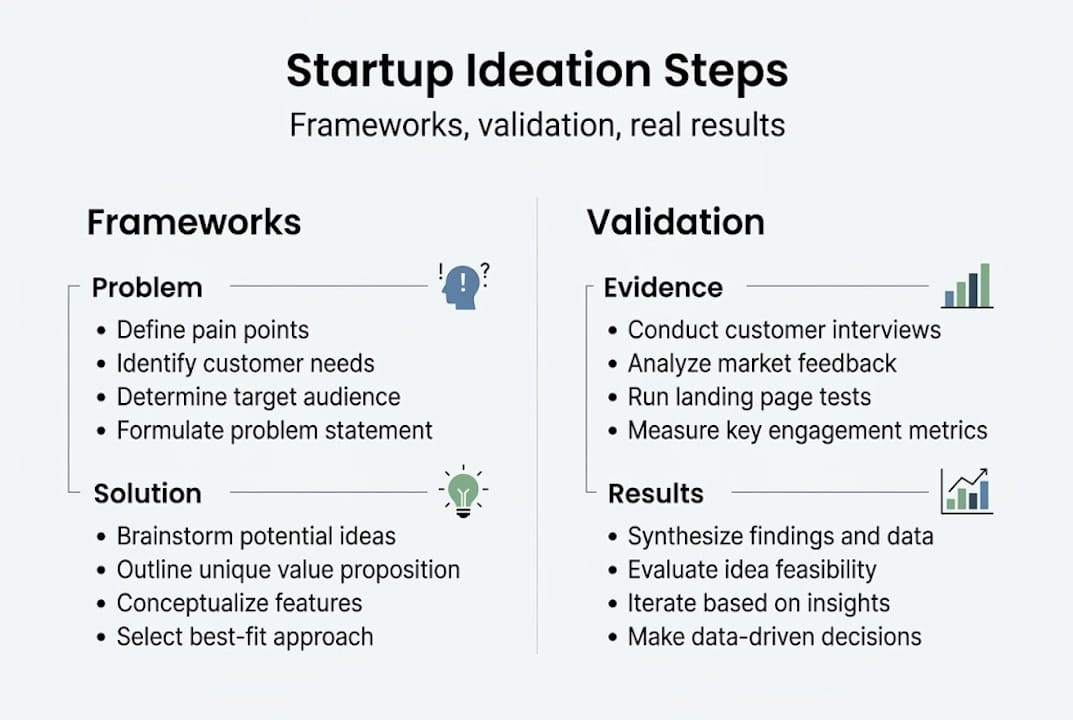
Step-by-step ideation sequence:
- Notice the problem. Write down three to five frustrations you or people you know encounter repeatedly. Be specific. “Scheduling is annoying” is too vague. “Freelancers lose three hours a week chasing invoice payments” is a real problem.
- Form a hypothesis. State clearly who has the problem, how severe it is, and what a possible solution looks like. One sentence. No jargon.
- Test with real users. Talk to at least ten people who match your target user profile. Do not pitch your solution. Ask about their experience of the problem. Listen for emotion and frequency.
- Propose your solution. Only after confirming the problem exists for real people should you sketch a solution. Keep it minimal.
- Pre-sell or launch a prototype. Founders should validate by launching or pre-selling to real users before investing heavily in building.
- Iterate. Use what you learn from early users to sharpen both the problem definition and the solution.
One of the most useful thinking tools is a simple Problem-Solution-Market Fit table:
| Element | Questions to answer |
|---|---|
| Problem | Is it urgent, frequent, and painful? |
| Solution | Does your fix actually remove the pain? |
| Market fit | Is there a specific group who will pay for this? |
Starting small is not a weakness. It is a strategy. The strongest ideas are often validated with a tiny, specific audience before scaling. Explore workshop examples for ideation to see how structured sprints help founders move through these steps faster.

Pro Tip: Resist the urge to target “everyone.” The more specific your initial user group, the faster you will get clear signals about whether your idea has real legs.
Avoiding common traps: Filtering real demand from ‘sitcom ideas’
Understanding the disciplined process also means recognizing the most common pitfalls founders walk straight into.
A “sitcom idea” is a startup concept that sounds smart, makes sense when you explain it at dinner, and might even get a few encouraging nods from friends. But nobody urgently needs it. Nobody would miss it if it disappeared tomorrow. These ideas are dangerous precisely because they are plausible enough to consume months of your time before you realize there is no real market.
Common red flags that your idea might be a sitcom idea:
- You cannot name ten specific real people who have this problem right now
- The problem only occurs once or twice a year for most people
- Your solution requires users to significantly change their behavior
- You have not spoken to a single potential customer yet
- The market is defined as “anyone who uses a smartphone”
- You are more excited about the technology than the problem it solves
Real demand leaves evidence. People are already trying to solve the problem with messy workarounds. Forums and Reddit threads are full of complaints about it. People have paid money for imperfect solutions. When you find that evidence, you are looking at a real problem.
Over 42% of startups fail due to no market need, making this the single most preventable cause of startup failure. The painful irony is that most of those founders worked incredibly hard. They just built something nobody urgently wanted.
To test for real demand before you build anything, ask yourself these questions:
- Have I talked to at least ten potential users who confirmed the problem unprompted?
- Would someone pay me today to solve this, even in a rough, manual way?
- Am I solving a problem I personally understand deeply, or one I am guessing about?
Real user signals, not plausible-sounding ideas, should guide what you build. When in doubt, go back to conversations with real users before writing a single line of code or spending a dollar on design.
Mentorship and iteration: Accelerating ideation success
Once you understand how to filter great ideas, adding mentorship and iteration can dramatically accelerate your progress.
Working through ideation alone is slow and expensive. You hit the same mental walls repeatedly, and without outside perspective, it is easy to fall in love with your own assumptions. Mentors and structured feedback loops break that cycle.
Accelerators and mentorship programs support ideation in three key ways. They provide frameworks that organize your thinking, accountability structures that keep you moving, and experienced voices that challenge your assumptions before you waste resources testing the wrong things.
The data on mentored startups is striking:
| Metric | Mentored founders | Non-mentored founders |
|---|---|---|
| Survival rate at 2 years | ~70% | ~44% |
| Revenue growth (year 1) | 3.5x more likely to grow | Baseline |
| Time to first paying customer | Shorter by an average of 4 months | Baseline |
These numbers reflect a simple truth: outside perspective speeds up the learning loop.
Ideation quality improves when founders actively seek feedback and evolve their ideas based on user and mentor input. The best mentors do not just validate your excitement. They poke holes. They ask uncomfortable questions. They push you toward evidence instead of letting you rest on assumptions.
Practical steps to use mentorship effectively during ideation:
- Find a mentor who has built something in your problem space, not just someone with a generic business background
- Come to every session with a specific question or assumption you want challenged
- Share your user research findings, not just your idea pitch
- Ask your mentor to steelman the opposite view of your hypothesis
- Review startup mentorship frameworks to structure how you apply feedback between sessions
Understanding the benefits of startup mentors goes beyond encouragement. The right mentor compresses what could take years of trial and error into months of focused iteration.
Pro Tip: Choose a mentor who makes you slightly uncomfortable. If every session leaves you feeling validated but unchallenged, you are not getting the feedback that actually improves your idea.
A perspective you won’t hear in most startup guides
Here is the uncomfortable truth most ideation articles skip entirely: the biggest risk you face is not a shortage of ideas. It is over-planning without testing anything real.
We see it constantly. Founders spend three months researching the market, building a pitch deck, and refining their value proposition on paper, then wonder why they feel stuck. The research phase feels productive, but it is often a sophisticated form of avoidance. It is much more comfortable to read about your market than to put a rough concept in front of a real person who might tell you it is not worth building.
The founders who move fastest embrace early discomfort. They share rough ideas. They get criticized. They adjust. Proven idea validation is not a clean, linear process. It is messy, occasionally discouraging, and consistently more useful than any amount of solo planning.
Harsh feedback from five real users in week one is worth more than five months of market research. It saves money, redirects energy, and builds the habit of customer obsession that great founders carry throughout their entire careers. Skip the endless refining and start testing. The world will tell you what it needs far more honestly than any business plan will.
Turn your startup idea into action with the right support
Startup ideation is not a solo sport. The frameworks in this article give you a strong foundation, but the fastest path from idea to traction runs through mentorship, structured accountability, and a community that challenges you to grow. At Nomad Excel, we design immersive programs that give early-stage founders exactly that. Whether you want to join an online entrepreneurship bootcamp for hands-on validation sprints or explore a startup mentorship program built for real execution, we provide the frameworks and expert guidance to move you forward. Discover the benefits of entrepreneurship bootcamps and take the next concrete step toward launching with confidence.
Frequently asked questions
How is startup ideation different from just brainstorming ideas?
Startup ideation is about finding urgent, real-world problems and testing them with users, not simply generating as many ideas as possible. Where brainstorming values volume, ideation values evidence, and ideation is rooted in recognizing urgent problems rather than creative output alone.
What is a ‘sitcom idea’ and why should I avoid them?
“Sitcom ideas” are startup concepts that sound clever but are not urgently needed by any real users, making them highly likely to fail before gaining traction. Real user demand is the only reliable filter for separating genuinely valuable ideas from plausible-sounding traps.
How can I validate my startup idea quickly?
Define a testable hypothesis and try to get early commitments or make pre-sales before fully building your solution. Founders should validate through real-world testing with actual users, not through market research documents alone.
What role does mentorship play in startup ideation?
Mentors accelerate ideation by providing structured feedback, accountability, and experienced perspective that sharpens your problem definition faster than solo iteration. Mentorship and feedback are vital for iterative ideation and help founders avoid costly assumptions.
Is it necessary to have a unique idea for startup success?
Uniqueness matters far less than solving an urgent problem for a specific audience and confirming real demand through user feedback. Execution, timing, and iteration consistently outperform originality as drivers of early startup success.
Comments are closed.