
Productivity Hacks for Founders: Boost Efficiency and Growth
TL;DR:
- Founders should evaluate hacks based on impact, speed, cost, and scalability to maximize effectiveness.
- Key hacks include time blocking, morning prioritization, automating workflows, and founder sprints.
- Sustaining productivity requires regular reviews, tracking leading indicators, and balancing work with rest.
Every founder knows the feeling: a task list that never shrinks, a calendar packed with competing priorities, and a nagging sense that the day slipped by without moving the needle. Time is the one resource you cannot manufacture more of, and wasted minutes compound into lost revenue, delayed launches, and founder fatigue. The good news is that the right productivity hacks, applied consistently, can measurably shift your startup’s trajectory. This article walks you through a clear framework for choosing the best hacks, a curated list of founder-tested strategies, a side-by-side comparison, and practical tools to make every gain stick.
Table of Contents
- How to evaluate productivity hacks: Key criteria for founders
- Top 6 productivity hacks that work for busy founders
- Productivity hack comparison: Effort, speed, and results
- Digital tools and templates: Founder-focused time savers
- Sustaining your productivity: Habits, tracking, and founder self-care
- Why striving for ‘more’ productivity can backfire for founders
- Level up your founder journey with Nomad Excel
- Frequently asked questions
Key Takeaways
| Point | Details |
|---|---|
| Test hacks deliberately | Introduce one productivity hack at a time and measure its effect for a week. |
| Automate and delegate | Use tools and workflows that automate repetitive tasks to multiply your output. |
| Sustain with self-review | Regularly review habits and goals to lock in gains and avoid burnout. |
| Choose for your stage | Pick productivity strategies matched to your current business phase, not generic trends. |
How to evaluate productivity hacks: Key criteria for founders
Not every productivity hack deserves a spot in your workflow. The internet is full of trendy techniques that work brilliantly for a solo content creator but fall flat for a founder managing a team, investors, and product development simultaneously. Before you adopt anything new, run it through a simple four-part filter.
- Impact: Will this hack free up meaningful blocks of time or reduce cognitive load? Marginal gains are fine for optimization, but early-stage founders need hacks that move the needle fast.
- Time to adopt: How long before you see a return? A hack that takes three weeks to set up but saves two minutes a day is a poor trade.
- Cost: Does it require paid software, a consultant, or significant setup? Free and low-cost hacks should come first when resources are tight.
- Scalability: Will this still work when your team doubles? A hack that breaks under growth is a short-term fix, not a system.
Awareness of common pitfalls matters just as much as the criteria above. Many founders fall into the trap of chasing the newest productivity trend instead of doubling down on what already works for their specific context. Choosing the right tools can dramatically affect productivity, which is why tool selection deserves the same rigor as any other business decision.
The deeper goal of any productivity hack is to protect your decision-making bandwidth. Every unnecessary task you handle personally is a decision that drains mental energy you could spend on strategy. Pair your hack evaluation with clear goal setting for entrepreneurs so you know which activities actually deserve your sharpest thinking.
Pro Tip: Test one hack at a time for at least a week before judging its value. Stacking too many changes at once makes it impossible to know what is actually working.
Top 6 productivity hacks that work for busy founders
With a solid filter in place, here are six high-impact hacks that real founders rely on to protect their time and accelerate output.
- Time blocking. Assign every hour of your workday to a specific task or category before the day begins. Time blocking increases daily output by up to 30%, making it one of the fastest wins available to any founder.
- Morning prioritization. Spend the first ten minutes of your day identifying your top three non-negotiable tasks. Everything else becomes secondary until those three are done.
- Automated workflows. Use tools like Zapier or Make to connect your apps and eliminate repetitive manual steps. Automating invoice reminders, lead notifications, or onboarding emails can save hours each week.
- Email batching. Check and respond to email in two or three scheduled windows per day rather than reacting to every notification. This alone can reclaim 90 minutes of deep work time daily.
- The two-minute rule. If a task takes less than two minutes, do it immediately rather than adding it to a list. This keeps small items from piling into a backlog that weighs on your focus.
- Founder sprints. Borrow from agile methodology and work in focused 90-minute sprints with a short break between each. This rhythm matches natural human attention cycles and sustains energy across a full workday.
“Clarity about what matters most is the real productivity hack. Everything else is just execution.” This mindset captures why goal setting directly increases founder efficiency.
Pro Tip: Stack compatible hacks for compounding gains. For example, combine time blocking with founder sprints so your blocked hours are also structured into focused work intervals. Explore more strategies through startup success tips to find what pairs best with your current workflow.
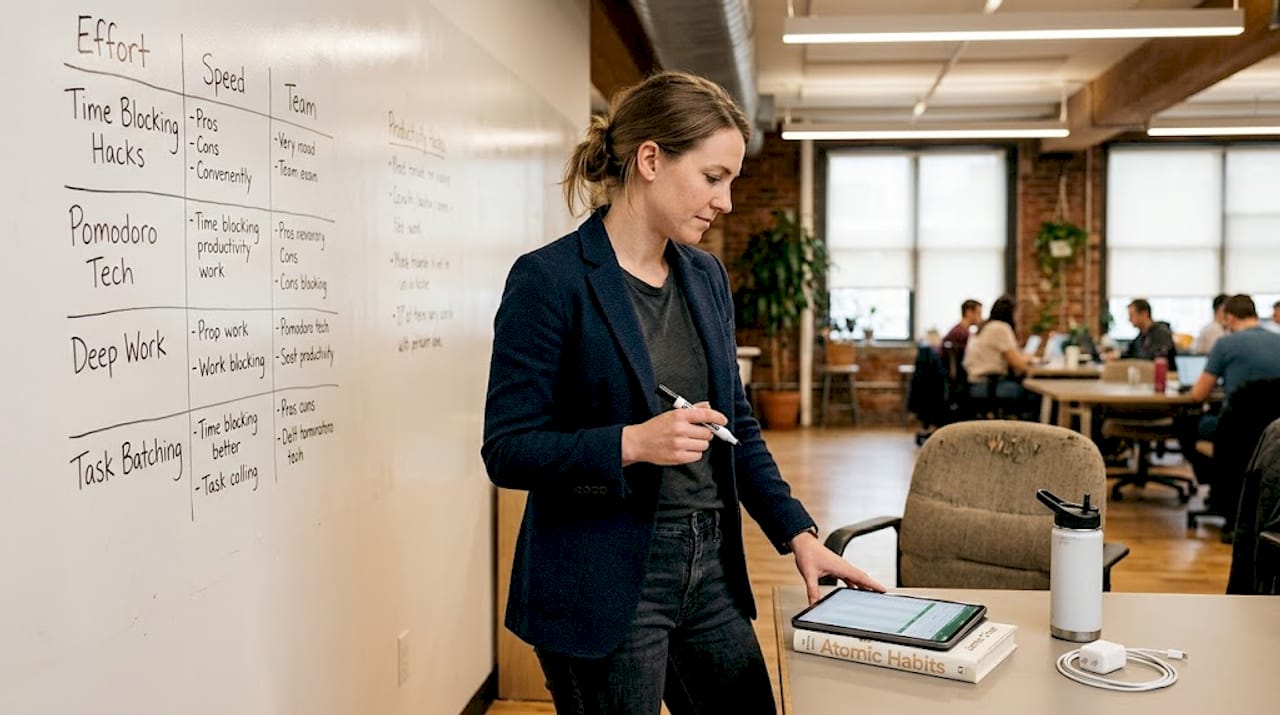
Productivity hack comparison: Effort, speed, and results
You might be wondering which hack is the right starting point, or which combination fits your business. The table below compares the core hacks across the dimensions that matter most to founders.
| Hack | Effort to adopt | Learning curve | Speed of results | Team impact |
|---|---|---|---|---|
| Time blocking | Low | Minimal | Immediate | High |
| Morning prioritization | Very low | None | Same day | Medium |
| Automated workflows | Medium | Moderate | 1 to 2 weeks | Very high |
| Email batching | Low | Minimal | Immediate | Medium |
| Two-minute rule | Very low | None | Immediate | Low |
| Founder sprints | Low | Minimal | 2 to 3 days | High |
As entrepreneurial frameworks research confirms, some hacks deliver immediate output increases while others build compounding benefits over weeks. Time blocking and the two-minute rule are your quick wins. Automated workflows are the long game.
Here is a quick guide for matching hacks to your current situation:
- Solo founder, pre-revenue: Start with morning prioritization and the two-minute rule. Zero cost, zero setup, instant clarity.
- Early team, rapid growth: Add time blocking and founder sprints to protect deep work while managing team communication.
- Scaling startup, operational complexity: Invest in automated workflows and email batching to reduce the volume of decisions hitting your inbox.
- Burnout risk: Prioritize founder sprints and email batching first. Both reduce the feeling of constant reactive pressure.
The key insight here is that no single hack wins for every founder. Your current pain point should drive the selection, not what is trending in productivity circles.
Digital tools and templates: Founder-focused time savers
Once you have picked your favorite hacks, the right digital tools make implementing them seamless. Here are founder-approved picks organized by use case.
| Tool | Best use case | Key feature | Starting price |
|---|---|---|---|
| Notion | Task management and templates | All-in-one workspace | Free tier available |
| Calendly | Scheduling automation | Eliminates back-and-forth emails | Free tier available |
| Zapier | Workflow automation | Connects 6,000+ apps | Free tier available |
| Toggl Track | Time tracking | Visual time reports | Free tier available |
| Loom | Async communication | Record and share video updates | Free tier available |
Founders using curated tools experience a 20 to 30% increase in daily efficiency, which translates directly into more hours for high-value work. The right stack is not about having the most tools. It is about having the right ones that work together without creating new complexity.
Consider these synergies when building your tool stack:
- Pair Calendly with Notion to auto-populate meeting agendas from scheduled calls.
- Use Zapier to push Toggl time data into a weekly report template, making your productivity reviews automatic.
- Replace long email threads with Loom videos to cut response time and reduce miscommunication on your team.
Templates are equally powerful. A reusable meeting agenda, a weekly review checklist, or a client onboarding sequence built once in Notion saves you from reinventing the wheel every time. Browse the entrepreneur tips blog for ready-to-use frameworks that fit common founder workflows.
Sustaining your productivity: Habits, tracking, and founder self-care
Time-savers mean little if you cannot make them part of your weekly rhythm. Here is how founders can lock in their gains and keep them working long-term.
- Build a weekly review ritual. Set aside 30 minutes every Friday to assess what worked, what stalled, and what needs adjustment. This single habit prevents productivity systems from quietly falling apart.
- Track leading indicators, not just outcomes. Instead of measuring revenue alone, track hours of deep work completed, tasks batched, or automations triggered. These leading metrics tell you whether your habits are holding.
- Use habit stacking. Attach new productivity behaviors to existing routines. For example, do your morning prioritization immediately after your first cup of coffee, before opening email.
- Schedule recovery intentionally. Block time for exercise, rest, and creative thinking the same way you block time for meetings. Recovery is not a reward for finishing work. It is a prerequisite for sustained output.
- Iterate quarterly. What works in month one may not serve you in month six. Tracking progress is essential to maintaining long-term productivity gain, so treat your system as a living document that evolves with your business.
Founder burnout is real and it is expensive. The most productive founders are not those who work the most hours. They are the ones who protect their energy as carefully as they protect their calendar. Explore future-proof entrepreneurship skills to understand how sustainable habits connect to long-term business resilience.
Pro Tip: Run a weekly productivity review every Sunday evening. Review three wins, one bottleneck, and one adjustment for the week ahead. This five-minute practice builds compounding self-awareness over time.
Why striving for ‘more’ productivity can backfire for founders
Here is the uncomfortable truth that most productivity content skips: optimizing for more is not the same as optimizing for better. Many early-stage founders treat productivity as a volume game, squeezing every minute into a task, chasing efficiency metrics, and measuring their worth by how full their calendar looks. That approach leads to burnout, not growth.
Real productivity leverage comes from ruthless alignment between your daily actions and your core business objectives. If you are executing faster on the wrong priorities, you are just accelerating in the wrong direction. The importance of goal setting is not just about clarity. It is about making sure the machine you are building is pointed at the right destination.
The founders who scale sustainably are not the ones who found a perfect morning routine. They are the ones who got honest about what only they can do, and systematically removed or delegated everything else. Productivity hacks are tools for creating leverage, not badges of discipline. Use them to buy back your thinking time, not to fill it with more tasks.
Level up your founder journey with Nomad Excel
If you are ready to put these productivity hacks into practice with a supportive founder ecosystem around you, Nomad Excel was built for exactly this moment. Our Online Entrepreneurship Bootcamp gives you structured frameworks, direct mentorship, and a community of driven founders who hold each other accountable to real results. Productivity habits are far easier to build and sustain when you are surrounded by people who share your ambition. Read our guide to entrepreneurship bootcamps to see how immersive learning accelerates what you can achieve alone. Visit Nomad Excel to explore all programs and take the next step toward building a business that grows with intention.
Frequently asked questions
What is the single most effective productivity hack for founders?
Time blocking, when consistently applied, delivers the fastest and most noticeable efficiency boost for founders, increasing daily output by up to 30%.
How can founders avoid burnout while staying productive?
Founders should schedule regular breaks, track their energy levels alongside their hours, and conduct weekly workflow reviews to catch imbalances early. Goal setting that aligns daily tasks with core priorities also prevents the exhausting cycle of busy work.
Are digital tools necessary for productivity hacking?
While not mandatory, the right digital tools can automate repetitive tasks and help founders increase efficiency by 20 to 30% daily, making them a strong investment for most early-stage businesses.
How do I make a new productivity habit stick as a founder?
Focus on one new habit at a time for at least a week, track your progress consistently, and adjust based on what fits your actual work style. Tracking progress is essential to maintaining long-term productivity gain.
Comments are closed.