
Why global business experiences drive startup growth
TL;DR:
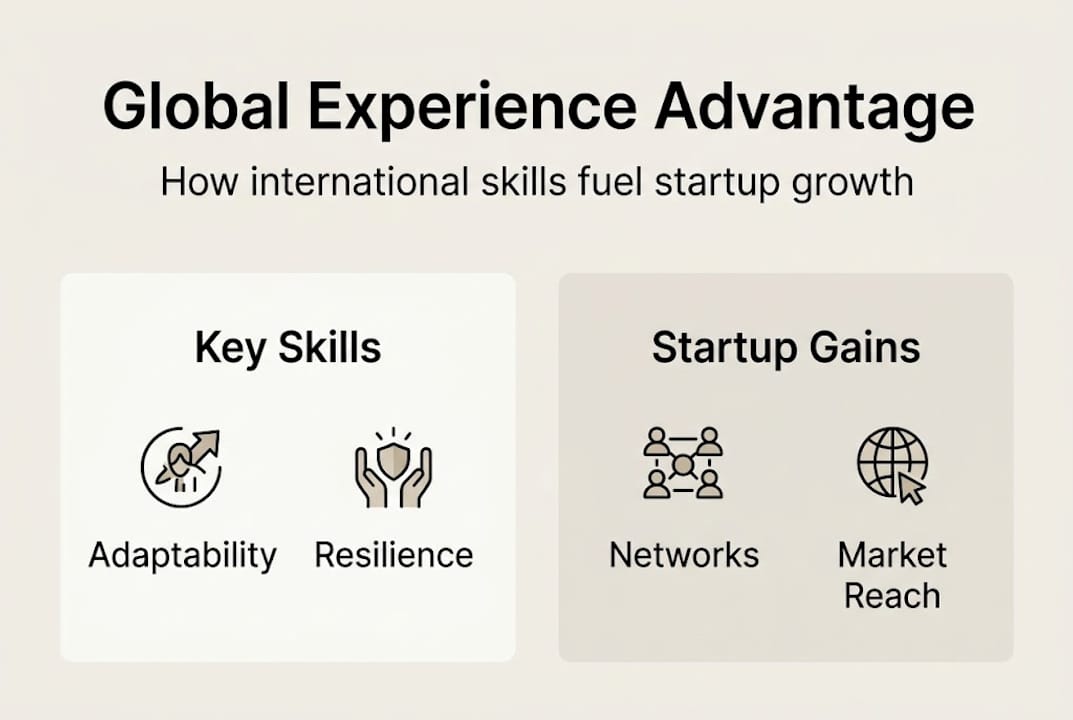
- Global experience develops cultural intelligence, networks, and practical entrepreneurial skills.
- Immersive programs accelerate startup adaptability and long-term success in international markets.
- Structured bootcamps and mentorship offer transformative global immersion for early-stage founders.
Most aspiring entrepreneurs believe that mastering their local market is the strongest foundation for long-term success. That belief, while understandable, misses a critical factor that research now consistently highlights: direct international experience is a stronger predictor of startup survival and adaptability than business education alone. Founders who have navigated foreign markets, worked alongside diverse teams, and operated inside immersive global programs develop skills that classroom instruction simply cannot replicate. This guide breaks down why global business experiences create such a powerful edge, what mechanisms drive that advantage, and how you can position yourself to benefit from immersive learning at the earliest stage of your entrepreneurial journey.
Table of Contents
- What are global business experiences and why are they different?
- How global experiences accelerate entrepreneurial skills and mindset
- Impact on resource building, networks, and startup success
- Navigating uncertainty and adapting for international growth
- A new way to think about global business experience
- Accelerate your next step with global entrepreneurship programs
- Frequently asked questions
Key Takeaways
| Point | Details |
|---|---|
| Cultural intelligence advantage | International experiences help you adapt products and strategies for global markets faster and more effectively. |
| Rapid entrepreneurial skill-building | Global exposure develops innovativeness, proactiveness, and real-time problem-solving beyond academic study. |
| Stronger networks and resources | Building international connections and experience-rich teams dramatically improves startup survival and growth odds. |
| Better risk navigation | Immersive international experience prepares you to handle uncertainty and make smarter market entry decisions. |
What are global business experiences and why are they different?
Global business experiences are not just about traveling to another country for a conference or spending a semester abroad. They represent a category of immersive, cross-border engagement that places you inside real business environments, cultures, and challenges far outside your comfort zone. These experiences include working internationally, participating in structured entrepreneurship programs in foreign markets, studying within global business cohorts, or joining bootcamps that intentionally expose founders to diverse perspectives and market realities.
What separates these experiences from standard academic study or local work experience is the quality of friction involved. When you operate in a different cultural and economic context, you cannot rely on familiar shortcuts. You are forced to listen more carefully, question your assumptions, and adapt in real time. This process builds what researchers and practitioners call cultural intelligence, the ability to read and respond effectively across cultural differences.
Experiential education for entrepreneurs consistently outperforms theory-based approaches because the learning is tied to consequence. Decisions matter. Relationships are real. Markets respond unpredictably. That pressure accelerates growth in ways that lectures and case studies simply cannot match.
Here is what distinguishes global business experiences from traditional alternatives:
- Immersive learning environments where you encounter unfamiliar regulations, consumer behaviors, and business norms
- Live mentorship from practitioners who have successfully navigated cross-border challenges
- Peer communities built across nationalities, industries, and backgrounds that challenge your thinking
- Accountability structures that demand action, not just reflection
- Real stakes tied to actual business decisions in complex environments
“Cultural intelligence builds through global business experiences, enabling entrepreneurs to understand diverse markets and adapt products and services effectively for international expansion.”
Critically, practical immersion fosters real-world learning on resilience, networking, and market adaptation in ways that online methods simply cannot replicate. The difference is not incremental. It is structural.
How global experiences accelerate entrepreneurial skills and mindset
Entrepreneurial orientation, commonly referred to as EO in business research, is the combination of traits that predict whether a founder will grow aggressively, pivot intelligently, and lead with confidence. Those traits include innovativeness, proactiveness, and a calibrated tolerance for risk. The good news is that EO is not fixed at birth. It can be developed, and global experience is one of the most powerful accelerators available.
Entrepreneurs with international experience develop enhanced EO, including innovativeness, proactiveness, and risk-taking, which directly accelerates their speed of internationalization. This is not a soft claim. It reflects patterns drawn from empirical research across hundreds of founders.
Here is how international immersion builds each core entrepreneurial skill:
- Innovativeness grows when you see how other markets solve the same problem differently. Exposure to varied solutions breaks the habit of defaulting to what worked locally.
- Proactiveness develops when you cannot wait for certainty. Operating in unfamiliar environments forces you to move on incomplete information, which becomes a competitive habit.
- Risk calibration sharpens when you survive real setbacks in foreign contexts. Risk stops feeling abstract and starts feeling manageable.
- Ambiguity navigation improves through constant exposure to environments where rules, expectations, and social norms differ from what you know.
- Rapid experimentation becomes second nature when markets respond differently than expected and iteration is the only path forward.
A global mindset from experience enables business model practices that overcome the liabilities of newness and smallness, helping founders internationalize faster and more sustainably.
| Skill area | Global experience outcome | Local-only experience outcome |
|---|---|---|
| Cultural adaptability | High, tested across contexts | Limited, assumption-based |
| Risk tolerance | Calibrated through real exposure | Theoretical, often inflated or deflated |
| Network diversity | Multi-national, cross-industry | Regional, often single-sector |
| Innovation approach | Draws on varied global solutions | Tends toward imitation of local models |
| Speed of expansion | Accelerated by prior familiarity | Slowed by unfamiliarity with foreign norms |
Pro Tip: Seek immersive, structured programs rather than solo international travel. The mentorship, peer accountability, and facilitated learning inside a well-designed program compound the benefits of the international setting itself. Passive exposure rarely produces the same depth of growth as investing in business education that combines environment with guided execution.
When you build global entrepreneurship strategies from a foundation of real cross-border experience, your decisions carry more precision and your confidence rests on something tested rather than assumed.
Impact on resource building, networks, and startup success
Mindset is only part of the advantage. Global business experiences also shape the practical infrastructure that determines whether a startup survives its earliest and most vulnerable years. Networks, mentors, funding contacts, and strategic partners are not found by accident. They are built through intentional proximity to the right environments.

High-performing early internationalizing startups are led by founders with prior international experience, strong human capital, and networks, and a meta-analysis of 378 studies confirms that resource-rich firms consistently outperform resource-poor ones. This is not a minor performance gap. Resource richness built through global exposure often determines whether a startup scales or stalls.
The types of human and social capital you build through global immersion include:
- Diverse mentor relationships with experienced operators across different markets and industries
- Co-founder and collaborator connections formed through shared challenge in high-pressure environments
- Investor introductions that happen organically inside global business communities
- Strategic partnerships that emerge from cross-border exposure to complementary businesses
- Operational knowledge about regulations, logistics, and cultural expectations in target markets
“You do not just expand your network abroad. You build relationships forged through shared difficulty, which are far more durable than connections made at local networking events.”
On the team side, founding teams with former MNE workers show higher survival rates, stronger growth, and better wages conditional on survival, even accounting for a higher early exit risk in some cases. Former multinational enterprise employees bring institutional knowledge, cross-functional skills, and existing networks that give early-stage startups a measurable edge.
| Experience profile | Startup survival rate | Growth trajectory | Network quality |
|---|---|---|---|
| Founders with international experience | Higher | Faster internationalization | Multi-national, diverse |
| Founders without international experience | Moderate | Slower, more locally bound | Regional, more concentrated |
| Teams with MNE background | Highest conditional | Strong when sustained | Institutional and broad |
The entrepreneurship bootcamp benefits extend well beyond the program itself. The peer communities, mentor relationships, and accountability structures formed during immersive programs become vital resources long after the experience ends. And the startup mentorship benefits gained through structured global programs are especially powerful because they connect founders with advisors who have already navigated the exact challenges they face.
Navigating uncertainty and adapting for international growth
Every founder encounters uncertainty. The question is not whether you will face it but how prepared you are to respond when familiar frameworks stop working. This is where international experience creates one of its most underappreciated advantages.
International experience reduces perceived uncertainty in foreign markets, moderates growth mode choices, and helps founders rely less on imitative strategies. When you have already operated in ambiguous, unfamiliar environments, new markets feel less threatening. You have a reference point. You know you can figure it out.
Here are practical steps to build your uncertainty-handling capacity through international immersion:
- Choose programs in culturally distant markets. The greater the cultural distance, the more your adaptability is genuinely tested and strengthened.
- Engage with local entrepreneurs, not just other internationals. Real market understanding comes from conversations inside the culture, not just alongside other visitors.
- Commit to execution during the program. Observation alone produces awareness. Taking action in a foreign context produces resilience.
- Debrief deliberately. After each challenge, reflect on what you assumed, what was wrong, and what you would do differently. This builds transferable judgment.
- Build relationships, not just itineraries. Durable networks across cultural distance are among the most valuable long-term assets you can carry out of any global experience.
Pro Tip: Not all global experiences carry equal weight. A weekend trip to an international conference produces very different outcomes than a structured, multi-week program inside a foreign market with real business stakes. Prioritize depth over breadth, especially in your earliest years as a founder.
That said, there is an important nuance worth naming. Deep localization sometimes matters more than wide geographic reach. If your business model depends on hyper-specific community trust, regulatory familiarity, or deeply local distribution, global exposure must be balanced with serious investment in understanding your specific target context. The future of entrepreneurship education increasingly recognizes this tension and designs programs that build both global awareness and local precision.
A new way to think about global business experience
Most conversations about global experience focus on speed. How fast can you internationalize? How quickly can you build a global network? But this framing misses the more important question: are you building something that lasts?
Meta-analysis across 426 samples debunks the myths that early internationalization and resource scarcity alone drive success. What actually matters is the quality of human capital, the depth of networks, and the strategic intentionality behind every move. Surface-level global exposure, attending a foreign conference, joining a short tour, or following a template from another market, rarely moves the needle in any meaningful way.
What genuinely transforms early-stage founders is deliberate immersion inside environments that challenge their assumptions, force real decisions, and connect them with practitioners who have already navigated what they are about to face. That is a very different experience from passive international exposure.
There is also a strong case for localization in specific contexts, particularly as regional markets grow more distinct. Being part of the entrepreneurship week community and staying connected to global conversations helps you recognize when broad reach serves you and when deep local roots matter more. The founders who thrive long-term are those who can make that distinction clearly and choose accordingly.
Accelerate your next step with global entrepreneurship programs
If this article has clarified one thing, it is that global business experience is not a luxury reserved for well-funded corporations. It is a strategic investment that early-stage founders can make right now through structured, immersive programs designed to accelerate growth through real execution and community.
At Nomad Excel, we design joining entrepreneurship bootcamps around exactly this principle: immersive, action-oriented learning in environments that challenge and support you simultaneously. Whether you are exploring our online entrepreneurship bootcamp or looking for guided support through our entrepreneurship mentorship program, the next step toward global growth is closer than you think. Explore what is possible and build the experience that sets your business apart.
Frequently asked questions
How do global business experiences build better entrepreneurs?
They develop cultural intelligence, global networks, and hands-on skills like adaptability and risk management, all of which accelerate entrepreneurial success in ways that local experience alone cannot replicate.
Can online learning replicate the benefits of international business immersion?
Online courses build knowledge, but immersive global experiences deliver unmatched real-world learning, mentorship, and relationship-building that purely digital environments cannot match.
Is international experience vital for all entrepreneurs, even those targeting local markets?
It offers valuable skills and mindsets for most founders, though localization can matter more than broad global reach in markets where deep community trust and regulatory familiarity are central to success.
What’s the best way for new founders to access global business experience?
Participating in structured, immersive bootcamps and mentorship programs is the most effective path, as these combine early global network building with practical execution and expert guidance in real business environments.
Comments are closed.