
Experiential entrepreneurship: accelerate growth hands-on
TL;DR:
- Experiential entrepreneurship is a hands-on “learning by doing” approach focusing on real challenges.
- It increases performance, engagement, resilience, and practical skills compared to traditional courses.
- Participating in active programs accelerates startup skills and readiness through real-world practice.
Most entrepreneurs enter business education expecting theory to carry them forward, only to discover that reading about customer discovery is nothing like actually doing it. The gap between classroom knowledge and real startup success is wide, and it catches many aspiring founders off guard. Experiential entrepreneurship closes that gap by putting learning directly into action, where feedback is immediate, stakes are real, and growth happens faster. This guide breaks down what experiential entrepreneurship is, why the evidence behind it is so compelling, and how you can use its core methods to sharpen your skills and build momentum as a founder.
Table of Contents
- What is experiential entrepreneurship?
- How experiential methods accelerate entrepreneurial growth
- Key components: Teamwork, mentorship, and experimentation
- Comparing experiential and traditional entrepreneurship education
- Why real-world practice trumps theory for entrepreneurs
- Take your next step: Join an experiential entrepreneurship program
- Frequently asked questions
Key Takeaways
| Point | Details |
|---|---|
| Hands-on learning wins | Experiential entrepreneurship helps you develop practical skills much faster than lectures. |
| Mentorship accelerates progress | Working with experienced mentors makes navigating challenges easier and more effective. |
| Teamwork builds resilience | Collaborating with peers strengthens your creative thinking and perseverance. |
| Real-world practice is crucial | Direct experimentation and feedback drive deeper understanding and entrepreneurship success. |
What is experiential entrepreneurship?
With the need for relevant, actionable learning set, let’s clarify what experiential entrepreneurship really means.
At its core, experiential entrepreneurship refers to a hands-on, “learning by doing” approach to entrepreneurship education and practice, emphasizing active participation over traditional lectures. Rather than absorbing information passively, you engage with real business challenges, test your assumptions, and build skills through direct experience. It’s the difference between studying how to swim and actually getting in the water.
This approach draws on a broad range of activities designed to simulate or recreate the conditions entrepreneurs face every day. Experiential education for entrepreneurs typically includes:
- Business simulations that replicate market dynamics and decision-making pressure
- Customer discovery interviews where you talk directly to potential buyers
- Rapid prototyping to test product ideas before investing significant resources
- Reflective practice sessions that help you extract lessons from both wins and setbacks
- Design thinking challenges that push creative problem-solving under real constraints
The contrast with lecture-based education is stark. Traditional business courses often prioritize frameworks and case studies, which have value but fall short when it comes to building the instincts and resilience that entrepreneurship actually demands. You can memorize a business model canvas without ever understanding the anxiety of presenting it to a skeptical investor.
“Experiential entrepreneurship refers to a hands-on, ‘learning by doing’ approach to entrepreneurship education and practice, emphasizing active participation over traditional lectures.” — Teaching Entrepreneurship
What makes this model especially powerful is that it mirrors the actual startup journey. Entrepreneurs rarely operate with complete information. They iterate, pivot, and learn from the market in real time. Experiential programs train you to do exactly that, building the mental flexibility and practical toolkit you need before the stakes get even higher.
How experiential methods accelerate entrepreneurial growth
Now that we know what experiential entrepreneurship is, here’s why it’s so effective and what actually happens in these programs.
The mechanics of experiential learning are well-documented and deliberately structured. Programs typically incorporate simulations, design thinking challenges, customer interviews, rapid prototyping, iteration, experimentation, and reflection. Each element serves a specific purpose: simulations build decision-making confidence, customer interviews sharpen empathy, and prototyping forces you to move from idea to tangible output quickly.
One widely adopted framework is the ExEC (Experiential Entrepreneurship Curriculum), a modular system used by universities and accelerators to guide learners through real startup activities. It emphasizes progress over perfection and treats every failed experiment as a data point rather than a defeat.
The numbers behind experiential learning are hard to ignore. Students in experiential classes are 70% more likely to outperform peers in traditional courses, and they gain twice the higher-order thinking skills, along with improved retention, engagement, resilience, and entrepreneurial self-efficacy.
| Outcome | Experiential learning | Traditional learning |
|---|---|---|
| Performance vs. peers | 70% more likely to outperform | Baseline |
| Higher-order thinking | 2x improvement | Standard |
| Retention | Significantly higher | Moderate |
| Self-confidence | Strongly boosted | Marginally improved |
| Resilience | Actively developed | Rarely addressed |
These results aren’t accidental. When you practice pitching to real people, you learn to read a room. When you prototype and get rejected, you learn to separate your identity from your idea. These are lessons that no lecture can fully replicate. Structured online entrepreneurship bootcamp formats have made this kind of learning accessible beyond geography, combining live sessions, mentorship, and peer accountability in ways that mirror in-person intensity.
Pro Tip: If you’re evaluating an experiential program, ask how much time is spent on actual customer conversations versus internal exercises. Programs that prioritize real-world interaction over simulated ones tend to produce faster, more durable growth.
Building creativity and innovation for startups is another measurable outcome of experiential methods. Design sprints and open-ended challenges train your brain to generate and test ideas quickly, a skill that compounds over time and becomes one of your strongest competitive advantages.
Key components: Teamwork, mentorship, and experimentation
Let’s dig deeper. What are the engines that power these immersive learning experiences?
Experiential entrepreneurship doesn’t work in isolation. Three core elements consistently appear in the most effective programs: team-based collaboration, active mentorship, and structured experimentation. Together, these components create an environment where growth isn’t just possible but almost inevitable.
Team-based activities are foundational. When you work alongside other founders on shared challenges, you encounter perspectives you wouldn’t generate alone. Peer collaboration for entrepreneurs builds collective resilience, sharpens communication, and often sparks ideas that no individual would have reached independently. Startup teams using LEGO design sprints, for example, physically model business concepts together, making abstract strategies tangible and testable in real time.

Mentorship is the accelerant. Extended active learning frameworks add coaching and mentoring to core elements like exploration, information provision, and control, driving both short-term and long-term entrepreneurial outcomes. A great mentor doesn’t just answer questions. They challenge your assumptions, hold you accountable, and help you see blind spots before they become costly mistakes. The entrepreneur mentorship guide at Nomad Excel outlines how structured mentorship differs from casual advice, and why the structure matters enormously for results.
Experimentation is the third pillar. Rapid testing cycles, where you build, measure, and learn in compressed timeframes, train you to act under uncertainty. Simulated entrepreneurship programs often use structured sprints to replicate this pressure in a lower-risk environment before you face it in the real market.
Here’s how these components compare in terms of their primary impact:
| Component | Primary benefit | Example activity |
|---|---|---|
| Teamwork | Collective innovation and resilience | LEGO design sprints, group pitches |
| Mentorship | Accountability and strategic clarity | Weekly 1:1 coaching sessions |
| Experimentation | Speed of learning and adaptability | Rapid prototyping, A/B testing |
Understanding the types of mentorship programs available helps you choose the right support structure for your stage. Peer mentorship, expert coaching, and group accountability all serve different functions, and the best programs layer all three intentionally.
Comparing experiential and traditional entrepreneurship education
You might wonder how these immersive strategies stack up against the usual classroom experience. Let’s make that comparison clear.
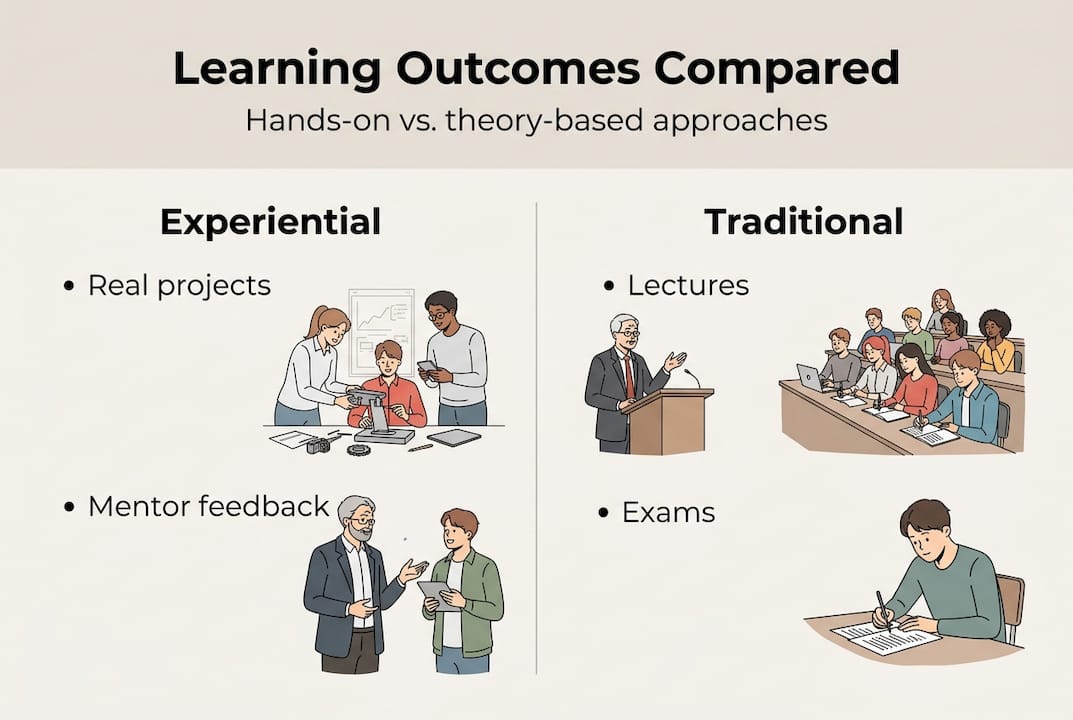
The differences between experiential and traditional entrepreneurship education go beyond teaching style. They affect outcomes, confidence levels, and how prepared you actually feel when you face a real business challenge. Here’s a practical breakdown of what sets them apart:
- Engagement level. Experiential programs demand active participation at every step. Traditional courses often allow passive consumption, where you can sit through a lecture without ever applying the material.
- Skill development. Hands-on methods build practical skills like negotiation, customer empathy, and rapid decision-making. Lecture-based models tend to develop analytical and theoretical knowledge, which is valuable but incomplete on its own.
- Feedback loops. In experiential settings, feedback is immediate and often comes from real customers or peers. In traditional courses, feedback arrives through grades, which rarely reflect real-world performance.
- Resilience building. Failing a prototype in a safe learning environment prepares you for real setbacks. Failing a written exam does not.
- Community formation. Immersive programs naturally build lasting networks. Classroom settings rarely foster the same depth of connection.
Students in experiential classes are 70% more likely to outperform peers in traditional courses, which reflects how much the method shapes the outcome. That said, it’s worth being honest about limitations. Diverse experiential approaches improve skills, knowledge, and engagement, but effects on actual enterprise creation are less consistently documented. Experiential learning makes you more ready. It doesn’t guarantee you’ll launch.
Facilitator quality matters enormously here. A poorly designed experiential program can feel chaotic rather than challenging. The best programs balance structure with freedom, giving you enough guidance to stay productive while leaving room for genuine discovery. Exploring entrepreneurship bootcamp benefits can help you evaluate what a well-run program actually looks like before you commit.
Pro Tip: Before enrolling in any program, ask to speak with past participants. Their honest accounts of what changed in their business thinking will tell you more than any sales page.
Why real-world practice trumps theory for entrepreneurs
After considering both models, here’s an honest view on why experiential entrepreneurship matters most, and what most people get wrong about it.
Conventional wisdom still places enormous value on credentials and theoretical knowledge. Business schools spend years teaching frameworks that look elegant on paper but often crumble under the pressure of real market conditions. The uncomfortable truth is that most entrepreneurial skills cannot be taught. They have to be earned through action.
What separates founders who thrive from those who stall isn’t knowledge. It’s the ability to act under uncertainty, absorb feedback without losing momentum, and build trust with a community that holds them accountable. These are outcomes of experience, not study.
Without hands-on practice, it’s easy to overestimate your readiness and underestimate how much you rely on others to grow. The most successful entrepreneurs we’ve seen prioritize learning in the trenches, where every setback becomes a lesson and every iteration brings clarity. Exploring real-world entrepreneurship education isn’t a shortcut. It’s the most direct path from aspiration to execution.
Take your next step: Join an experiential entrepreneurship program
Ready to move past theory and into action? Here’s how you can get started.
If this guide has clarified one thing, it’s that reading about entrepreneurship only gets you so far. The real growth happens when you’re in a room with other driven founders, working through real challenges with mentors who’ve been where you want to go. Nomad Excel’s immersive bootcamp programs are designed exactly for this, combining structured frameworks, expert mentorship, and a community that supports you long after the program ends. Pair that with a solid entrepreneur mentorship guide and you have a clear roadmap from idea to execution. Browse upcoming entrepreneurship bootcamps and find the program that fits your stage and goals.
Frequently asked questions
What are examples of experiential entrepreneurship activities?
Examples include startup simulations, customer interviews, rapid prototyping challenges, mentorship sessions, and team sprints. These hands-on activities build real skills through direct engagement with business problems rather than passive study.
Does experiential entrepreneurship guarantee launching a business?
No, but it significantly improves your skills, confidence, and readiness to launch when the opportunity arises. Diverse experiential approaches consistently improve knowledge and engagement, though actual enterprise creation depends on many additional factors.
How is experiential entrepreneurship different from traditional courses?
It emphasizes doing, experimenting, and learning from action rather than passively receiving information in lectures. The core distinction is active participation versus passive absorption, which produces fundamentally different skill sets.
What results can I expect from experiential entrepreneurship methods?
You’ll build deeper skills, higher engagement, stronger resilience, and self-confidence compared to traditional learning. Students in experiential classes are 70% more likely to outperform peers and gain twice the higher-order thinking skills.
Comments are closed.