
Entrepreneurial frameworks explained: paths to startup growth
TL;DR:
- Proven frameworks like Lean Canvas and Business Model Canvas guide faster, smarter startup decision-making.
- Regularly updating and applying these tools through Build-Measure-Learn accelerates validated learning.
- The key to success is applying frameworks dynamically, supported by mentorship and community feedback.
Most early-stage founders believe that entrepreneurial success comes down to instinct, hustle, or being in the right place at the right time. That belief is one of the most expensive misconceptions in business. The truth is that the founders who move fastest and waste the least are almost always working from proven frameworks, not guesswork. Tools like the Lean Canvas and Business Model Canvas act as strategic roadmaps, turning vague ambitions into testable plans. This guide breaks down the most effective entrepreneurial frameworks, compares them side by side, and shows you exactly how to put them to work so your startup grows with intention and speed.
Table of Contents
- Why frameworks matter for entrepreneurs
- Inside the Lean Canvas: Focused solutions for startups
- Business Model Canvas vs. Lean Canvas: What’s best for your journey?
- Turning frameworks into action: Build-Measure-Learn and mentorship
- Our perspective: The real power of frameworks isn’t just the tool
- Where to go next: Learn frameworks by doing
- Frequently asked questions
Key Takeaways
| Point | Details |
|---|---|
| Frameworks give structure | Using Lean Canvas and Business Model Canvas turns vague ideas into clear, testable plans. |
| Choose by stage | Lean Canvas excels for brand new startups, while Business Model Canvas is better for growth and partnerships. |
| Ongoing iteration is critical | Frequently update and test your framework to avoid stagnation and missed opportunities. |
| Mentorship accelerates learning | Having access to mentors and peer communities accelerates meaningful application and growth. |
Why frameworks matter for entrepreneurs
An entrepreneurial framework is a structured model that helps you organize your thinking, test your assumptions, and make faster, smarter decisions. Think of it as a blueprint for a building. Without one, you might still construct something, but you’ll waste materials, miss critical details, and likely rebuild from scratch more than once. Entrepreneurial frameworks provide structure and clarity in building a startup, which is exactly why they’ve become foundational tools in modern business education.
One of the biggest myths about frameworks is that they stifle creativity. Many founders resist them, worried that following a structured model will box them in. The opposite is actually true. When you have a clear framework, you free up mental energy that would otherwise go toward figuring out where to start. You spend less time spinning and more time experimenting.
Here’s what frameworks actually do for early-stage entrepreneurs:
- Cut through startup noise by giving you a focused set of questions to answer before spending money
- Accelerate validation by pushing you to test assumptions with real customers rather than internal debates
- Reduce wasted resources by identifying weak spots in your model before they become expensive mistakes
- Support rapid iteration so you can pivot quickly when the market gives you feedback
- Create shared language between you, your team, and potential investors or mentors
The three frameworks you’ll hear about most in startup circles are the Lean Canvas, the Business Model Canvas, and the Lean Startup methodology. Each serves a distinct purpose, and knowing when to use which one is a skill that separates founders who move fast from those who stay stuck in planning mode.
“The goal of a startup is to figure out the right thing to build as quickly as possible.” This principle sits at the heart of every major entrepreneurial framework, and it’s why the future of entrepreneurship education is increasingly centered on applied, framework-driven learning.
Understanding these tools at a conceptual level is useful. But the real shift happens when you start applying frameworks for business building in real conditions, with real feedback from real customers.
Inside the Lean Canvas: Focused solutions for startups
The Lean Canvas was created by Ash Maurya as a startup-specific adaptation of the Business Model Canvas. Where the original was designed for established businesses, the Lean Canvas was built for speed and uncertainty. Lean Canvas is a one-page startup adaptation of the Business Model Canvas, focused on problem-solution fit with 9 blocks.

Here’s a breakdown of each block and what it asks you to define:
| Block | What it captures |
|---|---|
| Problem | The top 3 problems your customer faces |
| Customer segments | Who you’re solving the problem for |
| Unique value proposition | Why your solution is different and worth attention |
| Solution | Your top 3 features or approaches |
| Channels | How you reach and deliver to customers |
| Revenue streams | How you make money |
| Cost structure | Your key expenses |
| Key metrics | The numbers that tell you if you’re growing |
| Unfair advantage | What you have that can’t be easily copied |
Filling out a Lean Canvas for the first time should take no more than 20 to 30 minutes. That’s intentional. The goal isn’t perfection; it’s clarity. Here’s a simple process to follow:
- Start with the Problem block. Write down the top three problems your target customer faces. Be specific, not general.
- Define your Customer Segments. Who experiences those problems most acutely? Narrow it down to one primary segment to start.
- Draft your Unique Value Proposition. Write one sentence that explains what you do and why it matters to that specific customer.
- Sketch your Solution. Keep it to three features or approaches. Resist the urge to build everything at once.
- Identify your Key Metrics. Pick one or two numbers that will tell you if your solution is actually working.
- Tackle the Unfair Advantage last. This is the hardest block to fill honestly. It forces you to ask what you have that a well-funded competitor couldn’t replicate in six months.
The Unfair Advantage block is where most founders stall, and that’s actually a productive discomfort. If you can’t answer it yet, that’s useful information. It means you need to keep building toward something defensible.
Pro Tip: Review and update your Lean Canvas every week during the early stages. Each customer conversation, failed test, or new data point should prompt at least a small revision. A teaching Lean Canvas approach used in structured bootcamps reinforces this habit from day one.
Business Model Canvas vs. Lean Canvas: What’s best for your journey?
The Business Model Canvas, developed by Alexander Osterwalder, came first. It’s a strategic tool designed to map out how an organization creates, delivers, and captures value. Business Model Canvas has 9 blocks: Customer Segments, Value Propositions, Channels, Customer Relationships, Revenue Streams, Key Resources, Key Activities, Key Partnerships, and Cost Structure.
The Lean Canvas swaps out four of those blocks to make it more relevant for startups. Out go Key Resources, Key Activities, Key Partnerships, and Customer Relationships. In come Problem, Solution, Key Metrics, and Unfair Advantage.
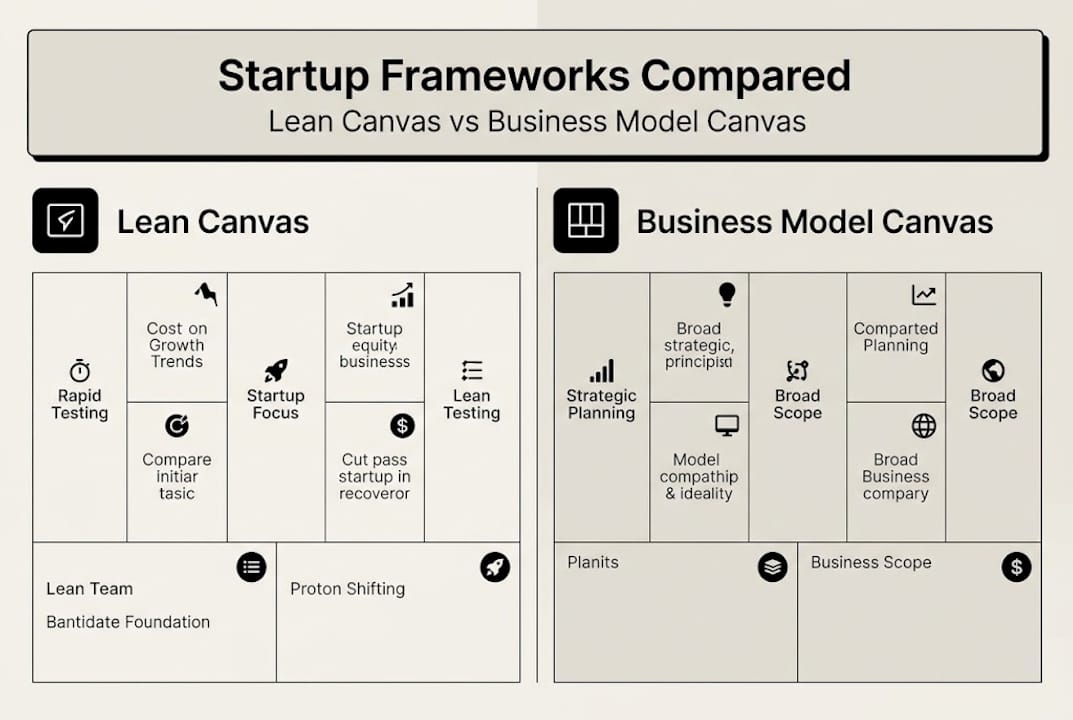
| Feature | Lean Canvas | Business Model Canvas |
|---|---|---|
| Best for | Early-stage startups | Established or scaling businesses |
| Focus | Problem-solution fit | Full business model design |
| Complexity | Simple and fast | More detailed and comprehensive |
| Iteration speed | Weekly updates encouraged | Quarterly or milestone-based reviews |
| Investor use | Less common | Widely recognized by investors |
Choosing between them isn’t about which one is better. It’s about which one fits where you are right now. Here’s a quick guide:
- Use Lean Canvas if you’re pre-revenue, still validating your core problem, or pivoting your model
- Use Business Model Canvas if you’re scaling, seeking investment, or mapping out partnerships and operations
- Use both if you’re transitioning from startup to growth stage and need to bridge early assumptions with operational reality
- Lean toward the Lean Canvas reference when speed matters more than completeness
- Lean toward the Business Model Canvas when you need to communicate your model to stakeholders or partners
One of the most common mistakes founders make is sticking rigidly to one framework regardless of how their company has evolved. A canvas that served you well at the idea stage will feel limiting once you have 500 customers and a team of five. Knowing when to graduate to a more complete model is part of building a mature business. Learn more about the Business Model Canvas and how it supports that transition.
Turning frameworks into action: Build-Measure-Learn and mentorship
A framework sitting in a Google Doc does nothing. The real value comes from running it through actual market conditions, and that’s where the Build-Measure-Learn cycle becomes your engine. The core of Lean Startup is the Build-Measure-Learn feedback loop using MVPs for validated learning.
An MVP, or minimum viable product, is the simplest version of your solution that lets you test your most critical assumption with real users. It doesn’t need to be polished. It needs to be functional enough to generate honest feedback.
Here’s how to run the cycle effectively:
- Build the smallest version of your solution that tests one specific assumption from your canvas.
- Measure how real users respond. Track the one or two key metrics you identified in your Lean Canvas.
- Learn from the data. Did users behave the way you expected? What surprised you? What do you need to change?
- Update your canvas based on what you learned before starting the next build cycle.
- Repeat until your metrics show consistent, repeatable traction.
“Validated learning is the process of demonstrating empirically that a team has discovered valuable truths about a startup’s present and future business prospects.” This is the principle that separates founders who iterate intelligently from those who build in circles.
The Build-Measure-Learn feedback loop is powerful on paper, but it’s significantly more effective when you have mentors and peers helping you interpret the signals. A mentor who has run this cycle dozens of times can spot a flawed assumption in your canvas that you’ve been too close to see. That outside perspective is often the difference between a pivot that saves the business and one that comes six months too late.
Immersive bootcamp environments accelerate this entire process. When you’re surrounded by other founders running the same cycles, sharing results, and challenging each other’s assumptions, Lean Startup for rapid growth becomes less of a concept and more of a daily practice. Investing in business education for entrepreneurs that combines frameworks with real execution support compounds your results far beyond solo learning.
Pro Tip: Lean on mentors and peers to spot blindspots in your approach. The assumptions you’re most confident about are often the ones most worth testing first.
Our perspective: The real power of frameworks isn’t just the tool
Here’s something most framework guides won’t tell you: the framework itself is almost never the reason a startup succeeds or fails. We’ve seen founders with beautifully filled-out Lean Canvases go nowhere, and others with messy, half-finished models build real businesses. The difference is almost always in how dynamically they applied the tool.
Most entrepreneurs over-invest in choosing the right framework and under-invest in the disciplined habit of updating it based on real feedback. A canvas reviewed once and filed away is just a document. A canvas revised weekly based on customer conversations is a living strategy.
Mentorship accelerates the insights that frameworks alone can’t provide. When an experienced founder looks at your canvas, they’re not just reading your answers. They’re pattern-matching against dozens of similar situations and pointing you toward the questions you haven’t thought to ask yet. That kind of guidance compresses learning in ways that no template can replicate.
The most effective founders we’ve seen treat their entrepreneurial strategies as living documents, constantly evolving with market-tested feedback. The tool matters. The habit of using it honestly, frequently, and in community with others matters far more.
Where to go next: Learn frameworks by doing
Understanding frameworks intellectually is a strong start, but real traction comes when you apply them in conditions that mirror the market. At Nomad Excel, our online entrepreneurship bootcamp is built around exactly this principle. Founders work through Lean Canvas, Business Model Canvas, and Build-Measure-Learn cycles with direct mentor support and a community of peers who challenge and sharpen their thinking every day.
If you’re still weighing whether structured learning is worth the investment, exploring why join an entrepreneurship bootcamp lays out the case clearly. And if you want to understand how expert guidance accelerates your results, our guide to mentorship programs for growth is a practical next step. The frameworks are proven. The question is whether you’ll apply them alone or with the support that makes them truly powerful.
Frequently asked questions
What is the difference between Lean Canvas and Business Model Canvas?
Lean Canvas is a startup-focused adaptation built for rapid assumption testing, while Business Model Canvas offers a broader, more complete view suited to scaling and established businesses.
How do I know which framework to choose for my business?
Business Model Canvas suits broad business planning while Lean Canvas is best for rapid startup testing, so choose based on whether you’re validating a new idea or mapping an existing operation.
Can I switch between frameworks as my startup grows?
Yes, many founders start with Lean Canvas for early-stage clarity and transition to Business Model Canvas once they’re scaling, building partnerships, or communicating their model to investors.
Why do frameworks fail for some entrepreneurs?
Frameworks fail when they’re treated as one-time exercises rather than living tools. Iterate weekly based on experiments to keep your framework aligned with what the market is actually telling you.
Comments are closed.