
Founder mindset: The real key to startup success
TL;DR:
- The founder mindset, emphasizing ownership, resilience, and adaptability, heavily predicts startup success.
- Core traits like determination, resourcefulness, and mission clarity differentiate high-performing founders.
- Practical exercises and immersive programs can effectively develop and reinforce essential founder mindset traits.
Most aspiring founders assume startup success comes down to the right funding, a brilliant idea, or deep technical expertise. The reality is far more nuanced. Startup outcomes are heavily shaped by the founder’s mindset, often more than any external resource. Yet mindset remains the most overlooked variable in early-stage planning. This guide breaks down what the founder mindset actually means, which traits research consistently links to growth, and how you can apply concrete strategies inside bootcamps and real startup environments to accelerate your results.
Table of Contents
- What is the founder mindset and why does it matter?
- Core traits of successful founders: Evidence and benchmarks
- Practical mindset strategies for early-stage entrepreneurs
- Founder mindset in community and startup culture: Risks and evolution
- Why most startup guides get founder mindset wrong
- Take your founder mindset to the next level
- Frequently asked questions
Key Takeaways
| Point | Details |
|---|---|
| Mindset drives success | Founder mindset is a more powerful predictor of startup outcomes than skills or funding. |
| Traits to develop | Key traits like resourcefulness, resilience, openness, and ownership boost business growth and survival. |
| Practical strategies | Daily mindset exercises and bootcamp participation accelerate real-world founder trait development. |
| Avoid pitfalls | Balance ambition with self-awareness to avoid burnout and toxic culture as your startup grows. |
| Bootcamps amplify growth | Immersive programs offer structured methods to strengthen founder mindset and build thriving communities. |
What is the founder mindset and why does it matter?
The founder mindset is not simply a positive attitude or a willingness to work hard. It is a deeply held orientation toward ownership, adaptability, and self-efficacy that shapes every decision a founder makes. Where a traditional employee mindset asks “what are my responsibilities,” a founder mindset asks “what needs to happen, and how do I make it happen?” That shift in perspective changes everything from how you handle setbacks to how you build your team.
Developing a strong founder mindset for growth means internalizing a set of behaviors and beliefs that keep you moving forward when circumstances are uncertain. Personality research consistently shows that traits like openness, conscientiousness, and resilience are directly linked to startup success, not IQ scores or credentials. These are learnable, trainable qualities, which is great news for anyone willing to put in the work.
The three cornerstones of founder mindset, as outlined in practical startup frameworks, are radical ownership, resourcefulness, and resilience. Each one plays a distinct role:
- Radical ownership: You take full responsibility for outcomes, not just tasks. Blame is replaced by problem-solving.
- Resourcefulness: You find creative paths forward with limited resources, rather than waiting for ideal conditions.
- Resilience: You recover quickly from failure, extracting lessons without losing momentum.
- Adaptability: You adjust your approach based on new information without abandoning your core vision.
- Self-efficacy: You believe in your capacity to figure things out, even in unfamiliar territory.
“The founder mindset is not about having all the answers. It is about trusting your ability to find them.”
Building a strong growth mindset is the foundation beneath all of these traits. Without it, even the best strategy will stall when the first real obstacle appears. With it, every challenge becomes a source of data and direction.
Core traits of successful founders: Evidence and benchmarks
Now that we understand the founder mindset, let’s examine which traits and behaviors actually drive successful outcomes. Research and real-world benchmarks point to a consistent cluster of qualities that separate high-performing founders from those who plateau early.
Y Combinator’s startup playbook, shaped by Sam Altman, identifies determination, team quality, and mission clarity as the most predictive factors in startup success. Notice that none of these are technical skills. They are mindset and culture indicators. Determination, in particular, is described as more important than intelligence in almost every early-stage scenario.
Additionally, diverse co-founder teams consistently outperform homogenous ones on both survival rates and growth metrics. Cognitive diversity, meaning different thinking styles and backgrounds, creates more robust problem-solving and reduces blind spots.
| Trait | Successful founders | Average early-stage entrepreneurs |
|---|---|---|
| Determination | Very high, sustained under pressure | Moderate, drops after setbacks |
| Openness to feedback | Actively seeks critique | Tends to avoid uncomfortable input |
| Resourcefulness | Creates solutions with limited means | Often waits for better conditions |
| Self-efficacy | Confident in ability to learn | Relies heavily on existing expertise |
| Mission clarity | Clear and consistent narrative | Shifts based on external pressure |
The concept of “Founder Mode,” popularized in startup circles, reinforces the idea that staying deeply involved in early operations gives founders a strategic advantage. Rather than delegating too early, high-performing founders maintain hands-on oversight of critical functions, which builds institutional knowledge and keeps culture tight.
Building strong team collaboration from day one also amplifies these traits. A founder with great self-efficacy who builds a team with complementary strengths moves significantly faster than one who tries to do everything alone.

Pro Tip: Before your next major decision, rate yourself honestly on each trait in the table above. Identifying your weakest area is the fastest way to know where to focus your development energy. Knowing your must-have founder skills helps you build a personal growth roadmap that is grounded in evidence, not guesswork.
Practical mindset strategies for early-stage entrepreneurs
Equipped with knowledge of key traits, let’s put things into action with practical tactics and exercises. The good news is that founder mindset is not fixed. It responds directly to the environments you place yourself in and the habits you build deliberately.
Here are five proven exercises to develop your founder mindset, particularly effective inside bootcamp and early startup settings:
- Decision journal: After every significant decision, write down your reasoning, the alternatives you considered, and the outcome you expect. Reviewing this weekly sharpens your judgment and builds radical ownership over time.
- Pre-mortem analysis: Before launching a project or campaign, imagine it has already failed. Work backward to identify the most likely causes. This builds resilience and improves planning.
- Resourcefulness drills: Set a constraint, such as a $0 marketing budget or a 48-hour deadline, and solve a real business problem within it. Constraints force creative thinking.
- Seek unscalable work early: Do things manually before automating them. This builds deep product and customer knowledge that no tool can replicate.
- Weekly accountability check-ins: Share your commitments with a peer or mentor and report back honestly. Community accountability is one of the fastest accelerants of founder behavior.
| Bootcamp activity | Mindset outcome |
|---|---|
| Peer feedback sessions | Openness, self-awareness |
| Sprint-based project work | Determination, execution focus |
| Mentor-led Q&A | Self-efficacy, mission clarity |
| Collaborative problem-solving | Resourcefulness, team trust |
| Daily reflection exercises | Radical ownership, resilience |
Applying these mindset frameworks for founders inside a structured bootcamp environment accelerates results because you are practicing in real time with real stakes and real peers. Theory alone rarely changes behavior. Immersive experience does.
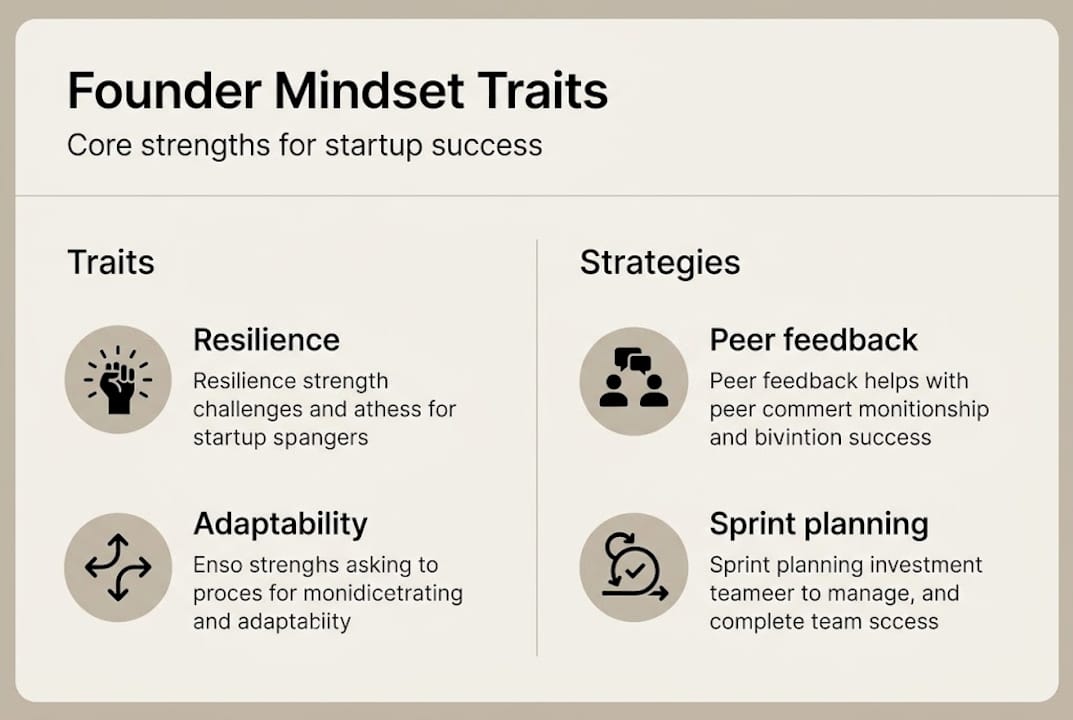
Pro Tip: The fastest growth often happens at the edge of your comfort zone. Deliberately sign up for the task you feel least qualified to handle. That discomfort is where founder traits get forged. Pairing this approach with solid bootcamp startup tips and a focus on creativity for startup growth creates a powerful development loop.
Founder mindset in community and startup culture: Risks and evolution
Practical strategies alone are not enough. The mindset must also fit into the wider startup community and culture. How a founder thinks shapes not just their own performance but the entire environment around them, for better or worse.
When founder mindset is healthy, it creates a culture of high agency, where team members feel empowered to take initiative, solve problems independently, and stay aligned with the company’s mission. This kind of culture is a genuine competitive advantage, especially in early stages when speed and adaptability matter most.
The benefits of a strong founder-led culture include:
- High-agency teams that act without waiting for permission
- Shared resilience that keeps morale steady during hard stretches
- Mission alignment that reduces internal conflict and improves decision speed
- Peer accountability that raises performance standards across the board
However, the risks are real. A toxic founder mindset can cause burnout and scaling dysfunction, especially when ego, control issues, or unchecked stress go unaddressed. Founders who confuse radical ownership with micromanagement, or resilience with ignoring their own limits, often create environments that repel talented people.
“Self-awareness is not a soft skill. For founders, it is a survival skill.”
Mindset must also evolve as your startup grows. Early on, you are the doer: writing copy, closing deals, onboarding customers. As the business scales, your role shifts to architect, designing systems, setting culture, and enabling others to execute. Founders who fail to make this transition become bottlenecks rather than accelerators.
Understanding the aspects of entrepreneurship that reduce failure includes recognizing when your mindset needs to evolve, not just when your strategy does. Pairing that self-awareness with strong growth strategies for startups creates a foundation that is both personally sustainable and organizationally scalable.
Why most startup guides get founder mindset wrong
Here is an uncomfortable truth: most startup guides focus on frameworks, templates, and tactical skill-building because those things are easy to teach and easy to sell. Mindset is harder to package, so it gets reduced to a motivational paragraph at the start of a chapter and then forgotten.
But in our experience working with early-stage founders across immersive bootcamps, the entrepreneurs who make the fastest progress are rarely the ones with the most polished pitch decks or the most technical skills. They are the ones who take radical ownership of every outcome, stay resourceful under pressure, and genuinely believe they can figure things out. Those raw founder traits consistently outshine sophisticated strategies.
Credentials and cleverness matter less than most people think. What actually moves the needle is the willingness to act before you feel ready, to own your failures without excuses, and to stay curious when everything feels uncertain. Building a strong founder mindset for growth is not a one-time exercise. It is a daily practice that compounds over time, and the returns are extraordinary for those who commit to it.
Take your founder mindset to the next level
If you are ready to move beyond theory and actively build the traits that drive real startup outcomes, immersive programs and mentorship can accelerate your journey in ways that self-study rarely matches. Structured environments create the pressure, feedback, and community that turn mindset concepts into lived habits.
Nomad Excel’s online entrepreneurship bootcamp is designed specifically for aspiring and early-stage founders who want to develop founder traits through hands-on execution, peer accountability, and expert mentorship. Not sure if a bootcamp is right for you? Explore the reasons for joining an entrepreneurship bootcamp and see how the experience maps to your goals. You can also learn how startup mentorship accelerates founder development at every stage of the journey.
Frequently asked questions
How does founder mindset impact startup survival rates?
Founders with resilience and resourcefulness significantly increase their startup’s chances of survival compared to those who rely primarily on technical skills or external resources alone.
What are quick daily exercises to cultivate a founder mindset?
Using a decision journal and seeking challenges daily are two of the most effective habits for building radical ownership and resourcefulness over time.
Can founder mindset lead to burnout or negative outcomes?
Yes. A toxic founder mindset risks dysfunction at scale, so balancing drive with self-awareness and leaning on community support is essential for long-term sustainability.
How does participating in bootcamps help develop founder traits?
Bootcamps create immersive, high-feedback environments where resourcefulness, resilience, and accountability are practiced in real time, which accelerates founder trait development far faster than solo learning.
Comments are closed.