
Types of Social Enterprise: Which Model Fits Your Idea?
Social enterprises fall into four core archetypes: Social Stimulators, Social Providers, Social Producers, and Social Intermediaries — each defined by who benefits, who pays, and how social meaning attaches to the value proposition. If you’re building a social business or studying the field, those four types are your starting map. Beyond them, you’ll also encounter:
- Entrepreneurial nonprofits that earn income to fund a mission
- Social cooperatives owned and governed by their beneficiaries
- Trading enterprises that sell goods or services to fund social programs
- Matchmaker and platform models that connect underserved producers to markets
- Multi-sided models serving distinct customer and beneficiary groups simultaneously
- A 16-model synthesis that maps these across four business-model families
This article covers all of them. You’ll get concrete examples (Warby Parker, TOMS, Kiva, Patagonia, TerraCycle, Greyston Bakery, BioLite), U.S. legal structures including B Lab’s B Corp certification and IRS 501©(3) rules, revenue models, and a practical checklist for choosing the right model. Nomadexcel’s bootcamp programs appear at the end for founders who want guided support.
Key Takeaways
The most durable social enterprises combine a clearly defined beneficiary-customer configuration with at least two revenue streams and governance structures that give beneficiaries a formal voice.
| Point | Details |
|---|---|
| Four core archetypes | Social Stimulators, Providers, Producers, and Intermediaries differ by who benefits, who pays, and how social meaning attaches to the offer. |
| Model mix beats pure types | Most resilient enterprises combine two or more revenue mechanisms; treat building blocks as modular and test each stream before scaling. |
| Legal form follows strategy | Choose 501©(3) for grant-dependent models, LLC for early-stage testing, and Benefit Corporation once your earned-income model is proven. |
| Validate before you build | A five-day sprint — problem interview, prototype, revenue test, impact metric, next steps — surfaces fatal flaws faster than any business plan. |
| Nomadexcel bootcamps | Nomadexcel’s structured sprints and mentorship help social founders validate revenue and impact models in weeks, not months. |
Table of Contents
- What makes a social enterprise different from CSR or a nonprofit?
- The four types of social enterprise explained
- Other frameworks you’ll encounter when studying social enterprise models
- What U.S. legal structures and certifications should you consider?
- How do social enterprises generate revenue?
- How do you choose the right social enterprise model for your idea?
- How to validate your social enterprise model in five days
- Why the model you choose matters more than most founders realize
- Nomadexcel bootcamps for social enterprise founders
- Sources
What makes a social enterprise different from CSR or a nonprofit?
A social enterprise is an organization that pursues a defined social or environmental mission through revenue-generating commercial activity. The mission is not a marketing add-on — it shapes every operational and financial decision the organization makes. Research confirms that mission guides internal architecture, financial management, and market choices, with profit serving the mission rather than being the end goal.
That distinction separates social enterprises from two categories people often confuse them with:
- Corporate Social Responsibility (CSR/ESG): A conventional company donates profits or reduces harm as a reputational strategy. The core business model is profit-first; social impact is secondary and optional.
- Traditional nonprofits: Mission-first, but typically grant-dependent and legally prohibited from distributing surplus to owners. A social enterprise earns revenue commercially and can reinvest surplus or distribute it under specific governance rules.
The four operational components that define a social enterprise are its value proposition (what it offers and to whom), its operational model (how it delivers), its profit model (how it captures revenue), and its social impact model (how it measures and sustains mission outcomes).
Pro Tip: Frame profit as fuel, not the destination. When you design your model, ask: “Does this revenue mechanism reinforce the mission or undermine it?” That single question will catch most structural errors before they become expensive.
The four types of social enterprise explained
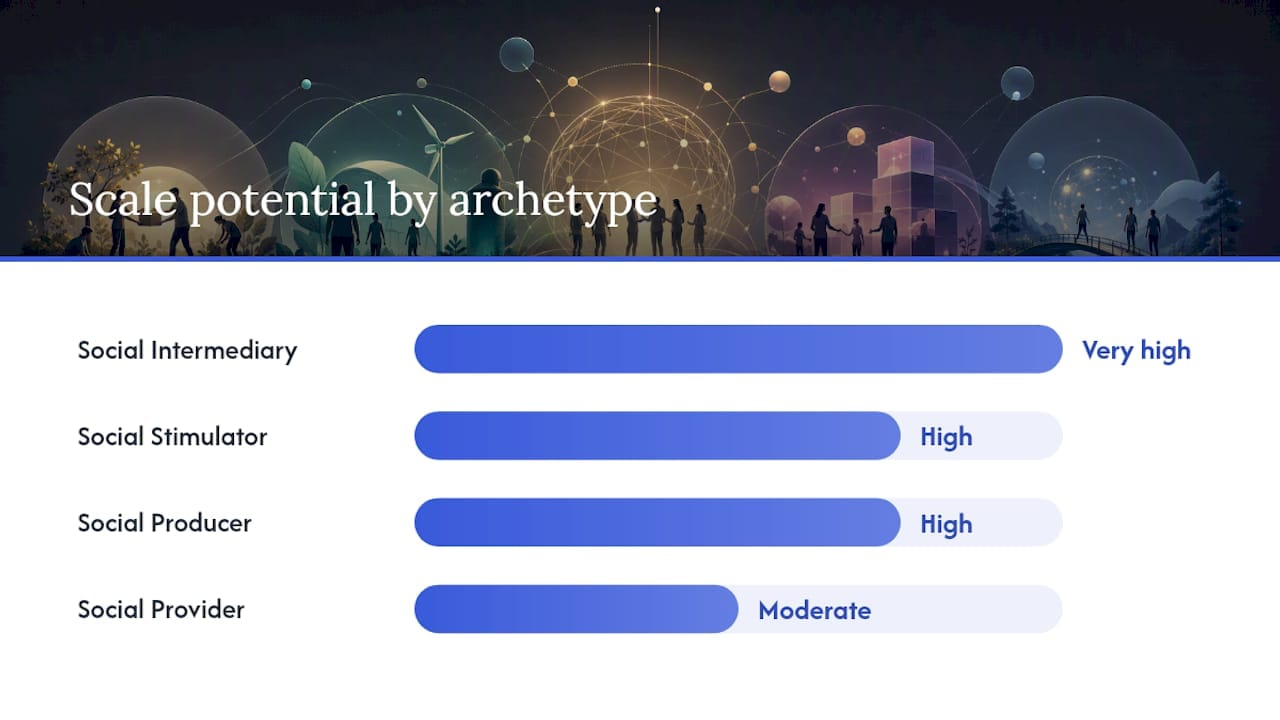
The academic framework developed from social entrepreneurship business-model research classifies social ventures along three choices: the scope of beneficiaries, the degree of overlap between customers and beneficiaries, and how social meaning attaches to the value proposition. Those three choices produce four distinct archetypes.
| Archetype | Who benefits vs. who pays | Primary revenue model | Typical legal form | Scale potential | Best use case |
|---|---|---|---|---|---|
| Social Stimulator | Broad society; paying customers fund public goods | Product/service sales; licensing | For-profit, B Corp, Benefit Corp | High — replicable products | Environmental goods, awareness campaigns |
| Social Provider | Specific beneficiaries who often cannot pay; third parties pay | Fee-for-service; grants; cross-subsidy | Nonprofit 501©(3); hybrid LLC | Moderate — depends on funding | Health, education, housing services |
| Social Producer | Beneficiaries are the producers/suppliers | Market-linkage; commission; cooperative revenue | Cooperative; LLC; Benefit Corp | High with local partners | Artisan supply chains, smallholder farming |
| Social Intermediary | Beneficiaries and customers are distinct groups connected by the enterprise | Platform fees; matchmaking commissions | LLC; hybrid; nonprofit | Very high — network effects | Microfinance, job platforms, fair-trade markets |
Social Stimulators
Social Stimulators sell products or services to paying customers while generating positive externalities for society at large. The customer and the beneficiary largely overlap, but the social impact extends beyond the transaction. Patagonia fits here: customers pay for outdoor gear, and the company channels revenue into environmental activism and supply-chain sustainability. TerraCycle charges brands and municipalities to recycle hard-to-process waste, creating environmental benefit that extends well beyond any single buyer. TOMS built its original “one-for-one” model on this logic — a paying customer triggers a social outcome for a separate beneficiary.
Social Providers
Social Providers deliver services to beneficiaries who often cannot pay market rates. A third party — government, donor, or cross-subsidizing customer — covers the cost. Greyston Bakery in Yonkers, New York, operates an open-hiring model: anyone who shows up gets a job, no questions asked. Revenue from commercial brownie sales (including a long-standing contract with Ben & Jerry’s) funds workforce development programs for people facing barriers to employment. The paying customer (a food company) and the beneficiary (a formerly incarcerated worker) are entirely different people.
Social Producers
Social Producers treat beneficiaries as the producers or suppliers, not just the recipients. The enterprise builds market access for people who would otherwise be excluded from value chains. BRAC’s Aarong brand and BRAC Dairy are textbook examples: artisans and smallholder farmers supply products that BRAC then markets commercially, returning income and skills to the producers. S4S Technologies took a similar path, pivoting from hardware sales to an end-to-end decentralized food-processing value chain that supported 100,000 smallholder farmers and helped 2,000 women entrepreneurs double or triple their incomes.

Social Intermediaries
Social Intermediaries connect two distinct groups — typically underserved producers or borrowers on one side and paying customers or investors on the other. Kiva is the clearest U.S.-accessible example: lenders fund microloans to entrepreneurs in developing markets, with Kiva operating the platform that makes the match. BioLite connects off-grid households to clean energy products while selling premium camping gear to outdoor enthusiasts, using the margin from the latter to subsidize the former.
The governance implication across all four types: the further customers and beneficiaries are from each other, the more formal the governance structures need to be to protect beneficiary interests. A Social Provider or Social Intermediary with no board-level accountability to beneficiaries is structurally vulnerable to mission drift, and resources like Colleges in South Africa – Private Colleges & TVET Explained | AskSmarty can help education-focused social enterprises build strong governance and operational frameworks.
Other frameworks you’ll encounter when studying social enterprise models
The four-archetype model is academically rigorous, but practitioners and funders use several other frameworks. Knowing them helps you read grant applications, impact reports, and investor decks without confusion.
The Four Lenses Strategic Framework organizes social enterprises by operational model rather than beneficiary logic:
- Organizational support models — provide capacity-building services to other nonprofits or social ventures
- Service subsidization models — use commercial revenue to fund free or reduced-cost services for beneficiaries
- Market linkage models — connect producers to markets, earning commissions or fees
- Fee-for-service models — charge beneficiaries directly, often on a sliding scale
- Employment/training models — use the act of employment itself as the social intervention (Greyston Bakery again)
- Cooperative models — beneficiaries own and govern the enterprise
The 16-model synthesis maps these across four business-model families borrowed from platform economics:
- Product models — sell a physical or digital product; social impact is embedded in the product itself (BioLite cookstoves, Warby Parker eyewear)
- Solutions models — deliver customized services; impact comes from the service outcome (workforce training, legal aid)
- Matchmaker models — facilitate transactions between two groups; revenue comes from the match (Kiva, fair-trade certification bodies)
- Multi-sided models — serve three or more distinct groups simultaneously, often with cross-subsidies flowing between them
A practical way to use these frameworks as a founder: ask which group holds the most power in your model. If it’s the paying customer, you’re likely in product or solutions territory. If it’s the beneficiary-as-producer, you’re closer to a cooperative or market-linkage model. That power question also determines your governance needs and your fundraising pitch.
Work Integrated Social Enterprises (WISEs) deserve a specific mention for U.S. founders. WISEs use employment as the primary social intervention, targeting people facing significant labor-market barriers. They’re common in social services and food production, and they often combine 501©(3) status with earned-income subsidiaries.
What U.S. legal structures and certifications should you consider?
Choosing the right legal form early saves significant restructuring costs later. In the U.S., four structures dominate social enterprise formation.
| Legal form | Tax status | Investor options | Profit distribution | Typical use case |
|---|---|---|---|---|
| 501©(3) Nonprofit | Tax-exempt; donors get deductions | Grants, program-related investments | Prohibited | Pure mission; grant-dependent models |
| LLC (standard) | Pass-through; flexible | Equity investors allowed | Unrestricted | Early-stage testing; for-profit social ventures |
| Benefit Corporation | Standard corporate tax | Equity investors allowed | Allowed with fiduciary duty to mission | Mission-locked for-profits in 40+ states |
| B Corp Certified (any entity) | Depends on underlying entity | Depends on underlying entity | Depends on underlying entity | Signal of verified social/environmental performance |
The most common point of confusion: Benefit Corporation is a legal status granted by a state (currently available in more than 40 states), while B Corp certification is a third-party credential issued by B Lab after a rigorous assessment of social and environmental performance. A company can be one without the other. Most serious social enterprises pursue both because the legal status protects the mission during investor pressure, and the certification signals credibility to customers and impact investors.
Pro Tip: If you’re still validating your revenue model, start as an LLC. It’s the fastest to form, the most flexible for pivoting, and it can convert to a Benefit Corporation once your model is proven. Launching as a 501©(3) before you know your earned-income strategy often locks you into grant dependency before you’ve tested whether the market will pay.
Questions to discuss with a U.S. attorney or accountant before choosing:
- Will you accept equity investment? (Rules out 501©(3) for the equity-raising entity)
- Do you need donor tax deductibility? (Requires 501©(3) or a fiscal sponsor)
- Does your state recognize Benefit Corporations? (Check your state’s business registry)
- How will you handle profit distribution if the venture succeeds?
- Do you plan to franchise or license the model? (Affects IP ownership structure)
How do social enterprises generate revenue?
Revenue model design is where most social enterprises either build resilience or create fragility. The most durable models combine at least two revenue streams.
- Fee-for-service: Beneficiaries or third-party payers pay directly for a service. Common in healthcare, legal aid, and job training. Greyston Bakery’s commercial contracts are a fee-for-service mechanism at scale.
- Product sales (beneficiary-as-customer): The beneficiary buys the product. Warby Parker’s buy-one-give-one model and BioLite’s off-grid energy products both use this mechanism, though BioLite layers a cross-subsidy on top.
- Cross-subsidy: Higher-paying customers fund lower or zero-cost access for beneficiaries. Eco Femme charges international and urban customers premium prices for menstrual products, using that surplus to subsidize free products and education for low-income women in India.
- Market-linkage and commission: The enterprise earns a fee for connecting producers to buyers. Fair-trade certification bodies and agricultural cooperatives often use this model.
- Carbon finance: Enterprises that reduce emissions can register carbon credits and sell them to offset markets. Gyapa Enterprises sold cookstoves in Ghana and registered the program under the Gold Standard™, generating carbon finance revenue alongside product sales — with an estimated 6 million tons of CO2 avoided.
- Franchising and licensing: An established social enterprise licenses its model to local operators, collecting fees while maintaining mission standards. This is one of the most effective paths to geographic scale without proportional central overhead.
- Impact investment and blended finance: Impact investors accept below-market returns in exchange for measurable social outcomes. They differ from traditional VCs in that they underwrite mission risk alongside financial risk, and they typically require an impact measurement framework before committing capital.
- Grants and donations: Useful as a bridge or for activities that cannot generate earned income, but dependency on grants alone is a structural vulnerability. The most resilient social enterprises treat grants as a minority share of total revenue.
Statistic callout: Gyapa Enterprises’ carbon finance program, registered under Gold Standard™, is linked to an estimated 6 million tons of CO2 avoided across more than 2.6 million stoves sold — a concrete illustration of how product sales and carbon credits can reinforce each other in a single revenue model.
How do you choose the right social enterprise model for your idea?
Model selection is not a one-time decision. Think of it as a series of testable hypotheses. Here’s a practical sequence:
- Define your beneficiary and your customer. Are they the same person, partially overlapping, or entirely separate? That single answer narrows you to one or two archetypes immediately.
- Test willingness and ability to pay. Can your beneficiary pay a market rate, a subsidized rate, or nothing? If nothing, identify who will pay on their behalf before you build anything.
- Map your value-capture paths. List every mechanism through which money could flow to your organization: product sales, service fees, commissions, grants, carbon credits, licensing. Rank them by feasibility given your team and market.
- Assess legal and funding implications. If you need donor tax deductibility, you need a 501©(3) or a fiscal sponsor. If you want equity investment, you need a for-profit entity. These constraints eliminate some model options before you choose them.
- Pilot with a minimal revenue model. Before building infrastructure, run a small experiment: sell 50 units, deliver the service to 10 clients, or place 5 producers with buyers. Real transaction data beats any business plan.
Decision shortcuts based on beneficiary-customer configuration:
- Beneficiaries can pay at or near market rates → fee-for-service or product model, consider LLC or Benefit Corporation
- Beneficiaries can pay a subsidized rate → sliding-scale fee-for-service or cross-subsidy model, consider hybrid structure
- Beneficiaries cannot pay but can supply value as producers → market-linkage or cooperative model
- Beneficiaries cannot pay and cannot supply value → grant-dependent or subsidized model, 501©(3) most appropriate
- You serve two distinct groups with different willingness to pay → multi-sided or matchmaker model
For impact measurement, align your metrics to your archetype from day one. Social Producers should track producer income and market access. Social Providers should track service utilization and outcome quality. Social Intermediaries should track transaction volume and both-side satisfaction. Governance structures should reflect who bears the most risk — typically the beneficiary — and give them a formal voice.
Pro Tip: Most successful social enterprises use a model mix rather than a single pure type. Design your model as modular building blocks: a core revenue mechanism plus one or two supplementary streams. Run small experiments on each stream before committing resources. The 16-model toolkit includes a seven-step selection process specifically built for this kind of structured experimentation.
How to validate your social enterprise model in five days
Founders often spend months on business plans before discovering a fatal flaw in their revenue logic. A five-day sprint compresses that learning dramatically.
- Day 1 — Problem validation. Conduct five to eight interviews with target beneficiaries. Use this template: “Tell me about the last time you experienced [the problem]. What did you do? What did it cost you?” You’re listening for frequency, severity, and current workarounds.
- Day 2 — Prototype. Build the simplest possible version of your offer. For a service, that’s a one-page description and a price. For a product, it’s a physical prototype or a mockup. Write your value proposition in one sentence: “We help [beneficiary] achieve [outcome] by [mechanism], unlike [alternative].”
- Day 3 — Revenue test. Ask someone to pay, commit, or pre-order. A letter of intent from a buyer, a $10 deposit, or a signed partnership agreement all count. If no one will commit even a small amount, the revenue model needs revision before you build further.
- Day 4 — Impact measure. Define one leading indicator of social impact you can measure within 30 days of launch. For a Social Producer model, that might be producer income per transaction. For a Social Provider, it might be service completion rate.
- Day 5 — Next steps. Synthesize what you learned. Decide: refine and re-test, pivot the model, or proceed to a larger pilot. Write a minimum viable offer document — one page, one revenue mechanism, one impact metric.
Pro Tip: Local partnerships accelerate every step of this sprint. A community organization with existing beneficiary relationships can connect you to interview subjects on Day 1 and distribution channels on Day 3, cutting weeks off your validation timeline. For education-focused social enterprises, resources like entrepreneurship education frameworks can help you structure program delivery as a social enterprise model.
Nomadexcel’s bootcamps use a similar sprint structure — structured daily sprints, mentorship, and peer accountability — specifically designed for founders at the validation stage. For social enterprise founders who want guided support through this process, the growth strategies for startups framework Nomadexcel uses is directly applicable to model validation.
Why the model you choose matters more than most founders realize
Choosing the wrong social enterprise model doesn’t just slow growth — it can trap a venture in a structural contradiction that no amount of hustle resolves. A Social Provider that accidentally prices itself as a Social Stimulator will either underserve its beneficiaries or exhaust its cross-subsidy. A Social Producer that governs itself like a traditional nonprofit will lose the trust of the producers it depends on, because they have no formal voice in decisions that directly affect their income.
What most guides understate is the governance dimension. The further your paying customers are from your beneficiaries, the more formal your accountability structures need to be. A board that includes no beneficiary representatives is not just an ethical gap — it’s a strategic one. Beneficiary insight is often the most accurate early-warning system for mission drift, and organizations that exclude it tend to discover the problem only after funders or journalists do.
The modular model design approach addresses this directly. When you treat your revenue mechanisms as interchangeable building blocks rather than fixed commitments, you preserve the ability to pivot without dismantling your governance structure. The enterprises that scale most effectively — BRAC, Kiva, Greyston Bakery — all evolved their revenue mix over time while keeping their governance architecture stable.
Nomadexcel bootcamps for social enterprise founders
Social enterprise founders face a specific challenge: they need to validate both a revenue model and a social impact model simultaneously, often with limited resources and no precedent in their local market. Nomadexcel’s Online Entrepreneurship Bootcamp is built for exactly this stage. Over one to four weeks, you work through structured sprints that cover idea validation, offer design, revenue testing, and community building — with direct mentorship from experienced operators and a peer cohort that holds you accountable to real milestones, not just plans.
The program suits early-stage social founders who have an idea and a target beneficiary but haven’t yet confirmed that someone will pay. You leave with a tested minimum viable offer, a clearer model choice, and a network of peers who understand the dual-mission challenge. Check the bootcamp page for current cohort dates and application details.
Sources
The sources below support the frameworks, examples, and legal guidance in this article. Each is worth reading in full if you’re designing or studying a social enterprise model.
- Research Summary: Building on business model research and the social entrepreneurship literature
- Social enterprise typology | The Four Lenses Strategic Framework
- Business Models of Social Enterprises: Insight into Key Components and Value Creation
- The 16 social enterprise model types – social enterprise business model toolkit
- Eco Femme – Case Study (Skoll Centre)
- The Gyapa™ cookstove: A market-based approach to sustainable development – Relief International
- S4S Technologies case study – Acumen
- How social enterprises build pathways out of poverty — BRAC USA
Comments are closed.