
How to Develop Strategic Initiatives That Drive Results
Develop strategic initiatives by aligning a limited number of outcome-focused objectives to your organization’s strategy, selecting a few high-impact initiatives per cycle, and giving each a named owner, a budget, and a review cadence. That sequence, confirmed by the six-step development method practitioners use most reliably, is where this guide starts and what every section below builds on.
Before your next planning meeting, run through this checklist. Every viable strategic initiative needs all seven elements:
- Strategic linkage: the initiative connects explicitly to one or more organizational objectives
- Measurable outcome: at least one quantifiable success metric with a baseline
- Named owner: a single accountable individual, not a committee
- Approved budget: a confirmed resource commitment, not a placeholder
- Timeline: a start date, end date, and at least two stage gates
- Review cadence: monthly operational check-ins and quarterly strategic reviews, scheduled in advance
- Stakeholder alignment: key sponsors and cross-functional leads have agreed on scope
Pro Tip: Before the scoping session, ask each participant to write one sentence describing what success looks like in 12 months. Collect the answers anonymously and display them at the start of the meeting. Misalignment surfaces in the first five minutes, which is exactly when you want it.
Pull together your executive sponsor, initiative lead, one finance representative, and one cross-functional stakeholder for a short scoping session. That group is small enough to make decisions and broad enough to catch blind spots.
Key Takeaways
Developing strategic initiatives successfully requires a disciplined six-step process, explicit governance, and a measurement framework that tracks outcomes before activity.
| Point | Details |
|---|---|
| Start with a signed charter | Every initiative needs scope, a named owner, a budget, and success metrics before execution begins. |
| Limit objectives to 3–5 | Focused portfolios outperform broad ones; more than five active objectives dilutes execution quality. |
| Set baselines before launch | Without a pre-initiative baseline, you cannot attribute results to the initiative or course-correct early. |
| Govern with monthly and quarterly rhythms | Monthly operational reviews catch execution drift; quarterly strategic reviews ask whether the initiative is still the right bet. |
| Nomadexcel accelerates alignment | Nomadexcel’s retreats and bootcamps help teams move from strategy to signed charters faster, with expert facilitation and built-in accountability. |
Table of Contents
- What is a strategic initiative, and how does it differ from a project?
- What types of strategic initiatives should you know?
- How to develop strategic initiatives: a 6-step process
- How do you translate an initiative into an execution roadmap?
- What governance model works best for strategic initiatives?
- How do you measure whether a strategic initiative is working?
- How do you prioritize initiatives when resources are limited?
- How do you build momentum and secure adoption in the first 90 days?
- What causes strategic initiatives to fail, and how do you prevent it?
- Practical templates and checklists you can use right now
- How facilitated sprints accelerate initiative development and alignment
- The first 30 days of leading a strategic initiative
- When facilitation is the right choice for your team
- Sources
What is a strategic initiative, and how does it differ from a project?
A strategic initiative is a focused, time-bound effort that advances one or more of your organization’s highest-priority objectives, requires cross-functional resources, and produces a measurable outcome that would not happen through normal operations.
That definition has four load-bearing words: focused, cross-functional, measurable, and non-BAU. Remove any one of them and you are describing something else. A project delivers a defined output within a function. A program coordinates multiple related projects. Business-as-usual (BAU) work keeps the lights on. A strategic initiative does none of those things alone. It changes the organization’s competitive position, capability, or performance in ways that are visible at the executive level.
The strategic planning process typically spans a one-to-five-year horizon, and strategic initiatives are the funded vehicles that carry the plan forward. Without them, a strategy document is a statement of intent with no engine.
Use this decision rule to separate strategic from operational work:
- Does failure to execute this work materially affect a strategic objective? If yes, it is strategic.
- Does it require budget or headcount from more than one function? If yes, it is strategic.
- Would the CEO or board ask about progress? If yes, it is strategic.
Example: A company decides to enter a new market segment. The project might be building a new product feature. The strategic initiative is the full market-entry effort: product adaptation, sales enablement, marketing, and customer success working together toward a revenue target in the new segment within a defined horizon.
What types of strategic initiatives should you know?
Not every initiative is built the same way, and choosing the wrong design for the type of work you are doing is one of the most common planning mistakes. The eight most common types, with a short example for each:
- Corporate initiatives span the entire organization and are sponsored at the C-suite level. Example: an enterprise-wide digital transformation program.
- Business-unit initiatives target a specific division’s competitive position. Example: a regional expansion into the Southwest market.
- Functional initiatives improve a single department’s capability or performance. Example: a finance team deploying a new ERP system.
- Capability-building initiatives close a skills or technology gap needed for future strategy. Example: a 12-month data literacy program for 200 managers.
- Compliance and defensive initiatives reduce risk or meet regulatory requirements. Example: a cybersecurity overhaul to meet updated NIST standards.
- Offensive and growth initiatives capture new revenue or market share. Example: launching a subscription tier to reduce revenue concentration.
- Corrective and turnaround initiatives address a performance shortfall that threatens the business. Example: a cost-reduction program targeting a 15% operating expense reduction in 9 months.
- Innovation bets explore new business models or technologies with uncertain but high-upside outcomes. Example: a 6-month pilot of an AI-assisted customer service model.
The type determines the governance weight, timeline, and resource shape. Compliance initiatives tend to have hard deadlines and non-negotiable scope. Innovation bets need lighter governance and more frequent pivots. Offensive growth initiatives need dedicated sales and marketing resources from day one. Knowing which type you are working with before you write the charter saves significant rework later.
How to develop strategic initiatives: a 6-step process
The six-step development method moves from confirming strategic direction through to assigning ownership and cadence. Run it in a structured workshop or across two to three planning sessions. Here is the sequence:
Step 1: Confirm strategic direction
Start with your mission, vision, and win conditions. If those are not written down and agreed upon, no initiative design will hold. Pull the most recent strategy document and ask: what does winning look like in three years? What are the two or three outcomes that matter most? The planning process always begins here because every downstream decision depends on a shared answer to this question.
Step 2: Assess your current state
Run an environmental scan: external factors (market, competitive, regulatory, technological) and internal factors (capabilities, resources, culture, performance data). Map the gap between where you are and where you need to be. Identify your critical success factors — the three to five conditions that must be true for your strategy to work. Gartner’s structured planning approach recommends a formal lookback before any forward-looking scan, so you are not planning against assumptions that last year’s results already disproved.
Step 3: Draft candidate objectives and initiatives
Generate candidate objectives across multiple strategic perspectives: financial, customer, operational, and people. Keep the list of strategic objectives to three to five. Research on strategic objectives consistently shows that organizations with more than five active strategic objectives lose focus and execution quality. For each objective, draft one to three candidate initiatives that could move the needle.
Step 4: SMART-test and stress-test
Apply the SMART test to every objective and initiative:
- Specific: is the scope clear enough to brief a new team member in one paragraph?
- Measurable: is there a metric with a baseline and a target?
- Achievable: does the organization have or can it acquire the capability and resources?
- Relevant: does it connect directly to a strategic objective?
- Time-bound: is there a clear end date and at least one interim milestone?
Then run a coherence check. Ask: if all of these initiatives succeed, do they collectively deliver the strategy? Do any of them conflict for the same resources or audiences? Coherence failures at this stage are far cheaper to fix than after funding is approved.
Pro Tip: Use a “pre-mortem” technique during the stress-test step. Ask the group: “It is 18 months from now and this initiative has failed. What went wrong?” The answers surface hidden assumptions and resource conflicts that a forward-looking review almost never catches.
Step 5: Design initiative charters
Each initiative that passes the SMART and coherence tests gets a charter. A charter is a one-to-two-page document that defines:
- Scope statement: what is in and explicitly what is out
- Strategic linkage: which objective this initiative advances
- Success metrics: three to five outcome KPIs with baselines and targets
- Budget: approved funding and resource commitments
- Timeline: start date, end date, and stage gates
- Dependencies: what this initiative needs from other teams or initiatives
- Risks: top three risks and initial mitigation steps
Step 6: Assign owners, resources, and cadence
Name a single accountable individual for each initiative. Not a team, not a steering committee — one person whose performance review reflects the initiative’s outcome. Confirm the resource commitment in writing: headcount, budget, and time allocation. Set the review cadence before the initiative launches. Monthly operational check-ins and quarterly strategic reviews are the standard rhythm that keeps initiatives on track without creating reporting fatigue.
The HBS Online guidance on strategic planning goals reinforces that strong goals are purpose-driven, forward-focused, and measurable — and that communicating ROI estimates alongside each initiative significantly improves executive buy-in during the approval step.
How do you translate an initiative into an execution roadmap?
Once the charter is signed, execution begins with a nine-step process that converts the development output into a running program. The TSI execution framework covers this sequence in detail:
| Step | Action | Key Output |
|---|---|---|
| 1 | Build a detailed execution plan | Work breakdown, milestones, dependencies |
| 2 | Secure resources and budget | Confirmed headcount and funding |
| 3 | Assemble the cross-functional team | Named team members with time commitments |
| 4 | Establish governance and decision rights | Steering committee, escalation path |
| 5 | Enable the team | Tools, training, access, and working norms |
| 6 | Adopt an agile mindset | Sprint cadence, backlog, and pivot protocol |
| 7 | Manage risks actively | Risk register with owners and triggers |
| 8 | Monitor progress against KPIs | Dashboard updated before every review |
| 9 | Celebrate milestones | Formal recognition at each stage gate |
For a 12-month initiative, a typical shape looks like this: months 1–2 for mobilization and detailed planning, months 3–6 for the first delivery phase with a stage gate at month 6, months 7–10 for the second delivery phase, and months 11–12 for embedding, measurement, and handover. Multi-year initiatives add a formal annual reset at each year boundary, where scope, resourcing, and objectives are reconfirmed against the current strategy.
Your monitoring dashboard should show outcomes, not just activity. Include: KPI performance against baseline and target, milestone completion rate, budget burn vs. plan, risk status (red/amber/green), and a one-line narrative from the initiative lead on the biggest current obstacle. A dashboard that only shows tasks completed is a progress report, not a strategic monitoring tool.
What governance model works best for strategic initiatives?
A lightweight but explicit governance model outperforms both heavy bureaucracy and no governance at all. The right structure gives initiative leads the authority to make day-to-day decisions while reserving scope, budget, and phase-gate approvals for the steering committee.
| Role | Responsibility | Time Commitment |
|---|---|---|
| Executive Sponsor | Champions the initiative at the leadership level; removes organizational blockers | 2–4 hours per month |
| Initiative Lead | Owns day-to-day execution, team coordination, and reporting | Full-time or 50% dedicated |
| Steering Committee | Approves phase gates, scope changes, and budget variances above threshold | Monthly 60-minute review |
| PMO (if applicable) | Provides templates, reporting standards, and portfolio-level visibility | Ongoing support role |
| Working Stream Leads | Own delivery within their functional area | 20% dedicated |
Decision rights need to be explicit before the initiative launches. A practical rule: the initiative lead approves decisions within the approved scope and budget. Anything that affects the strategic objective itself goes to the executive sponsor.
On resource allocation, be direct about time expectations:
- Dedicated resources (50% or more) are non-negotiable for initiatives in the execution phase.
- Dotted-line resources work for advisory or review roles, not for delivery.
- If a team member is assigned to three or more initiatives simultaneously, none of them will get their best work.
Workhuman’s guidance on strategic initiatives makes the point plainly: execution is where most plans fail, and the most common cause is missing owners, missing budgets, or a governance rhythm that never actually runs. Naming a single accountable individual for each initiative, with real resource authority, is the single highest-leverage governance decision you can make.
How do you measure whether a strategic initiative is working?
Measure outcomes first, activity second. The most common measurement mistake is tracking tasks completed and calling it progress.
Choose three to five outcome KPIs per initiative. Strategic objectives research recommends keeping the objective set to three to five items for focus — the same logic applies to KPIs. More than five metrics per initiative creates reporting noise and diffuses accountability.
| KPI Category | Example Metric | Measurement Frequency |
|---|---|---|
| Financial outcome | Revenue from new segment ($) | Monthly |
| Customer outcome | Net Promoter Score change | Quarterly |
| Operational outcome | Process cycle time reduction (%) | Monthly |
| Capability outcome | % of staff certified in new skill | Quarterly |
| Leading indicator | Pipeline volume in target segment | Weekly |
Set a baseline before the initiative launches. Without a baseline, you cannot tell whether the initiative caused the change or whether it would have happened anyway. Document the baseline in the charter and lock it before execution begins.
The Adobe strategic planning guide recommends using balanced scorecard perspectives to ensure your KPIs cover financial, customer, internal process, and learning dimensions — not just the financial outcomes that are easiest to measure. Scenario planning tools can also help you set realistic targets by modeling what “good” looks like under different external conditions.
Monthly operational reviews focus on KPI trends, risk status, and near-term milestones. Quarterly strategic reviews ask a harder question: is this initiative still the right bet, given what we know now? That distinction matters because the two reviews serve different purposes and should involve different audiences. Monthly reviews are for the initiative team and PMO. Quarterly reviews are for the steering committee and executive sponsor.
How do you prioritize initiatives when resources are limited?
Prioritize the highest-impact initiatives you can realistically resource. That sentence sounds obvious, but most organizations fund too many initiatives at once and under-resource all of them. The result is a portfolio of slow-moving, under-staffed efforts that collectively consume more energy than they produce.
Use five criteria to score and rank candidates:
- Strategic fit: how directly does this initiative advance a top-tier objective?
- Expected impact: what is the estimated financial or strategic value if it succeeds?
- Feasibility: does the organization have the capability and capacity to execute?
- Risk: what is the probability and cost of failure?
- Time to value: how quickly will the initiative produce a measurable result?
Score each candidate 1–5 on each criterion, weight the criteria by your organization’s current priorities, and rank the list. The HBS Online framework for strategic planning goals specifically recommends including ROI estimates when communicating and prioritizing goals, because concrete financial projections shift conversations from preference to evidence.
The capacity question is where most prioritization processes break down. Before finalizing the portfolio, build an explicit capacity plan: list the BAU activities that will be paused, reduced, or delegated to free up the time your initiative teams need. If you cannot name what stops, you have not actually freed capacity — you have just added to an already full plate.
A practical stop/continue rule: if an existing initiative has missed two consecutive quarterly milestones and the root cause is resource conflict rather than a solvable execution problem, pause it formally. A paused initiative with a restart plan is better than a zombie initiative that consumes resources without producing results.
For team-level goal alignment, cascade the prioritized initiative list into departmental goals before the quarter begins so every team knows which initiative work takes priority over BAU when conflicts arise.
How do you build momentum and secure adoption in the first 90 days?
Embed adoption design into the initiative charter from day one, not as an afterthought once execution is underway. Jack Henry’s FinTalk research makes this point directly: change management layered on after launch is a primary driver of last-mile adoption failure. The communication plan, stakeholder engagement approach, and adoption metrics belong in the charter alongside the KPIs.
Launch checklist for the sponsor and initiative lead:
- Communicate the “why” before the “what” — connect the initiative to the organizational mission in the launch message
- Name the initiative lead publicly and confirm their authority in the announcement
- Share the charter summary (one page) with all affected stakeholders within the first week
- Schedule the first operational review before the launch date, not after
- Identify two to three early adopters in each affected function who will model the new behavior
60–90 day quick-win plan:
The goal is one visible, concrete deliverable within 60 days that demonstrates the initiative is real and moving. This is not about rushing to results — it is about building credibility with skeptics and sustaining momentum with supporters. Choose a pilot, a proof of concept, or an early milestone that is genuinely meaningful, not just easy. A quick win that looks manufactured undermines trust faster than no quick win at all.
Track adoption metrics separately from outcome KPIs: participation rates in training or onboarding, usage rates for new tools or processes, and qualitative feedback from frontline teams. When adoption lags, intervene at the manager level first. Frontline adoption almost always reflects what managers are modeling and reinforcing, not what the initiative team is communicating.
For strategic alignment across teams, the most effective tactic is making the initiative’s progress visible to everyone it affects — a shared dashboard, a weekly one-paragraph update, or a standing agenda item in team meetings.
What causes strategic initiatives to fail, and how do you prevent it?
Most strategic initiatives fail for predictable reasons, and most of those reasons are visible in the first 90 days if you know what to look for.
- No single owner: when accountability is shared, it is owned by no one. Assign one named individual per initiative before funding is approved.
- Under-resourcing: initiatives funded at 60% of what they need produce 30% of the expected results. Build the resource plan before the charter is signed, not after.
- Weak governance: a steering committee that never meets, or that meets but never makes decisions, is not governance. Set a standing meeting cadence and publish decision rights in writing.
- Unclear success measures: “improve customer satisfaction” is not a KPI. “Increase NPS from 32 to 45 by Q4” is. Every initiative needs a baseline, a target, and a measurement date.
- No adoption plan: the initiative team delivers the output; the organization never changes its behavior. Adoption design belongs in the charter.
- Scope creep: every undocumented request that gets absorbed into the initiative is a tax on the team’s capacity. Use a decision log to record every scope discussion and its outcome.
Red flags in the first 90 days:
- The initiative lead cannot name the top three risks without looking at a document
- The steering committee has not met since the launch
- No baseline metric has been established
- The executive sponsor has not mentioned the initiative in a leadership forum
- Team members are still assigned to three or more competing priorities
The Jack Henry FinTalk practitioners add one more: prioritizing synthesis and deep understanding over quick wins early in the process. Leaders who rush to visible action before the team has genuinely aligned on scope and approach tend to generate rework that costs more time than the early momentum saved.
Practical templates and checklists you can use right now
Populate these templates with the outputs from the six-step development process. The charter comes first; the decision log and KPI dashboard follow from it.
Initiative charter fields
| Field | What to Write |
|---|---|
| Initiative name | Short, descriptive title (5–8 words) |
| Strategic objective | Which of the organization’s 3–5 objectives this advances |
| Scope statement | What is in scope and what is explicitly out of scope |
| Success metrics | 3–5 outcome KPIs with baselines and targets |
| Budget | Approved funding amount and source |
| Timeline | Start date, end date, and stage gate dates |
| Owner | Full name and title of the single accountable individual |
| Sponsor | Executive sponsor name and title |
| Dependencies | Other initiatives or teams this work depends on |
| Top risks | Top 3 risks with initial mitigation steps |
| Review cadence | Monthly operational / quarterly strategic |
Populated example (one paragraph): The “New Segment Entry” initiative advances the revenue diversification objective. Scope includes product adaptation, sales enablement, and marketing for the SMB segment in the Southwest region; it excludes enterprise sales and international markets. Budget is $400,000. The initiative runs from March 1 to December 31, with stage gates at June 1 and September 1. Owner: Sarah Chen, VP Sales. Sponsor: CFO. Dependencies: product team’s Q1 feature release.
Decision log
Use a simple running log with four columns: Date, Decision Made, Alternatives Considered, and Decision Owner. Update it after every steering committee meeting and every scope discussion. The decision log is your defense against “I don’t remember agreeing to that” conversations six months into execution.
KPI dashboard fields and one-page roadmap layout
A one-page roadmap for any initiative should show: initiative name and owner at the top, a horizontal timeline with phase labels and stage gate markers, three to five KPIs with current status (green/amber/red), top three risks with status, and a one-line “biggest current obstacle” note from the initiative lead. Keep it to one page. If it does not fit on one page, the initiative is not yet well-defined enough to execute.
For business growth frameworks that complement these templates, including balanced scorecard and OKR layouts, additional resources are available to help teams build out the full planning architecture.
How facilitated sprints accelerate initiative development and alignment
A focused facilitated sprint — one to three days with the right people in the room — reduces later rework and materially increases the probability that initiatives get funded and executed. The TSI practitioner guidance supports this: a short alignment sprint with clear outputs (signed charters, a prioritized portfolio, assigned owners) speeds funding decisions and reduces scope creep downstream.
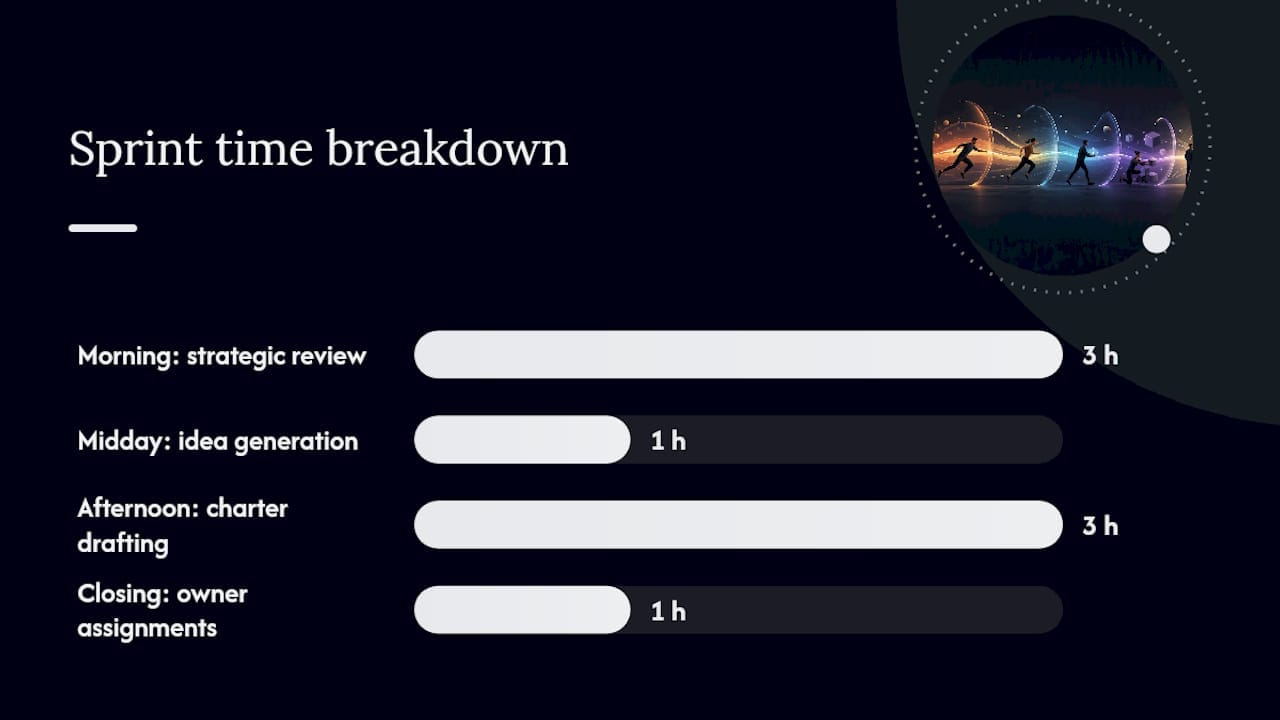
Sample 1-day agenda:
- Morning (3 hours): strategic direction review, current-state assessment, gap identification
- Midday (1 hour): candidate initiative generation and initial scoring
- Afternoon (3 hours): SMART-testing, coherence check, charter drafting for top two initiatives
- Closing (1 hour): owner assignments, resource commitments, review cadence, and next steps
Sample 3-day agenda:
- Day 1: strategic direction, environmental scan, current-state deep dive, and gap analysis
- Day 2: objective drafting, initiative generation, prioritization scoring, and pre-mortem stress-test
- Day 3: charter development for all prioritized initiatives, governance design, resource planning, and sponsor sign-off
An external facilitator adds specific value at three points: surfacing assumptions the internal team cannot see because they are too close to the work, forcing trade-off decisions that internal politics tend to defer, and holding the group to the agenda when conversations drift into BAU problem-solving. The alignment-drives-growth research shows that dedicated alignment time produces compounding returns — teams that align early spend less time resolving conflicts during execution.
Pro Tip: Build a “parking lot” visible to the whole room for off-topic but important issues that surface during the sprint. Acknowledge each item, assign a follow-up owner, and move on. This keeps the agenda on track without dismissing legitimate concerns, and it signals that the facilitator is listening.
Expected outputs from a well-run sprint: two to four signed initiative charters, a prioritized portfolio with scoring rationale, named owners and confirmed resource commitments, a governance calendar for the next quarter, and a resourcing plan that names what BAU work will be reduced to free capacity.
The first 30 days of leading a strategic initiative
The first 30 days set the trajectory for everything that follows. Your job in this window is not to produce deliverables — it is to build the conditions under which the team can produce them reliably.
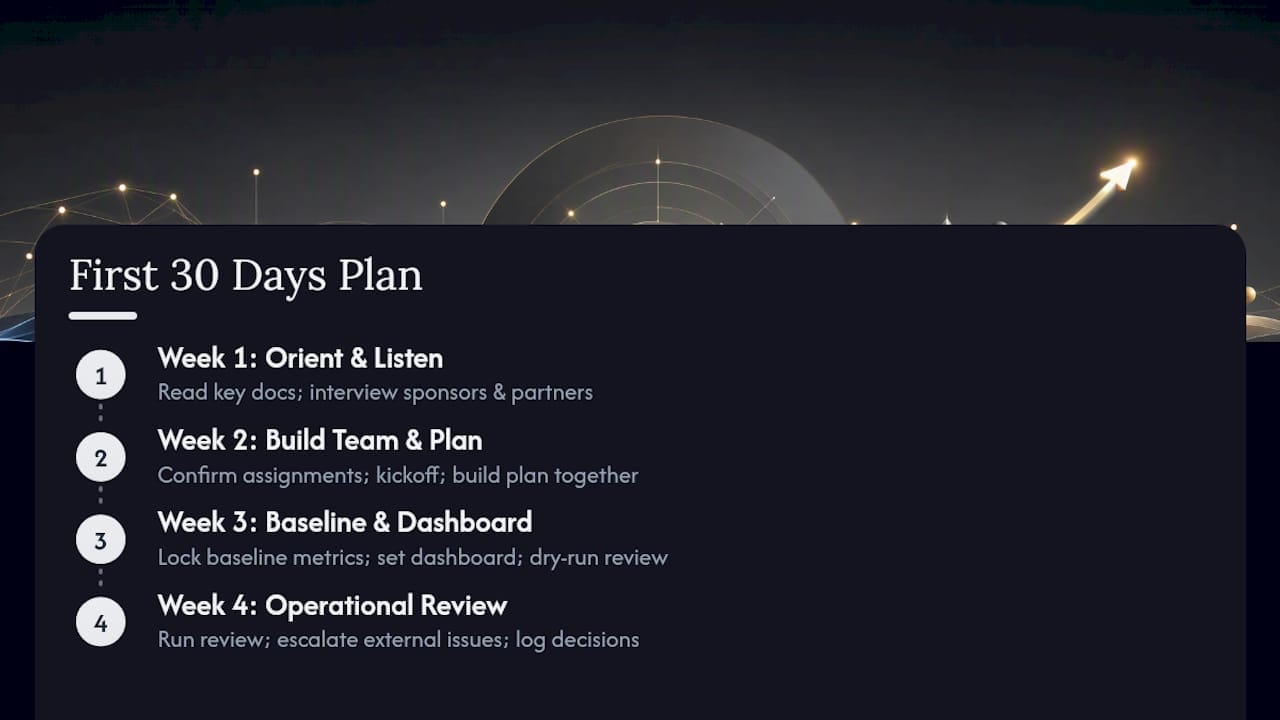
Week 1: orient and listen. Read every relevant document: the charter, the strategy, the last three quarterly reviews, and any prior attempts at similar work. Meet individually with the executive sponsor, each steering committee member, and your two or three most critical cross-functional partners. Ask each person the same question: “What does success look like to you, and what is the biggest risk you see?” The answers will not be identical, and the gaps between them are your first priority.
Week 2: build the team and the plan. Confirm team member assignments and time commitments in writing. Run a kickoff session that covers the charter, the decision rights, the review cadence, and the communication norms. Build the detailed execution plan together as a team, not alone — team members who help build the plan own it differently than those who receive it.
Week 3: establish the baseline and the dashboard. Lock the baseline metrics before any execution work begins. Set up the monitoring dashboard and run a dry-run review so the team knows what good reporting looks like. Identify the first milestone and confirm it is achievable within 60 days.
Week 4: run the first operational review. Even if there is nothing dramatic to report, running the first review on schedule signals that the governance rhythm is real. Escalate to the sponsor anything that requires organizational authority to resolve — resource conflicts, competing priorities, or scope ambiguity that the team cannot resolve internally. Solve locally anything that is within the initiative’s own authority.
The distinction between what to escalate and what to solve locally is one of the most important judgment calls an initiative lead makes. A useful rule: if resolving the issue requires someone outside the team to change their behavior or redirect their resources, escalate. If it requires the team to make a decision within the approved scope and budget, solve it locally and document it in the decision log.
When facilitation is the right choice for your team
Some initiatives benefit most from a structured external perspective, particularly when internal alignment is fragile, the stakes are high, or the team has never run a formal strategic planning process before. In those situations, a facilitated bootcamp or retreat compresses months of back-and-forth into a focused, productive sprint.
Nomadexcel’s company retreats and bootcamp programs are designed specifically for this moment: teams that need to move from strategy to signed initiative charters quickly, with expert facilitation, proven templates, and a structured accountability rhythm built in. The programs combine hands-on workshops, mentorship from experienced operators, and a community of peers who challenge and support each other well beyond the retreat itself.
For teams ready to go deeper, the online entrepreneurship bootcamp offers a full-featured sprint format with daily accountability, real-world execution frameworks, and direct access to mentors who have built and scaled businesses. If your team is at the point where you need more than a planning template and a good agenda, that is the right next step.
Sources
The following sources informed this guide and offer additional depth for leaders who want to go further:
- Strategic Planning Process: The 6 Steps Explained (With Examples)
- 8 Tactics to Develop & Operationalize Strategic Initiatives | FinTalk
- Strategic Initiatives: Key Types, How to Develop and Execute Them | TSI
- Key steps to create a strategic plan that drives business impact
- Strategic Initiatives: How to Define, Execute, and Measure What Matters
- What is a strategic plan? Explore strategies and trends
- Strategic planning goals (HBS Online blog)
Comments are closed.