
How to create a business development plan for fast growth
Most early-stage entrepreneurs have ambition in abundance, but ambition without structure rarely produces sustainable results. A business development plan is a roadmap for company growth, distinct from a general business plan by focusing on sales, marketing, partnerships, and expansion strategies. Without one, even the most motivated founders often find themselves spinning their wheels, reacting to opportunities rather than creating them. This guide walks you through every essential step, from defining clear objectives to measuring real outcomes, so you can build a plan that actually moves your business forward.
Table of Contents
- What is a business development plan?
- Essential components: What you need before you start
- Step-by-step: How to design your business development plan
- Common mistakes to avoid (and how to troubleshoot them)
- A fresh perspective: Why most business development plans fail (and what truly works)
- Accelerate your growth with the right support
- Frequently asked questions
Key Takeaways
| Point | Details |
|---|---|
| Purposeful planning | A business development plan is essential for transforming ambition into structured, actionable growth. |
| Stepwise process | Following a clear sequence—objectives, research, strategies, execution—ensures optimal results. |
| Continuous improvement | Regularly reviewing and updating your plan keeps your business adaptable and competitive. |
| Avoid common pitfalls | Recognizing and addressing typical planning mistakes saves resources and accelerates success. |
| Leverage support | Structured guidance and peer communities drive accountability and sustained progress. |
What is a business development plan?
A business development plan is a focused, strategic document that maps out exactly how your business will grow over a defined period. It is not the same as a traditional business plan, which tends to cover operational structure, founding team bios, and financial projections for investors. The development plan is more action-oriented. It answers the question: How will we win more business, reach new markets, and build the partnerships that drive revenue?
According to HubSpot’s strategic planning framework, a business development plan zeroes in on sales, marketing, partnerships, and expansion strategies, making it a living tool for growth rather than a static founding document. That distinction matters enormously for early-stage entrepreneurs who need momentum, not just documentation.
Here is what a strong business development plan typically covers:
- Sales strategy: How you will find, nurture, and close new clients or customers
- Marketing direction: Which channels and messages will attract your ideal audience
- Partnership opportunities: Strategic alliances that extend your reach or capabilities
- Expansion targets: New markets, geographies, or product lines on your growth horizon
- Resource allocation: Where your time, budget, and team energy will be invested
“A business development plan is not a wish list. It is a structured commitment to specific growth outcomes, backed by research and tied to measurable actions.”
Understanding the business plan vs. development plan distinction helps you avoid a common trap: treating your founding business plan as a growth tool when it was never designed for that purpose. Solo founders, startups, and scaling entrepreneurs all benefit from having both documents, each serving a different function at a different stage.
Skipping the development plan entirely is one of the most costly decisions an early-stage entrepreneur can make. Without it, resource allocation becomes guesswork, sales efforts lack direction, and growth stalls. With it, every team member and stakeholder understands where the business is headed and why.
Essential components: What you need before you start
Understanding the plan’s purpose is only the beginning. Before you sit down to map your strategy, you need the right inputs in place. Jumping into planning without proper preparation is like building a house without a foundation: the structure may look solid at first, but it will not hold.
Here is what to gather before you begin:
- Market data: Current industry size, trends, and customer behavior insights
- Financial baseline: Your current revenue, costs, and cash flow position
- Competitor landscape: Who your main competitors are, what they do well, and where they fall short
- Customer insights: Feedback, pain points, and buying patterns from your existing or target customers
- Team inventory: Skills, capacity, and gaps within your current team or network
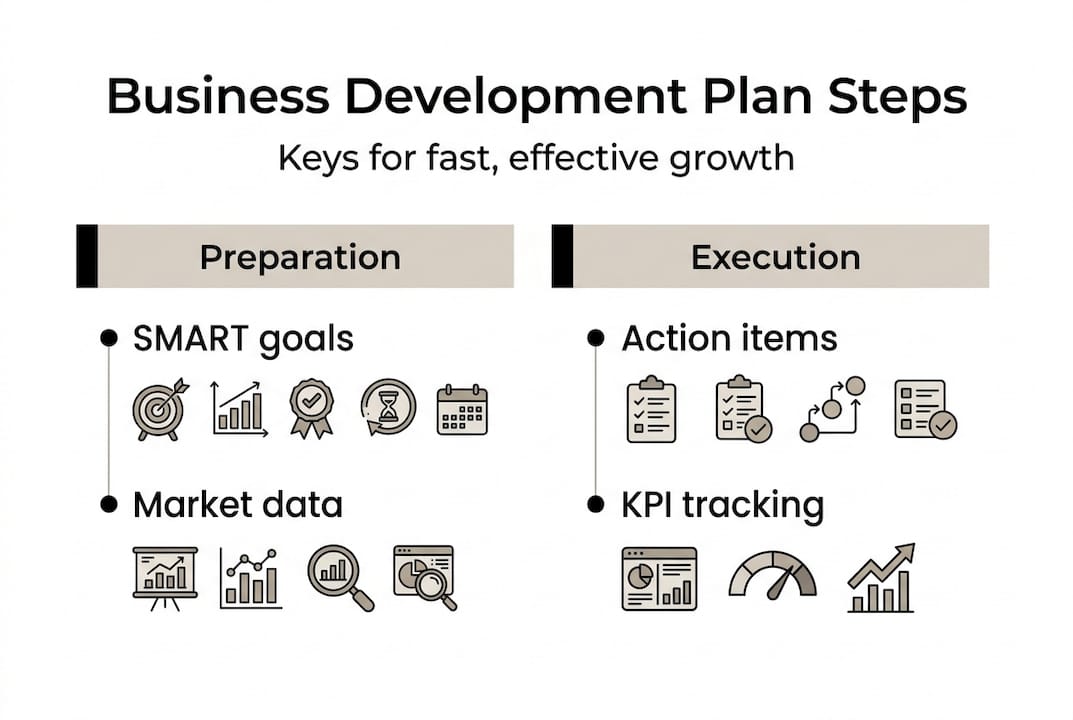
The core steps to create a BD plan include defining SMART objectives, conducting market research and SWOT analysis, identifying targets, developing strategies, setting KPIs, allocating resources, and scheduling regular reviews. Each of these steps depends on having accurate, current information before you start writing.

| Resource | Why it matters | Where to find it |
|---|---|---|
| Market research data | Validates your growth assumptions | Industry reports, surveys, Google Trends |
| Financial statements | Grounds your targets in reality | Accounting software, bookkeeper |
| Competitor analysis | Reveals gaps and opportunities | Direct research, review platforms |
| Customer feedback | Shapes your value proposition | Interviews, NPS surveys, CRM data |
| Planning templates | Speeds up documentation | HubSpot, Notion, Google Docs |
Who should be involved? If you are a solo founder, consider consulting a mentor, advisor, or fellow entrepreneur before finalizing your plan. If you have a small team, bring in whoever owns sales, marketing, or operations. Investing in business education for entrepreneurs before this stage can sharpen your analytical thinking considerably.
Common barriers at this stage include incomplete financial data, limited market research, and uncertainty about which metrics matter. Address these by setting a two-week preparation window before drafting your plan. Review your business launch essentials to make sure your foundational knowledge is solid.
Pro Tip: Use a shared digital workspace like Notion or Google Drive to centralize all your research. When your team can access and contribute to the same documents in real time, the planning process moves faster and produces better results.
Step-by-step: How to design your business development plan
Once you have gathered your resources, it is time to build. The process is more manageable than it looks when you break it into clear, sequential steps.
- Define your SMART objectives: Start with specific, measurable, achievable, relevant, and time-bound goals. “Grow revenue by 30% in 12 months” is a SMART goal. “Grow the business” is not.
- Conduct market research and SWOT analysis: Map your Strengths, Weaknesses, Opportunities, and Threats. This analysis sharpens your competitive edge and reveals where to focus.
- Identify your target customers and partners: Get precise. Which customer segments offer the highest value? Which partnerships could accelerate your reach?
- Develop your core strategies: Choose your primary growth levers from the table below.
- Set KPIs for each strategy: Revenue growth rate, customer acquisition cost, and new partnership count are strong starting points.
- Allocate resources: Assign budget, time, and personnel to each initiative.
- Schedule regular reviews: Build in monthly check-ins and a formal quarterly review.
The core steps to create a BD plan consistently emphasize that defining SMART objectives and setting KPIs are the two most critical actions for keeping a plan accountable and results-driven.
| Strategy type | Primary goal | Example KPI |
|---|---|---|
| Sales strategy | Increase revenue | Monthly recurring revenue growth |
| Marketing strategy | Build brand awareness | Lead generation volume |
| Partnership strategy | Extend market reach | Number of active partnerships |
| Expansion strategy | Enter new markets | Revenue from new segments |
For setting business goals that stick, connect each objective to a specific team member or owner. Vague ownership leads to vague results. Review practical goal setting tips to strengthen this step.
Pro Tip: Assign a named owner and a hard deadline to every action item in your plan. Shared responsibility without individual accountability is one of the fastest ways to watch a great plan collect dust.
Common mistakes to avoid (and how to troubleshoot them)
Every process has its hurdles. Knowing the most common pitfalls before you encounter them gives you a significant advantage and keeps your plan moving forward when things get complicated.
- Vague objectives: If your goals are not specific and measurable, you cannot track progress. Fix this by applying the SMART framework to every objective before finalizing it.
- Skipping market research: Assumptions about your market are not data. Invest time in real research, even if it is just 10 customer interviews and a competitor review.
- Undefined KPIs: A plan without metrics is a hope, not a strategy. Define at least two KPIs per growth strategy from the start.
- Poor accountability: Without clear ownership, action items stall. Assign every task to a specific person with a deadline.
- Infrequent monitoring: Reviewing your plan once a year is not enough. Markets shift, priorities change, and your plan needs to reflect that reality.
“Plans must be living documents. The core steps to create a BD plan include regular review and adjustment to avoid stagnation, because a plan that does not evolve will eventually become irrelevant.”
When something is not working, resist the urge to abandon the plan entirely. Instead, isolate the specific step that is underperforming. Is the strategy wrong, or is the execution inconsistent? Data will tell you which problem you are actually solving.
Building a strong growth strategy workflow helps you catch issues early. Understanding goal setting’s impact on long-term outcomes reinforces why regular review is not optional; it is essential.
Know when to pause and iterate. If your market has shifted significantly, or if three consecutive reviews show the same strategy underdelivering, it is time to revisit your assumptions and adjust your approach. Iteration is not failure. It is how smart entrepreneurs stay relevant.
A fresh perspective: Why most business development plans fail (and what truly works)
Here is the uncomfortable truth: most business development plans do not fail because of poor strategy. They fail because of poor follow-through. Entrepreneurs spend weeks crafting a thoughtful plan, then let it sit untouched while daily urgencies take over.
Rigid plans collapse when market realities shift, and they always shift. The entrepreneurs who sustain growth are not the ones with the most detailed plans. They are the ones who build adaptable systems around their plans, systems that allow for regular course corrections without losing strategic direction.
The hard-won lesson is this: self-assessment must be scheduled, not spontaneous. If you wait until something feels wrong to review your plan, you are already behind. Build review cycles into your calendar the same way you would a client meeting.
Community matters more than most founders expect. Joining a peer accountability group or structured program around step-by-step goal setting creates the external pressure that turns good intentions into consistent execution. Momentum is easier to sustain when others are watching and cheering.
Accelerate your growth with the right support
Adopting a growth-focused mindset often takes more than a great plan. It requires community, expert guidance, and structured accountability to turn strategy into results. At Nomad Excel, our entrepreneurship bootcamp programs are designed specifically for aspiring and early-stage entrepreneurs who want to move faster with the support of experienced mentors and a driven peer community. If you are serious about building and executing a business development plan that produces real outcomes, explore why joining an entrepreneurship bootcamp could be the most valuable investment you make this year. Discover everything Nomad Excel offers to help you grow with clarity and confidence.
Frequently asked questions
What is the difference between a business development plan and a business plan?
A business development plan focuses on practical growth strategies like sales and marketing, while a business plan covers overall operations and financial planning for investors or lenders.
How often should I update my business development plan?
Review and adjust your plan at least quarterly. The core steps to create a BD plan include regular review and adjustment, so more frequent check-ins are recommended if your market or goals shift rapidly.
What are the key elements of an effective business development plan?
Key elements include SMART objectives, thorough market research, strategy development, clear action steps with owners, measurable KPIs, and resource allocation, all informed by structured BD planning.
How do I track the success of my business development plan?
Measure success using KPIs like revenue growth rate, customer acquisition numbers, and progress toward SMART goals. Setting KPIs like these is a core part of effective BD planning, and you should revise tactics whenever results fall short.
Can I use templates or tools to help create my plan?
Absolutely. Planning templates and collaboration tools like Notion or Google Docs streamline the process, improve organization, and make it easier to keep your plan updated and accessible to your whole team.
Comments are closed.