
How to use an entrepreneurial operating system PDF
Downloading an entrepreneurial operating system PDF feels productive. You open it, skim the frameworks, maybe highlight a few sections, and then life gets busy. Weeks later, the file sits untouched in your downloads folder while your business runs the same way it always has. This pattern is far more common than most guides admit, and it points to a critical gap: the difference between having a system and actually building one. This article gives you both the strategic context and the step-by-step application you need to turn a static document into a living, breathing operating system for your business.
Table of Contents
- What is the entrepreneurial operating system?
- What you’ll find in an EOS PDF (and what’s missing)
- How real companies apply EOS: Case studies and practical steps
- Getting the most from your entrepreneurial operating system PDF
- Why most entrepreneurs fail with EOS PDFs (and how to break the pattern)
- Accelerate your EOS journey with real-world support
- Frequently asked questions
Key Takeaways
| Point | Details |
|---|---|
| EOS PDFs are starting tools | They provide a structured framework but require active use to impact your business. |
| Implementation is critical | Results come from action, customization, and accountability—not just from reading. |
| Learning with others works best | Entrepreneurs grow faster when combining frameworks with community and expert support. |
| Case studies show real success | Businesses that structured and implemented EOS achieved better efficiency and onboarding. |
What is the entrepreneurial operating system?
The Entrepreneurial Operating System, widely known as EOS, is a practical business framework designed specifically for small to mid-sized companies. Created by Gino Wickman and detailed in his book Traction, EOS gives founders and their teams a shared language and a set of tools to run their business with greater clarity and discipline. It is not a motivational philosophy or a vague productivity system. It is a structured method with defined components that work together.
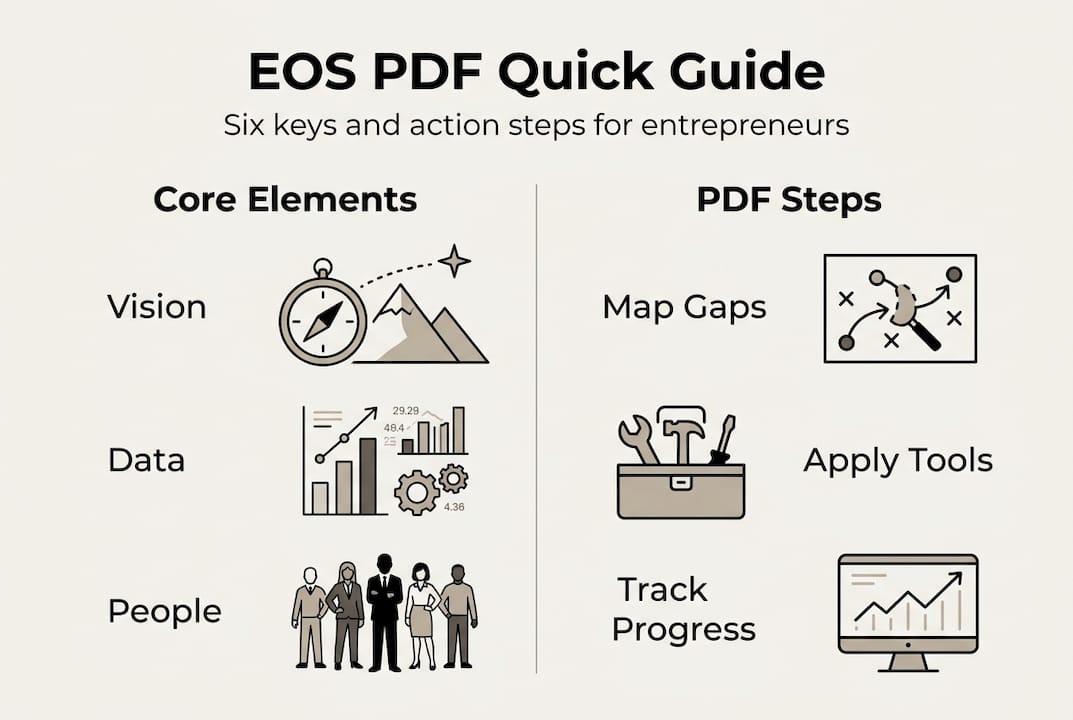
EOS is built around six core components:
- Vision: Getting every person in your organization aligned on where you are going and how you will get there
- People: Placing the right people in the right roles based on your company’s core values
- Data: Running your business on objective numbers, not gut feelings or opinions
- Issues: Identifying, discussing, and solving problems at their root rather than managing symptoms
- Process: Documenting and following your core business processes consistently
- Traction: Translating your long-term vision into short-term, executable priorities
These six components are not independent checklists. They interact. Weak data makes it harder to identify real issues. Unclear vision makes it impossible to put the right people in the right seats. That interdependence is exactly why EOS delivers results when applied properly. Case studies show EOS increased efficiency and accountability across industries, including food and agriculture businesses that used it to scale operations and build stronger leadership teams.
Pro Tip: Before downloading any EOS PDF, spend 20 minutes mapping your current business against the six components. Identify your weakest area first. That is where your implementation should start, not at page one of a generic document.
EOS is also more accessible than most founders realize. You do not need a large team or significant revenue to start. Early-stage entrepreneurs who explore our program often discover that EOS principles apply from day one, even when you are still validating your offer. The future of entrepreneurship education is increasingly built around frameworks like EOS because they give founders structure without sacrificing flexibility.
What you’ll find in an EOS PDF (and what’s missing)
A well-produced entrepreneurial operating system PDF typically includes a summary of the six core components, sample tools like the Vision/Traction Organizer (V/TO), accountability charts, scorecard templates, and meeting pulse guides. These resources are genuinely useful. They give you a map of the territory and a starting vocabulary for conversations with your team.
Here is an honest comparison of what you get with a PDF versus a more supported approach:
| Feature | PDF only | PDF + coaching or bootcamp |
|---|---|---|
| Framework overview | Yes | Yes |
| Customized implementation | No | Yes |
| Accountability structure | No | Yes |
| Real-time troubleshooting | No | Yes |
| Peer feedback and community | No | Yes |
| Adapted to your industry | Rarely | Often |
The gaps are significant. A PDF cannot ask you the right follow-up question when you are stuck. It cannot tell you whether your scorecard metrics actually reflect your business model. And it cannot hold you accountable when momentum fades after week two.
The most common mistakes founders make when using EOS PDFs alone include:
- Treating the V/TO as a one-time exercise rather than a living document
- Skipping the accountability chart because it feels premature for a small team
- Setting up a scorecard with vanity metrics instead of leading indicators
- Running Level 10 Meetings without first training the team on the format
- Abandoning the system after the first quarter when results are not yet visible
Gold Leaf Farming’s transformation started with structured EOS materials, but the real gains came when leadership committed to consistent implementation with outside guidance. The PDF was the starting point, not the solution.

Pro Tip: Pair your EOS PDF with an online entrepreneurship bootcamp or structured business education for entrepreneurs to close the accountability gap that most solo implementations miss.
How real companies apply EOS: Case studies and practical steps
Real-world EOS implementation follows a recognizable arc. Companies begin by clarifying their vision, then build the structural tools, and finally embed the system into their weekly rhythm. The gap between reading about this process and actually living it is where most founders get stuck.
Three case studies illustrate what committed implementation looks like in practice:
| Company | Challenge | EOS solution | Outcome |
|---|---|---|---|
| Gold Leaf Farming | Unclear roles, inconsistent processes | V/TO, accountability chart, process documentation | Stronger leadership alignment and operational consistency |
| ROBO MSP | Rapid growth without structure | Scorecard, rocks, Level 10 Meetings | Efficient scaling with clear priorities |
| Law firm | Slow onboarding, leadership gaps | Hired an Integrator, defined roles | Faster onboarding and improved team performance |
ROBO MSP scaled efficiently and a law firm improved onboarding by hiring an Integrator, demonstrating that EOS works across very different business types when applied with intention.
“The framework gave us a shared language. But it was the weekly discipline of the Level 10 Meeting that actually changed how we operated as a team.”
The practical steps these companies followed break down into four phases:
- Phase 1: Vision clarity. Complete the V/TO as a leadership team. Get alignment on your 10-year target, three-year picture, and one-year plan before touching any other tool.
- Phase 2: Structure. Build your accountability chart, assign clear roles, and identify who owns what. This is often uncomfortable but essential.
- Phase 3: Rhythm. Implement the meeting pulse: annual, quarterly, weekly, and daily check-ins that keep the system alive.
- Phase 4: Iteration. Review your scorecard weekly, surface issues openly, and adjust your quarterly rocks based on real data.
Guided implementation consistently outperforms solo effort. Founders who follow a bootcamp step-by-step guide alongside their EOS materials report faster adoption and fewer false starts because they have a structured environment that mirrors the accountability EOS is designed to create.
Getting the most from your entrepreneurial operating system PDF
Downloading the PDF is step zero. Here is a practical action plan for what comes next:
- Read the full document once without highlighting or taking notes. Get the complete picture before you start customizing.
- Identify your weakest EOS component using an honest self-assessment. This becomes your 90-day focus area.
- Complete the V/TO with your leadership team or a trusted advisor within the first two weeks. Do not do this alone.
- Set up your scorecard with five to fifteen weekly metrics that tell you whether your business is healthy. Avoid vanity metrics.
- Schedule your first Level 10 Meeting for the following week. Run it imperfectly. Adjust from there.
- Find an accountability partner or community. This is the single highest-leverage action you can take after downloading any EOS resource.
Building momentum requires more than good intentions. Organizations that commit to structured EOS rollout see major improvements in accountability, onboarding, and growth, while those who treat it as a self-study project rarely sustain progress past the first quarter.
Pro Tip: Block 90 minutes every quarter to review your V/TO as a team. Treat it like a board meeting, not a casual check-in. The formality signals to your team that the system is real.
For early troubleshooting, watch for these warning signs:
- Meetings drifting off the Level 10 format after a few weeks
- Scorecard metrics going unreviewed because “everyone is too busy”
- Rocks being carried over quarter after quarter without resolution
- Team members unclear on their role in the accountability chart
Experiential education for entrepreneurs and immersive programs like those at Nomad Excel are designed specifically to help founders work through these friction points with real support rather than guesswork.
Why most entrepreneurs fail with EOS PDFs (and how to break the pattern)
Here is the uncomfortable truth most EOS guides skip: the problem is rarely the framework. EOS is a well-designed, battle-tested system. The problem is that reading about accountability does not create accountability. Downloading a PDF about discipline does not make you disciplined.
We have seen this pattern repeatedly. A founder downloads the materials, feels a surge of clarity and motivation, builds a beautiful V/TO in a Google Doc, and then returns to fighting fires the next morning. The document becomes what the industry quietly calls “shelfware,” a resource that felt valuable at the moment of acquisition and has delivered nothing since.
The contrarian advice worth hearing is this: an imperfect EOS implementation with real support will outperform a perfect PDF sitting in your downloads folder every single time. Commit to doing it messily with a peer group, a bootcamp cohort, or a mentor before you commit to doing it perfectly alone.
The value of investing in business education is not the content itself. It is the environment that makes behavior change possible. Peer groups create social accountability. Bootcamps create structured urgency. Mentors create personalized feedback loops. None of those things exist inside a PDF, no matter how well it is written.
Accelerate your EOS journey with real-world support
With both the realism and the optimism of what EOS can do for your business, the next step is finding the right environment to make it stick. At Nomad Excel, we build immersive experiences specifically designed to help founders move from frameworks to execution. Our online entrepreneurship bootcamp gives you structured EOS application alongside a community of driven peers who hold you accountable in real time. If you are ready to stop treating your operating system as a solo project, explore why joining an entrepreneurship bootcamp accelerates results. Visit Nomad Excel to find the program that fits where you are right now.
Frequently asked questions
What is an entrepreneurial operating system PDF?
It is a downloadable guide or set of tools designed to help entrepreneurs structure and operate their business using the EOS framework. EOS materials provide actionable business systems, but their impact depends heavily on how consistently they are applied.
Can a PDF alone help me implement EOS?
A PDF is a starting point, but most entrepreneurs see real results when they add accountability, coaching, or a community for support. Real-world gains came when businesses paired structure with hands-on action, not just documents.
Where can I find high-quality EOS resources and support?
Entrepreneurship bootcamps, mentorship programs, and curated guides that combine EOS tools with peer learning are your best options for moving beyond the PDF and into genuine implementation.
What are common mistakes when using EOS PDFs?
Skipping the accountability structure and failing to adapt the content to your specific business are the most common pitfalls. Companies flourished when they customized and followed through on EOS processes rather than treating them as static templates.
Recommended
- Entrepreneurship Skills Guide for Launching Your Own Venture – Nomad Excel – Your Entrepreneurial Adventure Starts Here
- Execution Focused Entrepreneurship Guide for Fast Growth
- Entrepreneurship Bootcamp Step by Step: Launch and Scale Fast
- Entrepreneur Mindset Guide for Growth and Independence – Nomad Excel – Your Entrepreneurial Adventure Starts Here
Comments are closed.