
Elevate your B2C marketing: practical strategies for entrepreneurs
TL;DR:
- B2C marketing offers high ROI through accessible, low-cost channels like email and social media.
- Emotional triggers such as social proof, FOMO, and personalization are key to engaging consumers.
- Focus on retention and building community for sustainable, long-term growth over chasing viral campaigns.
Most entrepreneurs assume B2C marketing is a game reserved for brands with massive budgets and dedicated agencies. That assumption is costing them real growth. Email marketing delivers $36–42 for every dollar spent, which means the playing field is far more level than it looks. The strategies that drive results for consumer-facing startups are accessible, repeatable, and often low-cost. This article breaks down what B2C marketing actually involves, which channels deliver the highest return for early-stage founders, and how to build a practical system that grows with your business.
Table of Contents
- What makes B2C marketing unique?
- Core B2C marketing channels and strategies
- B2C marketing in practice: Startup playbook
- New frontiers: Trends and challenges in B2C marketing for 2026
- Our take: Building lasting B2C impact as a founder
- Ready to level up your B2C marketing?
- Frequently asked questions
Key Takeaways
| Point | Details |
|---|---|
| B2C vs. B2B fundamentals | B2C marketing relies on emotion and speed, while B2B is logic- and process-driven. |
| High-ROI channels | Email, social media, and paid ads consistently deliver the best returns for early-stage entrepreneurs. |
| Start simple, scale smart | Begin with 2–3 focused channels and grow as you validate results. |
| Retention over acquisition | Retaining customers is up to 7 times cheaper than acquiring new ones in B2C marketing. |
| Stay ahead of trends | Utilize AI tools, local marketing, and personalization—while balancing privacy—to grow in 2026. |
What makes B2C marketing unique?
With the promise of high ROI in mind, understanding the rules of the B2C game is essential. B2C marketing, or business-to-consumer marketing, operates on a fundamentally different logic than B2B. The buyer is an individual, not a committee. The decision is often emotional, fast, and influenced by social proof rather than spreadsheets and procurement cycles.
B2C involves shorter sales cycles and emotion-driven buying decisions, while B2B focuses on longer, logic-driven processes. That distinction changes everything about how you communicate, where you show up, and what you say. A B2B pitch might win on features and ROI data. A B2C message wins on feeling, identity, and desire.
Startups commonly stumble by treating their consumer audience like a business buyer. They write long-form product explanations when a single compelling image would convert better. They rely on rational arguments when urgency and social proof are the real levers. Understanding core B2C marketing means accepting that emotion is not a shortcut; it is the strategy.
Here is a quick comparison to anchor the distinction:
| Factor | B2C | B2B |
|---|---|---|
| Decision maker | Individual consumer | Team or committee |
| Sales cycle | Short (minutes to days) | Long (weeks to months) |
| Primary motivator | Emotion, identity, FOMO | Logic, ROI, risk reduction |
| Content style | Visual, punchy, story-driven | Data-heavy, detailed, formal |
| Volume | High volume, lower ticket | Lower volume, higher ticket |
The emotional and practical levers that move B2C buyers include:
- FOMO and scarcity: Limited-time offers and low-stock alerts trigger urgency.
- Social proof: Reviews, user-generated content (UGC), and influencer endorsements build trust fast.
- Identity alignment: Buyers choose brands that reflect who they are or who they want to be.
- Convenience: Frictionless checkout, fast delivery, and easy returns reduce hesitation.
- Personalization: Relevant messaging at the right moment feels less like marketing and more like service.
“The brands that win in B2C are not always the loudest. They are the ones that make the buyer feel understood.”
Investing in business education for entrepreneurs that covers consumer psychology gives founders a real edge here. Pair that with proven startup growth hacks and you have a foundation worth building on.
Core B2C marketing channels and strategies
Now that you understand the unique B2C mindset, let’s break down which strategies actually deliver for startups. Not every channel deserves your attention, especially when you are running lean. The goal is to identify the two or three channels where your audience already lives and where your investment will compound over time.
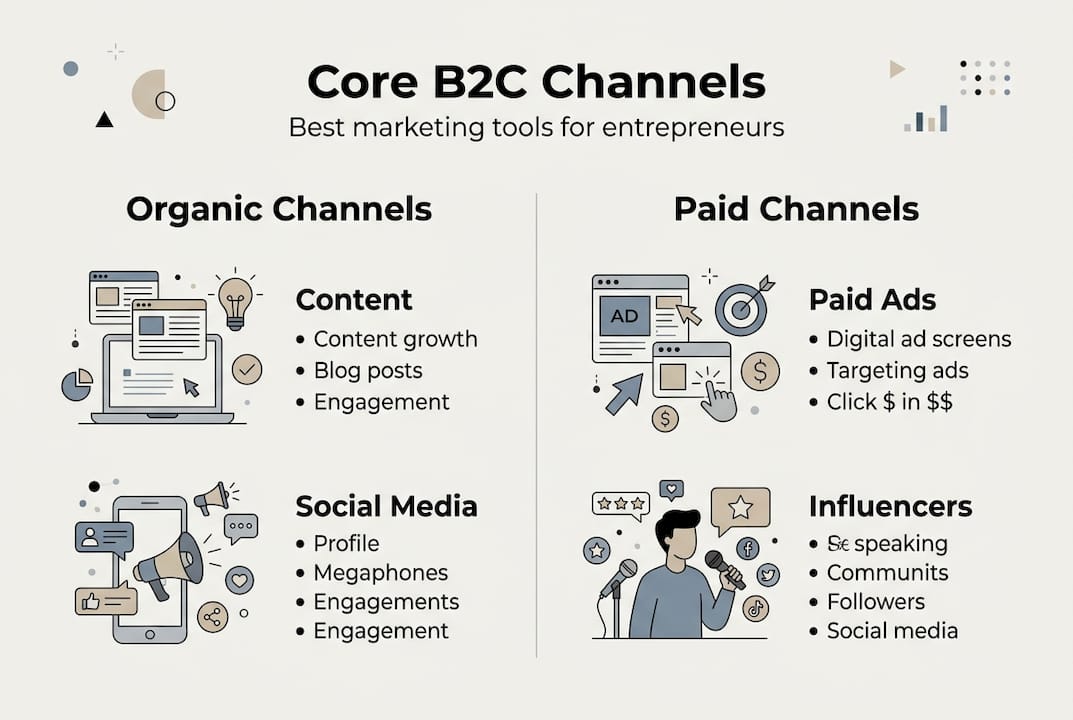
Core B2C channels include content marketing, social media, paid ads, influencer partnerships, and personalization, with email consistently offering the best ROI. Here is how they stack up for early-stage founders:
| Channel | Avg. ROI / ROAS | Best for | Startup fit |
|---|---|---|---|
| Email marketing | $36–42 per $1 spent | Retention, lifecycle | High |
| SMS marketing | $71 per $1 spent | Flash sales, urgency | Medium |
| Paid search | 2.87–4.5x ROAS | Validation, intent | Medium |
| Social media (organic) | Variable | Brand awareness, UGC | High |
| Influencer marketing | Varies by niche | Trust, reach | Medium |
| SEO / content | Long-term compounding | Organic traffic | High |
For small teams, the most effective tactics tend to be the ones that work while you sleep. Lifecycle email automation, for example, sends the right message at the right moment without requiring daily effort. A welcome sequence, an abandoned cart reminder, and a post-purchase follow-up can recover significant revenue with minimal ongoing work.

User-generated content is another underrated engine. When real customers share photos, reviews, or short videos, they do the trust-building that no ad can replicate. Encouraging UGC through simple prompts, hashtags, or small incentives creates a feedback loop of social proof that scales organically.
Personalized content, even at a basic level, outperforms generic messaging. Segmenting your email list by purchase history or browsing behavior and sending relevant offers can lift open rates and conversions meaningfully. Loyalty programs, even simple points systems, increase repeat purchase rates and lifetime value.
Pro Tip: Start with email and one social platform where your audience is most active. Master those before adding paid ads or influencer partnerships. Spreading too thin too early is one of the most common reasons early-stage B2C efforts stall.
For deeper guidance on building your social presence, explore these social media visibility strategies and pair them with effective email templates to build a two-channel system that drives both acquisition and retention. You can also review digital B2C strategies for a broader framework.
B2C marketing in practice: Startup playbook
Understanding the what is only half the battle. Here is how you can put B2C marketing into motion as a startup founder, even with a small team and a limited budget.
Step-by-step launch sequence:
- Research your audience. Define one primary customer persona. Know their pain points, preferred platforms, and buying triggers before spending a dollar.
- Choose 2–3 channels. Based on where your persona spends time and your own capacity, select your starting channels. Email plus one social platform is a strong default.
- Set up your foundations. Create a Google Business Profile, establish your social accounts, and set up a basic email list with a lead magnet or signup incentive.
- Run small tests. Spend a modest amount on paid ads or post consistently for 30 days before drawing conclusions. Test one variable at a time.
- Measure what matters. Track customer acquisition cost (CAC), lifetime value (LTV), and retention rate. Aim for a CAC to LTV ratio above 3:1 as a baseline health check.
- Iterate and scale. Double down on what works. Cut what does not. Add a new channel only when your core two are running smoothly.
Measuring CAC and LTV does not require a finance background. CAC is simply your total marketing spend divided by the number of new customers acquired in a period. LTV is the average purchase value multiplied by the average number of purchases per year and the average customer lifespan. These two numbers tell you whether your marketing is sustainable.
Building community around your brand accelerates everything. Events, both online and in person, create emotional connection that no ad can manufacture. Local collaborations with complementary businesses expand your reach without paid spend. Influencer partnerships, even with micro-influencers in your niche, can generate authentic exposure at a fraction of the cost of traditional advertising.
Common mistakes to avoid:
- Chasing vanity metrics like follower count instead of conversion and retention data.
- Trying to be everywhere at once before mastering one channel.
- Ignoring existing customers in favor of constant acquisition.
- Skipping the measurement step and making decisions based on gut feel alone.
Pro Tip: Time-box your B2C marketing to 1–10 hours per week depending on your stage. Use structured sprints to batch content, schedule emails, and review metrics rather than reacting daily. This keeps marketing from consuming time that should go to product and customer experience.
For a broader view of tactics that work at this stage, review these small business marketing strategies and revisit the startup growth hacks that align with your current phase. The actionable B2C playbook from Shopify also offers useful channel-specific frameworks.
New frontiers: Trends and challenges in B2C marketing for 2026
Even with a playbook in hand, entrepreneurs need to anticipate what is next to future-proof their marketing. The B2C landscape in 2026 is being reshaped by artificial intelligence, shifting search behavior, and a growing tension between personalization and privacy.
Over 60% of B2C brands are now using AI tools and generative AI for content creation, customer segmentation, and campaign optimization. Zero-click search, where users get answers directly on the search results page without visiting a site, now accounts for roughly 50% of searches. These two shifts alone require founders to rethink how they create content and where they invest in visibility.
71% of B2C customers expect personalization in their brand interactions, yet many of those same consumers are increasingly concerned about how their data is used. This tension is real, and navigating it requires a permission-first approach: collect data transparently, use it to genuinely improve the customer experience, and never trade short-term conversion for long-term trust.
“In 2026, the brands that earn trust will outperform the brands that simply optimize for clicks.”
Here are the key moves founders should prioritize to stay ahead:
- Optimize your Google Business Profile. Local search intent is rising, and 86% of brands are investing in GBP optimization to capture it.
- Use AI tools for content scale. Tools that help you produce more relevant content faster are now accessible at startup-friendly price points.
- Invest in events and community. As AI-generated content floods digital channels, human connection becomes a genuine competitive advantage.
- Adopt permission-first personalization. Build your email and SMS lists through genuine value exchange, not data scraping or aggressive retargeting.
- Prepare for zero-click search. Create content that answers questions directly and builds brand authority, even when users do not click through.
For founders ready to act on these shifts, exploring leveraging social media trends and learning more about AI for entrepreneurs are practical next steps. The 2026 marketing trends report from Forrester offers a detailed look at where consumer expectations are heading.
Our take: Building lasting B2C impact as a founder
Too many early-stage founders chase the viral moment. They spend weeks crafting a campaign hoping it breaks through, then feel defeated when it does not. The truth is that sustainable B2C growth rarely comes from a single spike. It comes from disciplined, repeatable systems that compound over time.
Retention and lifetime value are the most underappreciated metrics in founder-led B2C. Acquiring a new customer costs five times more than keeping an existing one, yet most marketing energy flows toward acquisition. Flipping that ratio, even partially, has an outsized impact on profitability.
The founders who consistently win are not the ones following every new trend. They are the ones who test rigorously, measure honestly, and scale only the tactics that their own data validates. Generic growth advice is everywhere. What actually moves the needle is a strategy grounded in your specific audience, your specific offer, and your specific community.
Build trust first. Layer in technology and automation once the human foundation is solid. The brands that endure are built on relationships, not algorithms. Investing in long-term education and community is one of the highest-leverage moves a founder can make at any stage.
Ready to level up your B2C marketing?
If this guide has sparked ideas but you want structured support to put them into action, Nomad Excel’s Online Entrepreneurship Bootcamp is built exactly for this stage of the journey. You will work alongside experienced mentors and a community of driven founders to refine your marketing strategy, test your offers, and build systems that scale. Explore the full range of Nomad Excel programs to find the right fit, or learn more about joining an entrepreneurship bootcamp and what the experience looks like in practice. Growth accelerates when you stop learning alone.
Frequently asked questions
What is a B2C marketing channel?
A B2C marketing channel is a pathway, such as email, social media, or paid ads, used to reach and engage individual consumers and drive purchases. Core B2C channels include content marketing, social, email, influencers, and paid advertising.
How do B2C and B2B marketing differ?
B2C marketing targets individuals and is driven by emotion and short sales cycles, while B2B marketing targets organizations and relies on rational decision-making over longer cycles. B2C features shorter cycles and emotional drivers, whereas B2B is logic and committee-based.
What is a good ROI for B2C marketing?
Strong B2C marketing can achieve $36–$42 ROI per dollar for email and 2.87–4.5x for paid search, though results vary by channel and market conditions.
How can small startups compete with large brands in B2C marketing?
Startups can win by focusing on 2–3 high-impact channels, building a strong community, and prioritizing retention over acquisition rather than trying to match big-brand ad spend.
Comments are closed.