
Entrepreneurial mindset shift: 5-7% better survival odds
TL;DR:
- A genuine entrepreneurial mindset involves how you interpret failure, uncertainty, and opportunity.
- Research shows mindset shifts can improve startup survival, income, innovation, and resilience.
- Practical growth involves deliberate risk-taking, feedback, reflection, brain training, and environment challenges.
Most people assume entrepreneurial success comes down to the right idea, the right timing, or the right connections. That belief keeps a lot of talented founders stuck. What actually separates thriving entrepreneurs from those who stall out is something less visible and far more powerful: how they think. A genuine entrepreneurial mindset shift is not about staying positive or reading the right books. It is a fundamental rewiring of how you respond to failure, uncertainty, and opportunity. This guide breaks down what that shift really means, what the research says about its measurable impact, and how you can start building it into your daily practice.
Table of Contents
- Defining the entrepreneurial mindset shift
- The science behind mindset shifts: What research reveals
- From theory to practice: How to foster a mindset shift
- Common obstacles and practical solutions
- Beyond buzzwords: Our perspective on cultivating an entrepreneurial mindset
- Next steps: Transform your entrepreneurial mindset with expert support
- Frequently asked questions
Key Takeaways
| Point | Details |
|---|---|
| Mindset drives success | Entrepreneurial outcomes strongly depend on deep mindset shifts, not just skills or tactics. |
| Evidence-based benefits | Research shows mindset transformation increases startup survival, innovation, and job creation. |
| Practical tools exist | Neuroscience and behavioral approaches both offer concrete steps to foster the right mindset. |
| Balance is crucial | Excessive grit without adaptability can backfire—successful founders balance persistence with learning. |
Defining the entrepreneurial mindset shift
The phrase “mindset shift” gets thrown around a lot, but it is worth being precise. A mindset shift for entrepreneurs is not a mood or an attitude adjustment. It is a structural change in how you interpret events, make decisions, and assign meaning to setbacks. Where a fixed mindset sees failure as evidence of personal limitation, an entrepreneurial mindset sees it as data. Where a scarcity mindset hoards opportunities, an entrepreneurial mindset actively creates them.
One of the clearest ways to understand this is by comparing entrepreneurial and managerial thinking side by side.
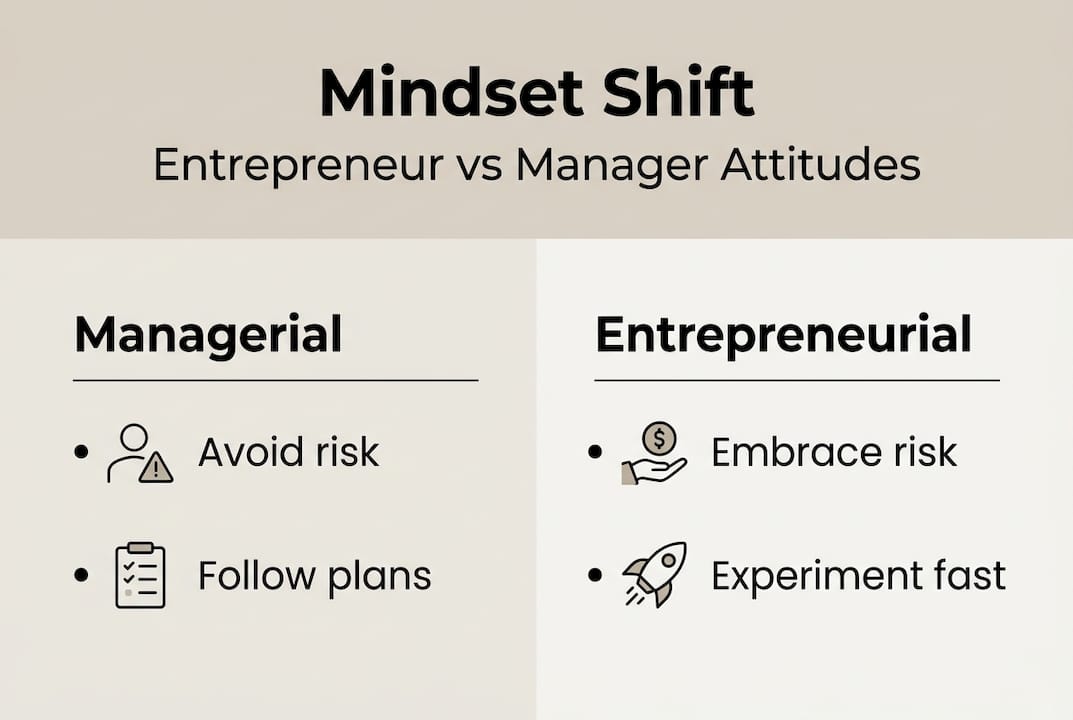
| Dimension | Managerial mindset | Entrepreneurial mindset |
|---|---|---|
| View of risk | Minimize and control | Evaluate and leverage |
| Response to failure | Avoid and conceal | Analyze and iterate |
| Time horizon | Short to medium term | Long-term vision |
| Resource approach | Optimize existing assets | Create new value from constraints |
| Opportunity lens | Scarcity | Abundance |
Research confirms that entrepreneurs show higher creative capacity, favor experimentation, and operate from an abundance mindset compared to managers. This is not a personality trait you either have or do not have. It is a learned orientation that develops with deliberate practice.
The key attributes of an entrepreneurial mindset include:
- Comfort with ambiguity: Acting decisively even when information is incomplete
- Opportunity recognition: Seeing problems as potential markets or solutions
- Resilience: Bouncing back from setbacks without losing momentum
- Self-efficacy: Believing your actions directly shape outcomes
- Long-term thinking: Prioritizing future value over immediate comfort
- Bias toward action: Preferring imperfect execution over perfect planning
Using an entrepreneur mindset guide can help you benchmark where you currently stand across these dimensions.
Pro Tip: Most new founders spend their first year obsessing over tactics, tools, and frameworks. That is understandable, but it is backwards. Mindset is the operating system. Skills are just apps. Fix the OS first.
The science behind mindset shifts: What research reveals
Now that you understand what an entrepreneurial mindset shift is, let’s see what the latest research says about its tangible benefits and real-world impact.
The evidence is striking. Studies on building a growth mindset consistently show that mindset is not just a soft variable. It has hard, measurable consequences for business outcomes.

| Research focus | Key finding | Impact area |
|---|---|---|
| Generalized self-efficacy | Increases startup survival by 5 to 7% | Survival rate |
| Growth mindset in founders | Linked to higher entrepreneurial income | Personal income |
| Perceived control | Boosts engagement, especially in high-GDP environments | Innovation output |
| Gender-sensitive effects | Growth mindset benefits women founders more strongly | Equity and inclusion |
| Grit and mindset interaction | Complex relationship; excessive grit can weaken resilience | Burnout risk |
High generalized self-efficacy increases startup survival, entrepreneurial income, job creation, and innovation, with particularly strong effects for women founders. This is a significant finding because it reframes mindset work as a concrete business strategy, not a feel-good exercise.
“A growth mindset does not just make you feel better. It measurably increases your startup’s odds of surviving and scaling, with a 5 to 7% lift in survival rates documented in recent empirical research.”
Another layer of nuance comes from newer work showing that growth mindset alters the relationship between grit and resilience. Perceived control, a core component of entrepreneurial thinking, lifts engagement more strongly in high-GDP environments, suggesting that context shapes how mindset effects play out. This means your mindset work should be calibrated to your specific market and circumstances, not applied as a one-size-fits-all prescription.
The takeaway is clear. Mindset is not a prerequisite for starting a business. It is a competitive advantage that compounds over time.
From theory to practice: How to foster a mindset shift
With the benefits clear, how do you make this mindset shift in real life?
Neuroscience offers some surprising answers. Brain-training techniques such as EEG-based cognitive exercises and structured attention training can enhance traits like focus, emotional regulation, and resilience at a neurological level. This is not speculation. Emerging research suggests that brain-aligned training is potentially more impactful than purely behavioral interventions when it comes to building lasting entrepreneurial traits.
That said, neuroscience tools are one piece of the puzzle. The daily behavioral practices you build are equally important. Here is a practical sequence to follow:
- Start with a failure audit. Each week, list one decision that did not go as planned. Write down what you assumed, what happened, and what you would do differently. This builds the habit of treating failure as feedback rather than identity.
- Practice deliberate risk-taking. Take one small, calculated risk every week. Pitch an idea to someone new. Test a pricing change. Launch a minimum viable version of something. Small risks build the neural pathways for bigger ones.
- Seek out structured feedback. Ask a mentor, peer, or customer one specific question about your blind spots. Feedback-seeking is a skill, and it is central to the entrepreneurial thinking guide approach.
- Use reflective journaling. Spend ten minutes at the end of each day noting what you learned, what surprised you, and what you want to approach differently. Reflection accelerates pattern recognition.
- Invest in cognitive training. Meditation, focused attention exercises, and even certain types of physical training improve executive function, which is the mental hardware behind good entrepreneurial decisions.
- Build your skills on a solid mindset base. Once you have a daily mindset practice running, layer in the entrepreneurship skills for new ventures that match your current stage.
Pro Tip: Do not treat mindset work as something separate from your business tasks. Integrate it. Reflect after a sales call. Journal after a product decision. The practice becomes most powerful when it is woven into your actual work, not scheduled as a separate self-improvement block.
Common obstacles and practical solutions
It is not all smooth sailing. Most entrepreneurs encounter real obstacles when trying to shift their mindset, and knowing what to expect helps you prepare.
The most common barriers and how to work through them:
- Fear of failure: This is the most cited obstacle. The fix is not to eliminate the fear but to act alongside it. Start with low-stakes experiments where failure costs little but teaches a lot.
- Fixed mindset loops: These are the internal narratives that say “I am not a tech person” or “I am bad at sales.” Counter them with evidence. Every time you learn something new, you are proving the narrative wrong. Use mindset frameworks for founders to identify which loops are running in your business decisions.
- Burnout: Pushing through exhaustion is often framed as resilience, but it is frequently the opposite. Burnout narrows thinking and kills creativity. Build recovery into your schedule the same way you build in work.
- Over-reliance on grit: This one surprises people. Grit is valuable, but research shows that excessive grit with high growth mindset can actually weaken resilience. When you push too hard without adapting, you become brittle rather than flexible.
- Perfectionism: Waiting until something is perfect is a fixed mindset behavior in disguise. It avoids the vulnerability of putting imperfect work into the world. The solution is shipping faster and iterating based on real feedback.
It is also worth remembering that mindset is a spectrum, not a binary. You are not either entrepreneurial or not. You are somewhere on a continuum, and the benefits of entrepreneurial mindset accumulate as you move along it. Progress is the goal, not perfection.
Beyond buzzwords: Our perspective on cultivating an entrepreneurial mindset
Having unpacked the actionable science and practice, here is our candid take on what actually moves the needle.
Most mindset content treats the subject as a motivational exercise. Read this book. Repeat these affirmations. Think bigger. That framing misses something important. The founder mindset perspective we have seen produce real results is systematic, physical, and uncomfortable.
Brain training matters. New experiences matter. Sitting in a room with other founders who are further along than you matters. These are not soft variables. They are the conditions under which genuine cognitive change happens. The most striking growth we observe comes from founders who deliberately put themselves in unfamiliar situations with structured support around them, not from those who read the right content alone.
Mindset definitions that stay abstract will always fail you. What works is daily practice, honest feedback, and environments that challenge your current assumptions at the edges. That is where the shift actually happens.
Next steps: Transform your entrepreneurial mindset with expert support
Ready to put these insights into action? The right support can kickstart your mindset shift faster than going it alone.
Understanding the science is a strong start, but the real shift happens in environments built for it. At Nomad Excel, our immersive programs are designed to create exactly those conditions: structured challenges, experienced mentors, and a community of founders who push each other forward. Whether you are exploring an online entrepreneurship bootcamp or want to understand why joining a bootcamp accelerates growth in ways solo learning cannot, we have resources built specifically for aspiring and early-stage entrepreneurs ready to make a lasting change.
Frequently asked questions
What is an entrepreneurial mindset shift?
An entrepreneurial mindset shift is a fundamental change in how you approach challenges, risk, and growth, preferring experimentation, learning, and resilience over fear and rigidity. Research shows that entrepreneurs favor experimentation and operate from an abundance mindset rather than a scarcity one.
How does mindset impact startup success?
A strong entrepreneurial mindset can measurably boost a startup’s odds of surviving and scaling. High generalized self-efficacy increases startup survival by approximately 5 to 7%, while also lifting entrepreneurial income, job creation, and innovation output.
What are practical ways to develop an entrepreneurial mindset?
Practice deliberate risk-taking, seek structured feedback, engage in reflective journaling, and use neuroscience-backed cognitive training regularly. Brain-training techniques such as EEG-based exercises can enhance focus and resilience at a neurological level.
What challenges do people face in shifting their mindset?
Common obstacles include fear of failure, burnout, and over-relying on grit instead of adaptability. Notably, excessive grit combined with a high growth mindset can actually weaken resilience rather than strengthen it.
Recommended
- Mindset shifts for founders: 7 frameworks to grow startups
- The Essential Guide to Benefits of Entrepreneurial Mindset – Nomad Excel – Your Entrepreneurial Adventure Starts Here
- How to Build a Growth Mindset for Entrepreneurial Success
- Entrepreneur Mindset Guide for Growth and Independence – Nomad Excel – Your Entrepreneurial Adventure Starts Here
- Top startup ideas for African entrepreneurs in 2026
Comments are closed.