
Brainstorming new ideas: a guide for early entrepreneurs
Launching a business starts with a single spark, but most aspiring entrepreneurs struggle to turn fleeting thoughts into structured, actionable ideas. Many believe brainstorming is simply sitting down and waiting for inspiration to strike. The truth is that effective ideation requires intentional frameworks, collaborative energy, and disciplined evaluation. This guide walks you through proven brainstorming techniques designed specifically for early-stage entrepreneurs who want to generate, refine, and validate business concepts that can actually succeed in competitive markets.
Table of Contents
- Key takeaways
- Why structured brainstorming is essential for entrepreneurs
- Collaborative brainstorming techniques that spark innovation
- Evaluating and refining ideas to identify viable business opportunities
- Tools and frameworks to streamline your brainstorming sessions
- Boost your entrepreneurial journey with expert support
- Frequently asked questions
Key Takeaways
| Point | Details |
|---|---|
| Structured brainstorming boosts quality | Structured brainstorming improves idea quality by setting clear objectives, time limits, and ground rules to focus on solving specific problems. |
| Collaborative brainstorming boosts creativity | Collaborative approaches bring diverse backgrounds and thinking styles together to generate more varied and higher quality ideas. |
| Frameworks guide ideation | Mind mapping, SCAMPER, brainwriting, and Six Thinking Hats provide structured prompts that expand opportunities while reducing bias and groupthink. |
| Evaluate and refine ideas | A disciplined evaluation stage helps filter concepts for feasibility, market fit, and potential impact before moving forward. |
Why structured brainstorming is essential for entrepreneurs
Most people think brainstorming means gathering in a room and shouting out whatever comes to mind. That approach rarely produces actionable business ideas. Without structure, sessions devolve into chaos where the loudest voices dominate and promising concepts get buried under noise.
Structured brainstorming creates guardrails that actually amplify creativity rather than constrain it. When you define clear objectives, set time limits, and establish ground rules, participants can focus their mental energy on solving specific problems instead of wondering what they should contribute. Research shows that structured brainstorming improves idea quality compared to unstructured free-for-alls.
Several proven methods work particularly well for entrepreneurial contexts:
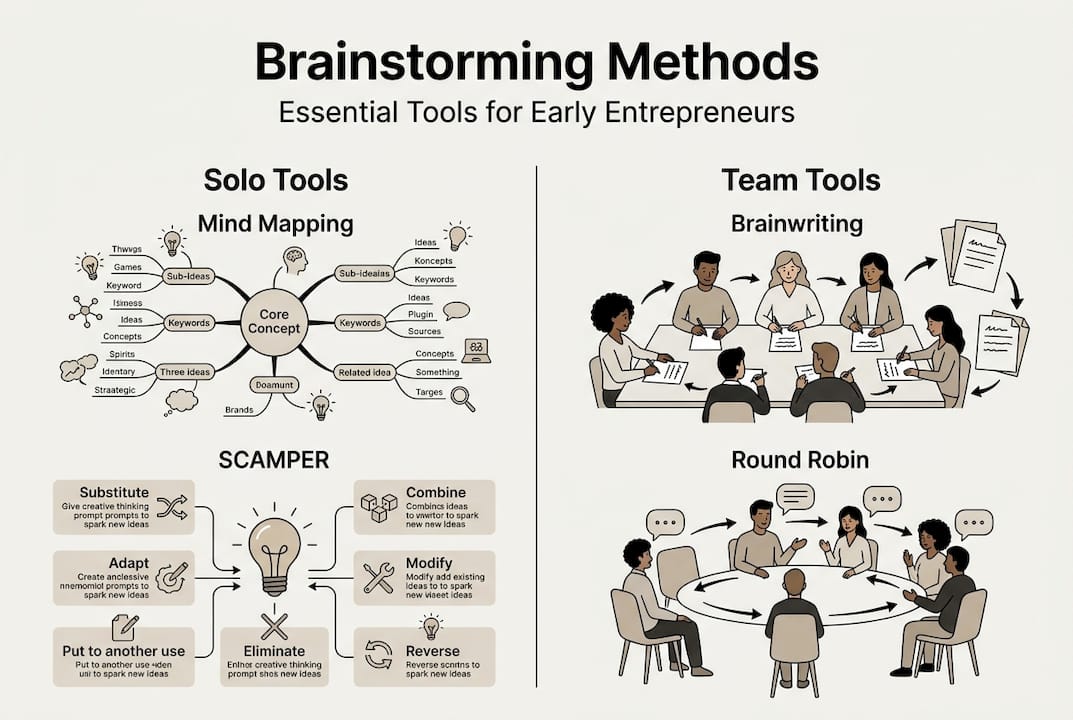
- Mind mapping starts with a central business challenge and branches outward into related concepts, creating visual connections between ideas
- SCAMPER prompts you to Substitute, Combine, Adapt, Modify, Put to other uses, Eliminate, or Reverse elements of existing solutions
- Brainwriting lets participants write ideas silently before sharing, preventing groupthink and giving introverts equal voice
- The Six Thinking Hats method assigns different perspectives (logical, emotional, creative, cautious, optimistic, process-oriented) to explore ideas from multiple angles
Each framework serves different purposes. Mind mapping excels at exploring broad opportunity spaces. SCAMPER works best when you’re innovating on existing products or services. Brainwriting shines in teams where personality dynamics might otherwise skew results.
Pro Tip: Set clear objectives and rules before brainstorming to maximize session effectiveness. Define the specific problem you’re solving, establish a time limit, and agree that all ideas are valid during generation phase.
The key is matching the method to your situation. If you’re starting from scratch with zero direction, mind mapping helps you explore possibilities. If you already have a basic concept and need to make it distinctive, SCAMPER pushes you toward innovation. Understanding these distinctions prevents wasted effort and frustration.
Collaborative brainstorming techniques that spark innovation
Solo brainstorming has its place, but collaborative approaches unlock idea diversity that single perspectives can’t match. When you bring together people with different backgrounds, expertise, and thinking styles, you create conditions for breakthrough insights that no individual could generate alone.

Round-robin brainstorming ensures everyone contributes by going around the circle and having each person share one idea per turn. This prevents dominant personalities from monopolizing the conversation and surfaces perspectives from quieter team members who might otherwise stay silent.
Brainwriting takes collaboration a step further by removing verbal dynamics entirely. Participants write ideas on cards or digital boards, then pass them to others who build on or modify the concepts. This technique produces higher quality ideas because people have time to think deeply rather than react in the moment.
Role storming asks participants to adopt different personas (a customer, a competitor, an investor, a skeptic) and generate ideas from those viewpoints. This method breaks people out of their habitual thinking patterns and reveals assumptions they didn’t know they were making.
Digital collaboration tools like Miro, MURAL, and Stormboard enable remote teams to brainstorm asynchronously across time zones. These platforms let you capture ideas visually, vote on favorites, and organize concepts into themes without losing anything in the shuffle.
Here’s how to run an effective collaborative brainstorming session:
- Define the specific challenge or opportunity you’re addressing with precise language
- Select 5 to 8 participants with diverse perspectives relevant to the problem
- Share the challenge and chosen method at least 24 hours before the session
- Start with a warm-up exercise to get creative thinking flowing
- Generate ideas for 15 to 25 minutes without evaluation or criticism
- Group similar concepts into themes and identify patterns
- Vote on the most promising ideas using dots, scores, or ranking
- Document everything and assign next steps for developing top concepts
| Technique | Primary benefit | Ideal scenario |
|---|---|---|
| Round-robin | Equal participation | Teams with mixed personality types |
| Brainwriting | Depth over speed | Complex problems requiring reflection |
| Role storming | Fresh perspectives | Breaking through mental blocks |
| Digital tools | Remote collaboration | Distributed teams or async work |
Pro Tip: Encourage diverse team composition to broaden idea sources. Include people from different departments, age groups, or experience levels to avoid echo chamber thinking.
The magic happens when you combine methods strategically. Start with brainwriting to generate a large pool of ideas individually, then use round-robin to build on the strongest concepts collaboratively. This layered approach capitalizes on both independent thinking and collective intelligence. Teams that foster innovation through structured collaboration consistently outperform those relying on ad hoc brainstorming.
Evaluating and refining ideas to identify viable business opportunities
Generating hundreds of ideas feels productive, but it’s meaningless without rigorous evaluation. Most brainstormed concepts won’t survive contact with market realities. Your job is separating genuine opportunities from wishful thinking before investing time and money.
Start by establishing clear evaluation criteria that align with your goals and constraints:
- Market demand: Does a significant audience actively need this solution right now?
- Feasibility: Can you actually build and deliver this with available resources and skills?
- Uniqueness: What makes your approach different from existing alternatives?
- Resource requirements: What capital, time, and expertise does execution demand?
- Scalability: Can the business grow beyond initial customers without proportional cost increases?
- Personal alignment: Does this opportunity match your strengths and interests?
Apply these filters systematically rather than relying on gut feelings. Score each idea on a simple scale (1 to 5 or 1 to 10) across all criteria, then calculate totals to identify standouts objectively.
Several frameworks help structure this evaluation process:
| Framework | What it reveals | Best used when |
|---|---|---|
| SWOT analysis | Strengths, weaknesses, opportunities, threats for each idea | You need comprehensive understanding of internal and external factors |
| Feasibility matrix | Plots ideas on axes of impact versus effort | You want to quickly identify low-hanging fruit versus long-term bets |
| Business model canvas | Maps out value proposition, customers, channels, revenue, costs | You’re ready to flesh out how an idea would actually operate |
| Lean canvas | Streamlined version focusing on problem, solution, key metrics | You’re working in high uncertainty and need to identify riskiest assumptions |
The feasibility matrix is particularly useful for early filtering. Plot each idea on a grid with potential impact on one axis and required effort on the other. Ideas in the high impact, low effort quadrant deserve immediate attention. High impact, high effort concepts might be worth pursuing with proper planning. Low impact ideas, regardless of effort, should be discarded or radically reimagined.
Once you’ve identified promising concepts, the real work begins. Effective growth strategies require iteration based on feedback and testing. Talk to potential customers before building anything. Ask what problems they face, how they currently solve them, and what would make them switch to a new solution. Their answers will reveal whether your idea addresses a real pain point or solves a problem that doesn’t actually exist.
Pro Tip: Regularly revisit and adapt your ideas based on feedback and evolving market conditions. Set monthly reviews where you reassess assumptions and adjust direction based on new information.
Many entrepreneurs fall in love with their initial concepts and resist changing them. This attachment kills businesses. The most successful founders treat ideas as hypotheses to be tested rather than visions to be protected. They pivot quickly when evidence suggests a different direction would serve customers better.
Tools and frameworks to streamline your brainstorming sessions
The right tools transform brainstorming from chaotic to productive. Digital platforms handle the logistics of capturing, organizing, and sharing ideas so you can focus mental energy on creative thinking rather than administrative tasks.
Miro and MURAL offer infinite digital whiteboards where teams can collaborate visually in real time or asynchronously. These platforms include templates for mind maps, affinity diagrams, and voting exercises that guide structured brainstorming without requiring facilitation expertise. You can invite unlimited participants, embed images and videos, and export results in multiple formats.
MindMeister specializes in mind mapping with a clean interface that makes complex idea trees easy to navigate. It integrates with project management tools so you can convert promising concepts directly into action items. The presentation mode lets you walk stakeholders through your thinking process visually.
Notion and Airtable work well for teams that prefer database approaches to ideation. You can create custom fields for evaluation criteria, link related concepts, and filter ideas by status or priority. These tools excel at the refinement phase when you need to track detailed information about each concept.
For in-person sessions, simple tools like sticky notes and poster boards still offer advantages. The physical act of writing and moving ideas around creates kinesthetic engagement that digital interfaces can’t fully replicate. Many teams use hybrid approaches, brainstorming on physical boards then photographing and digitizing results for long-term storage.
Beyond specific apps, conceptual frameworks provide mental models that enhance any brainstorming method. SCAMPER was mentioned earlier, but it deserves deeper attention. When you systematically ask what you could substitute, combine, adapt, modify, put to other uses, eliminate, or reverse about an existing solution, you’re forced past obvious iterations into genuinely novel territory.
The Six Thinking Hats method, developed by Edward de Bono, assigns different modes of thinking to explore ideas comprehensively. The white hat focuses on facts and data. The red hat embraces emotions and intuition. The black hat plays devil’s advocate. The yellow hat seeks benefits and opportunities. The green hat generates creative alternatives. The blue hat manages the process. By deliberately shifting between these perspectives, teams avoid getting stuck in single mindsets.
Best practices for using brainstorming tools effectively:
- Choose based on team size and working style; don’t adopt tools because they’re trendy
- Set clear goals for each session so everyone knows what success looks like
- Document everything immediately; ideas evaporate faster than you think
- Allocate specific time for review and synthesis after generation phases
- Train team members on chosen tools before high-stakes sessions
- Integrate brainstorming outputs with your project management system to ensure follow-through
The most powerful innovation strategies combine multiple tools and frameworks rather than relying on single approaches. Start with a conceptual framework like SCAMPER to generate raw ideas, use a digital whiteboard to organize and cluster them, then apply evaluation criteria in a spreadsheet or database. This layered approach leverages the strengths of each tool while compensating for weaknesses.
For entrepreneurs just starting their business ideation journey, the key is beginning with simple, accessible tools rather than getting paralyzed by options. A notebook and pen work fine for solo brainstorming. Free versions of digital tools handle small team needs. Invest in premium features only after you’ve established consistent brainstorming practices and know exactly what additional capabilities would help.
Boost your entrepreneurial journey with expert support
Mastering brainstorming techniques is just the beginning of building a successful business. The ideas you generate need validation, refinement, and execution support to become viable ventures. That’s where structured entrepreneurial education makes the difference between concepts that stay on whiteboards and businesses that actually launch.
Nomad Excel’s programs are designed specifically for entrepreneurs who want to move from ideation to execution with expert guidance and peer support. Our online entrepreneurship bootcamp provides frameworks for validating business ideas, building minimum viable products, and acquiring your first customers. You’ll work alongside other founders who challenge your thinking and hold you accountable to meaningful progress.
The collaborative environment mirrors the brainstorming principles covered in this guide, but takes them further by adding mentorship from experienced entrepreneurs who’ve built and scaled successful companies. Understanding why joining entrepreneurship bootcamps accelerates growth helps you see how structured programs complement self-directed learning.
Explore our program to discover how we help entrepreneurs transform brainstormed ideas into revenue-generating businesses through hands-on learning, accountability, and community.
Frequently asked questions
What is the difference between brainstorming and ideation?
Brainstorming is the specific creative process of generating multiple ideas rapidly without immediate judgment or evaluation. Ideation is the broader process that includes brainstorming plus the critical steps of evaluating, refining, and selecting ideas for development. Think of brainstorming as one tool within the larger ideation toolkit.
How can I encourage reluctant team members to contribute ideas during brainstorming?
Create a psychologically safe environment where all ideas are welcomed without criticism during the generation phase. Use anonymous submission tools or brainwriting techniques that don’t require verbal sharing. Assign rotating facilitation roles so everyone experiences leading the process. Breaking into smaller groups of three to four people often helps quieter individuals feel more comfortable participating.
What is the best way to evaluate multiple ideas quickly?
Use simple scoring criteria like feasibility, market demand, and competitive uniqueness, rating each idea on a scale of one to five. Apply a feasibility matrix that plots ideas on axes of potential impact versus required effort to visually identify high-value opportunities. Focus detailed analysis on ideas with the highest combined scores rather than trying to deeply evaluate everything.
Are digital brainstorming tools better than traditional pen and paper?
Digital tools offer clear advantages for remote collaboration, easy organization, and long-term documentation that physical methods can’t match. However, pen and paper can spark creativity through tactile engagement and reduce digital fatigue during intensive sessions. The best approach depends on your team’s working context, preferences, and whether you’re collaborating in person or remotely.
Recommended
- Complete Guide to Entrepreneurial Thinking – Nomad Excel – Your Entrepreneurial Adventure Starts Here
- Entrepreneurship Skills Guide for Launching Your Own Venture – Nomad Excel – Your Entrepreneurial Adventure Starts Here
- Harness creativity and innovation for startup growth
- What makes a company innovative? 2026 guide for entrepreneurs
Comments are closed.