
Goal Setting’s Impact on Entrepreneur Success
Setting clear, ambitious goals is often what separates a thriving startup from one that fades quickly. For aspiring entrepreneurs, mastering entrepreneurial goal setting means moving beyond vague intentions to build a structured roadmap rooted in personal motivation and self-knowledge. This approach not only fuels stronger commitment but also transforms big ideas into measurable action steps. Discover practical goal-setting techniques that will power your journey from first business concept through successful global growth.
Table of Contents
- Defining Goal Setting for Entrepreneurs
- Types of Goals in Business Building
- How Effective Goal Setting Fuels Growth
- Strategies and Tools for Goal Achievement
- Common Pitfalls and How to Avoid Them
Key Takeaways
| Point | Details |
|---|---|
| Unique Approach Required | Entrepreneurial goal setting requires a tailored process that blends motivation, self-knowledge, and decision-making frameworks. |
| Structured Goal Hierarchy | Establishing a hierarchy of specific, measurable, and attainable goals is essential for achieving long-term business vision. |
| Interconnected Goals | Different types of goals, including strategic, financial, operational, and developmental, must be aligned for holistic business growth. |
| Avoid Common Pitfalls | Entrepreneurs should be wary of vague objectives and unrealistic expectations, prioritizing flexibility and regular progress tracking. |
Defining Goal Setting for Entrepreneurs
Goal setting for entrepreneurs is a strategic process of identifying specific, actionable objectives that drive business growth and personal development. Unlike general goal-setting practices, entrepreneurial goal setting demands a unique approach that combines motivation, self-knowledge, and precise decision-making frameworks.
At its core, entrepreneurial goal setting involves creating a structured hierarchy of objectives that support long-term business vision. Goal hierarchy plays a critical role in entrepreneurial intention by providing a systematic approach to transforming aspirational ideas into concrete action plans.
Successful entrepreneurial goal setting typically encompasses several key characteristics:
- Specificity: Goals must be clearly defined and unambiguous
- Measurability: Objectives should have quantifiable outcomes
- Time-Framed: Precise deadlines create accountability
- Attainability: Goals must be realistic yet challenging
- Results-Oriented: Focus on tangible business outcomes
Entrepreneurial goal setting proficiency directly correlates with developing a strong entrepreneurial mindset, making it a fundamental skill for founders seeking sustainable business growth. By establishing a systematic approach to goal creation, entrepreneurs can transform abstract dreams into actionable strategies.
Pro tip: Break down your primary business goal into smaller, manageable quarterly objectives to maintain consistent progress and momentum.
Types of Goals in Business Building
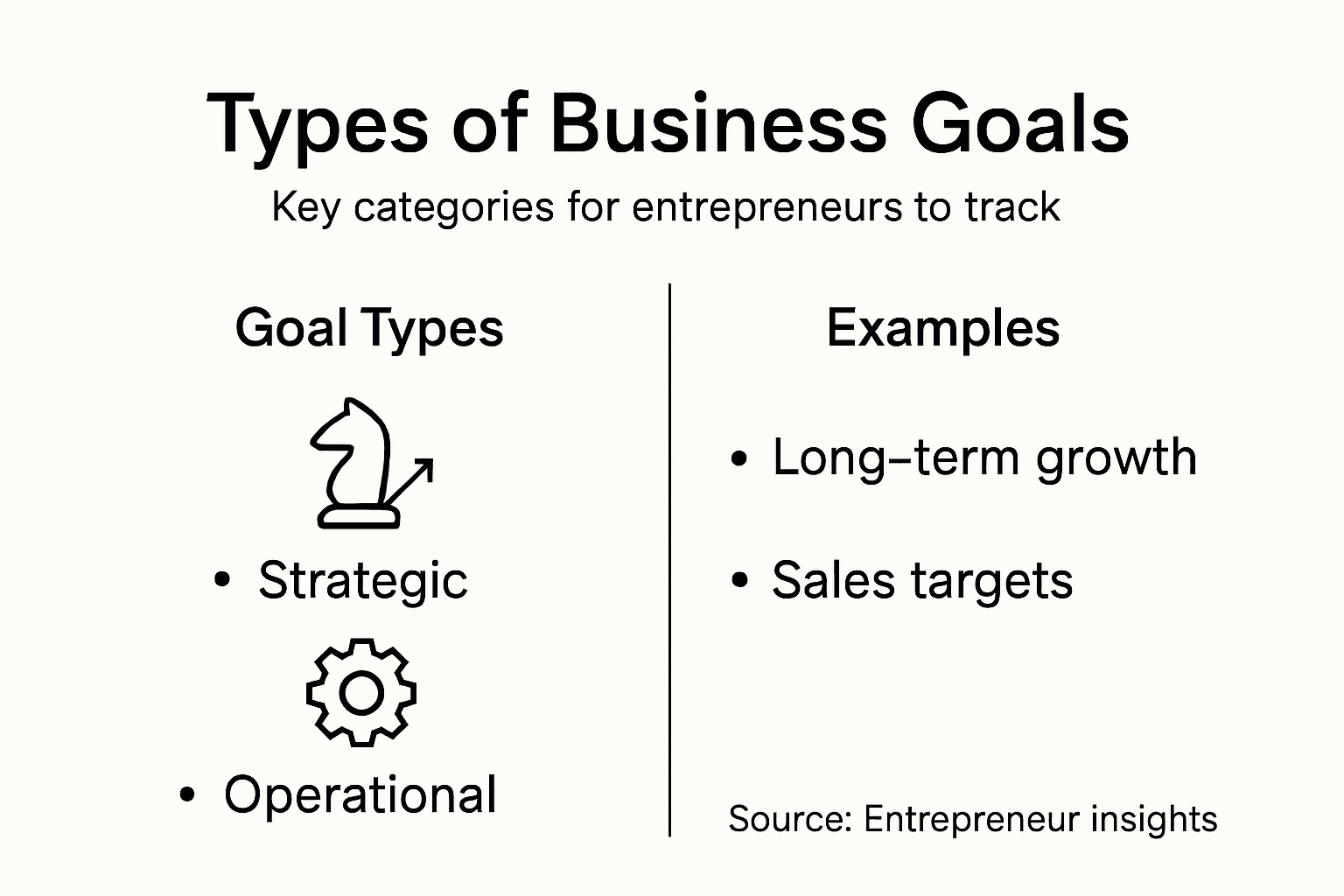
Entrepreneurs navigate complex business landscapes by establishing different types of goals that address various aspects of organizational development. Business goals range from broad long-term visions to specific short-term objectives, creating a comprehensive strategic framework for growth and success.
The primary categories of business goals typically include:
- Strategic Goals: Focusing on long-term vision and overall company direction
- Financial Goals: Addressing profitability, revenue targets, and financial health
- Operational Goals: Improving internal processes and organizational efficiency
- Developmental Goals: Targeting personal and organizational skill enhancement
- Innovation Goals: Driving product, service, and technological advancements
Businesses employ various goal-setting methodologies to effectively track and achieve these objectives. Performance goals concentrate on measurable outcomes, while learning goals emphasize knowledge acquisition and skill development. Growth goals specifically target business expansion and improvement across multiple dimensions.
Successful entrepreneurs understand that these goal types are interconnected. Strategic goals provide the overarching vision, while operational and financial goals create the tactical pathways to achieve that vision. By deliberately designing goals across these categories, founders can create a holistic approach to business building that balances immediate needs with long-term aspirations.
Here’s a comparison of common business goal categories and their typical focus areas:
| Goal Type | Main Focus | Example Outcome |
|---|---|---|
| Strategic Goals | Long-term company vision | Enter new international market |
| Financial Goals | Revenue and profit targets | Achieve $1M annual sales |
| Operational Goals | Process improvements | Reduce delivery times by 20% |
| Developmental Goals | Skills and knowledge | Complete leadership training |
| Innovation Goals | Product advancements | Launch new app feature |
Pro tip: Create a quarterly goal review process that evaluates progress across different goal categories, ensuring balanced and comprehensive business development.
How Effective Goal Setting Fuels Growth
Structured goal setting drives entrepreneurial performance by creating a powerful framework for sustained business growth. Entrepreneurs who develop intentional, well-defined goals transform abstract aspirations into actionable roadmaps that systematically propel their ventures forward.
Key mechanisms through which goal setting accelerates growth include:
- Focused Attention: Directing cognitive resources toward specific outcomes
- Sustained Motivation: Maintaining commitment through clear milestones
- Strategic Adaptation: Enabling responsive adjustments to changing business environments
- Performance Tracking: Creating measurable benchmarks for progress
- Resource Allocation: Optimizing time and energy toward priority objectives
Daily goal commitment significantly impacts entrepreneurial success, with research demonstrating that specific, challenging goals drive persistent effort and strategic behavioral changes. Effective entrepreneurs understand that goal setting is not a static process, but a dynamic strategy requiring continuous refinement and adaptive thinking.

Successful goal implementation requires more than just writing down objectives. It demands a holistic approach that integrates personal drive, strategic planning, and flexible execution. By creating goals that are simultaneously ambitious and realistic, entrepreneurs can build momentum, overcome challenges, and consistently move their businesses toward meaningful growth.
Pro tip: Implement a weekly goal review system that assesses progress, adjusts strategies, and realigns objectives to maintain consistent forward momentum.
Strategies and Tools for Goal Achievement
Entrepreneurial success depends on strategic tools and methodologies that transform abstract objectives into actionable plans. Entrepreneurs must leverage a comprehensive toolkit designed to bridge the gap between vision and execution.
Key strategies and tools for effective goal achievement include:
- Business Model Canvas: Visualizing and refining business strategy
- Lean Startup Methodology: Rapid testing and iteration of business concepts
- OKR Frameworks: Defining objectives and measurable key results
- Digital Tracking Tools: Real-time progress monitoring and analytics
- Mentorship Programs: External guidance and strategic perspective
Entrepreneurs utilize multiple resource access strategies to secure critical business resources. These strategies encompass interpersonal communication, network development, and targeted action plans that transform goals from theoretical concepts into practical implementations.
Successful goal achievement requires a dynamic approach that combines structured methodologies with flexible adaptation. By integrating multiple tools and strategies, entrepreneurs can create a robust framework that supports consistent progress, enables quick pivots, and maintains momentum through changing business landscapes.
This table summarizes popular entrepreneurial goal-setting tools and how they benefit businesses:
| Tool or Method | Primary Use | Business Benefit |
|---|---|---|
| Business Model Canvas | Strategy visualization | Clarifies business value |
| Lean Startup Methodology | Rapid experimentation | Reduces risk and waste |
| OKR Frameworks | Measuring progress | Aligns teams with priorities |
| Digital Tracking Tools | Real-time monitoring | Improves accountability |
| Mentorship Programs | External guidance | Provides experienced insights |
Pro tip: Create a quarterly goal audit system that evaluates tool effectiveness, reassesses strategies, and realigns objectives with emerging business opportunities.
Common Pitfalls and How to Avoid Them
Entrepreneurial goal setting is fraught with potential missteps that can derail even the most promising business ventures. Recognizing and proactively addressing these common challenges is crucial for maintaining momentum and achieving sustainable success.
Major goal-setting pitfalls entrepreneurs frequently encounter include:
- Vague Objectives: Setting unclear or overly broad goals that lack specificity
- Unrealistic Expectations: Creating goals that are either too ambitious or completely unattainable
- Lack of Flexibility: Rigidly adhering to initial plans without room for adaptation
- Insufficient Tracking: Failing to establish clear metrics for measuring progress
- Motivation Burnout: Overwhelming oneself with too many simultaneous objectives
Successful entrepreneurs understand that goal setting is a dynamic process requiring constant refinement. Strategic goal management involves creating a balanced approach that combines ambitious targets with realistic implementation strategies. This means developing goals that are challenging yet achievable, with built-in mechanisms for periodic review and adjustment.
To effectively navigate these pitfalls, entrepreneurs must cultivate a mindset of continuous learning and adaptability. This requires developing robust self-awareness, maintaining realistic expectations, and creating goal frameworks that allow for pivot points and strategic recalibration when circumstances change.
Pro tip: Implement a monthly goal review process that includes honest self-assessment, celebrates small wins, and allows for strategic goal modification.
Accelerate Your Entrepreneurial Success with Structured Goal Setting
The article highlights how specific, measurable, and adaptable goals play a vital role in transforming entrepreneurial dreams into actionable business growth. Many founders struggle with vague objectives, lack of accountability, and maintaining momentum—challenges that stand between intentions and real-world results. At Nomad Excel, we understand these pain points and offer immersive programs designed to equip you with clear frameworks and daily execution strategies to sharpen your focus and drive meaningful progress.
Our Entrepreneurship Bootcamps provide hands-on guidance on setting effective goals, building scalable systems, and sustaining motivation through a supportive community and expert mentorship. For teams ready to align around strategic priorities and foster innovation, our Company Retreats offer customized experiences that build trust, enhance communication, and refresh entrepreneurial thinking. Take the step to overcome common pitfalls like lack of flexibility and insufficient tracking by joining a program built to help you plan, execute, and adapt confidently every quarter.
If you are ready to turn your business aspirations into real achievements with structured goal setting and expert support, explore how Nomad Excel’s proven approaches can accelerate your growth today by visiting Nomad Excel. The time to act is now—build your roadmap to success with clarity, community, and execution at your side.
Frequently Asked Questions
What is goal setting for entrepreneurs?
Goal setting for entrepreneurs is a strategic process that involves identifying specific and actionable objectives aimed at driving business growth and personal development. It combines motivation, self-knowledge, and decision-making frameworks to transform ideas into action plans.
Why is goal hierarchy important in entrepreneurial goal setting?
Goal hierarchy is crucial as it provides a systematic approach to establishing a structured hierarchy of objectives that supports long-term business vision. It helps in transforming aspirational goals into concrete, actionable strategies.
How can effective goal setting fuel entrepreneurial growth?
Effective goal setting drives growth by creating focused attention on specific outcomes, maintaining sustained motivation through clear milestones, and enabling strategic adjustments to changing business environments. It establishes measurable benchmarks for tracking performance and optimizes resource allocation.
What are common pitfalls in entrepreneurial goal setting, and how can they be avoided?
Common pitfalls include setting vague objectives, having unrealistic expectations, lacking flexibility, insufficient tracking, and experiencing motivation burnout. Entrepreneurs can avoid these issues by implementing a structured goal management process that incorporates regular review and adjustment of their goals.
Recommended
- How to Stay Accountable as Entrepreneur for Lasting Growth
- How to Set Business Goals for Entrepreneur Growth
- 7 Essential Growth Strategies for Startup Success
- The Essential Guide to Benefits of Entrepreneurial Mindset – Nomad Excel – Your Entrepreneurial Adventure Starts Here
- 7 Practical Strategies for Self-Improvement with Hypnotherapy
Comments are closed.