
What Is Action-Based Growth? A Practical 2026 Guide
What is action-based growth, and why does it matter?
Action-based growth is an execution discipline that links specific, measurable actions directly to growth objectives, producing results through consistent operational rhythm rather than sporadic planning bursts. Think of it as the difference between writing a goal on a whiteboard and actually running the plays that get you there.
At its core, the approach rests on four elements:
- A focused target: One primary growth objective for a defined period, typically a short-term cycle
- Bottleneck diagnosis: Identifying the specific constraint (conversion, retention, delivery capacity, or unit economics) blocking progress
- Assigned ownership: Each growth lever has a named person responsible for weekly execution
- Leading indicators: A scorecard of 5–9 metrics such as pipeline volume, conversion rate, retention, and gross margin that signal whether actions are working before results fully materialize
This framework applies equally in business scaling and personal development. In business, it turns a growth strategy into a weekly operating rhythm. In personal development, it closes the gap between recognizing you need to change and actually changing your behavior.
Core principles that make action-based growth work
The methodology is not a one-time planning exercise. It is a repeatable system built on a handful of non-negotiable principles.
- 90-day cycles: Short enough to stay focused, long enough to see real signal from your actions
- Weekly operating rhythm: A structured cadence of scorecard reviews, priority lists, and brief strategy check-ins keeps teams from drifting toward activity over outcomes
- Bottleneck-first thinking: Growth leaders diagnose the specific constraint blocking progress rather than brainstorming tactics in the abstract
- Focused levers: Limiting initiatives to 2–3 growth levers per cycle preserves ownership clarity and makes it possible to attribute results to a cause
- Real accountability: Each lever has a named owner with a specific remit, not a committee with shared responsibility
- Course correction: Over 40% of growth-outperforming companies actively adjust initiatives based on measured progress against goals
- Marathon mindset: Sustained execution over a long period is what separates companies that plateau from those that compound growth.
Pro Tip: Pick your “not-doing” list as deliberately as your growth levers. Writing down what you are explicitly not pursuing this cycle protects focus better than willpower alone.
Why personal growth also requires action, not just insight
Psychology offers a sharp lens on why action is the critical ingredient in any growth process. Research on posttraumatic growth (PTG) draws a clear line between two very different experiences: growth cognitions (believing or feeling that you have changed) and growth actions (demonstrating that change through new behavior).
- Constructive growth occurs when individuals genuinely adapt after a difficult experience, translating new thinking into new ways of living and working
- Illusory growth is a psychological defense mechanism. It feels like progress but functions primarily to reduce distress, with no corresponding behavioral change
- The action requirement: Studies following the September 11, 2001 attacks and periods of violence in Israel found that individuals reported PTG only when they translated their growth cognitions into growth actions
- The risk of stopping at insight: Cognitive growth alone, without matching behavior, tends to function as an emotional coping strategy rather than real improvement
The parallel to business is direct. A founder who attends every conference, reads every book, and feels inspired but never changes their operating habits is experiencing the business equivalent of illusory growth. Genuine progress requires the behavioral shift.
How to implement action-based growth step by step
Getting this right comes down to process discipline, not motivation. Here is how to build the system.

Step 1: Set one 90-day target. Choose a single primary growth objective with a clear baseline and a specific number to hit, such as a 15% increase in monthly recurring revenue or a 20% lift in qualified leads.
Step 2: Diagnose the bottleneck. Map your constraints across five categories: demand (not enough leads), conversion (leads do not close), retention (customers leave), delivery capacity (you cannot fulfill), and unit economics (margins do not work). Scaling the wrong constraint is one of the most common and costly mistakes; growing lead volume while ignoring delivery capacity produces churn and reputation damage.
Step 3: Select 2–3 focused growth levers. Each lever gets an owner, a set of weekly actions, and one leading indicator to track.
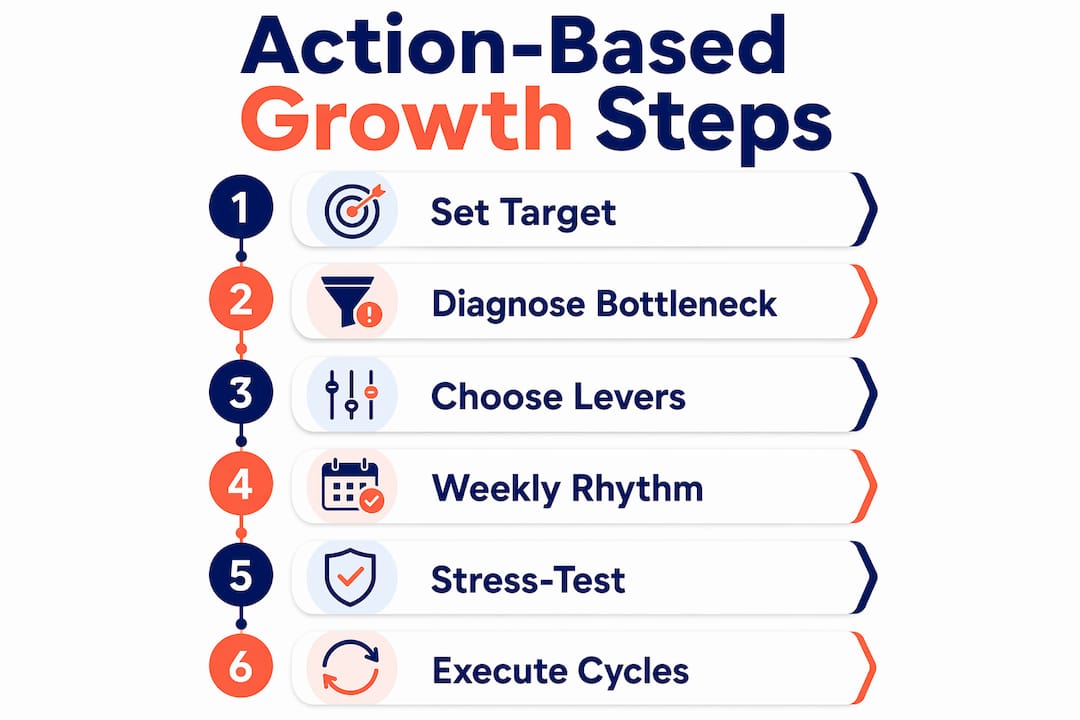
Step 4: Build your weekly operating rhythm. A weekly scorecard with several key metrics, a short priority list tied to those metrics, and a monthly strategy review form the backbone of execution.
| Growth Lever | Owner | Leading Indicator | Weekly Action |
|---|---|---|---|
| Conversion improvement | Sales lead | Proposal-to-close rate | Tighten qualification criteria |
| Retention | Customer success | churn rate | Proactive check-in calls |
| Pricing and margin | Founder | Gross margin % | Audit discount approvals |
| Acquisition channel | Marketing lead | Qualified leads per week | Test one new channel offer |
Step 5: Stress-test the plan. Ask what happens if conversion runs 20% below target, if a key client churns, or if fulfillment takes two weeks longer than expected. Scenario planning does not need to be complex; it needs to be consistent.
Step 6: Execute in focused cycles. Plan, launch, measure, and iterate. Change one major variable per cycle so you can attribute outcomes to a clear cause.
Pro Tip: If you feel behind on growth targets, reduce scope before adding tasks. Focus increases throughput more reliably than adding initiatives does.
How Nomadexcel accelerates growth through action and community
Nomadexcel was built on the conviction that growth happens fastest when execution, mentorship, and community reinforce each other daily. The entrepreneurship bootcamps translate that conviction into a structured, immersive experience.
- Execution over theory: Daily accountability sessions and structured sprints replace passive learning with real-world output
- Frameworks with mentorship: Participants work through proven business-building frameworks while receiving direct guidance from experienced entrepreneurs and operators
- Community as a growth lever: A curated peer network provides challenge, support, and collaboration that extends well beyond the program itself
- Retreat programs for teams: Nomadexcel’s business retreats combine strategic alignment workshops with authentic human connection, helping teams return with renewed focus and clearer direction
- Sustained accountability: The program structure mirrors the weekly operating rhythm that action-based growth requires, making the discipline feel natural rather than forced
The integration of community and mentorship is not a soft benefit. It adds accountability and practical guidance that individual effort alone rarely sustains over the 18-month horizon that meaningful growth demands.
Real-world examples of action-based growth in practice
Business example: A professional services firm with strong demand but a weak close rate chooses two levers for a 90-day cycle: tighten qualification and add a premium package. They publish two case studies, standardize delivery steps to free up capacity, and run a simple driver model (leads × close rate × average deal size) to stress-test outcomes. Revenue rises through better packaging before any headcount changes. The key was diagnosing conversion as the bottleneck rather than assuming the problem was lead volume.
Personal development example: A founder recognizes they need to delegate more but continues making every decision themselves. That recognition is a growth cognition. The growth action is writing a decision-rights document, assigning three recurring decisions to team members, and reviewing outcomes weekly. The behavioral change, not the insight, is what produces the actual shift in how the business runs.
Team example: A remote team uses a quarterly retreat to align on one primary growth target, assign lever ownership, and build a shared scorecard. The structured environment accelerates decisions that had stalled for months in async communication. Returning with a shared operating rhythm, the team executes more consistently in the weeks that follow.
Tools and techniques to measure progress in action-based growth
Measurement is what separates a growth plan from a wish list. These are the tools and methods that make progress visible and course correction possible.
Weekly scorecard: Track 5–9 metrics covering the full growth funnel: pipeline volume, conversion rate, retention or churn, gross margin, cash runway, and delivery time. Keep the list short enough that every number gets attention.
Driver model: A simple spreadsheet linking leads × close rate × average deal size × churn gives you a single model where you can see which lever produces the best outcome for the least risk. This is especially useful for stress-testing scenarios before committing resources.
Priority list: A short weekly list of tasks tied directly to scorecard metrics. If a task does not connect to a metric, it does not belong on the list.
Organic growth channels: Pairing your scorecard with a marketing strategy built around organic acquisition gives you a lower-cost leading indicator for demand-side levers.
Customer feedback loops: Structured customer feedback collected at regular intervals surfaces retention risks and expansion opportunities before they show up in lagging revenue numbers.
Monthly strategy review: A brief monthly session to assess whether the 90-day target is still the right target, whether the bottleneck diagnosis still holds, and whether resource allocation needs to shift.
Experimentation log: Growth outperformers encourage teams to test new ideas quickly and affordably, and they document what they learn. An experimentation log turns failed tests into institutional knowledge rather than sunk costs.
The business growth strategy workflow that Nomadexcel uses with founders integrates these measurement practices into the daily and weekly rhythms of the program, making them habits rather than quarterly obligations.
Key Takeaways
Action-based growth works because it ties every initiative to a measurable outcome, assigns clear ownership, and runs on a weekly rhythm that makes course correction routine rather than reactive.
| Point | Details |
|---|---|
| Define one target per cycle | A single 90-day primary objective keeps teams focused and results attributable. |
| Diagnose before you act | Identifying the specific bottleneck (conversion, retention, capacity) prevents scaling the wrong constraint. |
| Limit growth levers | Two to three focused levers with named owners outperform five diluted initiatives every time. |
| Measure with a scorecard | A weekly scorecard of 5–9 metrics makes progress visible and triggers timely course correction. |
| Action beats cognition | In both business and personal growth, behavioral change, not insight alone, produces lasting results. |
Comments are closed.