
The Role of Peer Support in Startups: 2026 Guide
TL;DR:
- Peer support in startups involves structured, experience-based collaboration among founders facing similar operational challenges. It outperforms mentoring and education as the primary growth driver, especially when groups meet consistently with clear focus and honest sharing. Building effective peer networks requires deliberate structure, shared stage, confidentiality, and regular attendance to foster trust and candid advice.
Peer support in startups is defined as structured, experience-based collaboration between founders who share operational challenges, offer honest feedback, and hold each other accountable for results. Unlike traditional mentoring or executive coaching, peer support puts founders in rooms with people who face the same pressures they do right now. Empirical research from Q1 2026 confirms that networking with peers is the dominant growth lever for startups, surpassing both mentoring programs and formal education. That finding should shift how you think about where to invest your time and energy as a founder.
What is the role of peer support in startups?
Peer support, in the startup context, is often formalized through what practitioners call peer advisory groups. These are small, curated circles of founders who meet regularly to work through real business problems together. The format differs sharply from a workshop or a coaching session. No one is selling you a framework. Everyone in the room has skin in the game.

Optimal peer advisory groups consist of roughly eight founders who meet for two hours, twice a month. Each session dedicates about 30 minutes to one founder’s specific operational problem. That structure forces precision. You cannot show up with a vague concern about “growing faster.” You need to name the actual problem: a hiring decision, a pricing model, a difficult co-founder conversation.
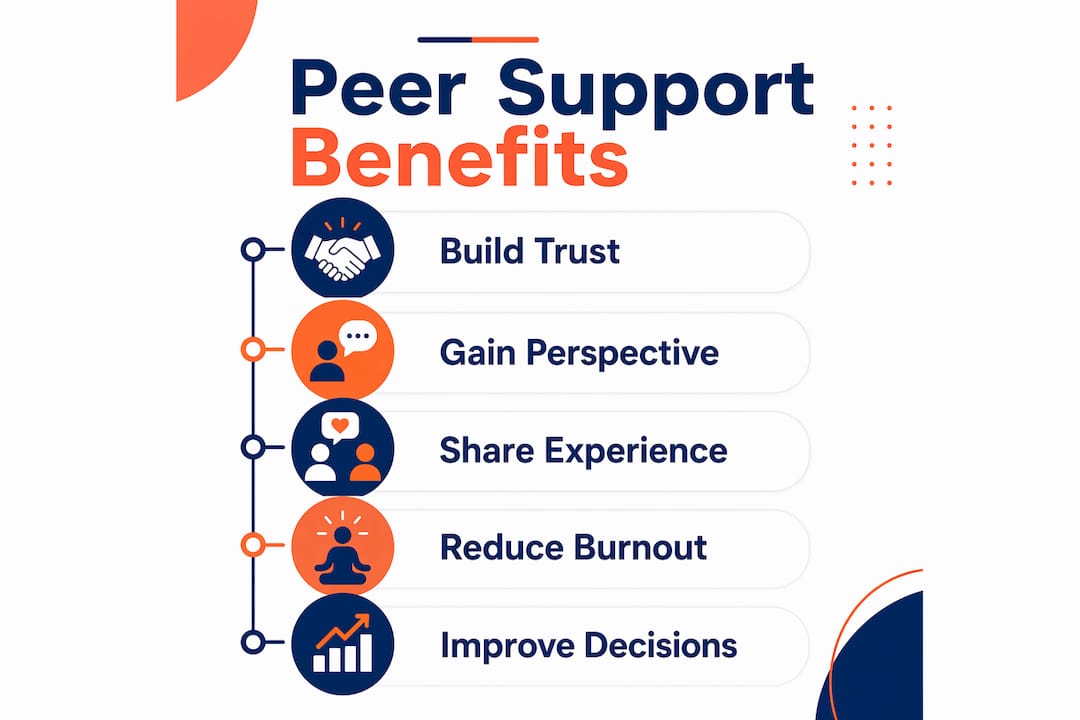
The benefits of peer support go beyond tactical advice. Founders gain perspective from people who have already navigated similar terrain, which compresses the learning curve significantly. The feedback is grounded in lived experience, not theory, and that distinction matters enormously when you are making decisions with real consequences.
Pro Tip: Before each peer session, write down the single most pressing operational problem you face. Bring that one problem, not a list. Specificity is what makes peer groups work.
The typical topics that generate the most value in these sessions include:
- Hiring decisions and team structure at early stages
- Cap table strategy and investor negotiations
- Customer concentration risk and revenue diversification
- Pricing changes and their effect on retention
- Co-founder conflicts and equity disputes
Each of these topics benefits from the perspective of someone who has already been through it, not someone who has studied it.
How do peer groups differ from executive coaches and mentors?
The distinction between peer advisory groups, executive coaches, and mentors is not just semantic. Each serves a different function, and confusing them leads founders to use the wrong tool at the wrong moment.
Executive coaches are trained to develop functional skills: communication, leadership presence, decision-making frameworks. They are skilled at helping you become a better operator. The problem is structural. Coaches are incentivized to retain clients, which can soften the feedback they deliver. A coach who tells you your business model is broken risks losing a paying client. A peer who tells you the same thing has nothing to lose and everything to gain from your success.
Mentors occupy a different role. They offer pattern recognition from their own career and typically provide guidance based on what worked for them. That wisdom is genuinely valuable, especially for early-stage founders who need directional clarity. The limitation is that mentors often lack current context. A founder who scaled a company a decade ago may not fully grasp the dynamics of your market, your team, or your specific constraints today.
Peer groups fill the gap that neither coaches nor mentors can. Peer advisory groups provide feedback from founders with direct, current context, offering perspectives that are honest in a way that coach-client dynamics rarely allow.
| Support type | Primary role | Key benefit | Best used for |
|---|---|---|---|
| Peer advisory group | Collaborative problem solving | Honest, experience-based feedback | Strategic decisions, real-time challenges |
| Executive coach | Skill development | Structured personal growth | Leadership and communication gaps |
| Mentor | Pattern recognition | Career and directional guidance | Early-stage clarity and long-term vision |
The most effective founders use all three. But peer groups are the one format that scales with you, because the people in the room are growing at the same pace you are.
What are the biggest misconceptions about founder peer support?
The most common mistake founders make is joining a peer group for the wrong reason. Showing up to “grow your network” or “get exposure” signals that you are not ready to use the format correctly. Founders should join peer groups to address specific, operational problems they currently face. Vague ambitions produce vague results.
The second misconception is that the quality of individual members matters more than consistency. It does not. Consistent membership and meeting frequency build the psychological safety that makes candid sharing possible. A group of eight brilliant founders who rotate in and out will never reach the depth of a stable group of six who have met reliably for a year.
Two more pitfalls that undermine peer groups:
- Advice-giving instead of experience-sharing. The most effective peer groups operate with a “no advice unless asked” rule. When someone shares a problem, the group responds by sharing relevant personal experiences, not by prescribing solutions. This approach reduces defensiveness and opens up honest disclosure.
- Performing confidence instead of sharing reality. The biggest barrier to getting value from peer support is the desire to appear successful. Founders who share vulnerabilities in peer settings consistently outperform those who work in isolation. Vulnerability is not weakness in this context. It is the mechanism that produces better outcomes.
Pro Tip: If you find yourself editing what you share with your peer group to protect your image, the group has not yet built enough trust. That is a signal to invest more in consistency and confidentiality, not to leave.
How do you build an effective peer support network as a founder?
Building a peer group that actually works requires deliberate design. Most informal founder networks fail not because the people are wrong, but because the structure is missing.
Select peers based on operational stage, not industry. A founder running a 10-person team faces different problems than a solo founder, regardless of sector. Match on company stage, revenue range, and the specific challenges you are each navigating right now. Industry diversity is actually an asset. It reduces competitive tension and broadens the range of experience in the room.
Commit to a fixed meeting cadence. Two hours, twice a month is the format that delivers the most focused results. Treat these sessions with the same priority as a board meeting. Canceling undermines trust and erodes the psychological safety the group depends on.
Establish confidentiality as a non-negotiable norm. What is shared in the group stays in the group. This rule needs to be stated explicitly at the start, not assumed. Without it, founders self-censor, and the group loses its core value.
Rotate the “hot seat” role. Each session, one founder brings a single, specific problem and receives the group’s full attention for 30 minutes. This structure prevents the group from becoming a general discussion forum and keeps sessions operationally useful.
Review and refresh membership annually. Groups evolve. A founder who was a great fit at the seed stage may no longer be aligned once they have raised a Series A. Annual reviews allow the group to stay relevant without creating awkward ongoing mismatches.
The impact of peer networks compounds over time. Founders who stay in consistent peer groups for two or more years report sharper decision-making, stronger accountability, and a measurable reduction in the isolation that derails so many early-stage founders. The peer mentorship in startups literature consistently points to long-term group membership as the variable that separates high-impact peer support from casual networking.
For founders who want to understand how to build these communities with staying power, the principles behind lasting founder communities offer a practical framework worth studying before you start recruiting members.
Pro Tip: Start with five founders, not eight. Smaller groups build trust faster. You can expand once the culture and norms are established.
Key Takeaways
Peer support is the most direct growth lever available to startup founders, and its impact depends entirely on structure, consistency, and honest participation.
| Point | Details |
|---|---|
| Peer support outperforms mentoring | Empirical research confirms peer networks are the dominant growth lever for high-growth founders. |
| Structure determines value | Groups of roughly eight founders, meeting twice monthly for two hours, produce the most focused results. |
| Consistency beats caliber | Stable, long-term membership builds the psychological safety that makes honest sharing possible. |
| Vulnerability drives performance | Founders who share real challenges in peer settings consistently outperform those who work alone. |
| Join with a specific problem | Founders who enter peer groups with a defined operational challenge get far more value than those seeking vague networking. |
Why I think most founders underestimate peer support
I have watched founders spend thousands of dollars on coaching programs, masterminds, and online courses, while the most valuable resource available to them was a conversation with someone who had already solved the exact problem they were stuck on.
The founder isolation problem is real. Community engagement helps founders benchmark their experiences, reduce burnout, and accelerate learning in ways that solo work simply cannot replicate. But the deeper issue is cultural. Founders are trained to project confidence. Admitting that you do not know how to handle a difficult investor conversation, or that you are terrified about your runway, feels like a professional risk. That instinct is exactly what keeps founders stuck.
The peer groups that produce the most dramatic results are the ones where someone finally says the thing they have never said out loud. That moment of honesty, met with recognition from the rest of the room, is where the real work begins. It is not therapy. It is peer collaboration in business at its most functional: people with shared stakes, offering honest perspectives, because they genuinely want each other to succeed.
The founders I have seen grow fastest are not the ones with the best coaches or the most prestigious accelerator on their resume. They are the ones who found a small, consistent group of peers and showed up honestly, every time.
— Amichai
Nomadexcel’s approach to peer-supported founder growth
Nomadexcel builds the kind of peer environment that most founders spend years trying to find on their own. The online entrepreneurship bootcamp brings together curated groups of founders for structured, hands-on programs that combine mentorship, accountability, and genuine peer collaboration. Every program is designed around the principle that founders grow fastest when they work alongside other founders who are equally committed to results. If you are ready to move beyond isolated problem-solving and into a community that challenges and supports you in equal measure, Nomadexcel’s programs offer a direct path to that experience. You can also explore why joining a bootcamp accelerates growth in ways that self-directed learning rarely matches.
FAQ
What is the role of peer support in startups?
Peer support in startups is structured collaboration between founders who share operational challenges and offer experience-based feedback. Research confirms it is the dominant growth lever for high-growth founders, surpassing traditional mentoring and educational programs.
How often should a peer advisory group meet?
The most effective peer groups meet twice a month for two hours per session. This cadence maintains momentum and builds the consistency that psychological safety requires.
What is the “no advice unless asked” rule in peer groups?
This rule means group members respond to a founder’s problem by sharing their own relevant experiences rather than prescribing solutions. It reduces defensiveness and produces more honest, useful disclosure.
How is a peer group different from a business mentor?
A mentor offers pattern recognition from their own career, while a peer group provides real-time feedback from founders navigating similar challenges right now. Both are valuable, but peer groups offer more current context and reciprocal honesty.
How do you choose the right peers for a startup peer group?
Select founders at a similar operational stage and revenue range, regardless of industry. Shared stage creates shared context. Industry diversity reduces competitive tension and broadens the range of experience available in the group.
Comments are closed.