
How to Build a Founder Community That Lasts
TL;DR:
- Building a founder community requires shared risk, a small dedicated seed group, and regular engaging interactions.
- Early success depends on clear purpose, targeted recruitment, pre-seeded content, and consistent meetings within 30 days.
A founder community is a purposeful network of entrepreneurs who share similar risks, support each other’s growth, and hold one another accountable through regular, honest interaction. Knowing how to build a founder community is one of the most practical investments an early-stage entrepreneur can make. The right group gives you real feedback, emotional resilience, and access to knowledge you cannot buy. Done well, it becomes a vital lifeline that outlasts any single product or funding round. This guide walks you through every stage, from the right mindset before you start to the metrics that tell you whether your community is actually working.
How to build a founder community: prerequisites and mindset
The single most important decision you make is defining your community’s purpose before recruiting anyone. A vague mission like “support for entrepreneurs” attracts everyone and serves no one. A sharp mission like “pre-revenue SaaS founders validating their first offer” attracts exactly the right people and filters out the rest.
Shared risk is the foundation that makes honest conversation possible. Lack of shared stakes is the primary reason founder communities fail. When members face genuinely similar pressures, such as runway anxiety, hiring decisions, or pricing uncertainty, they open up in ways that polished networking events never produce.
Before you send a single invitation, answer these four questions:
- Who belongs here? Define the stage, business model, and challenge set your ideal member faces right now.
- What does success look like? Decide whether success means co-founder introductions, revenue accountability, or skill sharing.
- How often will members meet? Commit to a cadence before launch, not after.
- What are the participation rules? Attendance expectations and confidentiality norms protect the group’s trust.
The table below shows how platform choice maps to community goals.
| Platform type | Best for | Trade-off |
|---|---|---|
| Async messaging (Slack, Discord) | Daily touchpoints and resource sharing | Low signal-to-noise without moderation |
| Video calls (Zoom, Google Meet) | Deep discussion and accountability | Scheduling friction at scale |
| In-person retreats or bootcamps | Trust building and culture setting | Higher cost and coordination effort |
| Community platforms (Circle, Mighty Networks) | Structured content and member profiles | Learning curve for less tech-savvy founders |
Pro Tip: Start with the simplest platform your founding members already use. Switching tools later is far easier than fighting low adoption from day one.
How do you recruit and onboard your founding members effectively?
Recruiting your first 10–20 members is the most consequential work you will do. Starting with a small, dedicated seed group of 10–20 members lets you establish culture before scale dilutes it. Every person you invite at this stage sets a behavioral norm for everyone who follows.
Follow this sequence to recruit and onboard with intention:
- Write a one-paragraph community brief. State the mission, the ideal member profile, and what members commit to. Send this before any conversation, not after.
- Recruit from warm networks first. Your first members should come from people you have already seen show up: past colleagues, accelerator cohorts, or event connections who ask good questions.
- Seed content before you open the doors. Without a curated core team contributing content and feedback before launch, new members go silent or leave quickly. Post three to five discussion threads, share a real business challenge, and ask founding members to respond before anyone else joins.
- Run a soft launch for four weeks. Invite only your seed group. Let them shape the norms, surface the best discussion formats, and identify what is missing.
- Onboard with a direct ask. Tell each founding member exactly what you need from them: one post per week, attendance at monthly calls, or a peer review session. Vague invitations produce vague participation.
Common pitfalls at this stage include recruiting for prestige rather than fit, accepting anyone who expresses interest, and skipping the soft launch because you are eager to grow. Each mistake creates a culture problem that compounds over time.
Pro Tip: Ask each founding member to introduce themselves by sharing one business challenge they are currently stuck on. It sets a tone of vulnerability from the first interaction and signals that this group is not a highlight reel.

What engagement strategies keep a founder community vibrant and valuable?
Consistent cadence is the single biggest predictor of community value. Communities meeting weekly or monthly are consistently rated higher value than those meeting quarterly. Frequency builds familiarity, and familiarity builds the trust that makes honest feedback possible.

The most durable communities use a mix of structured and informal touchpoints. Structured sessions include monthly hot-seat calls where one founder presents a live challenge and receives direct feedback. Informal touchpoints include async threads where members share wins, failures, and questions between calls. Both matter. Structured sessions create depth; informal touchpoints create continuity.
Specific practices that sustain engagement over time:
- Rotate facilitation. Let members lead sessions on topics they know well. Enduring communities thrive when members drive knowledge exchange rather than a single organizer controlling every interaction.
- Share real metrics. Encourage members to post actual revenue numbers, churn rates, or conversion data. Specificity invites specificity in return.
- Celebrate failure openly. Founder communities that openly celebrate failure and mental well-being build the psychological safety that sustains long-term participation.
- Create a member directory. A simple profile page with each founder’s stage, focus area, and current ask makes it easy for members to connect directly.
- Set a quarterly review. Every three months, ask members what is working, what is not, and what one change would make the community more valuable.
Pro Tip: Record your monthly calls and share the replay within 24 hours. Founders who miss a session stay connected, and the archive becomes a searchable resource that compounds in value over time.
A strong networking workflow for founders also helps members connect between formal sessions, turning the community into a living network rather than a scheduled event.
How do you measure success and troubleshoot common challenges?
The clearest early signal is simple: are members showing up and contributing? If a founder sees no tangible progress within 30 days, it signals a structural or participation problem. Thirty days is enough time to attend two or three sessions, receive one piece of useful feedback, and make at least one meaningful connection.
Watch for these warning signs of a community losing momentum:
- Attendance drops below 50% on two consecutive calls.
- The same two or three people carry every discussion.
- Members stop sharing real challenges and default to surface-level updates.
- New members join but never post or attend after the first week.
When you spot these patterns, the fix is almost always a selection or structure problem, not a motivation problem. A room of 15 founders with similar challenges generates more value than 100 random entrepreneurs. If your community has grown but engagement has dropped, tighten the member criteria and consider splitting into smaller cohorts by stage or focus area.
The table below maps common problems to practical fixes.
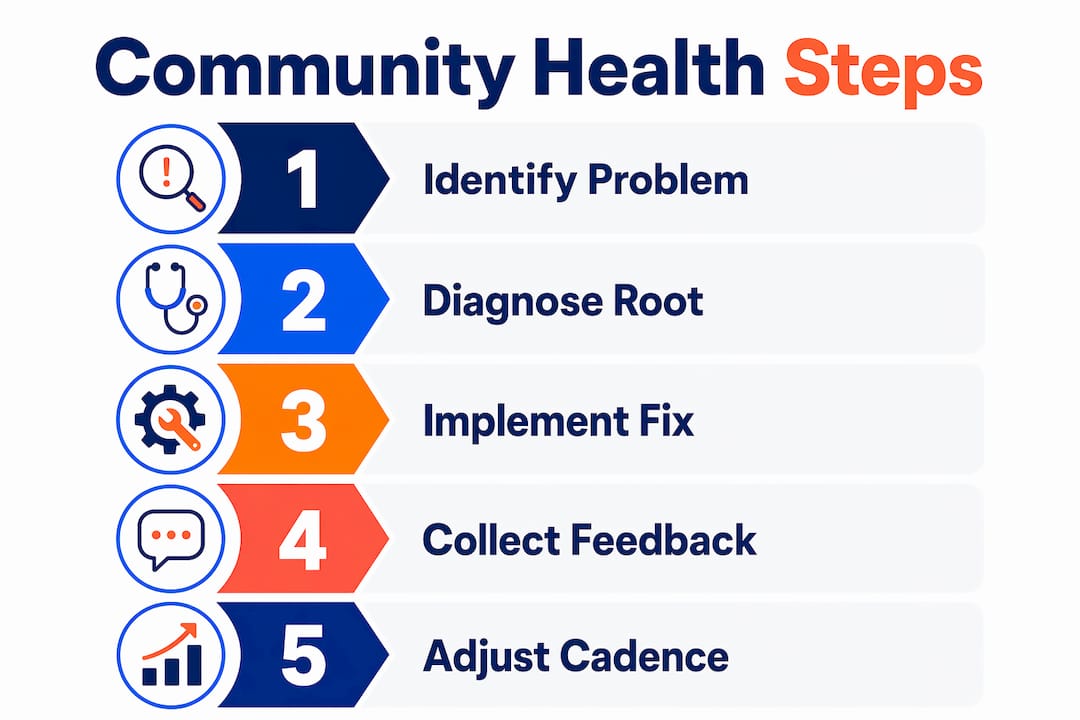
| Problem | Root cause | Fix |
|---|---|---|
| Low attendance | Wrong cadence or unclear value | Switch to monthly calls; clarify the agenda 48 hours before |
| Surface-level discussion | Lack of psychological safety | Introduce a confidentiality norm; model vulnerability as the organizer |
| Member churn | Poor fit at recruitment | Tighten the member profile; add a short application or interview |
| One-sided contribution | No participation structure | Assign rotating roles: facilitator, note-taker, hot-seat presenter |
| Stagnant growth | No referral mechanism | Ask each member to nominate one founder per quarter |
Use a short monthly feedback form, three questions maximum, to track member satisfaction and surface issues before they become exits. The step-by-step guide to building a startup community from Nomadexcel offers additional frameworks for evaluating community health at each growth stage.
Key takeaways
Building a lasting founder community requires shared risk, a curated seed group, consistent cadence, and member-led engagement from the start.
| Point | Details |
|---|---|
| Shared risk drives honesty | Recruit founders facing similar pressures so members open up and give real feedback. |
| Seed before you scale | Launch with 10–20 committed members and pre-seeded content to avoid the empty-room problem. |
| Cadence determines value | Weekly or monthly meetings consistently outperform quarterly ones for trust and engagement. |
| Size matters less than fit | A tight group of 15 aligned founders produces more value than 100 loosely connected ones. |
| Thirty days is your signal | No tangible progress within 30 days means the structure or member selection needs adjustment. |
What I have learned about building founder communities that actually work
By Amichai
Most founders wait too long to start. They want the perfect platform, the perfect member list, and the perfect agenda before they send a single message. That wait is the mistake. The communities I have seen thrive all started messy, with five or six people on a video call sharing problems they had never said out loud to anyone else.
The counterintuitive truth is that small and dense beats large and broad every time. I have watched 12-person groups outperform 200-person Slack communities because the 12 people were at the same stage, facing the same decisions, and willing to be honest about what was not working. That density creates a quality of conversation you simply cannot manufacture at scale.
The other thing most guides miss is the role of the organizer’s own vulnerability. If you are building the community, you have to go first. Share your own revenue numbers. Admit the hire that did not work. Ask for help publicly. The moment you do that, you give everyone else permission to do the same. That is when a community stops being a networking group and starts being something genuinely useful.
My honest advice: start with six people you respect, meet every two weeks for 60 minutes, and do not worry about a platform or a name for the first month. Build the habit before you build the infrastructure. The community that lasts is the one that earns its own momentum.
— Amichai
Nomadexcel’s bootcamp: a ready-made founder community
Building a founder community from scratch takes time, and not every founder has the network or bandwidth to do it alone. Nomadexcel’s online entrepreneurship bootcamp places you inside a curated cohort of driven founders from day one. The program combines hands-on business building, direct mentorship, and daily peer accountability, so the community forms naturally around shared work rather than scheduled small talk. Participants leave with a sharper strategy and an active network that continues well after the program ends. If you want to understand why joining a bootcamp accelerates both skills and relationships, Nomadexcel’s program is worth a close look.
FAQ
What is a founder community?
A founder community is a structured network of entrepreneurs who share similar business stages and challenges, meet regularly, and support each other through honest feedback, accountability, and shared learning.
Why join founder communities instead of general networking groups?
Founder communities require shared risk among members, which creates the vulnerability needed for honest feedback. General networking groups rarely produce that depth because members face different pressures and have little reason to be candid.
How many members should a founder community start with?
Start with 10–20 founding members. That size is large enough to sustain discussion but small enough to build genuine trust and set a strong culture before opening to a wider group.
How often should a founder community meet?
Weekly or monthly meetings produce the strongest results. Communities that meet only quarterly struggle to build the familiarity and trust that make peer feedback genuinely useful.
How do you know if your founder community is failing?
The clearest signal is no tangible progress for any member within the first 30 days. Falling attendance, surface-level discussion, and high early churn all point to a selection or structure problem that needs fixing quickly.
Comments are closed.