
The Role of Intentional Networking in Career Growth
TL;DR:
- Intentional networking focuses on building deep, mutually beneficial relationships with long-term value instead of collecting contacts randomly. It enhances career growth by opening access to hidden job markets, referrals, and collaboration opportunities. Practicing consistent efforts like follow-ups, value offering, and cross-industry connections fosters a strong, responsive professional community.
Intentional networking is the practice of building professional relationships with clear purpose, mutual value, and long-term commitment rather than collecting contacts for short-term gain. Most professionals treat networking as a numbers game, attending events and exchanging business cards without a plan. That approach produces a crowded contact list and very little real opportunity. The role of intentional networking is fundamentally different: it shifts your focus from volume to depth, from transactions to trust, and from random connections to relationships aligned with your goals. Tools like LinkedIn, structured follow-up habits, and a give-first mindset are the practical building blocks of this approach.
What is the role of intentional networking in professional and business growth?
Intentional networking functions as a direct channel to opportunities that never appear in public. 79.8% of jobs are filled through private networks rather than public postings. That single fact reframes networking from a nice-to-have activity into a career-critical skill.

The benefits extend well beyond job hunting. Purposeful relationship building drives collaboration, opens doors to new clients, and creates the kind of peer support that accelerates decision-making. When you connect with people who share your values and complement your skills, you gain access to knowledge, introductions, and resources that no job board or cold email can replicate.
The mindset shift here is significant. Traditional networking asks, “What can I get from this person?” Intentional networking asks, “Who do I want to build a mutually beneficial relationship with?” That reframe turns every conversation into a long-term investment rather than a one-time transaction.
Key outcomes professionals gain through intentional networking include:
- Access to the hidden job market through referrals and warm introductions
- Faster business growth via partnerships, referrals, and collaborative projects
- Mentorship and guidance from experienced peers who have solved the problems you face
- Emotional resilience through a community that supports you during setbacks
- Innovation by exposing yourself to perspectives outside your immediate field
Referral hires through networks stay longer and ramp up faster than those found via job boards. This compounds over time: a strong network does not just help you land one role or one client. It builds a foundation that keeps delivering value for years.
How does intentional networking differ from traditional networking?
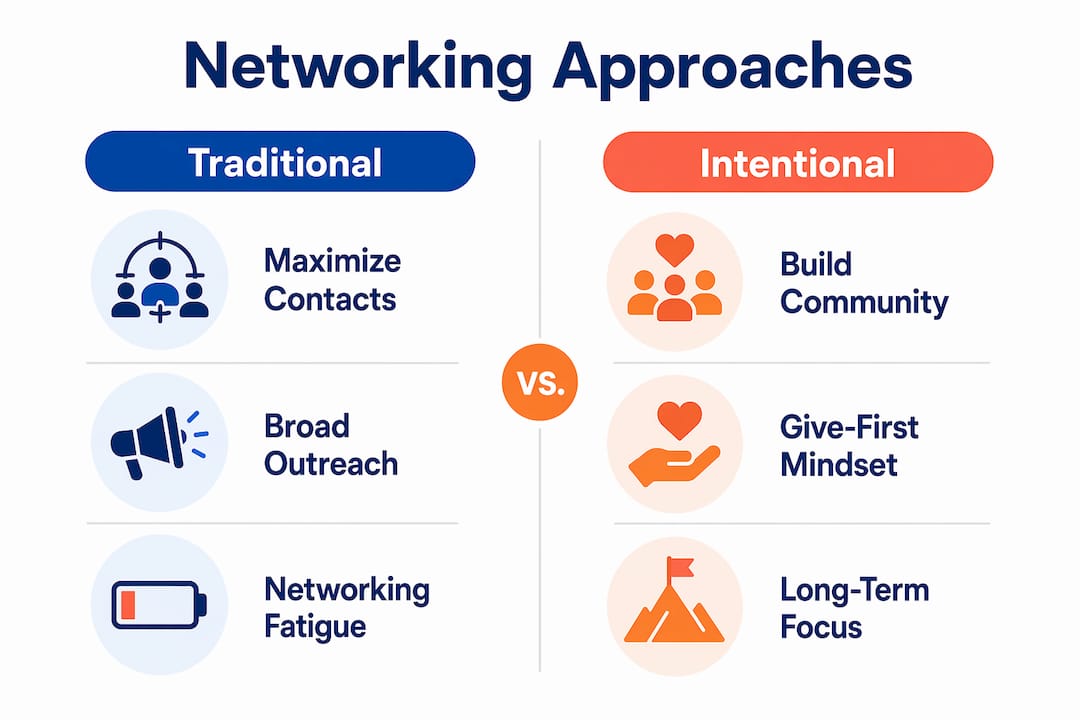
Traditional networking prioritizes breadth. The goal is to meet as many people as possible, hand out cards, and hope something sticks. Intentional networking prioritizes depth. The goal is to cultivate a smaller set of relationships where both parties genuinely invest in each other’s success.
Intentional networkers focus on building a community rather than accumulating contacts. That distinction matters because a community creates reciprocal value. A contact list is passive. A community is active, responsive, and generative.
The table below captures the core differences between the two approaches:
| Dimension | Traditional networking | Intentional networking |
|---|---|---|
| Primary goal | Maximize number of contacts | Build meaningful, mutual relationships |
| Follow-up behavior | Sporadic or absent | Timely, consistent, and personal |
| Mindset | “What can I get?” | “What can I give?” |
| Relationship depth | Surface-level familiarity | Trust-based, long-term connection |
| Outcome | Large, low-value contact list | Smaller, high-impact professional community |
Wide-net networking also produces a well-documented side effect: networking fatigue. When you attend every event and connect with everyone, the effort becomes unsustainable. You end up maintaining shallow relationships that drain energy without producing results.
The give-first mindset is the behavioral cornerstone of intentional networking. Networking success is directly linked to offering genuine value before seeking favors. This means sharing a useful article, making an introduction, or offering feedback before you ever ask for anything in return.
Pro Tip: Before your next networking event, identify three specific ways you can help the people you meet. Arrive as a giver, not a seeker, and watch how differently those conversations unfold.
What are proven strategies for practicing intentional networking?
The most effective framework for managing professional relationships is the three-tier network model: inner circle, middle ring, and weak ties. Each tier requires a different level of investment and serves a distinct purpose.
| Tier | Size | Contact frequency | Primary value |
|---|---|---|---|
| Inner circle | 5–10 contacts | Monthly | Deep trust, direct support, and collaboration |
| Middle ring | 25–50 contacts | Quarterly | Referrals, industry insight, and warm introductions |
| Weak ties | Unlimited | Occasional | Access to new information and hidden opportunities |
The inner circle is your most valuable professional asset. These are the people who will refer you, advocate for you, and tell you the truth. Monthly contact keeps these relationships warm without becoming burdensome. A short check-in message, a shared resource, or a coffee meeting every four weeks is enough.
The middle ring is where most career opportunities actually originate. Quarterly touchpoints, such as commenting on someone’s LinkedIn post, sending a congratulatory note on a promotion, or forwarding a relevant article, keep you present in their minds without demanding significant time.
Weak ties deserve more attention than most professionals give them. Maintaining weak ties is critical for accessing new information and hidden job markets because close ties often share redundant information. Your inner circle knows what you know. Your weak ties know things you do not.
Here is a practical sequence for building intentional connections:
- Identify your goals. Define what you want from your network: a new role, clients, collaborators, or mentors. This filters who belongs in each tier.
- Choose contacts aligned with your values. Shared values create durable relationships. Shared interests alone do not.
- Follow up within 48 hours. Prompt follow-up within two days of meeting someone significantly increases relationship retention. Reference something specific from your conversation to make the message personal.
- Add value before you ask. Send a resource, make an introduction, or offer a compliment on their recent work.
- Schedule recurring touchpoints. Use calendar reminders or a simple CRM tool to maintain consistent contact with your middle ring.
Pro Tip: Create a simple spreadsheet with your top 35–60 contacts, their tier, and the date of your last interaction. Review it monthly. Relationships decay faster than most professionals realize.
How can professionals build meaningful collaborations through intentional networking?
Diversity in your network is not a social nicety. It is a competitive advantage. Harvard Business School research confirms that exposure to varied perspectives across industries and functions correlates directly with increased opportunity and creativity. If everyone in your network works in the same field and thinks the same way, your network will not surface the unexpected ideas that drive real growth.
Cross-industry connections are particularly powerful for entrepreneurs and founders. A product designer who builds relationships with supply chain professionals, marketers, and behavioral scientists will consistently generate more original solutions than one who only talks to other designers. The networking strategies that produce the most innovation are the ones that deliberately cross professional boundaries.
Intentional networking also supports emotional health in ways that are easy to overlook. Strong professional networks actively combat isolation and promote wellbeing. For founders and independent professionals especially, the absence of a built-in team makes this community function even more vital.
Practical habits that deepen relationships over time include:
- Celebrating milestones publicly. Congratulate contacts on promotions, launches, and wins on LinkedIn. It takes 30 seconds and keeps you visible.
- Making introductions proactively. Connect two people in your network who would benefit from knowing each other. This positions you as a connector, which is one of the most valued roles in any professional community.
- Showing up consistently at recurring events. A monthly industry meetup or a quarterly mastermind group builds familiarity faster than sporadic large conferences.
- Using LinkedIn for light-touch maintenance. Commenting thoughtfully on a contact’s post takes two minutes and keeps the relationship active without requiring a formal meeting.
The professionals who build the most powerful networks are not the ones who attend the most events. They are the ones who follow through, add value consistently, and treat every relationship as a long-term investment. For founders looking for real-world networking examples, the pattern is always the same: depth, consistency, and generosity over time.
Key Takeaways
Intentional networking builds a smaller, higher-quality professional community that consistently outperforms large, shallow contact lists for career growth, business development, and personal resilience.
| Point | Details |
|---|---|
| Hidden job market access | Nearly 80% of jobs are filled through networks, not public postings. |
| Three-tier model | Maintain 5–10 close allies monthly, 25–50 contacts quarterly, and weak ties occasionally. |
| 48-hour follow-up rule | Following up within two days of meeting someone significantly increases long-term retention. |
| Give-first mindset | Offer value before asking for anything to build trust and mutual investment. |
| Diverse networks win | Cross-industry connections produce more innovation and opportunity than homogeneous ones. |
Why most professionals are networking wrong (and what actually works)
Most professionals I observe treat networking as a sprint. They show up intensely at a conference, collect 40 LinkedIn connections, and then go silent for six months. Then they wonder why their network does not deliver results when they need it most.
The uncomfortable truth is that networking only works when it is practiced as a long-term discipline, not a crisis response. The professionals with the strongest networks built them during periods when they did not need anything. They gave freely, followed up consistently, and stayed curious about other people’s work without an agenda.
The biggest misconception I see is that networking is fundamentally about self-promotion. It is not. Networking is mutual value creation, not a one-sided pitch. The moment you walk into a room thinking about what you can offer rather than what you can extract, the entire dynamic changes. People feel the difference immediately.
My practical advice: shrink your active network before you try to grow it. Identify your top 10 relationships and invest in them seriously for 90 days. You will learn more about what good networking feels like from those 10 relationships than from attending 20 events. Quality compounds. Volume does not.
— Amichai
How Nomadexcel accelerates intentional networking for entrepreneurs
Nomadexcel builds intentional networking directly into its programs, not as an afterthought but as a core outcome. The Online Entrepreneurship Bootcamp brings together curated groups of founders for 1–4 weeks of hands-on learning, mentorship, and peer collaboration. Participants leave with relationships that continue to generate referrals, partnerships, and support long after the program ends. For teams, Nomadexcel’s business networking retreats create the focused, in-person environment where meaningful professional relationships form fastest. If you are ready to build a network that actually works for your career and business, Nomadexcel’s programs give you the community, structure, and mentorship to make it happen.
FAQ
What is intentional networking?
Intentional networking is the practice of building professional relationships with clear purpose, mutual value, and long-term commitment. It prioritizes depth over volume and focuses on connections aligned with your goals and values.
Why does intentional networking matter for career growth?
Nearly 80% of jobs are filled through private networks rather than public postings, making purposeful relationship building the most reliable path to career advancement and opportunity.
How many contacts should an intentional network include?
The three-tier model recommends 5–10 close allies contacted monthly, 25–50 middle-ring contacts reached quarterly, and a broader set of weak ties maintained occasionally for access to new information.
What is the give-first mindset in networking?
The give-first mindset means offering genuine value, such as an introduction, a resource, or feedback, before asking for anything in return. Research links this approach directly to stronger trust and long-term networking success.
How soon should you follow up after meeting someone?
Following up within 48 hours of an initial meeting significantly increases the likelihood of converting that introduction into a lasting professional relationship.
Comments are closed.