
Scalable Business Systems: A 2026 Founder’s Guide
What are scalable business systems?
Scalable business systems are operational frameworks that let your company handle more customers, more revenue, and more complexity without proportionally increasing your costs or headcount. Think of them as the infrastructure underneath your business, the documented workflows, automation tools, and repeatable processes that keep everything running whether you’re in the room or not.
The clearest way to picture this: a truly scalable operation can handle significantly more customers without a proportional increase in employees or costs. That’s the benchmark worth building toward.

What separates a scalable business from one that simply grows is the shift from founder-dependent to system-dependent operations. In a founder-dependent model, your personal involvement is the engine. Pull yourself out, and things slow down or stop. A system-dependent model runs on documented processes and automated triggers, not on your memory or availability.
The core characteristics that define these systems:
- Repeatability: Every team member follows the same workflow and produces consistent results.
- Predictability: Outcomes are measurable and reliable, not dependent on individual talent.
- Automation: Repetitive tasks run without manual input, freeing people for higher-value work.
- Documentation: Processes are written down clearly enough that a new hire can follow them on day one.
- Modularity: Individual components can be updated or replaced without breaking the whole operation.
Industries from e-commerce to SaaS to professional services all apply these principles. A subscription software platform adds thousands of users with minimal added infrastructure cost. A content agency uses templated production workflows to onboard new writers without the founder reviewing every piece. The mechanism differs; the logic is the same.
How to build scalable systems in four practical steps
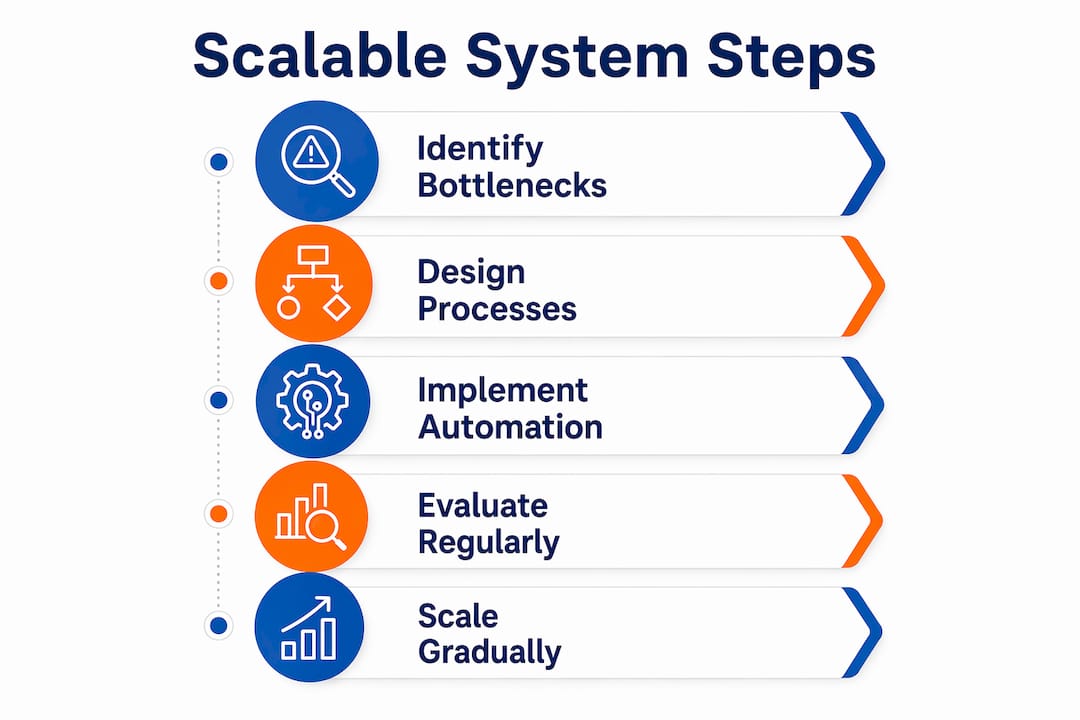
Building systems that actually hold up under growth pressure follows a four-step process: identify, document, automate, and evaluate. Each step builds on the last, and skipping ahead creates problems that compound fast.
Identify your highest-impact functions. Start with the areas that touch revenue most directly: customer acquisition, service delivery, onboarding, and fulfillment. These are the functions where a breakdown costs you the most, and where a well-built system pays back fastest.
Document workflows into Standard Operating Procedures (SOPs). Write out every step in plain language. If a process lives only in someone’s head, it cannot scale. SOPs don’t need to be elaborate; they need to be clear enough that someone new can follow them without asking questions.
Automate repetitive tasks after standardizing. This sequence matters. Automating before standardizing locks inefficiencies into your tech stack and makes them harder to fix later. Once a workflow is documented and proven, tools like Zapier, HubSpot, or Monday.com can handle the repetitive steps automatically.
Measure and evaluate regularly. Systems degrade without attention. Set clear metrics for each function, review them on a defined schedule, and refine based on what the data shows.
Pro Tip: Prioritize bottlenecks first and design your processes with loose coupling, meaning each component can be updated independently without triggering failures elsewhere. This prevents one weak link from stalling your entire operation.
The entrepreneurship bootcamp step-by-step guide from Nomadexcel walks founders through exactly this kind of structured build, from validating your first workflow to deploying automation at scale.
Growth vs. scaling: clearing up the most common misconception
Founders confuse growth and scaling constantly, and the confusion leads to real operational damage. Growth means increasing revenue while also adding more resources, like hiring more staff, expanding office space, or buying more equipment. Scaling means increasing revenue while keeping resource costs relatively flat.
A restaurant that opens a second location to serve more customers is growing. A restaurant that licenses its recipes and brand to franchise operators is scaling. The revenue potential of the second model is orders of magnitude larger, and the cost structure looks completely different.
The risks of mistaking one for the other:
- Overexpansion: Hiring aggressively before systems are in place creates chaos, not capacity.
- Margin erosion: If every new dollar of revenue requires a near-equal dollar of new cost, profitability never improves.
- Founder burnout: Without systems, growth just means more of everything falling on the same people.
Small businesses that attempt to scale before building foundational systems almost always hit a wall. The business gets bigger but not better, and the founder ends up more trapped, not less. Getting the sequence right, systems first, then scale, is what separates businesses that grow sustainably from those that grow painfully.
Why data-driven decisions are the backbone of scalable operations
Technology alone does not make a business scalable. True scalability depends on data-driven decision-making powered by relevant metrics, not just the tools you deploy. A business running on intuition and gut feel will make the wrong calls at exactly the moments when the stakes are highest.
The metrics that matter most for scaling:
- Lead-to-conversion rate: Shows whether your acquisition system is working or leaking.
- Cost per acquisition (CPA): Tells you whether growth is profitable or just expensive.
- Customer lifetime value (CLV): Determines how much you can afford to spend acquiring each customer.
- Operational efficiency ratios: Reveal where time and money are being lost in delivery.
A 2025 Wharton School study found that firms with higher returns to scale generate 7% more output than peers for the same increase in inputs, and that the top 5% of firms enjoy returns to scale approximately 10 percentage points higher than smaller competitors. Scalability, the research concluded, not just productivity, is what drives sustained dominance at the top.
The practical implication: tracking the right numbers lets you see which systems are working before problems become crises. Tools like Google Analytics, Salesforce, and Tableau give small business owners access to the kind of data visibility that used to require enterprise budgets. Understanding why measuring performance matters applies well beyond marketing; it’s the operating principle behind every function that needs to scale.
What Nomadexcel’s experts say about building systems that last
At Nomadexcel, the conversation around scalable systems comes back to one consistent theme: the business should be able to run without you. That’s not a goal for someday. It’s the design principle you build toward from day one.
“Entrepreneurs don’t like systems. But they play a key role in delivering predictable results for your clients, your shareholders, and, eventually, the investors who want to buy the business from you. Systems transform your company into a predictable, profitable operation.” — Jim Schleckser, CEO Project
The strategic value of this shift goes beyond operational convenience. Systems reduce risk by decreasing reliance on individual talent, which makes a business predictable and far more attractive to investors and acquirers. A business that depends on one person’s knowledge or relationships is a liability. A business with documented, repeatable systems is an asset.
Nomadexcel’s bootcamp programs address this directly, building frameworks for founders to document their core processes, identify automation opportunities, and create the kind of operational clarity that supports rapid growth. Participants leave with systems they can hand off, not just ideas they carry in their heads.
A few principles Nomadexcel emphasizes with founders:
- Hire for the system, not the superstar. Standardized workflows let average performers deliver excellent results consistently, which makes hiring more sustainable than chasing top talent every time.
- Culture follows structure. Teams align around clear processes. Ambiguity creates friction; documented systems create confidence.
- Measure ROI on every system you build. If a process doesn’t produce a measurable outcome, it’s overhead, not infrastructure.
Explore how to build scalable systems through Nomadexcel’s frameworks for founders at every stage.
Common pitfalls when implementing scalable systems
Most implementation failures come down to a handful of predictable mistakes, and knowing them in advance is most of the defense.
Automating chaos. The most common error: deploying automation tools before the underlying process is clean and documented. Automation amplifies whatever is already there. If the workflow is broken, the automation just breaks faster and at higher volume.
Building systems in isolation. A sales system that doesn’t connect to your delivery system creates handoff failures. Scalable operations require integration across functions, not just optimization within them. Startup founders scaling remotely face this challenge acutely, since disconnected tools across time zones compound quickly.
Skipping the documentation phase. Founders often feel they don’t have time to write things down. That instinct is exactly backwards. The documentation phase is what makes every future hour more productive.
Neglecting ongoing evaluation. Systems built for your business at 10 customers may not serve you well at 1,000. Regular audits, quarterly at minimum, catch drift before it becomes dysfunction.
Premature scaling. Attempting to scale before foundational systems are in place is one of the most common new venture mistakes. The result is operational strain, inconsistent customer experience, and a founder who ends up doing more manual work, not less.
Which technologies actually enable scalability?
The right tools reduce friction without adding complexity. For most small businesses and early-stage founders, a focused stack of well-integrated platforms outperforms a sprawling collection of disconnected apps.
Cloud-based platforms are the foundation. Tools like Google Workspace, AWS, and Notion give teams the ability to collaborate across locations, store and access information reliably, and scale storage and compute capacity without major capital investment. They also integrate with most automation and CRM tools, which keeps your stack connected.
Automation software handles the repetitive work that would otherwise consume hours of human attention. Zapier connects apps and automates multi-step workflows without code. HubSpot automates lead nurturing, follow-up sequences, and pipeline management. For e-commerce, Shopify’s built-in automation handles order processing, inventory alerts, and customer communications.
CRM and project management tools like Salesforce, Pipedrive, and Asana create the operational visibility that data-driven scaling requires. When every customer interaction and every project milestone is tracked in one place, patterns become visible and decisions improve.
AI-driven content and operations tools are increasingly part of scalable systems in 2026. AI-driven automation in content operations illustrates how education-sector businesses are using these tools to produce and distribute content at scale without proportional increases in team size.
The selection principle worth holding onto: choose tools that are simple enough for your current stage but flexible enough to grow with you. Overly complex platforms slow adoption and create new bottlenecks.
Key Takeaways
Scalable business systems let you grow revenue without growing costs at the same rate, and the businesses that build them early are the ones that stay in control as they expand.
| Point | Details |
|---|---|
| Systems over founder dependence | Document workflows so your business runs without your constant involvement. |
| Four-step build process | Identify, document, automate, and evaluate, in that order, to avoid locking in inefficiencies. |
| Growth is not scaling | Growth adds revenue and resources together; scaling adds revenue while keeping resource costs flat. |
| Data drives scalability | Tracking KPIs like CPA and CLV reveals what works before problems compound. |
| Top firms generate 7% more output | Wharton research shows firms with higher returns to scale generate 7% more output for the same increase in inputs, and that the top 5% of firms enjoy returns to scale approximately 10 percentage points higher than smaller competitors. |
Nomadexcel’s online entrepreneurship bootcamp gives founders the frameworks, mentorship, and community to build exactly these kinds of systems, from their first SOP to their first automated pipeline. If you’re ready to stop being the bottleneck in your own business, that’s where the work begins.
Comments are closed.