
What does innovation in business mean? A 2026 guide
Many entrepreneurs believe innovation is about launching shiny new products or inventing breakthrough technology. That’s a costly misconception. Innovation in business encompasses far more: new processes, business models, organizational structures, and marketing approaches that create tangible value. For early-stage founders and aspiring entrepreneurs, understanding innovation’s full scope is critical to building competitive advantage and accelerating growth. This guide clarifies what innovation truly means, explores proven methodologies, examines strategic types, and reveals how culture drives sustained success in 2026’s dynamic business landscape.
Table of Contents
- Defining Innovation In Business: Beyond The Buzzword
- Core Methodologies And Models Of Innovation Execution
- Types Of Innovation And Strategic Implications For Entrepreneurs
- Fostering A Culture And Community For Innovation Success
- Discover Innovation Skills With Nomad Excel’s Entrepreneurship Bootcamps
Key takeaways
| Point | Details |
|---|---|
| Innovation is comprehensive | It includes products, services, processes, and business models that create customer and investor value. |
| Methodologies drive execution | Structured approaches like innovation strategy development and business model processes reduce failure rates. |
| Risk profiles vary widely | Incremental innovation offers safety while radical innovation delivers transformative growth potential. |
| Culture enables sustainability | Creativity, collaboration, cross-functional teams, and unlearning biases fuel ongoing innovation success. |
Defining innovation in business: beyond the buzzword
Innovation in business means far more than product launches or technology breakthroughs. Innovation encompasses generating, developing, and implementing new ideas across products, services, processes, and business models that create value for customers, employees, and investors while driving growth and competitive advantage. This systematic approach distinguishes strategic innovation from random creativity or side projects.
Value creation sits at innovation’s core. When you innovate, you’re solving real problems for customers, improving operational efficiency for your team, or generating returns for investors. Each stakeholder benefits when innovation executes well. The process unfolds in three distinct phases: generation (ideating and brainstorming), development (prototyping and testing), and implementation (launching and scaling). Understanding this progression helps you allocate resources effectively and measure progress accurately.
Consider these innovation dimensions in your business:
- Product innovation creates new offerings or improves existing ones to meet evolving customer needs
- Process innovation streamlines operations, reduces costs, or accelerates delivery timelines
- Business model innovation reimagines how you create, deliver, and capture value in your market
- Organizational innovation restructures teams, workflows, or decision-making for better outcomes
Successful entrepreneurs recognize that innovation in entrepreneurship drives 30% higher growth compared to businesses that rely solely on execution of existing models. Innovation isn’t a luxury or an optional extra. It’s the engine that powers sustainable competitive advantage in markets where customer expectations and competitive dynamics shift constantly.
Pro Tip: Start small with process innovation before tackling radical product changes. Streamlining one operational bottleneck builds innovation muscle and demonstrates ROI to skeptical team members.
The key distinction is intentionality. Innovation requires deliberate strategy, resource allocation, and measurement. Random acts of creativity might spark interesting ideas, but systematic innovation transforms those ideas into market-ready solutions that scale.
Core methodologies and models of innovation execution
Effective innovation requires structured methodologies that transform creative ideas into market success. Key approaches include innovation strategy development, business model innovation processes, and execution models that mobilize cross-functional teams for rapid industrialization. These frameworks reduce failure rates and accelerate your path from concept to commercialization.
Innovation strategy development establishes the foundation. You must set clear goals aligned with market opportunities, develop deep understanding of customer needs and competitive dynamics, and allocate resources strategically across innovation initiatives. Without this strategic layer, innovation efforts scatter across disconnected projects that rarely deliver meaningful impact.
The business model innovation process follows three sequential stages:
- Ideation: Generate diverse concepts through brainstorming, customer research, and competitive analysis
- Research and development: Prototype solutions, test assumptions, and refine based on feedback loops
- Commercialization: Scale production, launch marketing campaigns, and optimize distribution channels
Each stage demands different skills, resources, and metrics. Rushing through ideation produces weak concepts. Skipping rigorous R&D leads to market failures. Poor commercialization wastes strong innovations.
| Innovation Stage | Primary Focus | Key Metrics | Timeline |
|---|---|---|---|
| Ideation | Quantity and diversity of concepts | Ideas generated, concepts validated | 2-4 weeks |
| R&D | Technical feasibility and product-market fit | Prototype iterations, user feedback scores | 8-16 weeks |
| Commercialization | Market penetration and revenue growth | Customer acquisition cost, revenue per user | 12-24 weeks |
The Innovation Execution model represents a paradigm shift in how companies industrialize new products. This end-to-end approach integrates design, engineering, supply chain, and go-to-market functions from day one. Cross-functional collaboration eliminates the traditional handoffs that slow innovation and introduce errors. Business model innovation for entrepreneurs becomes more efficient when teams work in parallel rather than sequence.
Pro Tip: Create a simple innovation scorecard tracking three metrics: ideas in pipeline, concepts in testing, and launches in market. Review monthly to identify bottlenecks before they stall momentum.
Successful entrepreneurs adopt 7 innovation strategies for startups that balance quick wins with long-term transformation. The methodology you choose matters less than consistent application and willingness to adapt based on results. Start with one framework, master it, then expand your toolkit as complexity grows.
Types of innovation and strategic implications for entrepreneurs
Innovation exists on a spectrum from incremental improvements to radical disruption. Understanding this range helps you balance risk and reward strategically. Top innovators allocate over 60% of R&D budgets to transformative and disruptive innovation, while strategic, organizational, and marketing innovation drive employment growth in intermediate markets.

Incremental innovation refines existing products, processes, or business models through small enhancements. This approach carries low risk but delivers limited growth potential. You’re optimizing what already works rather than creating new value propositions. Incremental innovation suits mature markets where customer needs are well understood and competitive dynamics are stable. It keeps your business relevant but rarely creates breakthrough advantage.
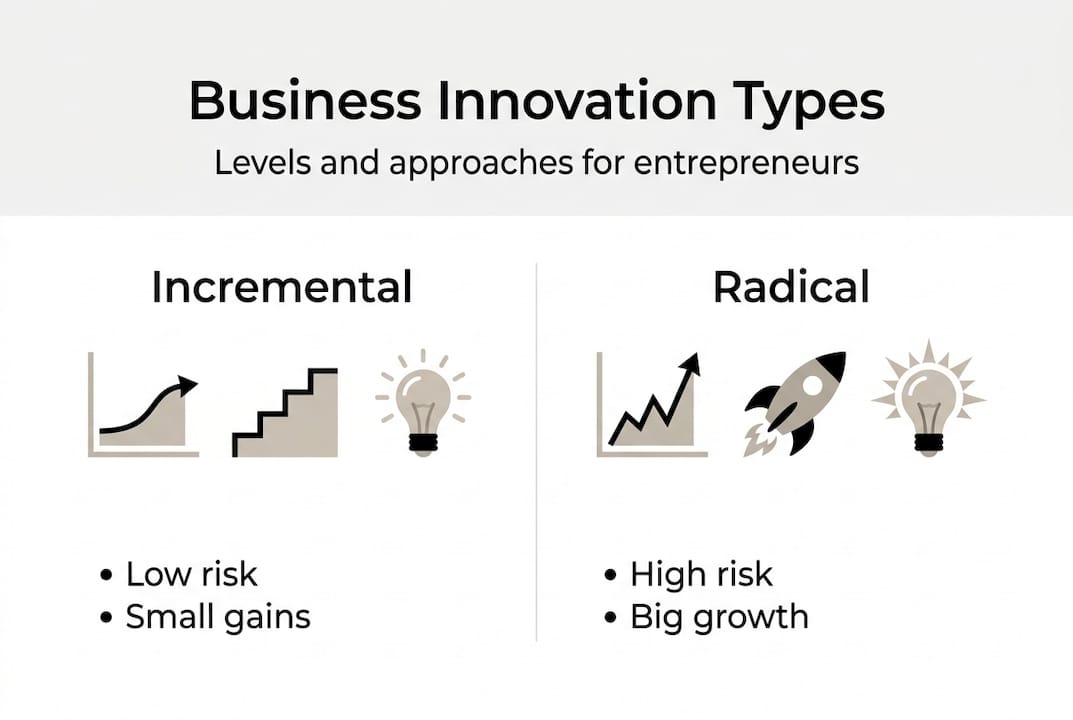
Radical innovation introduces fundamentally new solutions that disrupt markets and create new categories. This path carries high risk because you’re venturing into unproven territory with uncertain customer demand. However, successful radical innovation delivers outsized returns and establishes market leadership. Disruptors consistently outperform competitors through superior innovation execution and willingness to cannibalize their own products.
| Innovation Type | Risk Level | Growth Potential | Best For | Example |
|---|---|---|---|---|
| Incremental | Low | Modest | Mature markets, stable demand | Feature updates, efficiency gains |
| Radical | High | Transformative | Emerging markets, disruption opportunities | New categories, business model shifts |
| Strategic | Medium | Significant | Competitive repositioning | Market expansion, value chain integration |
| Organizational | Low-Medium | Operational | Scaling challenges, culture issues | Team restructuring, process redesign |
Digital innovation presents a unique dynamic. Research reveals digital innovation bifurcates between incremental and radical with no middle ground. You’re either making small improvements to existing digital products or creating entirely new platforms and ecosystems. This bifurcation forces strategic clarity: choose your lane and commit resources accordingly.
Strategic innovation reshapes competitive positioning through new market entries, partnerships, or value chain reconfigurations. Organizational innovation transforms internal structures, decision-making processes, or cultural norms to enable faster execution. Marketing innovation reimagines how you reach, engage, and convert customers through novel channels or messaging approaches. Each type creates economic impact beyond pure product development.
Pro Tip: Allocate 70% of innovation resources to incremental improvements that fund operations, 20% to adjacent opportunities that expand your market, and 10% to radical experiments that could redefine your business.
Entrepreneurs must understand their risk tolerance and market position when choosing innovation types. Early-stage startups often benefit from radical innovation because they have little to lose and everything to gain. Established businesses may prioritize incremental and strategic innovation to protect existing revenue while exploring new opportunities. Creativity and innovation drive entrepreneurial growth when matched appropriately to your stage and resources.
Fostering a culture and community for innovation success
Innovation thrives in environments that encourage creativity, embrace calculated risk-taking, and reward experimentation. Building this culture requires intentional leadership and systematic practices. Fostering collaborative communities through creativity culture, cross-functional teams, and feedback loops while unlearning outdated biases proves essential for breakthrough innovation.
Creativity culture forms the foundation. You must create psychological safety where team members propose unconventional ideas without fear of ridicule or punishment. This means celebrating intelligent failures that generate learning, not just successes that generate revenue. When people feel safe to experiment, innovation accelerates naturally. Leadership sets the tone through actions more than words: participate in brainstorming, acknowledge your own failures, and visibly reward risk-taking.
Cross-functional teams bring diverse perspectives that spark breakthrough thinking. Homogeneous groups tend toward groupthink and incremental ideas. Mixing engineers with marketers, designers with finance professionals, and junior employees with senior leaders creates cognitive friction that produces novel solutions. Structure regular collaboration sessions where different functions tackle problems together rather than in silos.
Feedback loops accelerate learning and refinement. Establish mechanisms for rapid customer feedback, peer review, and data analysis at every innovation stage. The faster you learn what works and what doesn’t, the quicker you pivot toward success. Weekly innovation reviews, customer advisory boards, and A/B testing frameworks all create feedback loops that inform better decisions.
Key cultural elements for sustained innovation:
- Autonomy: Give teams freedom to explore solutions within clear constraints and goals
- Resources: Allocate dedicated time and budget for innovation separate from operational demands
- Recognition: Celebrate both successful launches and valuable learning from failures
- Transparency: Share innovation progress, challenges, and lessons across the organization
Unlearning represents perhaps the most challenging cultural requirement. Your past success creates mental models and assumptions that block new thinking. Established practices feel safe and proven, making it difficult to question them objectively. Innovation demands you actively identify and challenge these biases. Ask regularly: what beliefs about our market, customers, or capabilities might no longer be true?
Pro Tip: Institute monthly “assumption audits” where teams list their core beliefs about customers, competitors, or operations, then systematically test one assumption through research or experimentation.
Community collaboration extends innovation beyond your organization’s boundaries. Engage with customers as co-creators through beta programs and design partnerships. Connect with other entrepreneurs through mastermind groups and industry networks. Partner with complementary businesses to combine capabilities and reach new markets. Harnessing creativity and innovation for startup growth becomes exponentially more powerful when you tap collective intelligence beyond your team.
Sustainable innovation culture evolves gradually through consistent practice and reinforcement. Start with small changes: one brainstorming session monthly, one cross-functional project quarterly, one assumption challenged weekly. These habits compound over time, transforming organizational DNA and creating lasting competitive advantage through continuous innovation capability.
Discover innovation skills with Nomad Excel’s entrepreneurship bootcamps
Transforming innovation theory into practical business results requires hands-on learning, expert mentorship, and a community of driven peers. Nomad Excel’s online entrepreneurship bootcamp equips you with frameworks, strategies, and execution skills to innovate systematically in your business. Our immersive programs combine business building workshops, direct guidance from experienced entrepreneurs, and daily accountability that accelerates your journey from innovative ideas to market success.
Discover why joining an entrepreneurship bootcamp creates breakthrough momentum for early-stage founders. You’ll learn proven business growth strategies for startup success while building lasting relationships with a global network of entrepreneurs who challenge, support, and collaborate with you long after the program ends.
What does innovation in business mean?
What is the difference between creativity and innovation in business?
Creativity generates original ideas and novel concepts, while innovation implements those ideas to create tangible business value. Creativity is the spark; innovation is the engine that transforms sparks into market solutions. Both are essential, but innovation requires additional elements like strategy, resources, and execution capability beyond pure creative thinking.
How do small businesses innovate with limited resources?
Small businesses innovate effectively by focusing on process and business model innovation rather than expensive product R&D. Start with customer feedback to identify high-impact improvements, leverage free or low-cost digital tools for experimentation, and partner with complementary businesses to share resources and capabilities. Constraint often drives more creative innovation than abundant budgets.
What role does failure play in business innovation?
Failure provides essential learning that refines innovation approaches and eliminates unproductive paths. Successful innovators fail frequently but cheaply through rapid prototyping and small-scale testing before major resource commitments. The key is extracting lessons systematically from each failure and applying those insights to subsequent attempts, creating a learning curve that accelerates toward success.
How can established companies maintain innovation momentum?
Established companies maintain innovation by dedicating separate teams and budgets to exploratory projects insulated from operational pressures. Create innovation labs with different success metrics than core business units, acquire or partner with startups to inject fresh thinking, and rotate high-performers through innovation roles to spread capability throughout the organization.
What metrics should entrepreneurs track to measure innovation success?
Track innovation pipeline metrics like ideas generated, concepts in testing, and time from idea to launch to measure process health. Monitor outcome metrics including revenue from new products, customer acquisition from new channels, and cost savings from process improvements to measure business impact. Balance leading indicators that predict future success with lagging indicators that confirm actual results.
How does digital transformation relate to business innovation?
Digital transformation is a specific type of innovation focused on leveraging technology to reimagine business models, customer experiences, and operational processes. It represents both incremental innovation through digitizing existing workflows and radical innovation through creating entirely new digital products or platforms. Successful digital transformation requires innovation culture, cross-functional collaboration, and willingness to cannibalize legacy systems.
Comments are closed.