
Team Building for Startups: Driving Growth Together
More than 60 percent of American startups struggle with team alignment and collaboration during their earliest growth stages. For every founder, building a strong team is not just about hiring smart people. It is about forming a group that can adapt quickly and work together under pressure. This guide uncovers vital strategies for assembling startup teams that thrive on diversity, agility, and shared purpose, giving you practical tools for driving success.
Table of Contents
- Defining Team Building in Startups
- Core Team Roles and Collaboration Models
- Effective Team Building Activities for Startups
- Hybrid and Remote Team Building Strategies
- Major Pitfalls and What Founders Should Avoid
Key Takeaways
| Point | Details |
|---|---|
| Strategic Team Composition | Startups must focus on building diverse teams with complementary skills to enhance scalability and innovation. |
| Intentional Team Dynamics | Founders should foster an environment of trust, clear communication, and shared vision to improve team cohesion. |
| Targeted Team-Building Activities | Implement structured activities that encourage collaboration and psychological safety to strengthen interpersonal relationships. |
| Avoiding Common Pitfalls | Founders must recognize the importance of balanced team structures and a healthy culture to prevent internal conflicts that can impede success. |
Defining Team Building in Startups
Startup team building represents a strategic process of assembling, developing, and aligning entrepreneurial teams to drive organizational growth and success. Unlike traditional corporate team development, startup team building focuses intensely on creating agile, diverse groups capable of navigating rapid change and uncertain business landscapes. Strategic team composition becomes critical in determining a startup’s potential for scalability and innovation.
At its core, startup team building involves deliberately constructing teams with complementary skills, diverse perspectives, and shared commitment to the organization’s mission. Research indicates that successful startup teams typically blend technical expertise, strategic thinking, and interpersonal capabilities. This means recruiting professionals who not only possess specialized skills but also demonstrate adaptability, collaborative spirit, and a growth mindset. The goal is creating a cohesive unit that can pivot quickly, solve complex problems, and maintain high performance under significant pressure.
Effective team building in startups requires intentional approaches to fostering trust, communication, and shared vision. This involves structured activities that enhance interpersonal dynamics, clarify roles, and establish robust problem-solving mechanisms. Founders must create environments that encourage open dialogue, mutual respect, and collective accountability. By investing in deliberate team development strategies, startups can transform individual talents into synchronized, high-performing teams capable of overcoming complex entrepreneurial challenges.
Pro tip: Design quarterly team alignment workshops that blend professional skill development with personal connection-building to strengthen team cohesion and maintain collaborative momentum.
Core Team Roles and Collaboration Models
Startup success hinges on strategically defining core team roles that enable dynamic collaboration and organizational agility. Team collaboration capabilities represent the critical foundation for technology-driven entrepreneurial ventures, emphasizing the need for flexible, interconnected professional relationships that can rapidly adapt to changing business landscapes.
Typically, successful startup teams comprise four primary role categories: technical leadership, product management, business strategy, and operational execution. Technical leaders drive innovation and product development, while product managers translate technical possibilities into market-ready solutions. Business strategists focus on market positioning, revenue models, and growth trajectories, and operational leaders ensure seamless execution and resource optimization. The magic happens when these roles interact synergistically, creating a holistic approach that balances creative vision with pragmatic implementation.

Here is a comparison of key team roles in startups and their strategic contributions:
| Team Role | Main Responsibilities | Strategic Impact |
|---|---|---|
| Technical Leader | Oversees product architecture and tech | Drives innovation, ensures quality |
| Product Manager | Aligns features with market needs | Bridges tech and business goals |
| Business Strategist | Develops revenue models and positioning | Sets growth direction for company |
| Operations Leader | Manages daily processes and resources | Enhances efficiency and scalability |
Effective collaboration models in startups transcend traditional hierarchical structures, instead embracing fluid, cross-functional interactions. This approach requires team members to develop robust communication skills, mutual respect, and the ability to contribute beyond their specific role boundaries. Successful teams cultivate an environment of psychological safety where diverse perspectives are welcomed, constructive feedback is normalized, and collective problem-solving becomes the default mode of operation. By establishing clear communication protocols, shared accountability metrics, and regular knowledge-sharing mechanisms, startups can transform potential role conflicts into opportunities for accelerated learning and innovation.
Pro tip: Implement monthly cross-functional workshops where team members from different roles present their challenges and collaborate on integrated solutions to break down organizational silos.
Effective Team Building Activities for Startups
Startups require targeted, purposeful team building activities that go beyond traditional corporate approaches. Evidence-based team building strategies emphasize structured interventions designed to rapidly cultivate trust, communication, and collective problem-solving capabilities. These activities are not about superficial entertainment, but about creating meaningful connections that directly impact organizational performance and team cohesion.
Successful startup team building activities typically fall into several strategic categories. Problem-solving challenges can include collaborative exercises like hackathons, where team members work together to solve complex technical or business problems within a compressed timeframe. Communication workshops focused on active listening, providing constructive feedback, and understanding diverse communication styles help break down interpersonal barriers. Cross-functional project sprints enable team members to work outside their typical roles, fostering empathy and understanding of different team perspectives. Additional activities might include shared learning experiences, such as collective skill-building workshops or team research projects that require collaborative research and presentation.
The most effective team building approaches for startups prioritize creating psychological safety and establishing robust communication frameworks. This means designing activities that encourage vulnerability, celebrate diverse thinking, and create opportunities for genuine interpersonal connection. Structured reflection sessions after collaborative activities can help teams process their experiences, identify learning opportunities, and develop shared mental models about teamwork and collective achievement. By intentionally creating spaces for meaningful interaction, startups can transform team building from a peripheral activity into a core mechanism for developing organizational capabilities and driving collective performance.
Pro tip: Design quarterly team building experiences that alternate between skill development workshops and collaborative problem-solving challenges to maintain engagement and continuous team growth.
Hybrid and Remote Team Building Strategies
Hybrid and remote team building requires intentional strategies that transcend physical distance. Remote collaboration models emphasize creating robust digital interaction frameworks that maintain team cohesion, trust, and collective performance across geographic boundaries. These approaches demand more sophisticated communication techniques and technological integration than traditional co-located team environments.
Successful hybrid team building strategies typically incorporate multiple engagement mechanisms. Digital communication platforms like video conferencing, collaborative project management tools, and asynchronous communication channels become essential infrastructure. Regular virtual team meetings with structured agendas, interactive breakout sessions, and intentional social connection activities help combat isolation and build interpersonal relationships. Techniques such as virtual coffee breaks, online team games, shared digital whiteboarding sessions, and rotating leadership opportunities can create meaningful interactions that simulate the spontaneous connections found in physical workspaces.
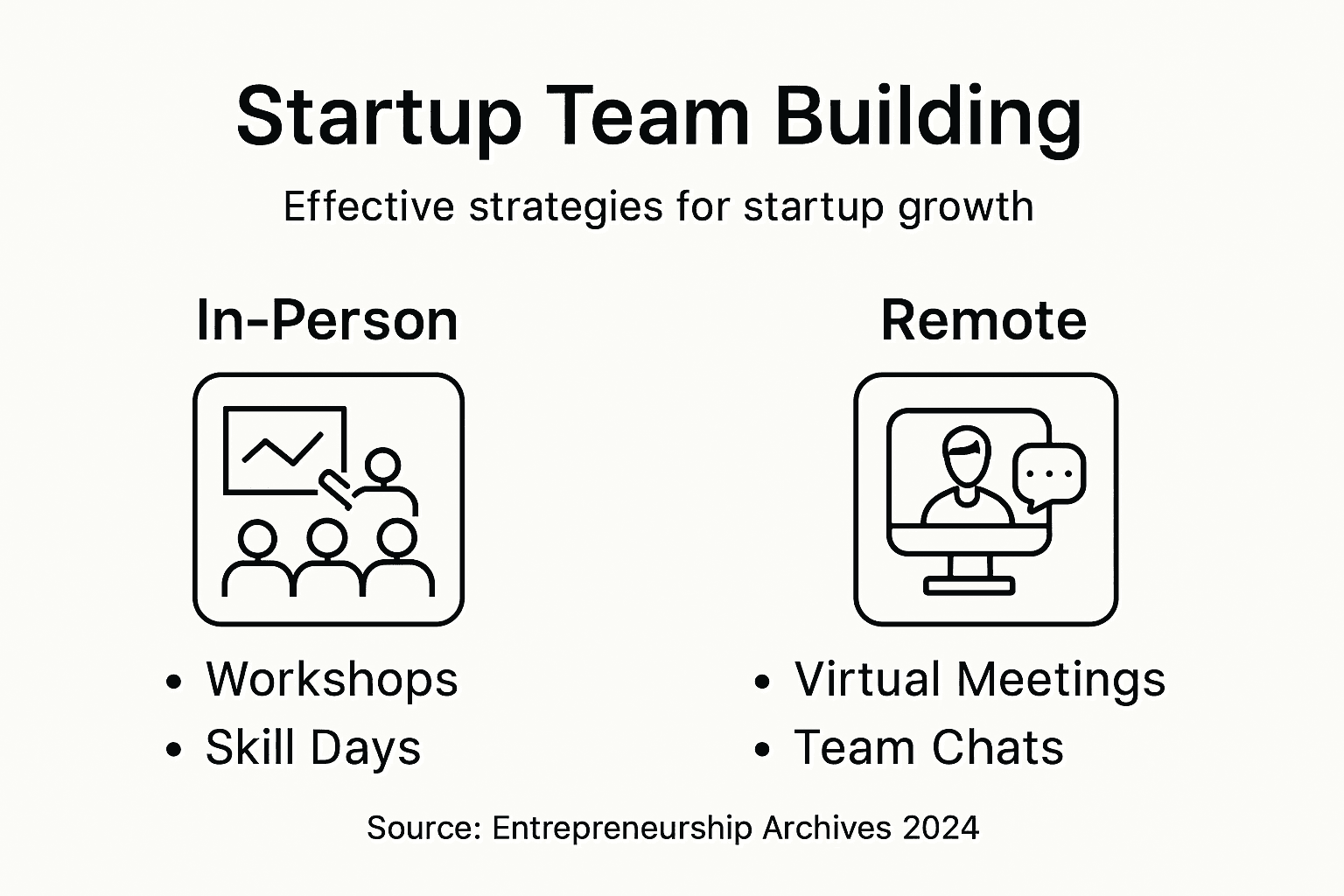
Below is a summary of remote and hybrid team building strategies and their potential benefits:
| Strategy | Description | Main Benefit |
|---|---|---|
| Virtual Meetings | Regular video-based team sessions | Increases shared understanding |
| Digital Collaboration Platforms | Tools for project tracking & chat | Boosts real-time coordination |
| Online Social Activities | Virtual games or coffee breaks | Builds team relationships |
| Rotating Leadership Opportunities | Different members lead activities | Encourages ownership, diversity |
The most effective hybrid team building approaches recognize the unique psychological dynamics of distributed teams. This means designing experiences that explicitly address potential communication barriers, create opportunities for vulnerability and authentic connection, and establish clear expectations around communication protocols. Periodic in-person retreats or team gatherings can serve as powerful catalysts for deeper relationship building, allowing teams to develop shared experiences and strengthen interpersonal bonds that sustain collaborative work during remote periods. By combining sophisticated digital collaboration tools with thoughtful human-centered design, startups can create resilient, high-performing teams that thrive regardless of physical proximity.
Pro tip: Implement a rotating “team connection leader” role where different team members design and facilitate monthly virtual engagement activities to distribute ownership and creativity.
Major Pitfalls and What Founders Should Avoid
Startup founders frequently underestimate the critical importance of team dynamics in determining organizational success. Team composition challenges reveal that most startup failures stem more from internal team problems than external market constraints. Recognizing and proactively addressing these potential pitfalls becomes paramount for sustainable growth and long-term viability.
Several fundamental pitfalls consistently emerge that founders must strategically navigate. Imbalanced team structures represent a primary risk, where founding teams lack diverse perspectives or overemphasize certain skill sets while neglecting others. This often manifests as teams comprised exclusively of business professionals without sufficient technical expertise, or technical teams lacking strategic business understanding. Founders should prioritize recruiting team members with complementary skills, ensuring representation across critical domains such as product development, technical implementation, market strategy, and operational execution. Additionally, unclear role definitions can create significant internal friction, leading to redundant efforts, communication breakdowns, and diminished collective productivity.
Another critical area of potential failure involves team culture and interpersonal dynamics. Founders must deliberately cultivate an environment of psychological safety, where team members feel empowered to share perspectives, acknowledge mistakes, and collaborate transparently. This requires establishing clear communication protocols, creating mechanisms for constructive feedback, and developing shared vision and values that transcend individual ego. Toxic team behaviors such as blame culture, territorial thinking, and lack of mutual respect can rapidly erode organizational potential, transforming what might have been a promising venture into a dysfunctional ecosystem.
Pro tip: Conduct quarterly team alignment workshops that explicitly address team dynamics, role expectations, and collective goals to proactively identify and mitigate potential interpersonal challenges.
Build Stronger Startup Teams with Proven Strategies and Expert Support
Building a startup team that thrives means overcoming challenges like unclear role definitions, imbalanced skills, and maintaining trust under pressure. This article highlights how crucial it is to design agile teams that communicate openly and align around shared goals. If you are facing difficulties in fostering psychological safety or creating effective collaboration models, you are not alone. The pain points of rapid change, diverse perspectives, and team cohesion require thoughtful action beyond traditional methods.
At Nomad Excel, we understand these challenges and offer immersive Entrepreneurship Archives bootcamps and customized company retreats designed specifically for startups seeking to accelerate growth through clarity, execution, and community. Our hands-on programs combine mentorship, structured sprints, and powerful peer networks focused on strengthening communication, defining strategic roles, and cultivating entrepreneurial leadership. Join a community that helps you avoid common pitfalls and transform your team dynamics into a competitive advantage.
Ready to unlock your startup’s full potential with expert guidance and tailored experiences Visit Nomad Excel today and explore how our Business Archives resources and workshops can fuel your growth journey. Don’t wait to build the cohesive, high-performing team your startup deserves.
Frequently Asked Questions
What strategies can startups use for effective team building?
Startups can implement targeted activities focused on trust-building, communication workshops, cross-functional project sprints, and problem-solving challenges. These activities should foster collaboration and enhance interpersonal dynamics.
What are the core roles in a startup team?
Typically, startup teams include four key roles: technical leaders, product managers, business strategists, and operations leaders. Each role contributes uniquely to innovation, market alignment, growth strategies, and execution efficiency.
How can founders avoid pitfalls in team dynamics?
Founders should ensure balanced team structures with diverse skills, clarify role definitions, and cultivate a culture of psychological safety where team members can share ideas freely without fear of negative consequences.
What are effective remote team building strategies for startups?
Effective remote team building strategies include regular virtual meetings, online social activities, and utilizing digital collaboration platforms. These help maintain team cohesion and foster interpersonal relationships despite physical distance.
Comments are closed.