
Immersive Learning: Unlocking Real-World Growth
Launching a business often feels like stepping into unknown territory, where hands-on insights and genuine skill development are tough to find in standard classrooms. For every aspiring entrepreneur, immersive learning opens a doorway to authentic, real-world experiences that encourage active participation and foster critical thinking. This guide explains how these transformative strategies work, highlighting the core principles and technology formats that make immersive learning a powerful tool for accelerating your business growth and connecting with a vibrant community.
Table of Contents
- Immersive Learning Defined And Core Principles
- Major Types And Technology-Driven Formats
- Key Features Fueling Deep Engagement
- Real-World Applications In Entrepreneurship
- Benefits, Challenges, And Common Mistakes
Key Takeaways
| Point | Details |
|---|---|
| Holistic Learning Environment | Immersive learning integrates real-world experiences, enhancing engagement and skill development. |
| Cutting-Edge Technologies | Virtual Reality, Augmented Reality, and Mixed Reality redefine learner interaction and practical application in various fields. |
| Active Participation and Feedback | Immersive learning emphasizes direct engagement and immediate feedback, fostering critical thinking and adaptability. |
| Navigating Challenges | Successful implementation requires strategic planning to address resource demands, technology complexity, and effective feedback mechanisms. |
Immersive learning defined and core principles
Immersive learning represents a transformative educational approach that transcends traditional classroom boundaries by integrating authentic, real-world experiences directly into the learning process. Comprehensive research in higher education reveals that immersive learning practices are multidisciplinary and extend far beyond conventional teaching methods, offering students profound opportunities for engagement and skill development.
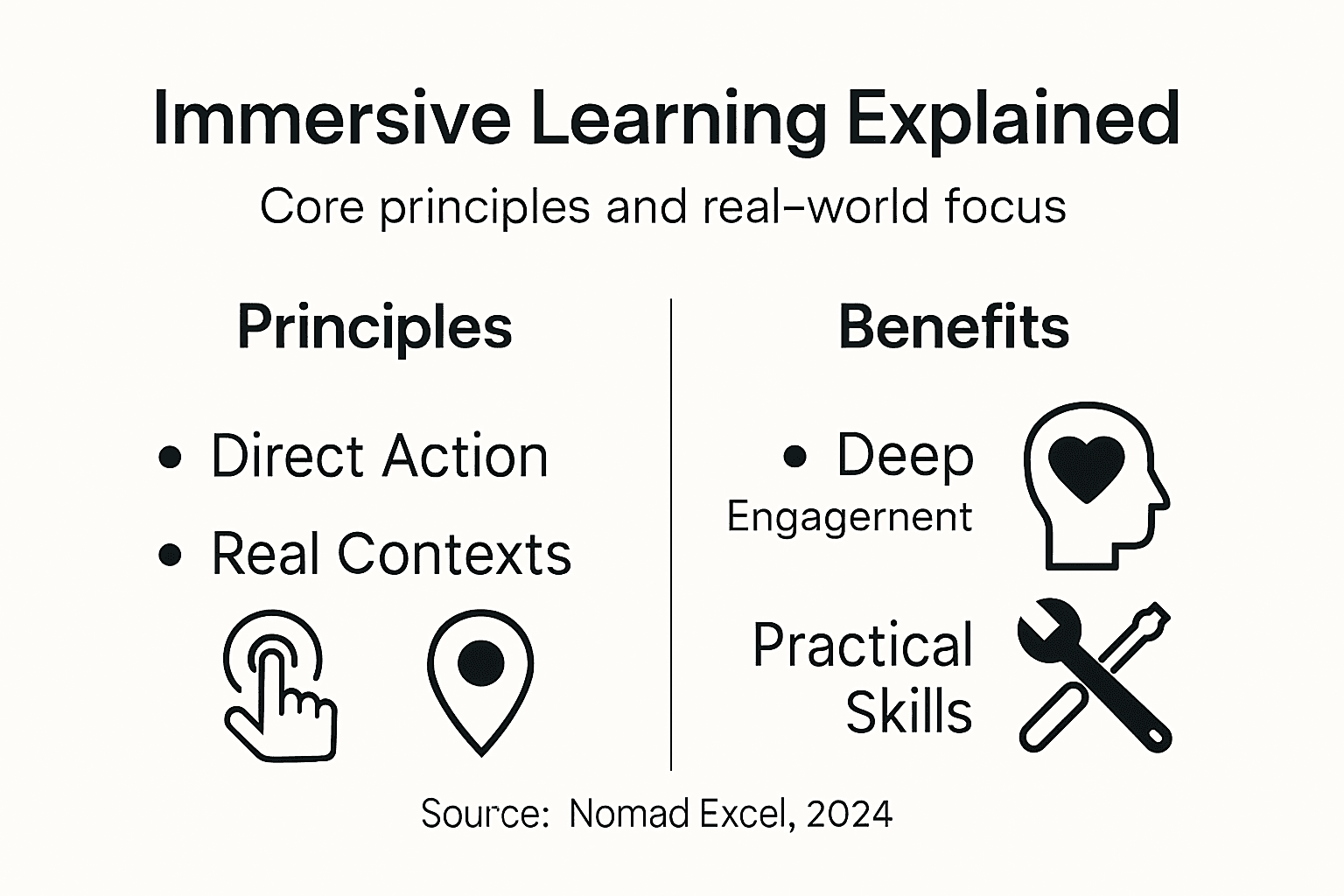
At its core, immersive learning consists of six critical theoretical components that distinguish it from standard experiential learning approaches. These components create a holistic learning environment that actively involves participants through multiple sensory and cognitive channels:
- Direct engagement with real-world contexts
- Active participation rather than passive observation
- Authentic problem-solving scenarios
- Contextual skill application
- Immediate feedback mechanisms
- Emotional and intellectual investment
Immersive learning strategies encompass diverse formats, including in-person experiences like internships, clinical practicums, and global learning programs, as well as digitally mediated platforms that simulate complex professional environments. This approach embraces both physical and virtual spaces, allowing learners to develop skills through quasi-realistic experiences that mirror professional challenges.
The primary distinction between immersive learning and traditional educational models lies in its commitment to creating comprehensive learning ecosystems. Instead of compartmentalizing knowledge, immersive learning integrates theoretical understanding with practical application, enabling participants to develop nuanced skills that extend beyond textbook comprehension. By placing learners in dynamic, responsive environments, these approaches foster critical thinking, adaptability, and real-world problem-solving capabilities.
Pro tip: Design your personal learning journey by actively seeking opportunities that blend theoretical knowledge with hands-on experiences, whether through internships, simulations, or collaborative projects.
Major types and technology-driven formats
Immersive learning technologies represent a sophisticated spectrum of digital and interactive experiences that revolutionize how professionals and students engage with complex learning environments. Cutting-edge immersive technologies leverage advanced digital platforms to create transformative educational and training experiences across multiple domains.
The primary immersive learning technology formats include:
- Virtual Reality (VR): Fully simulated digital environments
- Augmented Reality (AR): Digital overlays on real-world settings
- Mixed Reality (MR): Interactive blend of physical and virtual elements
- Extended Reality (XR): Comprehensive immersive experience technologies
Professional training technologies demonstrate remarkable versatility, particularly in high-stakes fields like medical training, aviation, and engineering. These technologies enable learners to practice complex skills in risk-free, highly controlled simulated environments that closely mirror real-world scenarios.
Here’s how immersive learning formats compare in terms of user experience and practical utility:
| Format Type | User Immersion Level | Common Applications | Example Benefit |
|---|---|---|---|
| Virtual Reality | Fully immersive, 3D | Skill training, simulation | Safe high-risk practice |
| Augmented Reality | Real-world with overlays | Fieldwork, real-time guidance | On-the-job enhancement |
| Mixed Reality | Interactive hybrid | Collaborative design, STEM | Real-world data manipulation |
| Extended Reality | All immersive tech combined | Broad learning integration | Seamless skill transfer |
Artificial intelligence plays a critical role in enhancing these immersive learning experiences by dynamically adapting content to individual learner needs, creating personalized educational journeys that respond in real-time to user interactions and performance. By integrating intelligent algorithms with immersive technologies, educational platforms can provide nuanced, responsive learning experiences that traditional methods cannot match.
Pro tip: Explore free online VR and AR training platforms to gain hands-on experience with immersive learning technologies without significant financial investment.
Key features fueling deep engagement
Immersive learning distinguishes itself through a complex set of engagement mechanisms that transform traditional educational experiences. Underlying learning components create a multidimensional approach that goes far beyond conventional teaching methodologies, actively engaging participants across multiple cognitive and sensory dimensions.
The key features driving deep engagement include:
- Context-Specific Immersion: Creating environments that mirror real-world scenarios
- Active Participation: Requiring direct interaction rather than passive observation
- Authentic Experiences: Designing learning scenarios with genuine professional relevance
- Reflective Learning: Encouraging critical analysis and personal insight
- Dynamic Feedback: Providing immediate, personalized performance insights
- Social Collaboration: Enabling multi-user interactions and collective problem-solving
Immersive learning spaces leverage sophisticated technological features to enhance engagement, including interactive 3D visualizations, spatial audio, and real-time multi-user collaboration tools. These elements create sensory-rich environments that dramatically exceed the capabilities of traditional classroom settings, transforming learning from a passive absorption of information to an active, participatory experience.

The psychological impact of these engagement features cannot be overstated. By creating environments that simultaneously challenge, support, and respond to individual learners, immersive learning platforms generate unprecedented levels of motivation, knowledge retention, and skill development. The integration of adaptive technologies, interactive design, and personalized learning paths ensures that each participant experiences a uniquely tailored educational journey.
Pro tip: Design your personal learning experiences by seeking platforms that offer multiple interaction modes and real-time feedback mechanisms.
Real-world applications in entrepreneurship
Entrepreneurial learning transcends traditional classroom boundaries by embedding practical experiences directly into educational frameworks. Entrepreneurship education approaches leverage immersive methodologies that expose aspiring entrepreneurs to authentic business challenges and real-world problem-solving scenarios.
Key real-world application strategies for entrepreneurial development include:
- Problem-Based Learning: Tackling genuine business challenges
- Startup Simulation Projects: Creating and managing mock businesses
- Live Client Consulting: Working with actual business clients
- Prototype Development: Designing and testing innovative solutions
- Pitch Competition Participation: Presenting business concepts to investors
- Community Engagement Initiatives: Solving local entrepreneurial challenges
Experiential learning pedagogies integrate multiple instructional approaches that build comprehensive entrepreneurial competencies. These methodologies combine design thinking, peer assessment, formative feedback, and active learning techniques to cultivate the complex skills required for successful business creation and management.
The ultimate goal of these immersive entrepreneurial applications is to bridge the critical gap between theoretical knowledge and practical execution. By providing controlled yet authentic environments where aspiring entrepreneurs can experiment, fail safely, and learn iteratively, these approaches develop not just skills, but the adaptive mindset necessary for navigating complex business landscapes.
Pro tip: Create a personal project portfolio that documents your entrepreneurial learning journey, showcasing real-world problem-solving experiences and iterative growth.
Benefits, challenges, and common mistakes
Immersive learning represents a transformative educational approach with significant potential and nuanced complexities. Learning technology implementation reveals a sophisticated landscape of advantages and potential pitfalls that demand careful navigation and strategic planning.
Key benefits of immersive learning include:
- Enhanced Engagement: Creating deeply interactive learning experiences
- Contextualized Understanding: Connecting theoretical concepts with practical applications
- Active Skill Development: Providing safe environments for experimentation
- Personalized Learning Paths: Adapting to individual learner needs
- Real-World Simulation: Mimicking complex professional scenarios
- Accelerated Skill Acquisition: Compressing learning curves through intense experiences
Immersive technology challenges encompass multifaceted obstacles that require strategic mitigation. These include significant resource investments, potential technological barriers, and the risk of cognitive overload that can diminish learning effectiveness if not carefully managed.
Common mistakes in immersive learning implementation often stem from inadequate preparation and insufficient understanding of technological integration. Practitioners frequently underestimate the complexity of creating truly effective immersive experiences, overlooking critical elements such as comprehensive feedback mechanisms, reflective learning opportunities, and the nuanced balance between technological innovation and pedagogical effectiveness.
The following table summarizes frequent challenges and how to address them in immersive learning:
| Challenge | Impact on Learners | Mitigation Strategy |
|---|---|---|
| High resource demands | Limits accessibility | Start small, scale gradually |
| Tech complexity | Steep learning curve | Offer training and support |
| Cognitive overload | Reduces retention | Break content into short segments |
| Insufficient feedback | Hinders improvement | Integrate real-time assessment |
Pro tip: Develop a systematic evaluation framework that continuously assesses both technological implementation and learning outcomes to refine your immersive learning strategies.
Unlock Real-World Growth with Immersive Learning at Nomad Excel
The article highlights the crucial challenge many entrepreneurs face: bridging the gap between theoretical knowledge and practical execution through immersive learning. You may be seeking ways to engage deeply with authentic business challenges, gain immediate feedback, and develop a powerful mindset that fosters real-world growth. This is exactly where Nomad Excel’s immersive entrepreneurship bootcamps and company retreats deliver exceptional value. Our programs focus on hands-on learning, mentorship, and community support designed to accelerate your ability to execute and scale effectively.
If you want to transform your entrepreneurial journey or strengthen your team with a proven framework that blends immersive learning principles such as active participation, real-world problem solving, and immediate feedback, explore our Entrepreneurship Bootcamps. Designed for early-stage founders ready to launch or scale, these programs offer step-by-step frameworks, expert guidance, and a community to keep you motivated. For teams, our custom retreats help align goals, build trust, and inspire innovation through curated experiences. Don’t wait to elevate your business growth now. Discover how to turn immersive learning into tangible results by visiting Nomad Excel and take the first step toward your next breakthrough today.
Frequently Asked Questions
What is immersive learning?
Immersive learning is an educational approach that integrates real-world experiences into the learning process, actively engaging students through multiple sensory and cognitive channels.
What are the core principles of immersive learning?
The core principles of immersive learning include direct engagement with real-world contexts, active participation, authentic problem-solving scenarios, contextual skill application, immediate feedback, and emotional investment.
What technologies are used in immersive learning?
Immersive learning utilizes technologies such as Virtual Reality (VR), Augmented Reality (AR), Mixed Reality (MR), and Extended Reality (XR) to create engaging and interactive learning environments.
How does immersive learning benefit entrepreneurship education?
Immersive learning enhances entrepreneurship education by embedding practical experiences, such as problem-based learning and live client consulting, directly into the learning framework, bridging the gap between theory and real-world application.
Recommended
- Growth Mindset in Business: Unlocking Team Potential
- How to Build a Growth Mindset for Entrepreneurial Success
- 7 Essential Growth Strategies for Startup Success
- Experiential Education Explained: Real-World Impact for Entrepreneurs
- learn languages with music
- Apprendimento interattivo: perché trasforma davvero l’istruzione – Recupero Anni Scolastici e Diploma Online
Comments are closed.