
Goal Alignment: Driving Team Results and Growth
Most entrepreneurs reach a point where big dreams and daily demands start pulling in different directions. Without a clear way to synchronize personal ambitions with business goals, progress can stall and motivation may falter. Goal alignment brings clarity and purpose to the chaos, guiding each step from individual aspirations to measurable results. Discover how defining, integrating, and tracking aligned objectives can fuel your entrepreneurial growth, turning scattered efforts into collective momentum that lasts beyond the bootcamp experience.
Table of Contents
- Defining Goal Alignment And Its Core Purpose
- Types Of Goal Alignment: Personal, Team, Organizational
- How Goal Alignment Drives Execution And Focus
- Common Barriers And Misconceptions About Alignment
- Best Practices For Achieving Effective Goal Alignment
Key Takeaways
| Point | Details |
|---|---|
| Goal Alignment is Essential | Aligning personal, team, and organizational goals creates a unified path toward higher performance and sustainable growth. |
| Continuous Review is Crucial | Implementing regular review sessions ensures ongoing alignment and allows for quick adjustments to goals as needed. |
| Clear Communication Channels | Establishing transparent channels for discussion among team members fosters collaboration and keeps everyone focused on common objectives. |
| Overcoming Barriers | Addressing common barriers, such as limited resources and resistance to change, is vital for encouraging effective goal alignment across the organization. |
Defining Goal Alignment and Its Core Purpose
Goal alignment represents the strategic process of synchronizing individual, team, and organizational objectives to create a unified path toward meaningful achievement. At its core, this approach transforms disconnected efforts into a powerful, coordinated momentum that drives sustainable growth and performance.
In the entrepreneurial context, goal alignment goes beyond simple task coordination. Organizational strategy depends on consistent alignment to deliver value and create an environment where individuals can perform at their highest potential. This means breaking down complex strategic objectives into measurable, actionable key results that connect personal motivations with broader business outcomes.
Key components of effective goal alignment include:
- Clarity of purpose: Ensuring every team member understands how their individual work contributes to broader organizational objectives
- Measurable outcomes: Establishing clear, quantifiable indicators that track progress toward shared goals
- Continuous communication: Creating transparent channels for discussing objectives, challenges, and progress
- Adaptive frameworks: Developing flexible systems that can adjust goals as business environments evolve
Personal and professional goal integration plays a critical role in this process. Holistic leadership requires aligning personal aspirations with professional objectives to create sustainable motivation and meaningful career development. When entrepreneurs understand how their individual growth connects to their business’s strategic direction, they unlock unprecedented levels of engagement and performance.
Pro tip: Schedule quarterly personal and professional goal review sessions to ensure continuous alignment and identify emerging opportunities for growth and realignment.
Types of Goal Alignment: Personal, Team, Organizational
Goal alignment is a multifaceted process that operates across different organizational levels, each playing a crucial role in driving overall performance and strategic success. Goal alignment occurs through interconnected layers that cascade from individual aspirations to comprehensive organizational strategies.
Personal Goal Alignment represents the foundational level where individual motivations and professional objectives intersect. For entrepreneurs, this means:
- Identifying personal career aspirations
- Understanding individual strengths and development areas
- Connecting personal growth with broader professional objectives
- Creating measurable personal performance targets
Team Goal Alignment elevates individual objectives into collective achievements. This level focuses on:
- Synchronizing individual contributions
- Establishing shared team objectives
- Creating collaborative performance metrics
- Developing transparent communication channels
Organizational Goal Alignment represents the strategic pinnacle where team and individual goals integrate with broader enterprise objectives. OKRs provide a structured framework for achieving this comprehensive alignment, enabling organizations to:
- Transform high-level strategic vision into actionable tactics
- Create transparent goal-tracking mechanisms
- Foster enterprise-wide accountability
- Ensure consistent progress toward strategic milestones
Goal alignment is not a one-time event but a continuous, dynamic process that requires regular assessment and recalibration.
Pro tip: Implement quarterly alignment review sessions that allow individuals, teams, and organizational leaders to reassess and realign goals collaboratively.
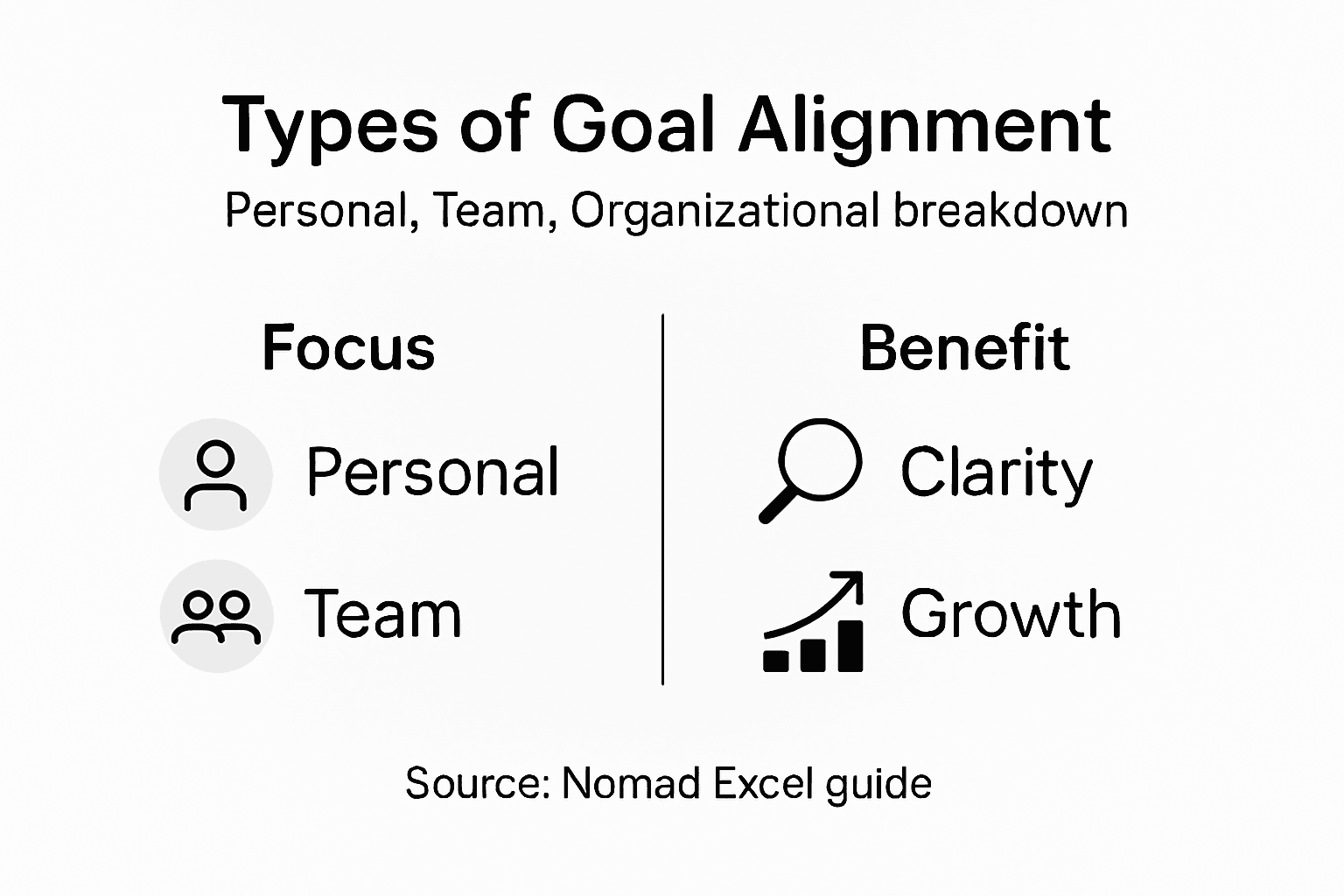
Here’s a summary of alignment types and their unique business impact:
| Alignment Type | Primary Focus | Unique Benefit | Example Business Impact |
|---|---|---|---|
| Personal | Individual growth | Boosts motivation and engagement | Increased entrepreneurial drive |
| Team | Collective collaboration | Enhances teamwork and synergy | Stronger project execution |
| Organizational | Enterprise strategy | Ensures unified direction | Achieves long-term business goals |
How Goal Alignment Drives Execution and Focus
Goal alignment transforms abstract strategic intentions into tangible, actionable outcomes by creating a laser-focused approach to organizational performance. Goal alignment clarifies priority objectives and concentrates collective energy toward measurable results, preventing fragmented efforts and redirecting resources toward high-impact activities.
At its core, effective goal alignment drives execution through several critical mechanisms:
- Establishing clear performance expectations
- Creating transparent accountability structures
- Eliminating redundant or misaligned work efforts
- Providing a unified direction for team activities
- Enabling rapid decision-making processes
Intrinsic motivation emerges as a powerful byproduct of well-designed goal alignment. Meaningful goal setting enhances performance by connecting individual contributions to larger organizational objectives. When team members understand how their specific tasks contribute to broader strategic outcomes, engagement and productivity naturally increase.
The execution-driving power of goal alignment manifests through several key dynamics:
- Prioritizing strategic initiatives
- Reducing organizational friction
- Creating measurable progress indicators
- Fostering a sense of collective purpose
Successful goal alignment transforms individual efforts into a coordinated, high-performance ecosystem where every contribution matters.
Pro tip: Develop a quarterly goal review system that allows real-time adjustments and maintains strategic momentum across personal, team, and organizational levels.

Common Barriers and Misconceptions About Alignment
Goal alignment encounters numerous challenges that can derail even the most well-intentioned strategic efforts. Common barriers prevent effective goal pursuit by creating organizational friction and individual resistance that undermines collaborative potential.
Key barriers to successful goal alignment include:
- Limited organizational resources
- Lack of clear communication channels
- Resistance to change
- Misaligned incentive structures
- Insufficient leadership support
- Complex hierarchical obstacles
Misconceptions about goal alignment often emerge from fundamental misunderstandings about how individual and organizational objectives interact. Personal and professional goals can be complementary, not inherently competitive. Many entrepreneurs mistakenly believe that personal aspirations must be sacrificed for professional success, when in reality, these goals can be strategically integrated.
The most prevalent misconceptions about goal alignment typically manifest in three primary domains:
- Believing alignment is solely top-down
- Assuming personal goals conflict with organizational objectives
- Thinking alignment is a one-time event rather than an ongoing process
Successful goal alignment requires viewing objectives as interconnected ecosystems, not isolated competing priorities.
Pro tip: Conduct monthly reflection sessions that explicitly map personal growth objectives to organizational strategic goals, creating a holistic alignment framework.
Compare common barriers to alignment and practical solutions:
| Barrier | Root Cause | Practical Solution |
|---|---|---|
| Limited resources | Overextended operations | Prioritize high-impact objectives |
| Resistance to change | Fear of uncertainty | Involve stakeholders early |
| Misaligned incentives | Contradictory reward systems | Develop shared success metrics |
| Insufficient leadership | Lack of executive support | Provide leadership training |
Best Practices for Achieving Effective Goal Alignment
Goal alignment requires strategic and intentional approaches that transform abstract objectives into concrete, actionable plans. Setting SMART goals creates sustainable alignment by establishing clear, measurable expectations that bridge individual aspirations with organizational strategies.
Key best practices for effective goal alignment include:
- Developing clear, measurable objectives
- Creating transparent communication channels
- Establishing regular feedback mechanisms
- Balancing short-term tactics with long-term vision
- Fostering a culture of continuous learning
- Implementing flexible goal-tracking systems
Structured goal-setting frameworks play a critical role in achieving meaningful alignment. Effective alignment integrates personal development with organizational strategy, ensuring that individual growth trajectories directly contribute to broader enterprise objectives. This approach requires deliberate strategy and ongoing commitment from leadership and team members alike.
The most impactful goal alignment strategies typically involve:
- Conducting comprehensive goal-mapping sessions
- Creating cross-functional collaboration opportunities
- Developing personalized development plans
- Implementing transparent progress tracking
Successful goal alignment transforms individual potential into collective organizational momentum.
Pro tip: Design quarterly alignment workshops that explicitly connect individual performance goals with broader organizational objectives, creating a dynamic and responsive goal ecosystem.
Unlock True Growth Through Goal Alignment with Nomad Excel
The challenge of achieving seamless goal alignment across personal, team, and organizational levels is a reality many entrepreneurs and leaders face. This article highlights how clarity, continuous communication, and adaptive frameworks drive execution and foster intrinsic motivation. Yet turning these strategic concepts into actionable momentum requires more than just theory. It demands immersive experiences where founders and teams build sharp strategies, create accountability, and align around meaningful outcomes.
At Nomad Excel, we specialize in bridging this gap through hands-on entrepreneurship bootcamps and tailored company retreats that put goal alignment into practice. Our programs empower driven entrepreneurs and teams to:
- Break down complex objectives into measurable steps
- Strengthen collaborative communication and trust
- Build frameworks for sustainable execution and growth
Whether you want to accelerate your startup or realign your team for stronger business impact, explore how our immersive experiences promote real results. Join a community committed to turning aligned goals into lasting success. Discover the full potential of your business and leadership with Nomad Excel. Learn more about our Entrepreneurship Bootcamps and custom Company Retreats designed to elevate your growth journey.
Take the next step now and transform goal alignment into your greatest growth advantage.
Frequently Asked Questions
What is goal alignment?
Goal alignment is the strategic process of synchronizing individual, team, and organizational objectives to create a unified path toward meaningful achievement and sustainable growth.
Why is goal alignment important for teams?
Goal alignment is crucial for teams because it transforms individual efforts into coordinated actions, enhances collaboration, and ensures that everyone works towards shared objectives, ultimately driving overall performance and success.
How can organizations achieve effective goal alignment?
Organizations can achieve effective goal alignment by developing clear, measurable objectives, fostering transparent communication, establishing regular feedback mechanisms, and implementing structured goal-setting frameworks like OKRs.
What are common barriers to successful goal alignment?
Common barriers to successful goal alignment include limited organizational resources, resistance to change, misaligned incentive structures, and insufficient leadership support.
Recommended
- Business Alignment: Driving Startup Growth Globally
- 7 Essential Growth Strategies for Startup Success
- Business Execution: Turning Plans into Real Growth
- Leadership Development Guide for Building High-Impact Teams
- Goal Alignment: How It Drives Team Success – Optio Station: Best Project Management App for Prioritization
Comments are closed.