
Business Meetups Near Me: How to Find Ones Worth Your Time
The fastest way to find business meetups near you is to check three places in one sitting: your local chamber of commerce calendar, the Small Business Administration’s event listings, and event-search platforms filtered by your city and by topics such as entrepreneurship or small business. Then attend a group twice before you judge it. Below you will find where each kind of meetup lives, how to match a format to your goals, and what to do if your area has little on offer.
TL;DR
- Start with the chamber of commerce, professional associations and alumni groups, then add event platforms searched by location.
- Free, official options exist: the SBA events search and SCORE’s free mentoring and webinars.
- Match the format to your goal: mixers for introductions, workshops for skills, referral groups for steady leads, online communities for niche topics.
- Go at least twice before deciding a group fits, and arrive with a short list of people you want to meet.
- If your local scene is thin or generic, a multi-day, cohort-based bootcamp can compress months of networking into days.
Table of Contents
- Where business people actually meet
- How to find current meetups in your area
- Types of business meetups, and who each one suits
- How to choose a meetup before you commit
- How to make connections that last
- When local meetups are not enough
- Our perspective: from meetups to a community that works
- Meet a founder community through a Nomad Excel bootcamp
- A simple 30-day plan to build your local network
- Common mistakes to avoid
- FAQ
- Sources
Where business people actually meet
Most business networking happens at industry events, and many professionals also join a civic club or a professional organization, such as a local chamber of commerce. Online spaces such as social platforms, forums and webinars fill in the rest.
In practice, “business meetup” covers a wide range. Event guides list chamber events, conferences, industry-association events, coworking-space mixers and online professional events as the main places people meet. Each draws a slightly different crowd:
- Chamber mixers attract local shop owners, service providers, accountants, bankers and real estate agents. They suit anyone who sells to customers in the same town.
- Industry association events attract people from one field. They suit you if you want peers, suppliers or clients who already speak your language.
- Coworking mixers skew toward freelancers, remote workers and early-stage founders. The mood is usually relaxed.
- Conferences and expos give you volume: many conversations in a day, though fewer deep ones.
- Online professional events remove geography, which matters if you travel or live somewhere with a small business community.
If you freelance or run a one-person company, the coworking and small-business groups tend to feel most natural. If you plan to hire or sell to other companies, the chamber and industry association are worth the membership conversation.
How to find current meetups in your area
Event calendars change weekly, so the useful skill is knowing where to look, not memorizing a list. A practical routine:
- Check your local chamber calendar. Many chambers publish member and public events, and some let non-members attend a first event.
- Search event platforms by location. Guides recommend searching event platforms by city and consulting professional or alumni associations. Use filters such as “small business,” “entrepreneurship” and “startups,” and widen your radius to the nearest larger city.
- Use the SBA event search. The SBA’s upcoming events page lets you narrow by keyword, date range and district office, and lists events hosted by resource partners, some of them free.
- Look for SCORE chapters. SCORE offers free one-on-one mentoring and webinars to entrepreneurs. It is mentoring first, but its workshops put you in a room with other founders.
- Ask around. Your workplace, a former colleague or a client can often point to a group you would never find in search results.
- Add an online layer. Industry-specific Slack communities keep the conversation going between in-person events.
Save searches and set alerts where the platform allows it. A group that meets monthly is easy to miss if you only look when you feel like going out.
Types of business meetups, and who each one suits
Not every networking event works the same way. Common formats include meet-and-greets, professional development workshops, speed-networking events and casual happy hours. Referral-based organizations are another model: the largest of them reports more than 11,000 chapters worldwide.
| Format | Best for | What to expect | Watch for |
|---|---|---|---|
| Casual mixer or happy hour | Meeting people with no agenda | Open conversation, easy entry | Little structure, so set your own goal |
| Speed networking | Shy first-timers, quick introductions | Timed one-on-one rounds | Short exchanges, so follow up fast |
| Workshop or talk | Learning a specific skill | Presentation plus Q&A | Less time to chat unless there is a social hour |
| Referral group | Service providers wanting steady leads | Weekly or biweekly meetings, one seat per profession | Attendance expectations and membership cost |
| Industry association event | Peers, suppliers, hiring | Panels, tables, conferences | Can feel closed if you are new |
| Online community | Niche topics, frequent travelers | Chat, virtual calls | Easier to lurk than to build ties |
A useful rule of thumb: pick one recurring group for relationships, and one occasional event for learning or exposure. Relationships compound only when you see the same people repeatedly.
How to choose a meetup before you commit
The cheapest way to evaluate a group is to attend. One suggestion from a networking coach is to attend a group at least twice before deciding whether its audience and format fit your goals. The first visit shows you the room. The second shows you whether the room is the same.
Before you go, check:
- Who attends. Look at past events or the member list. Are these people you would hire, learn from, or sell to?
- Format. Is it structured introductions, an open floor, or a speaker? Pick what you will actually enjoy.
- Frequency and timing. A monthly breakfast you can attend beats a weekly dinner you will skip.
- Cost. Many mixers are free or low-cost; membership organizations charge dues. Know the figure before you arrive.
- Stage fit. A group of established owners can be a great source of advice, but a group of early-stage founders may share your exact problems.
- Follow-up culture. Does anyone connect afterward, or does everyone leave when the event ends?
How to make connections that last
The U.S. Chamber of Commerce advises that effective networking needs a systematic approach, such as building a target list of people and keeping a consistent routine, rather than leaving things to chance encounters. Here is what that looks like at a single event:
- Decide on one outcome. Two useful conversations, one introduction to a specific person, or one question answered.
- Prepare a one-sentence description of what you do and who you help, in plain words.
- Ask questions first. People remember how a conversation felt more than what you said.
- Take a note on your phone right after each chat: name, topic, a promised next step.
- Follow up within two days with something specific, like an article, an introduction or a short thank-you.
For more examples, our guides on effective networking examples for entrepreneurs and the complete guide to networking for entrepreneurs go deeper on scripts and follow-up habits.
When local meetups are not enough
Some readers search “business meetups near me” and find a handful of generic mixers or nothing at all. That is common for digital nomads, remote professionals and freelancers in smaller towns. Others find plenty of events but leave without the kind of relationships that change a business.
There are three practical responses:
- Widen your radius. A monthly trip to the nearest city can beat a weekly event with the wrong crowd.
- Go online for the first conversation and in person for the second. Industry communities and webinars help you find people before you travel.
- Join a cohort. A group that spends days together builds trust faster than a series of one-hour meetups. We explain why in why business communities matter for entrepreneurs and community building strategies.
Mentoring is the other missing piece in many local scenes. If you want guidance from people who have done it, our overview of types of mentorship programs for entrepreneurs will help you compare the options.
Our perspective: from meetups to a community that works
We run entrepreneurship bootcamps and company retreats, and we see the same pattern again and again. Founders attend a few meetups, collect business cards, and still feel alone with their biggest decisions. The cards were never the problem. The missing ingredient is repeated, focused time with the same people.
That is why our programs are built around a curated group of driven founders working together for one to four weeks, with hands-on workshops, direct mentorship from experienced entrepreneurs, marketers and operators, and daily accountability. Our aim is for participants to leave with sharper strategy, new revenue-driving skills and a peer network that keeps supporting and challenging them long after the program ends.
We would never tell you to stop going to local events. A good chamber breakfast or a founders’ coffee is a great way to meet your neighbors. We think of those as the foundation, and a bootcamp as the accelerator: you bring your local relationships, and you add a group that grew with you through a sprint.
The best networking is rarely a one-off event. It is a rhythm of showing up, helping, and following through, and we design our programs to give you that rhythm from day one.
Amichai
Meet a founder community through a Nomad Excel bootcamp
If you want a concentrated version of a meetup, our bootcamps put aspiring and early-stage founders in the same room, in person or online, with a structured plan. Current published options include:
| Program | Format | Price |
|---|---|---|
| 5-Day Online AI Bootcamp | Online | €300 one-off |
| Online Business Bootcamp | Online | €500 one-off |
| Entrepreneurship Sprint Bootcamp, Idea Space, Lisbon | In person | €1,350 one-off |
| Entrepreneurship Sprint Bootcamp, Second Home, Lisbon | In person | €1,500 one-off |
| 1-Week Bootcamp, Agaete, Canary Islands | In person | €400 registration fee |
| 10-Day Bootcamp, Pipa, Brazil | In person | €400 registration fee |
| 2-Week Bootcamp, Playa Venao, Panama | In person | €400 registration fee |
Dates and availability change, so see our upcoming bootcamps page for the current schedule. Online programs are a low-commitment way to start if you cannot travel. If you lead a team, our custom retreats cover alignment, leadership and innovation, and our guide to business networking retreats for entrepreneurs explains how that format works.
A simple 30-day plan to build your local network
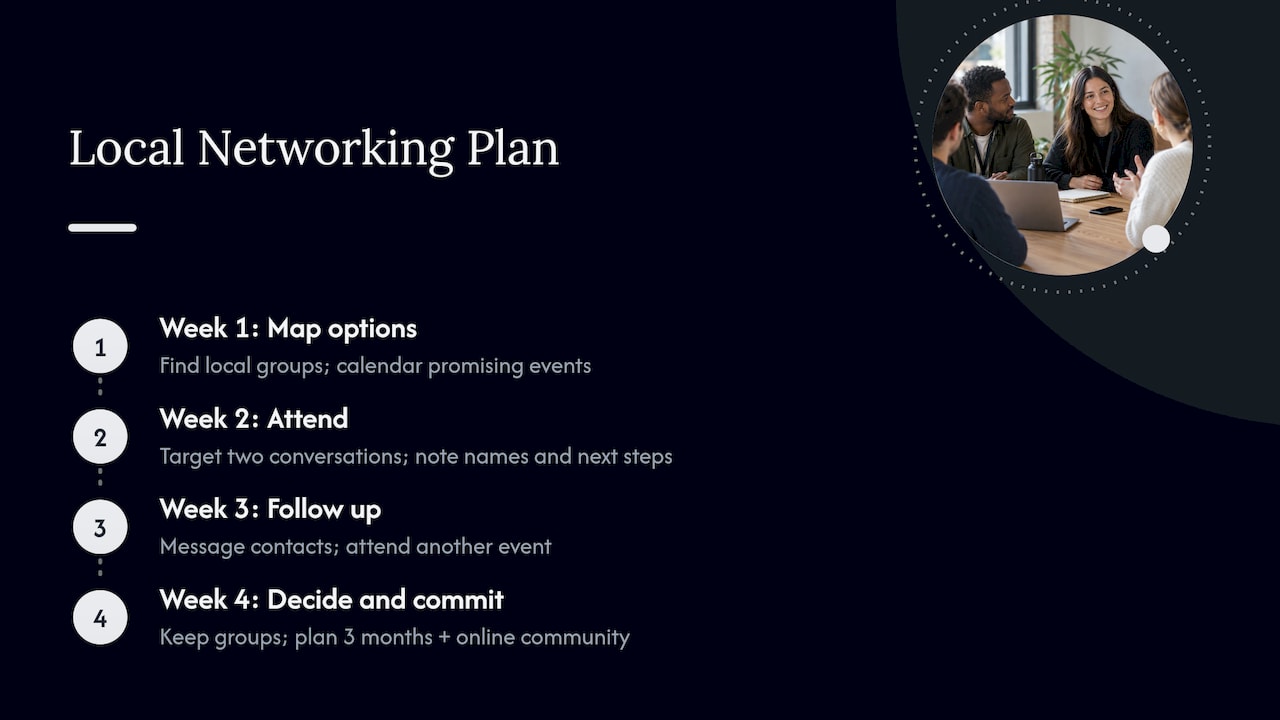
If you would rather start today, here is a plan you can run alongside a full-time job or a client schedule.
Week 1: Map the options. Spend an hour finding your chamber calendar, the SBA events search, one SCORE chapter or webinar, and two event-platform groups in your area. Put every promising event in your calendar, even ones you doubt.
Week 2: Attend your first event. Choose the one with the clearest match to your goals. Set a single target: two real conversations. Write down names and next steps as soon as you leave.
Week 3: Follow up and attend a second. Send your follow-up messages, then go to a second event from a different group, or return to the first. A repeat visit tells you more than a first.
Week 4: Decide and commit. Keep the one or two groups where you felt useful and welcome. Drop the rest. Schedule the next three months of attendance, and add one online community for the weeks between events.
At the end of the month you should have a short list of contacts, a clear sense of which format suits you, and at least one person you could call with a question. If the answer is no, that tells you something too: widen your search or look at a cohort-based program.
Common mistakes to avoid
- Treating every event as a sales pitch. People buy from those they trust, and trust takes more than one conversation.
- Collecting contacts without a follow-up plan. A card with no message sent is a missed opportunity.
- Sticking to a room of identical people. Some variety, such as a supplier, a mentor and a peer, gives you a fuller picture.
- Joining too many groups at once. Two groups attended consistently beat six attended once.
- Waiting until you need something. Show up and help others first. When you ask later, the answer comes easier.
FAQ
Where do business people meet?
Mostly at industry events, chamber of commerce gatherings, professional associations and civic clubs, according to career guidance. Coworking spaces, conferences and online communities are common too. Which one suits you depends on whether you want local customers, industry peers or a flexible remote crowd.
How do I join a business group?
Joining often means signing up for a networking group, civic club or professional organization, such as a local chamber of commerce. Many groups let you attend a first event as a guest, so ask before paying dues. Attend twice, then decide.
How can I find business meetups in my area?
Check your chamber’s calendar, search event platforms by city, and consult professional or alumni associations, as this guide suggests. The SBA events page is a free, official starting point. Widen your radius if your town is small.
Are there free business meetups?
Yes. Many mixers and community events are free or low-cost, and the SBA lists events from resource partners, some marked free. SCORE also offers free mentoring and webinars. Membership organizations such as referral groups usually charge dues, so confirm costs first.
What can I do if there are no good meetups near me?
Try online communities, travel to a nearby city once a month, or join a multi-day cohort program. A bootcamp gives you concentrated time with other founders, which is hard to replicate in a one-hour event. See our upcoming bootcamps for current options.
Sources
- What Is Networking in Business? (With Tips and Importance)
- Find Local Networking Events Abroad
- 7 Local Organizations for Entrepreneurs to Network and Grow
- An All-Encompassing Guide to Networking Events
- Business Networking Events Near Me: How to Find the Right Ones
- Every Business Networking Group in the U.S.
- How to Find Local Networking Events Near You
- How Entrepreneurs Can Network More Effectively
- SBA: Find upcoming events