
Founders: Build an Evidence Based Community in 90 Days
The most effective ways to build a business community are cohort bootcamps, structured accountability groups, mentor-matched pods, recurring sprints with demo days, and immersive in-person retreats, each backed by controlled studies on peer effects and incubation outcomes. These formats work because they combine deliberate structure with real relationships, not just proximity. The right mix depends on your stage, team size, and how much external accountability your people actually need.
TL;DR:
- Cohort bootcamps can produce significant spillover effects, improving team performance by up to two-thirds standard deviation when participants are housed together.
- Structured accountability groups with regular progress reporting and shared trackers causally enhance venture outcomes, especially for founders lacking external monitoring.
- Mentor-matched pods lead to approximately 22% revenue growth and 15% employment increase over six months, providing tangible business benefits for early-stage teams.
- In-person community formats foster richer trust and collaboration, as online groups tend to have lower network density and fewer indirect connections.
- Building a community requires deliberate screening for diverse backgrounds, clear structures, and commitment, with success measured by active task completion and early business signals.
Table of Contents
- Ways to Build Community That Actually Move Business Forward
- Design Principles That Determine Whether a Community Actually Works
- How to Launch, Run, and Scale Your Community in 90 Days
- What Practitioners See Work in Bootcamps and Retreats
- How Nomad Excel Turns These Methods Into a Program You Don’t Have to Build Yourself
- Selected Research and Practitioner Readings
- Sources
- FAQ
Ways to Build Community That Actually Move Business Forward
Most founders default to a Slack channel and a monthly happy hour, then wonder why nobody shows up after month three. The methods below work because they pair social connection with a structural reason to keep engaging: a deadline, a mentor check-in, a demo to prepare for.
Cohort bootcamps. A fixed group moves through the same curriculum on the same timeline, usually over one to four weeks. Cohesion happens fast because everyone hits the same obstacles at the same time. Research on peer effects in startup teams found that a one standard deviation increase in a nearby team’s performance was tied to a two-thirds standard deviation improvement in the focal team’s output, which is a striking spillover for something as simple as sitting in the same room. This fits founders validating an idea or refining an offer for the first time. Start by capping the group at 15 to 20 people and building in shared milestones every few days.
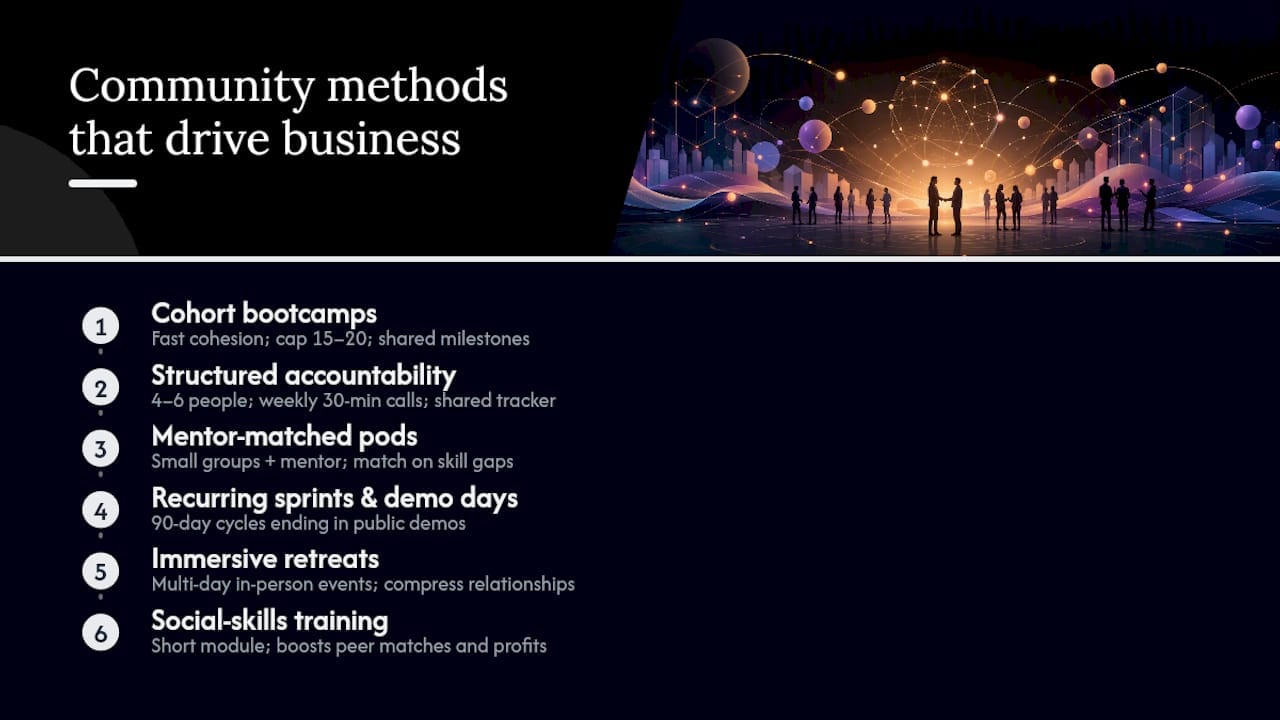
Structured accountability groups. Sometimes called platoons or advisory boards, these are small groups (four to six people) that meet on a fixed cadence to report progress and commit to next steps publicly. A working paper on accelerator programs found structured accountability causally improves venture performance for certain founders, particularly those who lack external monitoring. It fits solo founders and small teams without a board. Start with a weekly 30-minute call and a shared tracker for committed tasks.
Mentor-matched pods. Small groups paired with one or two experienced operators for a defined period. Incubated companies in one program grew 22% more in revenue and 15% more in employment over six months than non-incubated peers, and pairing with a high-ability mentor added roughly 3.2% more revenue a year later. This fits early-stage teams past the idea stage who need judgment, not just information. Start by matching on skill gaps, not personality.
Recurring sprints and demo days. Short execution cycles (often 90 days) that end in a public showcase. The forcing function of a deadline plus an audience keeps momentum from decaying, and it gives your business sprints a natural rhythm. This fits teams that already have a product and need velocity.
Immersive retreats. Multi-day, in-person events that compress months of relationship-building into a week. They fit distributed teams or founders who only connect online otherwise.
Social-skills training. A short module teaching people how to network deliberately. In a field experiment, entrepreneurs who received social-skills training matched with 50% more peers and grew monthly profits by roughly 20%. Most communities skip this step entirely and just hope people mingle well on their own.
Pro Tip: Pick one primary method and one supporting method, not five at once. A cohort bootcamp paired with light accountability check-ins outperforms a scattered mix of every tactic on this list.
Design Principles That Determine Whether a Community Actually Works
Structure only pays off if the underlying group dynamics are right. Three variables decide whether a community produces real business outcomes or just pleasant small talk: psychological safety, composition, and format.
Psychological safety is a behavior, not a personality trait. Amy Edmondson’s research and the practical steps built on it show leaders can create it through repeatable actions: asking more questions, normalizing mistakes as part of learning, and inviting input with humility. A PLOS One study found that safety behaviors like collaboration and give-and-take improve innovative performance specifically through better communication, not through comfort alone.
Diversity beats similarity, but only up to a point. Groups made entirely of people who already know each other underperform. Research on prior ties found that founders with deep existing networks tend to fall back on old contacts and miss out on the spillovers cohorts are designed to create. Screening for a mix of backgrounds, industries, and stages produces more useful friction than a room of lookalikes.
- Screen for skill and experience diversity, not just demographic variety.
- Cap group size around 15 to 20 for cohort settings; smaller for accountability pods.
- Weight selection toward founders who lack strong existing networks. They benefit most.
- Choose in-person formats when trust and serendipity matter most.
Format matters more than most founders assume. Comparisons of offline and online cohorts found that online groups had lower network density and fewer indirect connections than in-person ones. If your goal is deep trust and unplanned collaboration, weight toward physical retreats or bootcamps. If the goal is ongoing accountability among people who already know each other, virtual formats work fine.
How to Launch, Run, and Scale Your Community in 90 Days
- Recruit deliberately. Screen applicants for commitment level, stage fit, and existing network density. Flag founders with heavy prior ties. They need extra encouragement to engage with new people.
- Run an onboarding ritual in week one. Use structured icebreakers, set explicit norms around asking questions and admitting what you don’t know, and assign a facilitator to model that behavior early. Icebreaker frameworks from a team building activities guide work well here.
- Set a fixed cadence for weeks two through twelve. Weekly accountability calls, biweekly mentor touchpoints, and a demo or milestone review at the 90-day mark. A clear mentorship program structure prevents mentor relationships from fizzling.
- Track four metrics: attendance and engagement rate, number of new peer connections formed, committed tasks completed, and early revenue or progress signals.
- Scale through alumni. Turn graduates into peer facilitators, build an asynchronous knowledge base of past sprints, and run recurring cohorts instead of one-off events.
Pro Tip: Track “committed tasks completed” every week, not just attendance. Attendance measures interest; completed commitments measure whether the community is actually changing behavior.
What Practitioners See Work in Bootcamps and Retreats
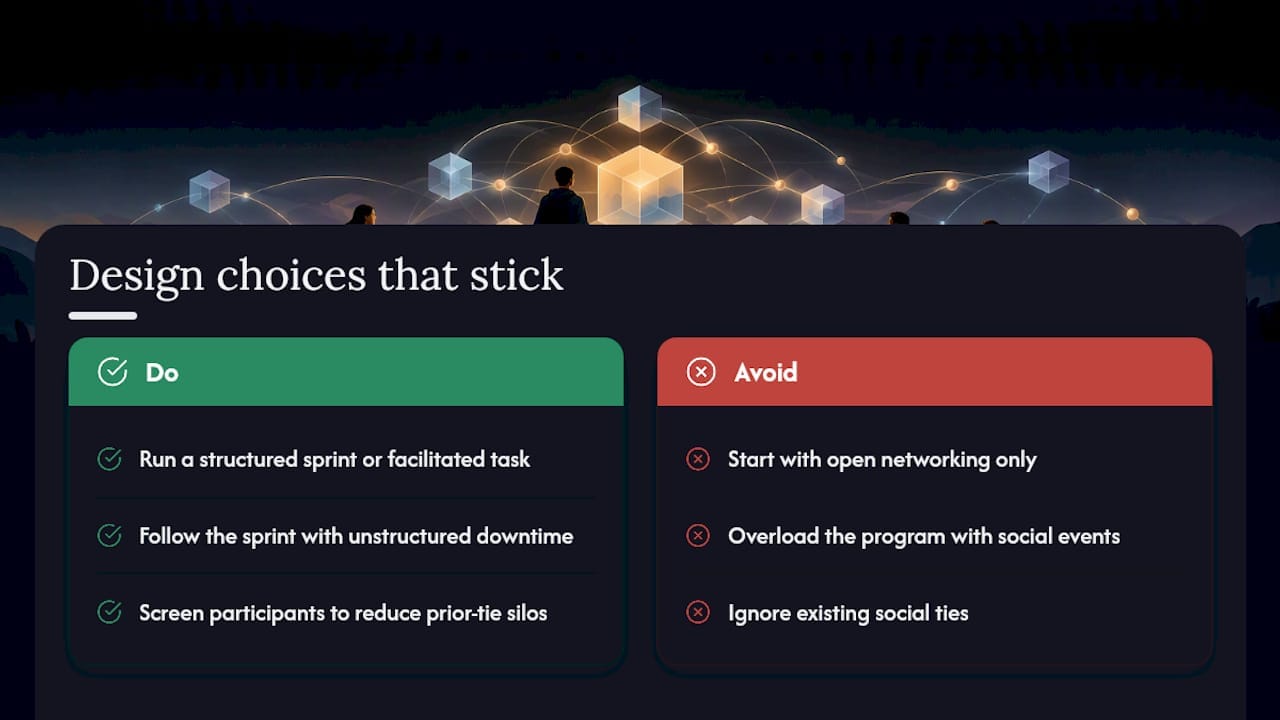
The pattern that separates a community that sticks from one that fades is structure around the social time, not instead of it. Groups that jump straight into open networking sessions without a shared task tend to produce polite conversation and little else. The ones that work pair a structured sprint or facilitated small-group exercise with unstructured time afterward. The sprint gives people something concrete to bond over; the downtime lets the relationship deepen.
The most common mistake is overloading a program with social events and assuming connection will happen organically. It rarely does at scale. The second mistake is ignoring prior-tie effects entirely. Groups run without screening default to whoever already knows whoever, which quietly reproduces the same silos the community was supposed to break down.
— Amichai
How Nomad Excel Turns These Methods Into a Program You Don’t Have to Build Yourself
Everything above works, but building it from scratch means designing curriculum, recruiting for fit, training facilitators, and running logistics on top of running your business. The methods above can be combined into structured programs that offer cohort learning with mentor-matched guidance and accountability sprints, while company retreats focus on building trust and serendipity through in-person time for distributed teams. The Online Business Bootcamp delivers the mentor-pod and accountability structure in a remote format, while options like a company retreat handle the in-person density that virtual cohorts can’t replicate.
If you’d rather join a built program than assemble one:
- Browse the current bootcamp lineup to see cohort dates and formats.
- Read the case for joining a bootcamp before committing.
- Visit Nomad Excel to request program details for your team or your own founder journey.
This is a paid, facilitated path rather than a do-it-yourself one, and it exists for founders and teams who’d rather start building relationships this week than spend the next quarter designing a curriculum first.
Selected Research and Practitioner Readings
- Social skills training and peer matching among entrepreneurs
- Incubation and mentoring outcomes for early-stage ventures
- Prior ties and peer effects on startup teams
- Psychological safety and innovative performance
- Building trust in virtual settings
Sources
- Social Skills Improve Business Performance: Evidence from a randomized experiment with entrepreneurs
- Early-Stage Venture Incubation and Mentoring Promote Learning, Scaling, and Profitability Among Disadvantaged Entrepreneurs
- Prior ties and the limits of peer effects on startup team performance
- The impact of team psychological safety on employee innovative performance (PLOS One)
FAQ
What is the fastest way to build a business community?
A short, structured cohort bootcamp typically builds cohesion fastest because everyone faces the same challenges on the same timeline. Peer-effect research found spillovers as large as a two-thirds standard deviation improvement in team output from proximity alone.
How many people should be in a founder accountability group?
Four to six people works best for accountability pods, since it’s small enough for everyone to report progress each session without the meeting running long. Larger cohort programs, like bootcamps, can support 15 to 20 participants because the structure carries the group rather than individual accountability.
Does mentorship actually improve business outcomes?
Yes. One incubation study found mentor-matched companies gained roughly 3.2% higher revenue and 3.5% higher profits a year after the program compared to peers without mentor access.
Should a business community meet in person or online?
In-person formats tend to build trust and serendipity faster, since research comparing the two found online cohorts had lower network density and fewer indirect connections. Virtual formats still work well for ongoing accountability once relationships are already established.
What does it cost to join a Nomad Excel bootcamp?
Pricing varies by program. The 5-Day Online AI Bootcamp costs €300 one time, and the Online Business Bootcamp costs €500 one time. In-person sprint bootcamps in Lisbon have published prices of €1,350 or €1,500. Current pricing for retreats and other formats is available directly on the Nomad Excel site.