
90 Day Playbook for Founders to Create a Community That Sticks
Start narrow, not broad: pick one clear purpose, recruit a 10 to 20 person founding cohort by hand, and run one signature event within your first two weeks to seed real activity. That single move, done well, beats months of building an online presence. This pattern holds whether you’re building online or in person.
TL;DR:
- Building a community from scratch is most effective when starting with a small, specific purpose and recruiting a dedicated founding cohort through personal invites.
- Community phases include seed, launch, stabilization, and growth, with early focus on density and quality content rather than scale or member count.
- The choice of platform should align with your community model, favoring minimal tools like forums, chat, or course platforms depending on your structure.
- Consistency in small actions, such as daily engagement and hosting regular rituals, is crucial for long-term retention and momentum.
- Tracking engagement metrics like first-time participation and cohort retention provides more meaningful growth indicators than total member numbers.
Table of Contents
- How Do You Create a Community from Scratch?
- What Are the Steps to Build a Community?
- Which Platform and Tools Should You Use?
- What Should the First 90 Days Look Like?
- How Do You Keep a Community Growing Long Term?
- How Do You Know if Your Community Is Actually Working?
- What Real Experience Backs This Playbook?
- How Should You Handle Governance and Moderation?
- How Do You Resolve Disputes Without Losing Members?
- How Do You Build an Inclusive Community from the Start?
- How Do You Plan for Growth Without Losing What Works?
- How Do You Get Members Creating Content and Leading?
- What Actually Trips People Up Early On
- Want a Faster Path to Your Founding Cohort?
- Sources
- FAQ
How Do You Create a Community from Scratch?
Building a community and building an audience are not the same project, even though they get confused constantly. An audience listens to you. A community talks to each other, with or without you in the room. That distinction should shape every decision you make in your first month, because the moment members start solving each other’s problems without waiting for you to show up, you have something durable. Before that happens, you’re just running a broadcast channel with extra steps.
Your starting point needs a member value proposition: one sentence explaining what someone gets by joining that they cannot get anywhere else. Not “networking” or “support.” Something specific, like “weekly feedback on your pricing page from three founders who’ve shipped SaaS products in the last year.” Vague promises attract passive members. Specific promises attract people who show up.
From there, pick an operating model. There are three that work reliably:
- Audience-first: you already have followers, subscribers, or customers, and you’re converting passive attention into active participation. Works well if you have distribution but no engagement.
- Event-driven: the community exists around a recurring gathering, in person or on a call, and the connective tissue between events is secondary. Works well for local or niche professional groups.
- Ambassador-based: a small set of highly engaged members carry the culture and recruit others, and you deliberately step back from being the hub. Works well once you’ve outgrown founder-led everything.
None of these is universally correct. Community-led growth strategies for small businesses show that treating community as an operating system, rather than a marketing campaign, tends to outperform any single tactic, because it forces you to think about member behavior instead of your own content calendar.
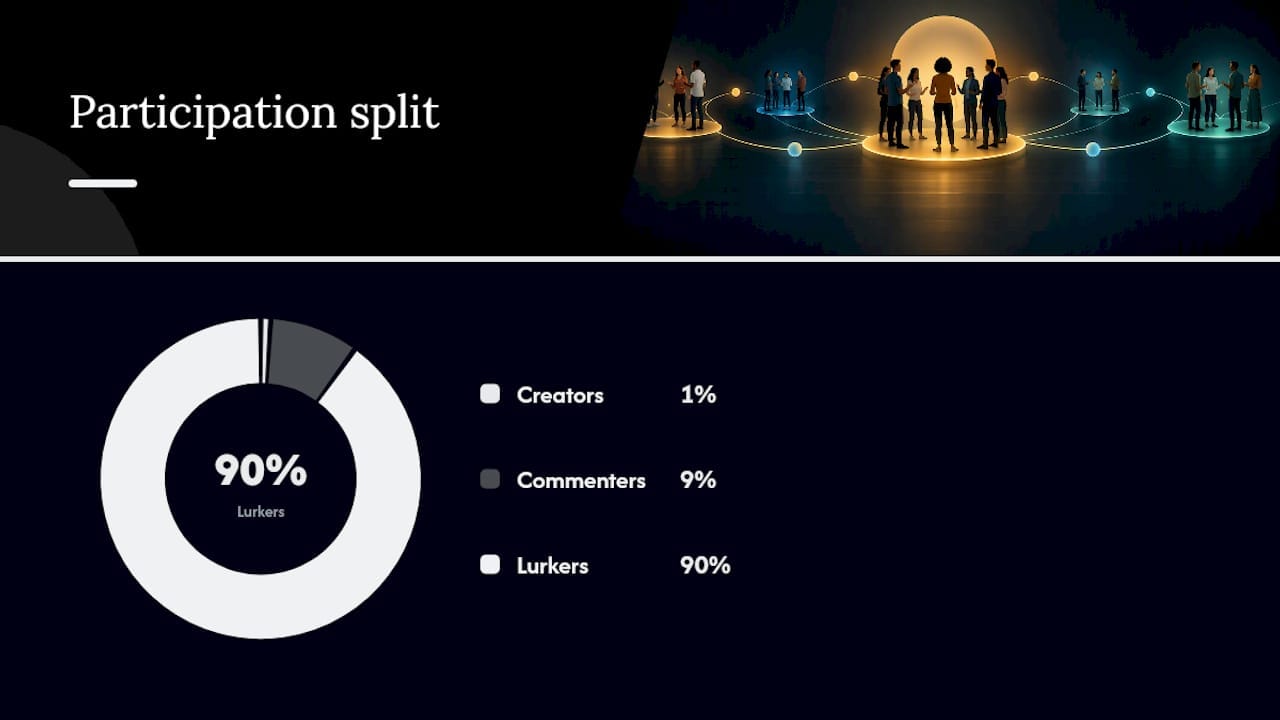
Underneath whichever model you choose, the same behavioral math applies. Community design research points to a rough 1-9-90 distribution: about 1% of members create most of the visible content, 9% comment and react, and 90% mostly watch from the sidelines. That’s not a failure state.
What Are the Steps to Build a Community?
A community launch has four phases, and skipping the first two is the most common reason communities feel empty six weeks after they open. Practitioner data suggests communities typically take 6 to 12 months to reach critical mass, so the goal in the early phases isn’t scale. It’s density.
Pro Tip: Resist the urge to open registration widely before you have content in the space. An empty room with 500 members feels far deader than a full room with 30.
- Prelaunch, week one. Write down your purpose in one sentence, decide the two or three metrics that will tell you if it’s working (first-time participation rate is a good starting metric), and assign roles even if it’s just you wearing three hats. Build a small taxonomy of topics or channels, no more than five to start. More categories than active members is a common early mistake.
- Seed, weeks two and three. Recruit your founding cohort of 10 to 20 people through personal, individual invites, not a mass email. Ask each one a specific favor: introduce themselves in a thread, answer one question, share one resource. Publish 15 to 20 starter threads yourself before you invite anyone, so the space never looks empty on someone’s first visit.
- Launch, weeks four through six. Run one or two signature events, the kind that gives people a reason to show up on a specific day. Activate a simple onboarding flow that prompts a low-friction first action, like introducing themselves or answering a poll, within their first five minutes.
- Stabilize, months two and three. Identify the members who are naturally answering questions and helping others, and formally recognize them, whether that’s a title, a badge, or early access to something. Turn your best recurring questions into canonical, pinned answers so new members stop asking the same thing every week.
The founder or core team typically has to manually drive over half of visible activity in month one, and that share should decline steadily as members start engaging each other directly. If you’re still writing every post in month three, something in your model needs adjusting. It usually means the value proposition wasn’t specific enough, or the founding cohort was recruited too passively.
Which Platform and Tools Should You Use?
Your platform choice should follow your model, not the other way around. Too many organizers pick a tool because it’s trendy, then spend months trying to force their community’s behavior to fit the software instead of finding software that fits the behavior they want.
Run through this checklist before committing to anything:
- Real-time chat vs. searchable forums. Chat platforms create energy and immediacy but bury good answers within hours. Forums preserve knowledge but feel slower and less social. Most communities need a bit of both.
- Membership controls. Can you gate access by tier, approve applications manually, or segment members by cohort? If you plan to charge for access eventually, confirm this early.
- Event workflows. Does the platform handle RSVPs, reminders, and recordings natively, or will you be duct-taping a calendar tool and a video platform together indefinitely?
Mapped to the three models: audience-first communities usually do well on forum-first platforms where content accumulates and gets found through search. Event-driven communities lean on chat-first tools that support quick coordination around a date. Ambassador-based and cohort communities, especially ones tied to structured learning, often fit course-plus-community platforms that bundle content delivery with discussion.
Whatever you pick, keep the surrounding stack minimal. A shared calendar for events, a simple form or spreadsheet for tracking members and their engagement, and one lightweight analytics view (even a monthly manual count of active participants) is enough to start. Adding a project management tool, a separate CRM, and three integrations before you have 50 active members is a distraction dressed up as preparation.
What Should the First 90 Days Look Like?
The first three months are where most communities either build momentum or quietly stall, and the difference usually comes down to consistency of small actions rather than any single big move.
Pro Tip: Block 30 minutes daily for community upkeep during your first 90 days. It’s a small, non-negotiable habit that prevents the slow fade where a community goes quiet because nobody restarted the conversation.
- Daily, weeks one through four. Personally welcome every new member by name within a day of joining. Keep seeding starter discussions, aiming for at least one new thread a day until organic conversation outpaces you. Curate and share one useful resource daily, even something small, so there’s always fresh content for members to find.
- Weekly, throughout the 90 days. Post a discussion prompt tied to a real problem your members face, not a generic icebreaker. Spotlight one member’s win or contribution publicly. If you ran an event that week, turn it into searchable follow-up content, a short recap, a key quote, a resource list, rather than letting it disappear into a recording nobody rewatches. Community building strategies used in entrepreneurship bootcamps follow this exact pattern: every workshop becomes reusable material, not a one-time moment.
- Monthly, at the 30, 60, and 90 day marks. Review your core metrics and be honest about the trend line. Publicly recognize your top three to five contributors, ideally with something concrete like a shoutout, a badge, or early access to a future event. Start identifying one or two members who could take on informal moderation or ambassador responsibilities, and begin training them before you need them.
By day 90, you should have a visible archive of searchable content, a handful of members who post without being prompted, and at least one recurring ritual members expect. If none of that exists yet, the fix is rarely a new feature. It’s usually more personal outreach and fewer passive announcements.
How Do You Keep a Community Growing Long Term?
Retention comes from rituals, not features. A predictable rhythm, a weekly thread, a monthly call, a quarterly in-person meetup, gives members a reason to return that has nothing to do with whether your platform added a new button. Neuroscience research on social connection suggests that repeated group interaction correlates with measurable belonging, which is a fancy way of confirming what community organizers have known for decades: showing up consistently matters more than showing up impressively.
Design your rituals around your members’ actual jobs-to-be-done, not around what’s easy for you to run. If your members joined to get feedback, your ritual should be a recurring feedback session, not a generic “hang out” call that drifts into small talk.
Recognition systems are where a lot of communities either build loyalty or accidentally kill it. A few patterns that work:
- Contributor ranks or badges give the top 1% to 9% a visible reason to keep creating, tapping into the same identity-driven motivation that drives brand loyalty through authentic engagement.
- Exclusive access, an early call, a private channel, a first look at new content, rewards consistency without requiring public performance, which suits quieter high-value members.
- Referral or inner-circle tiers work once you have a stable core; introducing a paid tier before that core exists usually just filters out the people you need most.
Save monetization for after retention is proven. A community that can’t keep members engaged for free will struggle even harder to keep them engaged for money.
How Do You Know if Your Community Is Actually Working?
Vanity numbers lie. Member count tells you almost nothing; a group of 2,000 with 40 active people is weaker than a group of 200 with 80 active people. Track a small set of KPIs instead:
- First-time participation rate: the percentage of new members who take any action (post, comment, react) within their first week.
- DAU/MAU for your active cohort, not your total membership, to see how sticky engagement is among people who show up at all.
- Event attendance as a raw number and as a percentage of your active base.
- Retention by cohort, tracking whether members who joined in month one are still active in month three.
- Searchable asset count, the running total of threads, guides, and recaps members can find later without asking again.
One benchmark worth planning around: seeded communities commonly need 6 to 12 months to reach critical mass, so a flat or slow-growth first quarter is not automatically a warning sign.
Track these in a simple spreadsheet monthly for the first year; a dedicated analytics tool is rarely necessary before month six. If first-time participation rate is climbing and retention by cohort holds steady, keep doing what you’re doing. If attendance is flat for two months straight, iterate on your ritual before assuming the whole model is broken. If searchable asset count isn’t growing at all, that’s usually a sign your events aren’t being converted into anything members can find later, and that fix is often the fastest win available.
What Real Experience Backs This Playbook?
This playbook reflects patterns Nomad Excel has observed across cohort-based entrepreneurship bootcamps and company retreats, where a founding group of participants has to become a functioning peer network within days, not months. Running an in-person bootcamp is, in effect, a compressed version of the seed and launch phases described above: a small group, a shared purpose, and structured rituals from day one.
A few resources worth exploring if you want to see the model in action:
- Why community-driven bootcamps accelerate business growth breaks down how cohort structure builds lasting peer networks.
- How to build a startup community that drives real growth covers measurement and turning events into lasting knowledge.
- Previous Bootcamps shows past cohorts if you want a sense of scale and format.
If you’re weighing whether to build your founding cohort organically or borrow one, a bootcamp can function as an instant seed group, compressing weeks of recruiting into a single immersive program.
How Should You Handle Governance and Moderation?
Every community needs rules before it needs them, meaning you write your guidelines while things are calm, not after your first conflict forces your hand. Keep the rules short enough that members actually read them: what’s welcome, what’s not, and what happens when someone crosses the line.
Governance works best as a layered system. You, as founder, set the tone and hold final authority early on. As the community grows past a few hundred active members, distribute moderation to trusted members, ideally the same people your recognition systems have already surfaced as reliable contributors. Give them clear, narrow authority (removing spam, flagging disputes) rather than vague “keep things nice” instructions that lead to inconsistent enforcement.

Transparency matters more than strictness. Members tolerate firm rules if they understand why they exist and see them applied consistently. What erodes trust fastest is selective enforcement, letting a founding member break a rule that a newcomer would get warned for.
Document moderation decisions somewhere your team can reference them, even informally. This prevents the common failure mode where two moderators handle the same type of issue completely differently, which members notice immediately and resent. As you formalize governance, revisit your rules every few months. What worked with 30 members often needs adjustment at 300, particularly around how much self-organization you allow versus how much you centralize.
How Do You Resolve Disputes Without Losing Members?
Conflict is not a sign your community is failing. It’s a sign people care enough to disagree, and how you handle the first few disputes sets the precedent for every one after it.
Address disagreements privately first whenever possible. Public callouts, even well-intentioned ones, tend to escalate rather than resolve, because they turn a two-person disagreement into a spectator event. Reach out directly, hear both sides, and only bring a resolution back to the group if the dispute genuinely affects shared space or rules.
Separate personality friction from actual rule violations. Two members who simply don’t get along don’t need punishment; they might just need a reminder to disengage from each other’s threads. A member who violates stated guidelines, harassment, spam, bad-faith arguing, needs a consistent, predictable response: usually a warning first, then temporary restriction, then removal if it continues.
Have an appeals path, even a simple one. Members are far more accepting of a moderation decision, even one they disagree with, if they feel it was made fairly and they had a chance to explain their side. Skipping this step tends to create resentment that resurfaces later, sometimes publicly, sometimes as quiet disengagement you never see coming.
Finally, resist the urge to make every dispute a policy change. One bad interaction doesn’t always mean your rules are wrong. Wait for a pattern before you rewrite your guidelines around a single incident.
How Do You Build an Inclusive Community from the Start?
Inclusion isn’t a values statement you post once. It’s a set of decisions that show up in who gets invited first, whose voices get amplified, and who feels safe posting something imperfect.
Start with your founding cohort. If your first 10 to 20 members all look alike, think alike, or come from the same network, your community’s culture will calcify around that narrow experience before newer, more diverse members ever arrive. Deliberately recruit founding members across different backgrounds, experience levels, and perspectives relevant to your purpose, not as a checkbox, but because varied founding voices produce richer early content and a wider sense of who “belongs” here.
Watch who’s actually talking. If your comment threads and event attendance skew heavily toward one demographic while your membership is more mixed, that’s a signal your format or timing might be quietly excluding people. Rotating event times across time zones, offering both text and voice ways to participate, and actively inviting quieter members into visible roles all help close that gap.
Write your guidelines to explicitly name unacceptable behavior around exclusion, not just generic “be respectful” language. Vague rules get inconsistently enforced, and inconsistent enforcement is where members from underrepresented groups usually feel the friction first.
Recognition systems should reflect this too. If your contributor spotlights consistently feature the same few voices, actively look for who else is doing good, quieter work and hasn’t been seen yet.
How Do You Plan for Growth Without Losing What Works?
Growth breaks things that worked fine at a smaller size, and the communities that scale well are the ones that plan for that breakage instead of being surprised by it.
The first phase, roughly your founding cohort through a few hundred active members, runs on founder-led attention. You know most members by name, and moderation can be informal because you’re personally present in most conversations. This phase should not be rushed; it’s where your culture gets set.
The second phase starts once you can no longer track every member personally. This is where the ambassador model, mentioned earlier, becomes less optional and more necessary. You need documented guidelines, delegated moderation, and canonical answers to recurring questions, because you physically cannot answer everything yourself anymore.
The third phase, often past a thousand active members, usually requires structural changes: sub-communities or channels organized by topic or region, a tiered recognition system with real teeth, and possibly dedicated staff or paid moderators. Communities that skip straight from phase one to phase three without building phase two’s infrastructure tend to fracture, because there’s no middle layer of trusted members to absorb the load.
Plan your taxonomy, your channel structure, and your moderation model with the next phase in mind, not just your current size. Retrofitting structure onto an already-large, already-chaotic community is far harder than building it in before you need it.
How Do You Get Members Creating Content and Leading?
Most of them became active because something specific invited them in: a direct question, a small ask, a visible reason to contribute.
Lower the barrier to a first contribution deliberately. Instead of “share your thoughts,” ask something narrow and answerable: “What’s one tool you switched to this year and why?” Specific prompts get specific answers, and specific answers are far easier for a new member to write than an open-ended invitation.
Turn your best contributors into hosts, not just posters. A member who consistently gives good feedback can be invited to co-host a discussion or lead a session on their specific expertise. This does two things: it gives them a title and visibility that motivates continued contribution, and it distributes your workload as founder, which matters most in the stabilize and grow phases.
Make member-generated content easy to find and easy to build on. If someone writes a genuinely useful post, pin it, reference it later, and tell them directly that it helped someone. That feedback loop, seeing your contribution actually used, is one of the strongest reasons contributors stay active long term.
Formalize a leadership pathway once you have enough active members to support one: informal helper, then recognized contributor, then ambassador or moderator. Members who can see a path forward contribute more consistently than members who feel like permanent spectators.
What Actually Trips People Up Early On
Most first-time community builders overbuild their tools before they have anyone to use them, spending weeks configuring a platform that would work fine as a basic group chat with three channels. The fix is simple: launch with the minimum viable setup and add structure only when actual usage demands it.
The second trap is opening too broad, welcoming everyone instead of a specific type of member, which produces a room full of people with nothing in common to talk about. Narrow your purpose until it feels almost too specific, then hold that line for the first few months.
The third trap is delaying recognition until “enough” people are active. Recognize your first genuinely helpful member immediately, publicly, and specifically. Waiting for scale before you reward contribution guarantees you’ll have less of it. Save this as your working checklist: define one narrow purpose, hand-recruit your first 20 members, seed your own content before inviting anyone, run one event in week two, and recognize your first great contributor the same week you see them show up.
— Amichai
Want a Faster Path to Your Founding Cohort?
Building a community from zero works, but it takes months of manual seeding, personal invites, and patient consistency before the room fills itself. If you’d rather compress that timeline, a structured, in-person format does a lot of that seeding work for you in a matter of days instead of months. Nomad Excel’s entrepreneurship bootcamps bring together a curated cohort of founders for one to four weeks of hands-on building, mentorship, and daily collaboration, which naturally produces the kind of founding cohort this article describes: a small group who already trust each other, already have shared context, and already know how to keep each other accountable once the program ends. It’s not a requirement for building a community; it’s an accelerant for readers who want the founding cohort and the rituals in place before they go home. If that fits where you are, explore current bootcamp programs and see which cohort format matches your goals.
Sources
- Community-led growth strategies for small businesses (Shopify)
- Popup
- PLOS One study (group membership and social behavior)
FAQ
How Can You Build a Community from Nothing?
Pick one narrow purpose, hand-recruit 10 to 20 founding members through personal invites, and seed 15 to 20 starter discussions before anyone else arrives so the space never looks empty. Follow with one signature event in your first two to three weeks to give people a reason to show up together.
How Is a Community Typically Formed?
Communities form around a shared purpose or problem, then solidify through repeated interaction, rituals, and recognition of active contributors. Research on group behavior shows repeated social interaction strengthens feelings of belonging, which is why consistent events matter more than one impressive launch.
How Do You Start a Small Community?
Start with a founding cohort of 10 to 20 people rather than opening broadly, since a small, engaged group creates more visible activity than a large, quiet one. Expect it to take 6 to 12 months to reach critical mass, so treat the first quarter as a seeding phase, not a growth failure.
What’s the Fastest Way to Get a Founding Cohort?
Hand-recruiting through personal outreach is the standard method, but an immersive program can compress that process significantly. Nomad Excel’s bootcamps gather a curated group of founders for one to four weeks of structured collaboration, which functions as an instant founding cohort for entrepreneurs who’d rather not build one from scratch.
How Do You Know if Your Community Is Actually Growing?
Track first-time participation rate, retention by cohort, and event attendance rather than raw member count, since a large but inactive group is weaker than a small, engaged one. If those metrics hold steady or climb over a few months, the model is working even if total growth feels slow.