
4 Revenue Streams Founders Should Model: Education & Service Examples
Revenue streams fall into four core buckets: recurring or subscription income, transaction-based sales, service and project work, and secondary sources like licensing, advertising, and affiliate commissions. Recurring revenue gives you predictability. Transaction, service, and project work each carry their own scalability and resource tradeoffs, and the mix you choose shapes how your business grows.
TL;DR:
- Most businesses should prioritize testing a core predictable revenue stream, such as recurring subscriptions or retainers, before diversifying into multiple types.
- Technology and SaaS companies benefit from a focus on metrics like monthly recurring revenue and churn rates to measure health and forecast growth.
- Transactional and service-based models scale faster but carry limitations like resource constraints and reliance on customer acquisition cost.
- Investors favor businesses with a diversified revenue mix, especially those with predictable recurring income, for lower risk and higher valuation multiples.
- Startups must treat each revenue stream as an hypothesis, validating willingness to pay and adjusting or dropping models that do not perform well in real sales tests.
Table of Contents
- What Counts as a Revenue Stream (and What Doesn’t)
- The Main Revenue Types, With Real Examples
- How to Choose and Test a Revenue Stream
- Realistic Revenue Mixes Worth Modeling
- Tracking and Forecasting Each Stream
- Why Investors Look Past Your Top-Line Number
- Treat Every Revenue Stream as a Hypothesis, Not a Decision
- Where to Test These Models Before You Bet the Business on Them
- Sources
- FAQ
What Counts as a Revenue Stream (and What Doesn’t)
A revenue stream is any distinct source of money flowing into your business, tied to a specific product, service, or customer relationship. Not all revenue counts the same way, and confusing the two can distort how healthy your business actually looks.
Operating revenue comes from your core activities. If you run a coaching business, that’s client fees. If you sell software, it’s subscriptions. Non-operating revenue comes from everything else: interest on cash reserves, a one-time asset sale, a legal settlement, a grant. Investors and lenders care deeply about this distinction because operating revenue tells them whether the actual business works, while non-operating revenue can flatter a balance sheet without reflecting anything repeatable.
Most businesses fall into a few broad categories, and understanding the split matters before you touch pricing or packaging:
- Recurring/subscription: memberships, SaaS fees, retainers billed on a schedule
- Transaction/sales: one-time purchases, e-commerce orders, single-ticket sales
- Service or project-based: hourly consulting, fixed-scope projects, freelance contracts
- Secondary/ancillary: licensing, advertising, affiliate commissions, brokerage fees
Many businesses run hybrid models that blend two or more of these. A gym might charge a monthly membership (recurring) plus one-off personal training sessions (transaction), and that blend is often the difference between a business that survives a slow month and one that doesn’t.
The Main Revenue Types, With Real Examples
Each of these models comes with its own math, its own risks, and its own ceiling. Knowing which one fits your product before you build pricing around it saves months of guesswork.
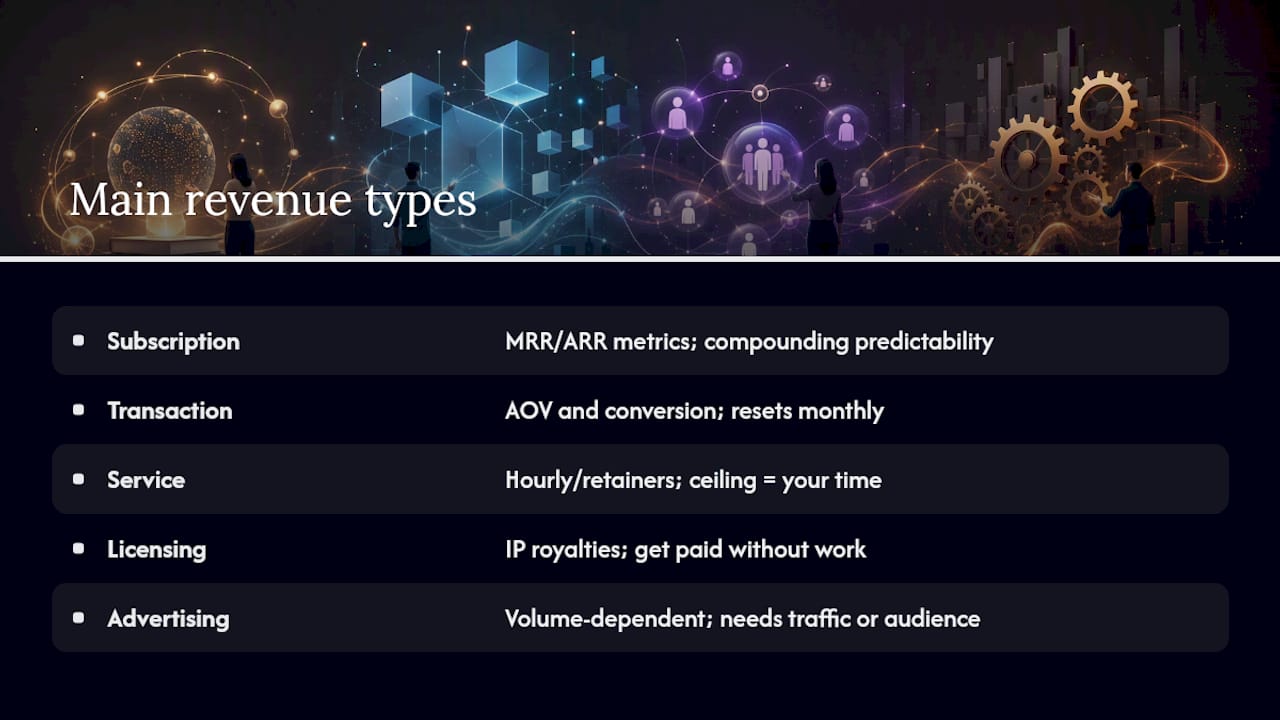
Recurring/subscription revenue shows up in gym memberships, streaming services, and every SaaS product you’ve ever paid for monthly. The Business Model Canvas framework lists subscription fees alongside asset sales and licensing as core revenue mechanics worth mapping early. The key metrics here are Monthly Recurring Revenue (MRR), Annual Recurring Revenue (ARR), and churn rate. The upside is compounding predictability: a customer who pays $50 a month for a year is worth $600, and you can forecast against that. The downside is acquisition cost. If it costs you $80 to land a customer who churns after two months, you’re underwater before the model works.
Transaction/sales revenue covers e-commerce, retail, and any one-off purchase. Average Order Value (AOV) and conversion rate drive the math instead of retention curves. This model scales fast with the right traffic, but it resets to zero every month; there’s no compounding base unless you layer in repeat purchase incentives.
Service-based revenue includes hourly consulting, retainers, and value-based pricing where you charge for outcomes instead of hours. The ceiling here is your own time. A consultant billing $150 an hour caps out at whatever hours exist in a week, which is why service businesses eventually push toward retainers or productized offers to escape the hourly trap.
Project-based revenue is common in agencies, construction, and freelance design work, typically billed against milestones. The risk is estimation. Underquote a project’s scope and the margin evaporates halfway through; overquote it and you lose the bid.
Licensing and royalties let you get paid for intellectual property without doing the work yourself, common in software, franchising, and media. It works best once you already have something proven that others want to distribute.
Advertising, affiliate, commission, and brokerage revenue are the classic ancillary streams. Shopify’s breakdown of ecommerce revenue models groups these alongside subscription and freemium as common structures depending on traffic and audience behavior. These streams rarely work in isolation. You need volume, whether that’s site traffic, transaction flow, or a large audience, before advertising or affiliate income becomes meaningful.
Usage-based and freemium models meter billing to actual consumption (think cloud computing) or offer a free tier that converts a percentage of users to paid. Mature SaaS companies increasingly blend subscription and usage-based pricing to match cost with value delivered.
Pro Tip: Before you commit to a pricing model, ask what your customer already pays for something similar. A buyer used to paying per project will resist a subscription pitch, and a buyer used to subscriptions will balk at a project quote. Match the model to existing purchasing habits, not just your preferred cash flow.
Recurring revenue and brokerage or affiliate commissions tend to produce steadier income than one-off transactions, which is exactly why so many founders try to bolt a subscription onto a transactional business the moment they can.
How to Choose and Test a Revenue Stream
Picking a revenue model isn’t a branding decision. It’s a math problem wearing a strategy costume. Run through this sequence before committing capital or messaging to any one stream:
- Check product fit first. A high-consideration purchase (consulting, custom software) rarely works as a low-friction subscription. A low-cost, frequently-used product rarely justifies project billing.
- Test willingness to pay before building anything. Run a landing page with real pricing and see who clicks “buy,” not just who says they’d be interested.
- Match the model to your sales motion. If you’re closing deals over multiple calls, transaction pricing wastes that relationship. If you’re selling self-serve, a project quote adds unnecessary friction.
- Model your margins at small scale. A service model with 70% margin at ten clients might collapse at fifty if it requires proportional headcount.
- Run a small-sample sales test. Sell to ten real customers before assuming the model works for ten thousand.
- Watch for early red flags: high refund requests, customers negotiating price down repeatedly, or a sales cycle that keeps stretching longer than projected.
If your test customers keep asking “can I just pay once instead?”, that’s not an objection to overcome. That’s market feedback about which model actually fits.
Realistic Revenue Mixes Worth Modeling
The strongest businesses rarely rely on one stream. They sequence additions once the first one proves itself.
- Online education: one-time course sales, a recurring membership community, affiliate partnerships, and corporate training contracts layered on once the core audience is established. For creators looking to maximize the return on their course launches, strategies like boosting course launch ROAS with value based retargeting can significantly enhance monetization.
- Retail/e-commerce: direct product sales, a subscription box for repeat categories, and private-label licensing once brand recognition supports it.
- Consulting/agency: monthly retainers for stability, project work for margin spikes, workshops for lead generation, and a paid community subscription for recurring touchpoints.
Add streams in that order. A brand-new consultancy chasing five revenue types before landing its first retainer is optimizing a problem it doesn’t have yet.
Tracking and Forecasting Each Stream
Lumping all revenue into one number hides which parts of your business actually work. Enterprise finance teams segment revenue by stream precisely because each one carries its own pricing structure, recognition timeline, and cost profile.
Track these by type:
- Recurring: MRR, ARR, churn rate, cohort retention curves
- Transaction: AOV, conversion rate, repeat purchase rate
- Service: utilization rate, realization rate (billed vs. worked hours)
- Project: margin per project, milestone completion against budget
Pro Tip: Run cohort analysis on your recurring revenue monthly, not quarterly. A churn problem that takes ninety days to notice is a churn problem that’s already cost you three months of customers you could have saved.
Segmenting revenue by stream also stops one profitable stream from quietly subsidizing a losing one, which happens more often in founder-run businesses than most people admit.
Why Investors Look Past Your Top-Line Number
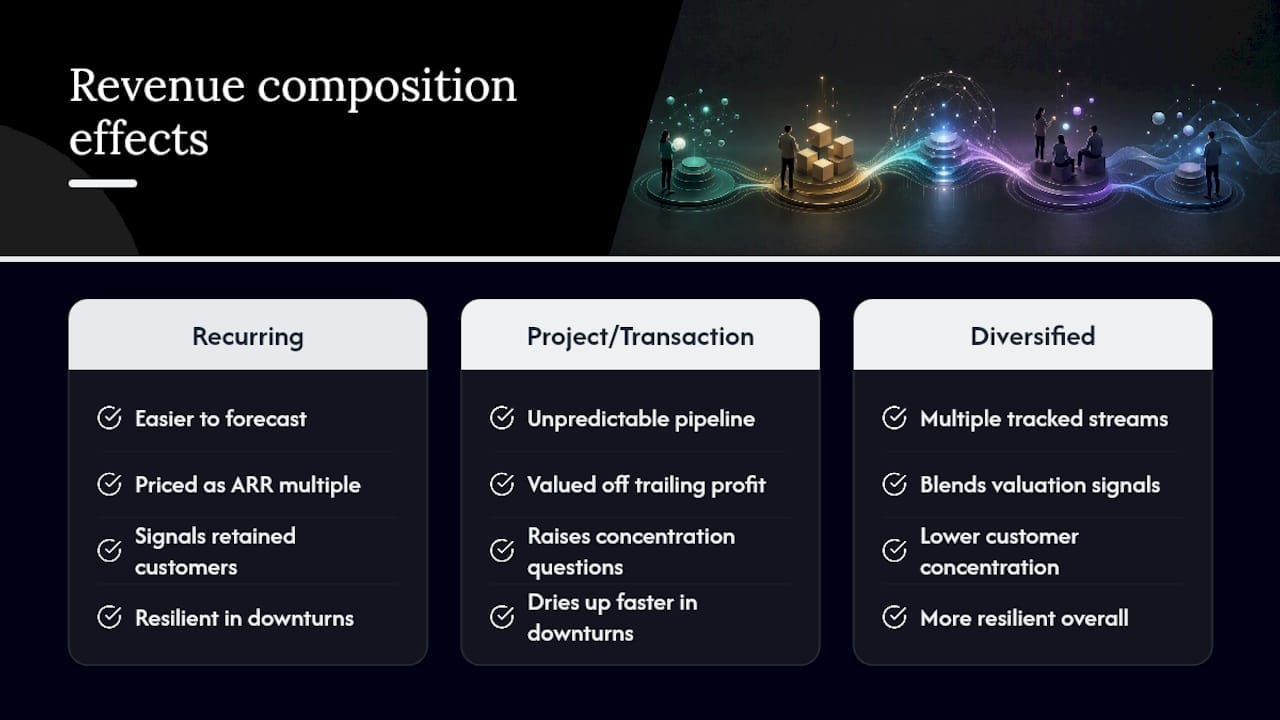
Two businesses can post identical annual revenue and get valued completely differently, and the reason almost always comes down to composition. A company earning $2 million entirely from recurring subscriptions typically commands a higher multiple than one earning the same amount from unpredictable one-off projects, because the subscription base is easier to forecast and defend.
Investors read your revenue mix as a proxy for risk. Recurring revenue signals retained customers and a repeatable acquisition motion. Heavy reliance on project or transaction revenue raises questions about pipeline volatility and customer concentration, especially if a handful of clients account for most of the total.
Diversification changes the story further. A business with three or four healthy, tracked streams looks more resilient than one leaning entirely on a single channel, even if the single-channel business currently earns more. That resilience matters most during downturns, when transactional and project revenue tend to dry up faster than subscription bases.
The composition also affects how buyers value an acquisition. Recurring revenue often gets priced at a multiple of ARR, while project-based revenue gets valued closer to a multiple of trailing profit, because buyers assume it won’t repeat automatically. If you’re building toward a raise or an eventual sale, the mix of streams you choose today is already shaping the number someone offers you later.
Treat Every Revenue Stream as a Hypothesis, Not a Decision
The mistake founders make isn’t picking the wrong revenue model. It’s treating the first model they pick as permanent. Every stream you launch is a hypothesis about what customers will pay for and how. Test it cheaply, watch the actual numbers, and be willing to kill a stream that isn’t earning its keep, even if it sounded smart on the whiteboard.
My advice: lock one predictable core stream first. Get it profitable and repeatable before you add licensing, affiliate income, or a second product line on top of it. Diversification built on a shaky foundation just multiplies your risk instead of spreading it.
— Amichai
Where to Test These Models Before You Bet the Business on Them
Reading about revenue models gets you halfway there. Actually pricing an offer, pitching it to real prospects, and watching the numbers respond takes structured practice, which is what some entrepreneurship bootcamps aim to provide. Some programs combine hands-on frameworks for validating offers with mentorship from experienced entrepreneurs, enabling participants to test pricing and packaging decisions within a supportive cohort rather than alone. Whether you’re deciding between a subscription and a project-based model or trying to layer in a second stream without breaking your core offer, the Online Entrepreneurship Bootcamp gives you a structured week to stress-test the model before you commit real capital to it. Check current dates and pricing on the relevant program pages to see if a cohort fits your timeline.
Sources
- Revenue Lifecycle Management — revenue streams (Salesforce)
- What Are Revenue Streams? Overview, Types & Examples | NetSuite
- Revenue Streams: Overview, Types, and Examples — AltexSoft
- Revenue Models Explained: How To Choose a Revenue Model – Shopify
FAQ
What Are the Two Main Types of Revenue Stream?
The two broadest categories are recurring revenue (subscriptions, memberships, retainers) and transaction-based revenue (one-time sales), though most businesses eventually add service, project, or ancillary streams on top.
What Are Six Revenue Streams Available to Most Franchisors?
Franchisors typically earn from initial franchise fees, ongoing royalty percentages, marketing fund contributions, product or supply sales to franchisees, training fees, and renewal or transfer fees.
What Are 10 Examples of Revenue?
Common examples include subscription fees, product sales, service fees, project billing, licensing royalties, advertising income, affiliate commissions, brokerage fees, usage-based charges, and franchise royalties.
What Are the Three Main Types of Revenue Models?
Most frameworks group revenue models into recurring/subscription, transaction/sales, and service or project-based, with secondary models like licensing and advertising layered in as ancillary income.
Does Diversifying Income Streams Actually Reduce Risk?
Generally yes. Spreading revenue across recurring, transactional, and ancillary sources reduces dependence on any single customer segment or sales channel, though adding streams too early can dilute focus before your core offer is proven.
Comments are closed.