
Founders: Prove Unit Economics to Build a Scalable Startup in Weeks
A scalable startup is a business built to grow revenue much faster than its costs. Run the test on your own venture: could you serve ten times as many customers without your cost base multiplying alongside them? If the honest answer is no, you don’t have a scalable model yet. The next check to run is your unit economics, because that’s where the truth about scalability actually lives.
TL;DR:
- Start scaling only after proving stable or improving unit economics, including customer acquisition costs and lifetime value.
- Focus on building repeatable sales, onboarding, and support processes that can be documented and replicated reliably by others.
- Hire for specific, repeatable workflows and pay down technical debt incrementally to ensure infrastructure can handle tenfold growth.
- Wait until your acquisition channels are predictable and your team structure can absorb double or triple the volume without chaos.
- Use structured bootcamps to accelerate testing, validation, and system building before committing to rapid growth.
Table of Contents
- What Does “Scalable Startup” Really Mean?
- What Signals Show a Startup Can Scale?
- How Do You Test if Your Startup Is Scalable?
- Building the Systems That Let You Scale
- When Is the Right Time to Scale?
- What Mistakes Derail Startups When They Scale?
- How Bootcamps Help Founders Get Scale Ready Faster
- The Mindset That Actually Gets Startups to Scale
- Ready to Build a Startup That Can Actually Scale?
- Sources
- FAQ
What Does “Scalable Startup” Really Mean?
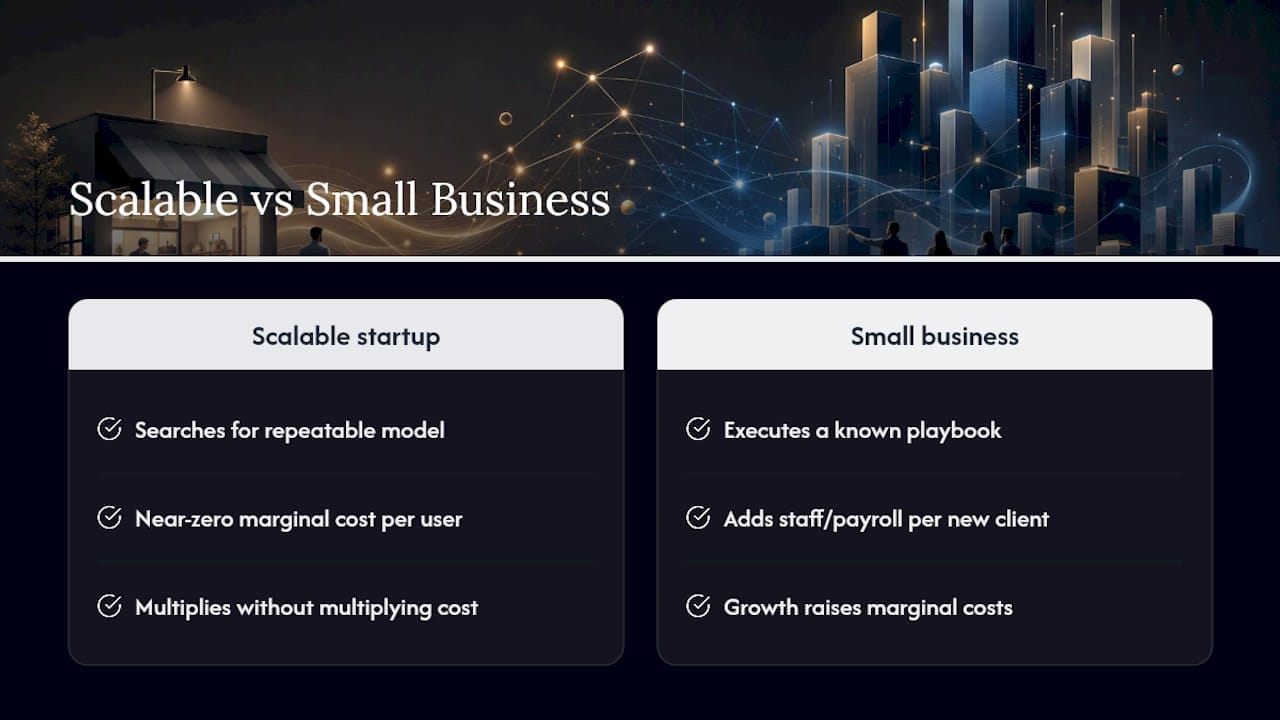
The term traces back to entrepreneurship theorist Steve Blank, who described a scalable startup as a temporary organization built to search for a repeatable, scalable business model, not to run one that already exists. That distinction matters more than it sounds. A restaurant owner executing a known playbook is running a small business. A founder testing pricing, channels, and messaging to find a model that multiplies without multiplying cost is running a scalable startup.
The formal test comes down to marginal cost. A software company that adds its ten-thousandth user pays almost nothing extra in server costs. A boutique consulting firm that adds its tenth client needs another consultant, another set of billable hours, another chunk of payroll. Same growth curve, completely different cost curve. That gap between revenue growth and cost growth is what separates a startup built for scale from a business built for a stable, predictable income.
What Signals Show a Startup Can Scale?
Investors and operators look for the same handful of traits before they believe a pitch deck’s growth projections. Here’s what actually holds up under scrutiny:
- A large addressable market. A tiny, saturated niche caps your ceiling no matter how efficient your operations get.
- Low marginal cost. Digital products, platforms, and licensable IP tend to scale better than anything requiring proportional human labor per customer.
- A repeatable acquisition and sales process. If your best salesperson’s method can’t be documented and taught to a new hire, you don’t have a process. You have a personality.
- Improving unit economics at scale. Costs per customer should fall, or at least hold steady, as volume rises, not creep upward.
- A founding team that can operate under uncertainty. Scalable ventures typically chase venture-style growth and outside capital rather than steady owner income, which is a different entrepreneurial path entirely from running a lifestyle business.
How Do You Test if Your Startup Is Scalable?
Talk is cheap. Numbers tell you the truth. Before you plan a single hire or ad campaign around scaling, run these diagnostics on the business you actually have today.
Start with product-market fit signals: cohort retention curves that flatten rather than decay, and repeat purchases that grow without heavy discounting. If customers only stick around because of a promotion, that’s not fit. That’s a subsidy.
Then get precise on unit economics:
- Customer acquisition cost (CAC): what you spend, fully loaded, to land one paying customer.
- Lifetime value (LTV): what that customer actually generates over the life of the relationship.
- Contribution margin: revenue minus the variable cost of serving each customer.
- Burn multiple: how much cash you burn for every dollar of new revenue you generate.
Pro Tip: Practitioner guidance from venture firms warns that founders who scale before proving these numbers often trigger dangerous burn multiples, the kind that spook investors and drain runway fast. Prove profit-market fit before you pour fuel on the fire.
Once the economics check out, document your sales funnel step by step, then hand it to someone else and see if they can replicate your results. If your fulfillment, support, or onboarding process breaks at double the load, it will shatter at ten times the load.
Building the Systems That Let You Scale
Scaling doesn’t just require more customers. It requires infrastructure that doesn’t buckle when those customers show up. This is where a lot of ambitious founders get exposed.
Start with people. Hire for specific, repeatable workflows instead of vague “we’ll figure it out” capacity, and build leadership depth before you need it. Research on scaling-stage companies attributes 65% of failures to people and organizational problems rather than product or market issues, which tells you where most founders should actually be spending their attention.
The operational checklist looks something like this, with guidance on prototyping and testing go-to-market experiments using practical AI tools for entrepreneurs:
- Architect your tech stack with scale in mind from day one, and build a habit of paying down technical debt in small doses rather than letting it pile up.
- Create documented, scalable processes for customer support, finance, and sales operations before volume forces you to improvise.
- Design a go-to-market playbook that a new hire could pick up and run, not one that only works because you’re the one running it.
- Align your financing timeline with actual operational milestones, not with an arbitrary fundraising calendar.
Guidance from Stripe’s scaling resources echoes this: build systems with scaling in mind early, and prioritize operational readiness in the areas showing the most growth potential rather than trying to fortify everything at once. Founders looking for a structured approach to this systems work can find a step-by-step breakdown in how to build scalable systems for startup growth.
When Is the Right Time to Scale?
Timing kills more startups than bad ideas do. Scale too early and you burn cash proving a model that doesn’t work yet. Scale too late and a competitor eats the market you spent years building.
Watch for these readiness signals before you accelerate:
- Unit economics that hold steady or improve as volume grows, not economics that only work on a spreadsheet.
- An acquisition channel you can repeat predictably, not one lucky viral moment.
- A team structure that can absorb 2x volume without every process falling on the founder’s desk.
High-performing companies that get this timing right tend to invest heavily in a repeatable sales model, and some reach $100 million in sales within two to four years of finding product-market fit. That pace is rare precisely because most founders scale before the fundamentals are locked in.
What Mistakes Derail Startups When They Scale?
Most scaling failures trace back to a handful of avoidable errors, and they tend to compound each other fast.
- Scaling before unit economics are proven. Watch your burn multiple closely. If it’s climbing while growth stalls, stop and fix the model before spending another dollar on growth.
- Hiring generically instead of for repeatable roles. Vague hires create vague accountability. Document the workflow first, then hire against it.
- Letting technical debt pile up unaddressed. Pay it down in increments as you grow instead of treating it as a future problem.
- Losing product focus chasing every new opportunity. Preparing an organizational bedrock of talent, decision rights, and culture before rapid scaling is what keeps a growing company from fracturing under its own momentum.
How Bootcamps Help Founders Get Scale Ready Faster
Founders often need to compress months of trial and error into a shorter window before capital or momentum runs out. Immersive entrepreneurship bootcamps can put founders through structured sprints that test repeatable sales plays, sharpen who the actual target customer is, and build the early systems described above, with mentors and peers checking the work in real time.
Typical outcomes founders walk away with include:
- Clarified customer segments instead of a vague sense of “who this is for”
- Validated MVP metrics instead of assumptions
- A prioritized scaling roadmap instead of a scattered to-do list
- Leadership alignment across co-founders and early team members
The Mindset That Actually Gets Startups to Scale
Scaling comes down to a simple sequence founders keep skipping: search for the repeatable model first, prove it with real numbers second, and only then scale. Most failures happen when founders scale on conviction instead of evidence. Discipline beats hustle here. Measure your unit economics obsessively, document every workflow before you hire against it, and resist the urge to expand before the model earns it.
— Amichai
Ready to Build a Startup That Can Actually Scale?
Reading about product-market fit and unit economics is one thing. Testing them against real customers, with mentors catching your blind spots before they become expensive mistakes, is another. Nomadexcel’s entrepreneurship bootcamps compress the search-prove-scale cycle into focused weeks of hands-on execution instead of months of guessing alone, pairing you with experienced operators and a community of founders working through the same diagnostics covered above. If you’re ready to stress-test your model with people who’ve actually built repeatable systems, check out the online entrepreneurship bootcamp and see which cohort fits your timeline.
Sources
- Make No Little Plans – Defining the Scalable Startup
- From start-up to centaur: Leadership lessons on scaling
- How to scale a business: 6 tactics to utilize | HBS Online
- How to scale a startup
FAQ
What Is the Simplest Definition of a Scalable Startup?
A scalable startup is a venture built so revenue can grow much faster than costs, tested by whether it can serve ten times more customers without ten times the expense.
What’s the Difference Between Growth and Scaling?
Growth is simply adding more revenue or customers; scaling means growing revenue while costs rise much more slowly, which requires efficient systems, not just more effort.
What Are the Most Important Metrics for Scalability?
Customer acquisition cost, lifetime value, contribution margin, and burn multiple are the core numbers, since they reveal whether growth is sustainable or just expensive.
When Should a Startup Start Scaling?
Only after unit economics are proven and the sales or acquisition process is repeatable, not the moment revenue starts climbing.
Can Bootcamps Really Speed Up Scaling Readiness?
Structured programs like Nomadexcel’s bootcamps compress the testing and validation process into weeks by pairing founders with mentors who catch flawed assumptions before they become expensive mistakes.
Comments are closed.