
Founders: Five Step Business Objective Templates and a 30/60/90 Sprint
Here’s a working objective you can adapt right now: “Increase repeat customer orders by 15% by December 31, among our top 200 accounts, owned by the Head of Sales.” That single sentence follows the format worth memorizing: Outcome plus metric plus deadline plus scope plus owner. It also satisfies the SMART criteria (Specific, Measurable, Achievable, Relevant, Time-bound), which is the standard every strong business objective should meet.
TL;DR:
- More than 90% of strategic goal failures stem from poor implementation of measurable objectives, not from flawed strategies.
- Objectives should include a specific outcome, a clear metric, a deadline, ownership, and scope to ensure accountability and progress tracking.
- Setting only financial goals neglects critical internal, customer, and growth objectives that impact long-term success.
- Limiting yourself to three to five objectives per cycle prevents dilution of effort and enhances focus on key results.
- Regularly reviewing lead and lag measures weekly, monthly, and quarterly improves chances of meeting objectives and allows timely course correction.
Table of Contents
- How to Write a Business Objective vs. a Business Goal
- Why Clear Business Objectives Actually Matter
- The Five-Step Process for Writing a Business Objective
- Business Objective Examples and a Reusable Template
- How Do You Track Progress on a Business Objective?
- Common Mistakes That Weaken a Business Objective
- Who Wrote This and What’s the One Technique Worth Stealing?
- A Founder’s Lesson on Getting Specific
- Turn a Written Objective Into an Executed One
- Sources
How to Write a Business Objective vs. a Business Goal
A goal is the destination. An objective is the checkpoint that proves you’re headed the right way. If your goal is “become the leading regional coffee roaster,” your objective might be “open two new wholesale accounts per quarter through June.” The goal sets direction; the objective sets a measurable, time-bound piece of the path.
Most planning guides sort objectives into four buckets, and skipping any one of them is how businesses end up financially healthy but organizationally brittle:
- Financial/economic objectives: revenue, margin, cash flow, cost reduction
- Customer/social objectives: retention rate, satisfaction scores, referral volume
- Internal/human objectives: hiring, training completion, employee turnover
- Development/organic objectives: new product launches, market expansion, process upgrades
Categorizing this way matters because founders naturally gravitate toward financial numbers and neglect the rest. A team that hits its revenue target while burning out its staff or ignoring product quality hasn’t actually executed its strategy. It has traded one problem for another.
Why Clear Business Objectives Actually Matter
Vague direction is expensive. When “grow the business” is the only marching order, every employee fills in the blank differently, and daily work stops lining up with strategy.
The scale of this problem is bigger than most founders assume. Ninety percent of senior executives at large organizations admit they’ve failed to reach all their strategic goals because of poor implementation, not because the strategy itself was flawed. That statistic should reframe how you think about objective-writing: the failure point usually isn’t the idea. It’s the absence of a measurable, owned, time-bound version of that idea.
Clear objectives fix this in three concrete ways:
- They convert abstract strategy into a decision filter your team can use daily.
- They create accountability, because a number with a deadline is either hit or missed.
- They give teams a reason to care, since progress toward a specific target is motivating in a way “do better” never is.
The Five-Step Process for Writing a Business Objective
Writing an objective that survives contact with a real business quarter takes more than a good sentence. It takes a process. A practitioner five-step method maps cleanly onto SMART, and each step earns its place in the sequence.
- Identify the priority. Start with the one or two areas where progress would matter most this quarter (Relevant). Don’t brainstorm ten priorities and hope to shrink the list later.
- Define the desired outcome. Write the actual result you want, in plain language, before touching numbers (Specific). “Reduce customer churn” beats “improve customer experience” because it names an outcome, not a feeling.
- Add a measurable success indicator. Attach a number and a source of truth. Churn rate from your CRM. Response time from your help desk tool. This is where Measurable lives.
- Set a realistic deadline. A number without a date is a wish. Thirty, 60, or 90 days works for most operational objectives; a full fiscal year suits bigger strategic ones (Time-bound).
- Confirm alignment, ownership, and scope. Name exactly who owns the result and which part of the business it touches, then check that it still serves the underlying goal (Achievable and Relevant, together).
Applied end to end: Priority is customer retention. Outcome is fewer canceled subscriptions. Success indicator is monthly churn rate. Deadline is the end of Q2. Owner is the Customer Success Lead, scoped to the mid-tier plan segment.
Pick three to five objectives per cycle, not ten. Beyond that, teams stop treating any of them as urgent. On stretch versus realistic targets, aim for achievable but ambitious: a number your team believes is possible with real effort, not one that requires a miracle or one they’ll hit by accident.
Pro Tip: If two objectives on your list could both be satisfied by the same weekly task, you probably only need one of them. Merge before you finalize.
Business Objective Examples and a Reusable Template
Objective writing gets easier once you’ve seen enough real ones. Here are role and function examples, each in the Outcome + metric + deadline + scope + owner format:
- Sales: Close 20 new mid-market accounts by December 31, in the East region, owned by the Regional Sales Manager.
- Retention: Raise 90-day customer retention from 68% to 80% by Q3, across the subscription tier, owned by the Customer Success Lead.
- Operations: Cut average order fulfillment time from 48 to 24 hours by April 30, across the warehouse team, owned by the Operations Manager.
- Product: Ship the mobile checkout redesign by March 15, for the flagship app, owned by the Product Lead.
- Team/culture: Complete onboarding certification for 100% of new hires within 30 days of start date, company-wide, owned by the HR Manager.
- Marketing: Grow qualified email leads from 500 to 900 per month by Q2, across the paid campaign channel, owned by the Marketing Lead.
Blank template: [Outcome verb + specific result] + [from baseline to target metric] + [by deadline] + [scope: team, region, or segment] + [owned by: role].
Filled example with a visible baseline: “Increase website conversion rate from 2.1% to 3.5% by September 30, on the main product page, owned by the Growth Marketer.”
A solo founder writing their own objective can use first person and looser scope. A department head reporting to a founder needs the scope line to be explicit, since ownership ambiguity is exactly what causes overlapping objectives later. For more on connecting objectives to the bigger picture, see this guide on setting business goals for growth.
How Do You Track Progress on a Business Objective?
Every objective needs two kinds of numbers: the lag measure that proves success, and the lead measures that predict it. Revenue is a lag measure. Number of qualified sales calls booked this week is a lead measure. If you only watch the lag number, you find out you failed a quarter too late to fix it.
A workable cadence looks like this:
- Weekly: check lead measures only. Calls made, demos booked, content published.
- Monthly: review overall status against the objective, and flag anything drifting off pace.
- Quarterly: conduct the full objective review, decide what’s renewed, retired, or rewritten.
Regular check-ins paired with lead measures meaningfully raise the odds of hitting a target, mainly because they surface problems while there’s still time to correct course.
Rebaseline an objective when the underlying assumption breaks, not when the number simply looks hard. If a competitor exits your market and your growth objective becomes trivial to hit, rewrite the target and log the reason in writing. That note protects you from taking credit for a shift you didn’t cause.

Common Mistakes That Weaken a Business Objective
Most weak objectives share the same flaw: they describe an activity instead of an outcome. “Post more on social media” is a task. “Grow Instagram-driven leads from 40 to 100 per month by Q3, owned by the Marketing Coordinator” is an objective. The rewrite takes the same intention and gives it a number, a deadline, and a name.
Watch for these recurring problems:
- Wording so vague it can’t be proven wrong (“improve efficiency”)
- Confusing a task (send a newsletter) with an outcome (grow newsletter-driven revenue)
- Writing too many objectives for one cycle, so none get real attention
- Leaving ownership unassigned, which guarantees nobody follows up
Run every draft through a short clarity checklist before you finalize it: metric named, baseline stated, target set, owner assigned, scope defined, deadline attached. If any one of those six is missing, the sentence isn’t an objective yet.
Pro Tip: Read your objective out loud to someone outside your department. If they can’t tell you, without help, whether it was hit or missed, rewrite it.
Who Wrote This and What’s the One Technique Worth Stealing?
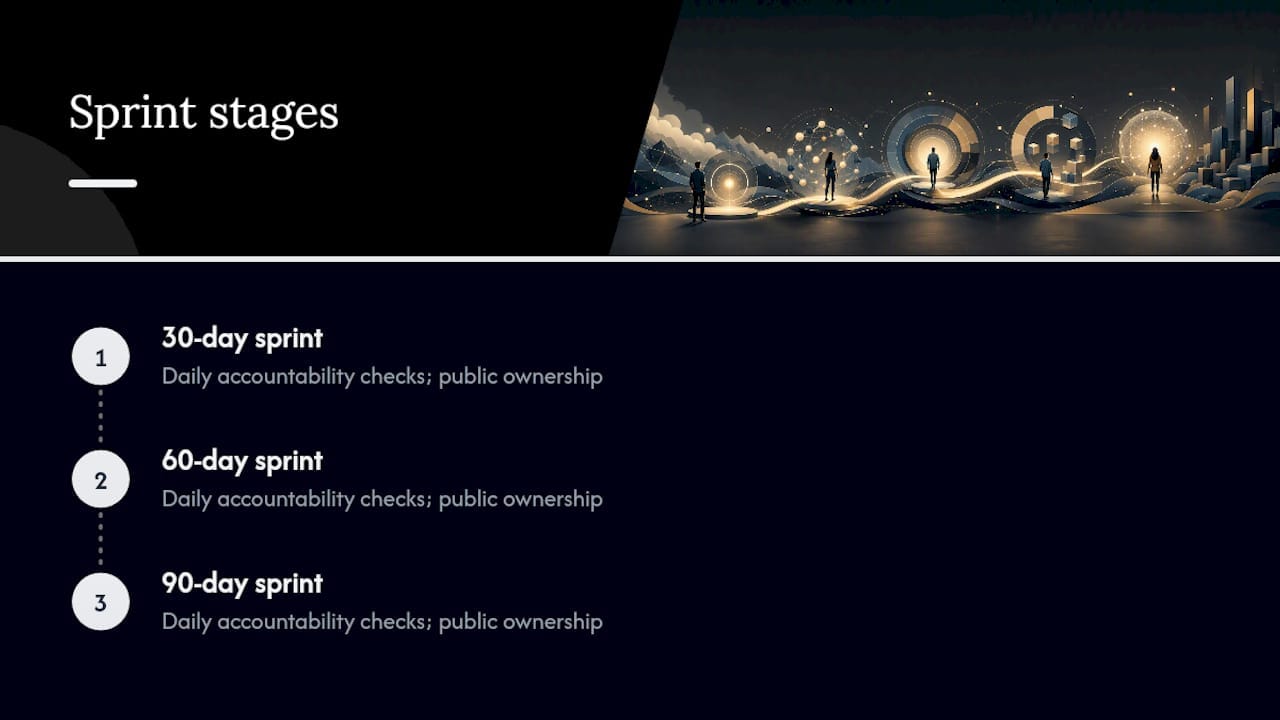
This guide draws on widely used frameworks in entrepreneurship bootcamps, where founders write and pressure-test objectives in real time. One technique worth borrowing directly: turn each written objective into a public, 30/60/90-day sprint with a daily accountability check. Public ownership changes behavior faster than private good intentions ever do.
A Founder’s Lesson on Getting Specific
An early objective I watched fail read “improve customer support.” Nobody could say, three months later, whether it worked. No baseline, no owner, no deadline, just good intentions dressed up as strategy.
Rewrite yours today using the format above, and put the first lead-measure check on your calendar before you close this tab.
— Amichai
Turn a Written Objective Into an Executed One
Writing a strong objective is the easy half. Nomad Excel exists for the harder half: turning that sentence into daily execution through structured frameworks, direct mentorship, and public accountability sprints, the same approach detailed here for founders writing goals under real time pressure. Instead of a template sitting in a document nobody reopens, programs offer cohorts of founders who check progress weekly and mentors experienced with similar challenges.
If you’re ready to stop rewriting the same vague objective every quarter, look at the Online Entrepreneurship Bootcamp and see the current program dates. Bring the objective you just wrote. Leave with a 30/60/90-day sprint built around it.
Sources
- Setting SMART goals for 2026: A practical guide for small business owners
- Why strategic plans fail (HBS Online)
- How to write objectives for your business plan