
Founders: Write a Business Goal in Under an Hour with Accountability
Write your business goal in this order: outcome, metric, deadline, owner. For example, “Increase repeat customer revenue by 15% by June 30, owned by the sales lead.” That structure works because it forces you to name what changes, how you will know it changed, and who is accountable if it doesn’t.
TL;DR:
- Setting too many goals at once reduces focus and increases the risk of stall, especially for small teams or solo founders.
- Goals should be outcome-driven, with clear metrics, deadlines, and a designated owner to ensure accountability and measurable progress.
- Use a short, structured review cadence such as weekly or monthly to track KPIs directly tied to your business impact.
- Avoid vanity metrics and activity-based goals that do not influence revenue or retention; verify KPIs by asking if doubling the number improves your business.
- Prioritize high-impact, feasible goals by scoring impact and capacity, and limit goals to prevent overwhelm and enhance execution.
Table of Contents
- How to Write a Business Goal: Goal vs. Objective vs. Key Result
- Why Clear Business Goals Matter for Small Businesses
- SMART Goals, OKRs, and KPIs: Which Framework Fits?
- A Step-by-Step Method for Writing a Business Goal
- Business Goal Examples: Short-Term and Long-Term Templates
- Prioritizing Goals: What to Cut and What Kills Execution
- Measuring Progress: KPIs, Dashboards, and Review Cadence
- A Workshop-Ready Checklist for Turning Goals Into Action
- A Founder’s Take on Ambition, Realism, and Revision
- Write the Goal, Then Get the Accountability to Execute It
- Sources
How to Write a Business Goal: Goal vs. Objective vs. Key Result
People use “goal,” “objective,” and “key result” like they’re interchangeable. They’re not, and mixing them up is one reason plans stall before they start.
A goal is the destination: the broad outcome you want, like “become the top-rated coffee roaster in your city.” An objective is a measurable milestone that moves you toward that destination, usually with a shorter timeline. A key result is the specific number that proves an objective happened, borrowed from the OKR framework popularized by companies like Intel and Google. Think of it as a funnel: one goal, a few objectives, several key results underneath each.
You write a goal when you’re setting direction for a quarter or year. You write objectives when you’re breaking that direction into chunks a team can actually execute this month. Confusing the two is why so many “goals” read like task lists.
Before you write any goal, check it against this short list:
- Outcome: what result changes, stated as a business impact, not an activity
- Metric: the number that proves it happened
- Deadline: a specific date, not “soon” or “this year”
- Owner: one named person accountable for it, not “the team”
Experienced founders tend to revise objectives often, sometimes monthly, while keeping the higher-level goal stable unless the underlying strategy shifts. That stability matters. Constantly rewriting your destination makes it impossible to tell if you’re actually getting closer to it.
Why Clear Business Goals Matter for Small Businesses
Vague goals don’t just fail to inspire. They quietly waste your limited time, cash, and attention on the wrong problems.
Clear goals do four things a to-do list can’t: they force focus on what matters most, they help you prioritize when everything feels urgent, they guide where money and hours actually go, and they give your team something concrete to rally around, instead of a vague mission statement.
The execution gap is bigger than most founders assume. A study cited by HBS Online found that A large majority of senior executives at large companies failed to meet all their strategic goals, and the reason wasn’t bad strategy. It was poor implementation.
If that failure rate holds at companies with entire strategy departments, a solo founder writing goals on a napkin faces the same risk, just with less room for error. The most common failure modes are predictable:
- Setting too many goals at once, which splits attention until nothing moves
- Tracking vanity metrics (followers, downloads, page views) instead of outcomes tied to revenue or retention
- Writing goals with no deadline, so “eventually” becomes the default timeline
SMART Goals, OKRs, and KPIs: Which Framework Fits?
You don’t need all three frameworks for every goal, but you should know what each one is actually for.
SMART is the standard for writing a single, well-formed goal statement. It stands for Specific, Measurable, Achievable, Relevant, and Time-bound, and it works because it forces every vague ambition through five filters before it counts as a real goal. A textbook example: “increase sales of product X by 25% in the next 6 months.” Fill in your own version using this order: outcome + number + deadline + owner.
OKRs (Objectives and Key Results) work better than a single SMART goal when you’re coordinating multiple teams or people toward one direction. The objective stays qualitative and inspiring (“become the fastest-shipping vendor in our category”), while two or three key results underneath make it measurable (“cut average shipping time from 5 days to 2 days by Q3”). Use OKRs when one goal needs several people pulling different levers at once. Use a standalone SMART goal when one owner can drive the whole outcome.
KPIs are the ongoing numbers you track to know if a goal is on pace. The trap is picking KPIs that measure activity instead of outcome. Website traffic is a vanity metric on its own; conversion rate or revenue per visitor is the outcome-oriented version of the same data. A useful test: if the number could go up while your bank balance goes down, it’s probably a vanity metric.
Pro Tip: Run this quick filter on every KPI before you adopt it: “If this number doubled tomorrow, would our revenue or retention actually improve?” If the honest answer is no, it’s a vanity metric dressed up as progress.
For deeper worked examples across different industries, Esade’s guidance on SMART goals walks through how the same framework applies whether you’re running a retail shop or a software company.
A Step-by-Step Method for Writing a Business Goal
Here’s a five-step process you can run in under an hour, start to finish.
- Assess your current state. Before you write anything, spend five to ten minutes on a mini version of a SWOT analysis: what are you good at, where are you weak, what’s the opportunity in front of you, and what threat could derail it? You don’t need a formal audit. You need honesty about your actual capacity.
- Choose the outcome and its metric. Pick the business result that matters most right now, revenue, retention, margin, or reach, and attach a number to it. Skip anything that measures output (posts published, calls made) unless you can tie it directly to a business outcome.
- Draft the SMART statement. Combine outcome, metric, deadline, and owner into one sentence. “Grow monthly recurring revenue from $8,000 to $12,000 by September 30, owned by the founder.”
- Break the goal into milestones. A 12-month goal without checkpoints is a wish. Split it into three or four milestones with their own mini-deadlines, and assign a name to each one, not just the overall goal.
- Set your review cadence and adjustment rules. Decide in advance how often you’ll check progress (weekly for short goals, monthly for long ones) and what triggers a change, like a milestone missed two cycles in a row.
This sequence mirrors the practical implementation steps that show up across most solid goal-setting guidance: assess, get input, be specific, set a timeline, apply a framework, establish metrics, communicate, choose your tracking tool, monitor progress, and mark milestones when you hit them.
Pro Tip: Write the deadline before you write the metric. Founders who pick the date first tend to set more realistic numbers, because the timeline forces the question “is this actually possible in that window?” before ego gets involved.
Once you’ve drafted the statement, read it out loud to someone outside the business. If they can’t repeat back the number, the date, and who owns it after hearing it once, rewrite it. For more structured guidance on turning this into a repeatable habit, Nomadexcel’s step-by-step goal-setting resource walks through the same method with more detail on team execution.
Business Goal Examples: Short-Term and Long-Term Templates
Steal these templates and swap in your own numbers.
90-day (short-term) goals:
- Sales: Close several new client contracts within a defined quarter, owned by the sales lead, tracked weekly against a pipeline target.
- Marketing: Grow email subscriber list significantly by a set date, owned by the marketing coordinator, measured through weekly signup counts.
- Operations: Reduce average order fulfillment time measurably by the end of a quarter, owned by the operations manager.
- Customer success: Increase customer satisfaction score meaningfully within about three months, owned by the support lead.
12-month (long-term) goals:
- Sales: Grow annual recurring revenue substantially by year-end, broken into quarterly targets of roughly $20,000 in added revenue each period.
- Product: Launch two new product features validated by paying customers within the year, with milestone checkpoints every quarter for design, build, test, and release.
- Marketing: Build organic traffic substantially over the course of a year, tracked in quarterly blocks tied to content output and conversion, not just page views.
- Operations: Cut customer churn rate from 8% to 4% within the year, reviewed monthly with course corrections built in after each quarter.
Notice the pattern: every “grow the business” ambition gets translated into a number tied to cash, retention, or time, never a raw activity count.
Prioritizing Goals: What to Cut and What Kills Execution
Not every good idea deserves a spot on your goal list this quarter. If everything is a priority, nothing is.
A simple ranking method works well for small teams: score each candidate goal on impact (how much it moves revenue or retention) and feasibility (how realistic it is given your current capacity), then keep only the highest scores on both axes. A goal that scores high on impact but low on feasibility isn’t dead, it just waits for next quarter.
Setting too many goals at once is one of the fastest ways to overwhelm a small team and stall everything. Cap it at one to three goals for the whole company, and one to two per small team. More than that and attention splits until nothing gets finished.
Watch for these red flags before you commit to a goal:
- No named owner (defaults to “the team,” which means no one)
- No metric (sounds inspiring, measures nothing)
- Language too broad to fail or succeed by (“improve customer experience”)
- No review cadence, so drift goes unnoticed for months
Pro Tip: If a goal statement could apply to almost any business in any industry, it’s too vague to execute. Specificity is what makes a goal falsifiable, and falsifiable goals are the only ones you can actually measure progress against.
Measuring Progress: KPIs, Dashboards, and Review Cadence
A goal without a tracking rhythm is just a hope with a deadline attached.
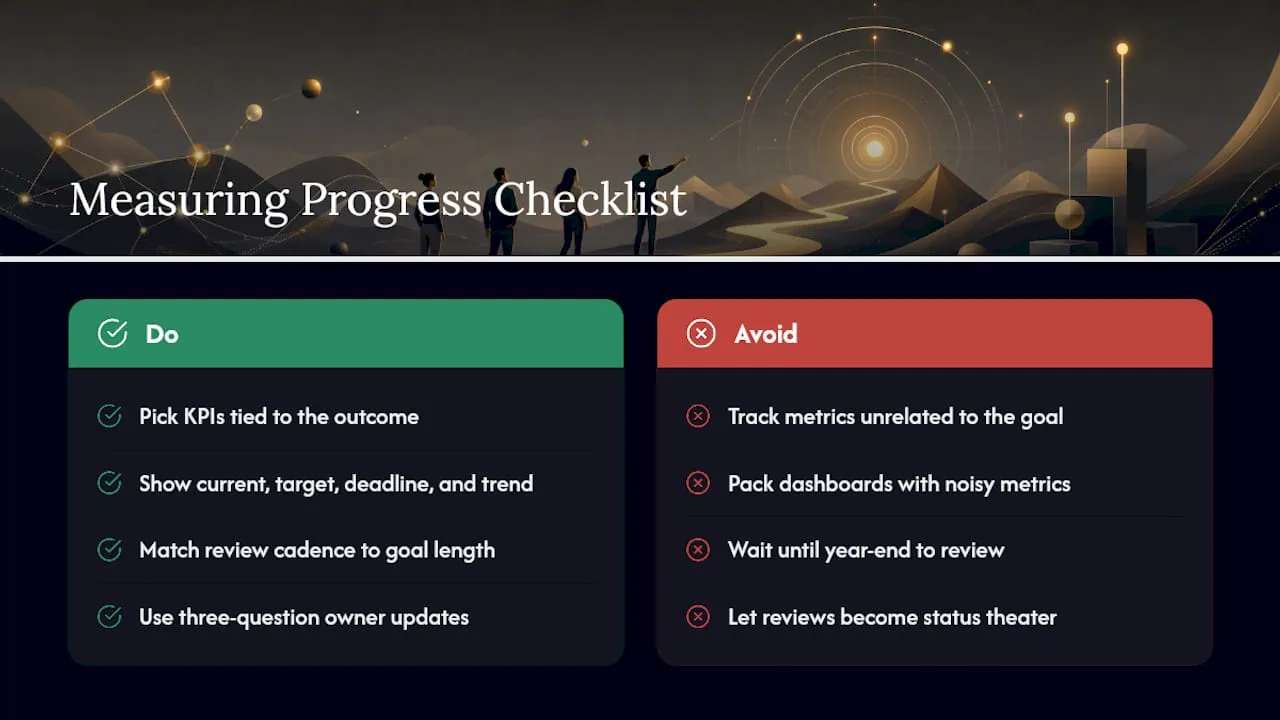
Start by picking KPIs that map directly to your stated outcome. If your goal is revenue growth, track revenue per customer or monthly recurring revenue, not raw lead count. If your goal is retention, track churn rate or repeat purchase rate, not social engagement. The rule is simple: a KPI should move in the same direction as your bank account when things go well.
Your dashboard doesn’t need to be elaborate. Show the current number, the target number, the deadline, and the trend line since your last review. Avoid dashboards packed with metrics that don’t tie back to the goal. If a number doesn’t help you decide whether to keep going or change course, cut it.
Established business planning resources recommend regularly reviewing goals and translating long-term ambitions into quarterly checkpoints with measurable milestones, rather than waiting until year-end to find out you missed the target.
For review cadence, match frequency to goal length: weekly check-ins for 90-day goals, monthly reviews for 12-month goals. Keep the review itself short. A useful format is three questions per owner: what’s the current progress number, what’s blocking it, and what’s the next concrete action. That structure, sometimes called a weekly owner update, keeps reviews from turning into status theater. For a broader framework connecting goals to financial, customer, and internal-process measures, HBS Online’s guide to setting business objectives is worth a look, and Nomadexcel’s own business execution checklist breaks the review process into eight concrete steps.
A Workshop-Ready Checklist for Turning Goals Into Action
A goal statement is only as good as the accountability behind it. Here’s the compact checklist we use with founders in bootcamp settings to move from draft to execution fast.
Before locking in a goal, confirm it has: the outcome, the metric, the deadline, the named owner, and the first three milestones written out with their own dates.
Then build in accountability, because a goal that lives only in a private document rarely survives contact with a busy week. Three mechanisms consistently help:
- Weekly owner updates limited to three numbers: progress, blockers, next action
- Peer sprints, where a small group commits to the same review schedule and checks each other’s numbers
- Milestone sign-offs, a short conversation when each milestone is hit or missed, so drift gets caught early instead of at year-end
Founders working through Nomadexcel’s entrepreneurship bootcamps build exactly this kind of structure into their first week, pairing goal drafts with daily accountability sprints instead of leaving them to chance.
A Founder’s Take on Ambition, Realism, and Revision
Most founders write goals that are either too safe to matter or too ambitious to survive contact with reality. The useful middle ground isn’t a compromise between the two. It’s writing a goal ambitious enough to matter and specific enough to test quickly, then treating it as a living document instead of a commandment.
I’ve seen the pattern play out the same way in bootcamp settings again and again: goals written alone in a notebook drift. Goals shared with even one accountability partner get revisited, argued with, and adjusted, which is exactly what keeps them alive. Revise the objective the moment the market tells you something new. Keep the underlying goal steady unless your whole strategy changes.
— Amichai
Write the Goal, Then Get the Accountability to Execute It
Writing a sharp SMART goal solves half the problem. The other half, staying accountable to it through daily execution when motivation dips, is what most founders working alone actually struggle with. Nomadexcel’s entrepreneurship bootcamp closes that gap with structured sprints, direct mentorship, and a peer community that checks in on your numbers, not just your intentions.
It fits best for aspiring and early-stage founders who can write a goal but need the daily structure to actually hit it, and for small teams that want alignment without building an accountability system from scratch. If you’re ready to turn this quarter’s goal draft into a tracked, executed outcome, explore the bootcamp program and see which cohort fits your timeline.
Sources
- Why do strategic plans fail? | HBS Online
- What are SMART goals? | SNHU
- How to create SMART goals for your business | Esade Beyond