
Why Focus on Business Frameworks for Growth
TL;DR:
- Business frameworks help entrepreneurs turn complex challenges into clear, manageable strategies and improve decision quality. They should be selected based on business stage and specific problems, and regularly reviewed to maintain effectiveness. When properly applied, frameworks enhance team alignment, signal credibility, and support smarter growth.
Business frameworks are structured decision-support tools that organize complex challenges into clear, manageable strategies, giving entrepreneurs a reliable method to make better choices and build stronger businesses. For aspiring founders and small business owners, the question of why focus on business frameworks has a direct answer: without structure, decisions default to gut feeling, and gut feeling alone rarely scales. Frameworks like SWOT, PESTLE, and governance models give you a shared vocabulary, a repeatable process, and a way to spot blind spots before they become costly mistakes. Research confirms that structured planning tools help small and medium enterprises signal credibility to stakeholders and improve internal alignment, especially during growth and fundraising phases. That credibility gap is real, and frameworks close it.
Why focus on business frameworks for better decisions
The core benefit of business frameworks is that they improve the quality of your decisions. Without a framework, you are essentially making strategic choices based on incomplete information and unexamined assumptions. With one, you are running your thinking through a disciplined filter.

Research shows that consistent framework application improves the quality of corporate strategic decisions in dynamic markets. That finding matters because small businesses operate in some of the most dynamic markets of all, where customer preferences shift fast and resources are tight. A framework like SWOT forces you to examine your strengths, weaknesses, opportunities, and threats in one structured pass, rather than addressing each in isolation when a crisis hits. PESTLE extends that analysis outward to political, economic, social, technological, legal, and environmental factors that affect your market.

The most important thing to understand about these tools is that they complement intuition, not replace it. The best founders use frameworks as lenses to challenge assumptions and expose blind spots, not as substitutes for experience. A framework does not tell you what to decide. It tells you what questions you have not asked yet.
Pro Tip: Before applying any framework, write down your current assumptions about the market, your customer, and your competitive position. After running the framework, compare. The gaps between your assumptions and the framework’s output are where your real strategic work begins.
Key decision-making frameworks worth knowing:
- SWOT analysis: Maps internal strengths and weaknesses against external opportunities and threats
- PESTLE analysis: Audits macro-environmental forces affecting your business
- Porter’s Five Forces: Evaluates competitive intensity in your industry
- Jobs-to-be-Done: Focuses strategy on the specific outcomes customers are trying to achieve
- OKRs (Objectives and Key Results): Aligns team priorities with measurable business goals
Each of these tools serves a different purpose. Choosing the right one for the right question is the skill that separates founders who grow from those who stay stuck.
How to choose the right framework for your stage
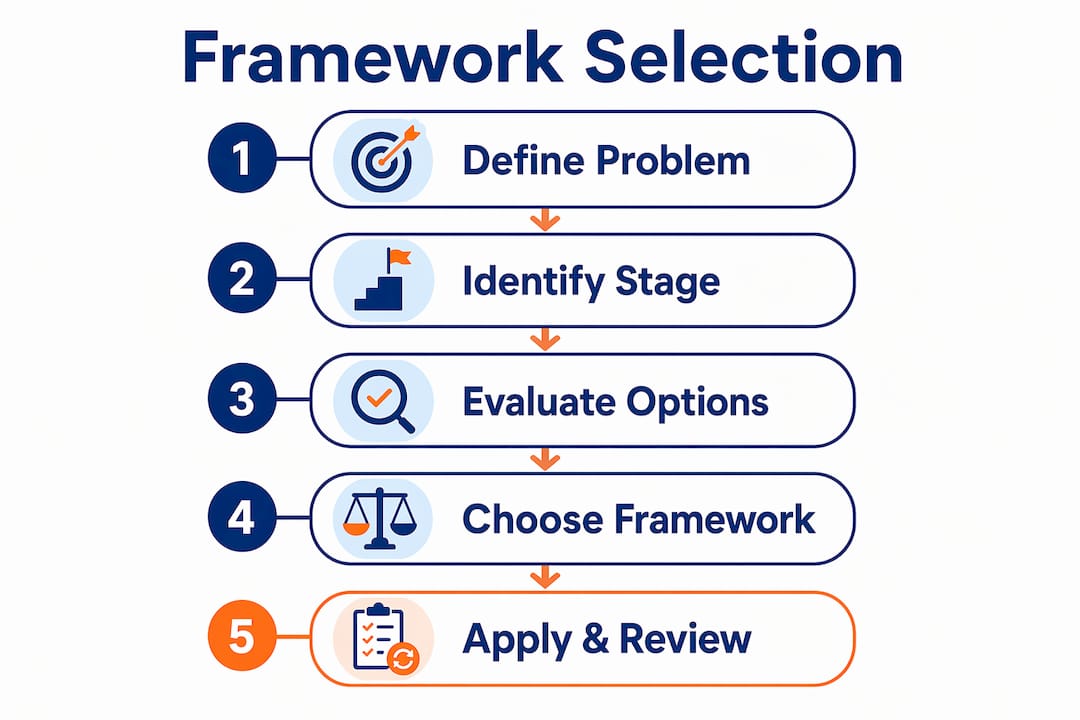
No single framework fits every business or every moment. The right operating framework depends on your specific pain points: whether you need better decisions, stronger execution, or faster learning. Matching the framework to the actual problem is the most underrated skill in early-stage entrepreneurship.
Business maturity matters significantly here. A pre-revenue founder validating a new idea needs a different tool than a business owner managing a team of ten and $500,000 in annual revenue. Applying an enterprise-level governance framework to a two-person startup creates bureaucracy without benefit. Applying a lean validation framework to a scaling operation leaves critical operational risks unaddressed.
A practical way to match frameworks to your stage:
- Idea validation stage: Use Jobs-to-be-Done and lean canvas models to test assumptions cheaply before committing resources.
- Early revenue stage: Apply SWOT to identify your strongest competitive advantages and the weaknesses that could derail early traction.
- Growth stage (approaching or past $250,000 in revenue): Shift to operating frameworks that address execution, team alignment, and process documentation.
- Scaling stage: Introduce governance frameworks and OKRs to maintain oversight and strategic direction as the organization grows more complex.
The most common mistake at every stage is choosing a familiar framework over a suitable one. Founders who learned SWOT in a business course tend to apply it to every problem, even when the real issue is execution or team alignment rather than strategic positioning. Improper framework use can be disastrous for operational stability and growth potential. The fix is simple: start with the problem, then select the tool.
Pro Tip: Write a one-sentence problem statement before selecting any framework. If the framework you are considering does not directly address that statement, choose a different one.
Common mistakes when applying business frameworks
Frameworks fail when founders treat them as automatic answer generators. A framework is a disciplined set of questions designed to challenge your thinking, not a template that produces strategy on its own. Framework effectiveness depends more on proper application than on memorizing the model.
The most damaging mistakes include:
- Filling frameworks with generic data. A SWOT analysis populated with vague statements like “strong team” or “competitive market” produces nothing useful. Every cell needs specific, evidence-based content.
- Ignoring organizational context. A framework applied without understanding your specific customer base, team culture, or market position will generate outputs that look professional but lead you in the wrong direction.
- Over-layering frameworks. Running five frameworks simultaneously without a clear purpose creates analysis paralysis. Each framework should answer one specific strategic question.
- Using frameworks once and filing them away. Markets change. Assumptions that were valid six months ago may be outdated today. Returning to frameworks repeatedly counteracts cognitive bias and surfaces new blind spots, even when the business environment seems stable.
- Skipping documentation. An operating framework without documented context is fragile. Key decision histories must accompany the framework to maintain its integrity when leadership changes or the team grows.
The best practice is to treat each framework as a living document, not a one-time exercise. Schedule quarterly reviews. Update inputs as your market data improves. Share the outputs with your team so the framework becomes a shared reference point rather than a private founder artifact.
How to integrate frameworks into your entrepreneurial workflow
The real value of business frameworks shows up when they become part of how your team thinks and communicates, not just how you plan. Frameworks give cross-functional teams a common language, enabling consistent, criteria-based discussions rather than subjective debates. That shift from opinion to evidence is where alignment actually happens.
For small business owners, integration looks like this in practice:
| Workflow moment | Framework application | Outcome |
|---|---|---|
| Monthly team meetings | OKR review and progress check | Keeps priorities visible and accountable |
| New product or offer decisions | Jobs-to-be-Done analysis | Grounds decisions in customer needs, not assumptions |
| Investor or partner conversations | Business plan with SWOT summary | Signals credibility and strategic clarity |
| Market shifts or competitive threats | PESTLE or Porter’s Five Forces | Provides structured response rather than reactive decisions |
| Annual planning | Full strategic review using chosen operating framework | Aligns team around goals for the year ahead |
Frameworks also support fundraising in a concrete way. Business planning tools help SMEs signal credibility to stakeholders and improve internal alignment during growth and fundraising phases. Investors do not just evaluate your idea. They evaluate whether you think clearly and systematically about your business. A well-applied framework demonstrates both.
The business plan as a dynamic process supports continuous learning and adaptive decision-making under uncertainty. That means your framework use should evolve as your business evolves. What you need to learn at the idea stage is different from what you need to manage at the growth stage. Build the habit of asking, “Which framework best addresses what we need to figure out right now?” and your strategic thinking will sharpen with every cycle.
Nomadexcel builds this habit directly into its bootcamp programs, where founders practice applying frameworks to real business challenges in structured, mentored environments. You can explore the entrepreneurial frameworks guide on the Nomadexcel site for a practical starting point.
Clear governance frameworks support disciplined management and oversight, enhancing organizational resilience and reducing risk. Governance is not just for large corporations. Even a five-person team benefits from documented decision rights, clear accountability, and a structured review process.
Key Takeaways
Business frameworks are the most reliable tools entrepreneurs have for turning complexity into clear, repeatable decisions that support growth.
| Point | Details |
|---|---|
| Frameworks improve decision quality | Consistent application of tools like SWOT and PESTLE produces better strategic choices than intuition alone. |
| Match the framework to the stage | Pre-revenue founders need validation tools; scaling businesses need execution and governance frameworks. |
| Application quality determines value | Generic inputs produce generic outputs; every framework cell needs specific, evidence-based content. |
| Frameworks create team alignment | A shared framework gives cross-functional teams common language and consistent decision criteria. |
| Review frameworks regularly | Returning to frameworks quarterly counteracts bias and surfaces blind spots as market conditions change. |
What I have learned from watching founders use frameworks wrong
The most common mistake I see is not ignorance of frameworks. It is overconfidence in them. A founder runs a SWOT analysis, fills in the four boxes, and walks away feeling like they have done the strategic work. They have not. They have done the administrative work of filling a template.
The frameworks that actually change a business are the ones that make you uncomfortable. When a PESTLE analysis surfaces a regulatory shift you had not considered, or a Jobs-to-be-Done exercise reveals that your customers are not actually buying what you think they are buying, that discomfort is the point. That is the framework doing its job.
My honest recommendation: pick one framework per quarter and go deep with it. Do not run five frameworks in parallel. Run one, document your findings, share them with your team, and act on what you learn. Then revisit it three months later with fresh data. The value of structured frameworks is not in the model itself. It is in the discipline of returning to structured questions when the pressure to act on instinct is highest.
Founders who build that discipline early grow faster and make fewer expensive mistakes. The ones who skip it tend to discover their blind spots the hard way, usually at the worst possible moment.
— Amichai
Nomadexcel bootcamps: frameworks in practice
Understanding frameworks in theory is a starting point. Applying them under real conditions, with experienced mentors and a community of founders pushing alongside you, is where the skill actually develops. Nomadexcel’s online entrepreneurship bootcamp is built around exactly that: hands-on framework application, structured sprints, and direct mentorship from operators who have used these tools to build real businesses. Participants leave with a sharper strategy, a tested framework practice, and a peer network that continues to challenge their thinking long after the program ends. If you are ready to move from knowing frameworks to using them well, the bootcamp is where that shift happens.
FAQ
What is a business framework?
A business framework is a structured set of questions or models that helps entrepreneurs organize complex challenges into clear strategic options. Common examples include SWOT, PESTLE, OKRs, and Porter’s Five Forces.
Why do small businesses need business frameworks?
Small businesses benefit from frameworks because they improve decision quality, signal credibility to investors, and create alignment within small teams. Research shows that the absence of structured frameworks in SMEs is a critical gap during growth and fundraising phases.
How do I choose the right business framework?
Start with a one-sentence problem statement, then select the framework that directly addresses that problem. Match the tool to your business stage: validation frameworks for early-stage founders, execution and governance frameworks for growing businesses.
How often should I revisit a business framework?
Returning to frameworks at least quarterly counteracts cognitive bias and surfaces new blind spots as market conditions shift. A framework reviewed once and filed away loses most of its strategic value.
Can business frameworks replace experience and intuition?
Frameworks complement experience and intuition rather than replace them. The most effective founders use frameworks to challenge their assumptions and expose blind spots, not to substitute for judgment built through real-world experience.
Comments are closed.