
The Role of Workshops in Development for Entrepreneurs
TL;DR:
- Workshops are interactive sessions that enhance skills, foster collaboration, and produce tangible development outcomes. They outperform passive learning formats by emphasizing practice, accountability, and real-time feedback, making them essential for team growth and innovation. Designing focused, hands-on workshops with clear goals and follow-up mechanisms ensures long-lasting skill retention and business progress.
A workshop is an interactive, participatory session designed to build skills, foster collaboration, and achieve specific development outcomes through hands-on experience. Unlike lectures or webinars, workshops place participants at the center of the learning process, requiring them to practice, problem-solve, and engage with peers in real time. The role of workshops in development has grown significantly as entrepreneurs and remote professionals seek faster, more practical paths to growth. Research from SessionLab and participatory learning models confirms that structured, activity-driven sessions outperform passive formats on nearly every measure of skill retention and application.
What are the key benefits of workshops in skill and business development?
Workshops produce measurable gains across multiple dimensions of professional performance. Participatory workshop programs have been shown to increase production skills by 80% and entrepreneurial confidence by 65%. That means a well-designed workshop does not just teach concepts. It changes how participants see themselves and their capacity to act.
The benefits span three broad categories:
- Skill acquisition: Leadership, technical, and communication workshops give participants frameworks they can apply the same week. A negotiation workshop, for example, typically includes live role-play scenarios that force participants to practice under pressure, not just absorb theory.
- Faster learning curves: Hands-on training produces stronger engagement and skill retention compared to one-way lectures. When you build something, debate a case, or solve a real problem during a session, the learning sticks in a way that watching a video simply cannot replicate.
- Stronger team bonds: Shared challenges create trust. Teams that work through a difficult exercise together leave with a different relationship than teams that sat through the same presentation.
Workshop-based skill development also signals organizational investment in people, which drives longer tenure and higher engagement. For entrepreneurs building small teams, that signal carries real weight.
Pro Tip: Design at least 60% of your workshop time around doing rather than listening. Participants retain far more from a 20-minute exercise than from a 40-minute presentation on the same topic.

How do workshops compare to other professional development methods?
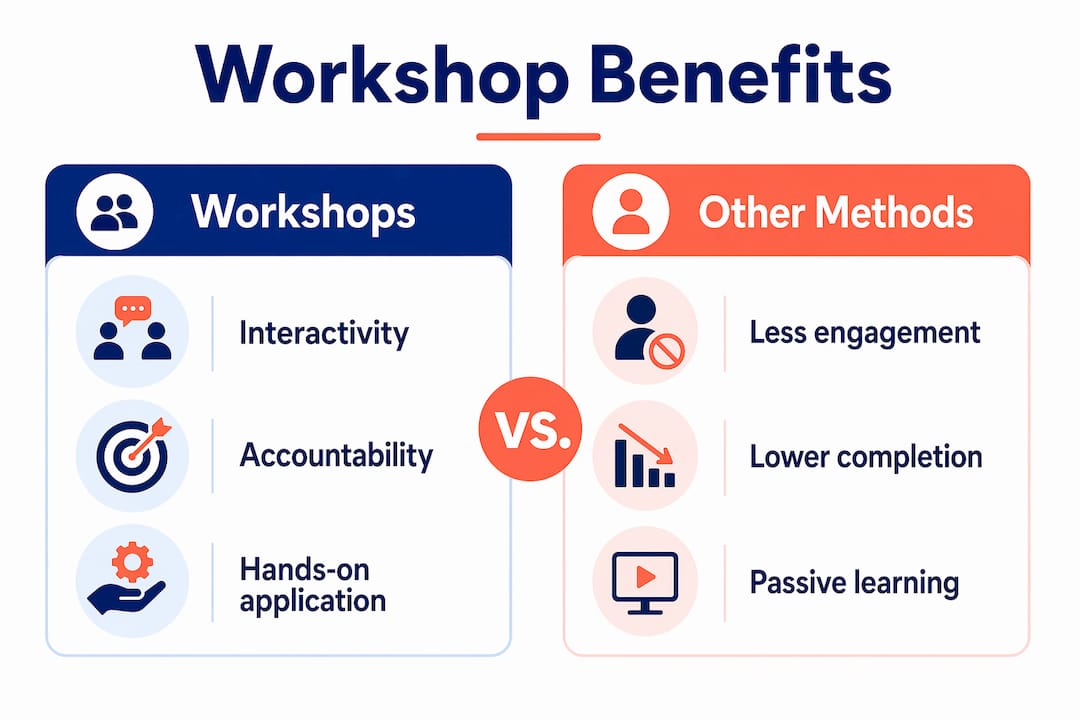
Webinars, online courses, and self-directed tutorials each serve a purpose. Workshops occupy a distinct position that the others cannot fill. Workshops provide structure, accountability, and real-time interaction that self-directed online learning structurally cannot offer. You cannot ask a pre-recorded video a follow-up question. You cannot get peer feedback from a solo tutorial.
The table below captures the core distinctions:
| Format | Interactivity | Accountability | Skill application | Best for |
|---|---|---|---|---|
| Workshop | High | High | Immediate, in-session | Complex skills, team alignment |
| Webinar | Low | Low | Delayed or absent | Awareness, information sharing |
| Online course | Medium | Self-directed | Asynchronous | Knowledge building at own pace |
| Training session | Medium | Moderate | Structured but passive | Compliance, process training |
LinkedIn learning data consistently shows that completion rates for self-directed online courses hover below 15%. Workshops, by contrast, are synchronous commitments. Participants show up, stay present, and leave with something tangible. That structural difference is not a minor detail. It is the reason workshops remain the preferred format for high-stakes skill development in organizations ranging from early-stage startups to Fortune 500 companies.
Blended learning approaches that combine workshops with online content are gaining traction. A practical model pairs a short online module for foundational knowledge with a live workshop for application and feedback. This combination reduces the time burden on participants while preserving the accountability and interaction that make workshops effective.
What are best practices for designing and participating in effective workshops?
Effective workshop design follows a clear sequence. The steps below apply whether you are building a session for your own team or selecting a workshop to attend as an individual professional.
- Define a specific outcome. Vague goals produce vague results. “Improve communication” is not a workshop goal. “Practice delivering a 60-second business pitch and receive structured peer feedback” is.
- Design the agenda around the 20/80 principle. Agendas that prioritize doing over listening produce better business outcomes and higher return on investment. Allocate 20% of time to instruction and 80% to practice, discussion, and application.
- Use role rotation. Role rotation in workshops grounds training in local, decision-relevant contexts, transforming the session into a sustainable co-creation process rather than a one-off event. When participants take turns facilitating, presenting, and critiquing, they engage with the material from multiple angles.
- Build in follow-up mechanisms. Climate adaptation workshops show that statistically significant knowledge gains persist six months post-workshop when participants commit to specific follow-up actions during the session itself. A 15-minute closing exercise where each participant writes one concrete next step dramatically improves post-workshop application.
- Tailor content to the audience. Remote professionals face different constraints than in-office teams. Entrepreneurs at the idea stage need different frameworks than those managing a team of ten. Generic content produces generic results.
For entrepreneurs and remote professionals attending workshops rather than designing them, the same principles apply in reverse. Arrive with a specific challenge you want to solve. Engage actively during exercises rather than observing. Commit to one follow-up action before you leave the room.
Pro Tip: The most common workshop design mistake is over-packing the agenda. Cut one-third of your planned content and use that time for deeper practice on the remaining material. Depth beats breadth every time.
You can also explore group coaching skills as a complement to workshop facilitation, particularly when working with small teams where individual skill gaps vary significantly.
How do workshops spark innovation and team growth?
Innovation rarely emerges from routine. Workshops spark creativity by removing participants from their daily environment and placing them in a focused, collaborative space where fresh thinking is both expected and rewarded. For entrepreneurs and remote teams, this shift in context is often the catalyst for breakthroughs that months of regular work meetings never produce.
The mechanism is straightforward. When a team works through a structured problem-solving exercise together, they surface assumptions, challenge each other’s thinking, and build shared language around complex challenges. That process strengthens both the quality of ideas and the relationships between team members. The role of innovation workshops in team growth extends well beyond the session itself. Teams that workshop together regularly report stronger communication patterns and faster decision-making in their day-to-day work.
Specific activities that consistently drive innovation and cohesion include:
- Rapid prototyping exercises: Teams build a rough version of a solution in 30 minutes, then present and critique each other’s work. The speed forces creative thinking and reduces perfectionism.
- Assumption mapping: Participants list every assumption behind a current strategy, then rank them by risk. This exercise alone has redirected entire product roadmaps.
- Cross-functional role swaps: A marketing lead spends 20 minutes solving an operations problem. The resulting perspective shift generates ideas that siloed thinking never would.
- Retrospective workshops: Teams examine what worked, what did not, and what they would do differently. Done well, these sessions build psychological safety and a culture of honest feedback.
For entrepreneurs looking for concrete examples, Nomadexcel’s innovation workshop examples for entrepreneurs illustrate how these formats translate into real business contexts. The role of custom workshops in team building is particularly pronounced when activities are designed around the team’s actual challenges rather than generic exercises.
Key takeaways
Workshops drive measurable skill gains, stronger team bonds, and sustained learning outcomes that passive formats consistently fail to match.
| Point | Details |
|---|---|
| Workshops outperform passive formats | Hands-on participation increases production skills by up to 80% and entrepreneurial confidence by 65%. |
| Structure and accountability are the differentiators | Unlike webinars or online courses, workshops provide real-time feedback and commitment mechanisms that sustain learning. |
| Design determines outcomes | Agendas built on the 20/80 principle and role rotation produce deeper skill adoption and longer-lasting results. |
| Follow-up is non-negotiable | Knowledge gains persist six months post-workshop when participants commit to specific actions during the session itself. |
| Innovation requires a change of context | Workshops remove teams from routine and create the focused environment where genuine creative breakthroughs happen. |
Why I think most professionals underinvest in workshops
Most professionals treat workshops as occasional events rather than deliberate development tools. That framing is the problem. A workshop attended without a clear goal is a pleasant afternoon. A workshop designed around a specific skill gap or strategic challenge is a turning point.
I have watched entrepreneurs spend months consuming online content and attending webinars, then join a single well-designed workshop and make more progress in two days than in the previous six months. The difference is not the quality of the information. It is the accountability, the peer pressure, and the forced application that workshops create. You cannot passively absorb your way through a live exercise.
The other underappreciated factor is community. The people you meet in a workshop often become your most valuable professional relationships. They have seen you think, struggle, and solve problems in real time. That shared experience creates a different kind of trust than any LinkedIn connection ever will.
For remote professionals especially, workshops serve as vital anchors in an otherwise isolated work life. The human energy in a room of motivated peers is genuinely difficult to replicate through a screen. When you find a workshop that combines strong facilitation, a relevant curriculum, and the right cohort, invest in it without hesitation. The return compounds in ways that are hard to predict and easy to underestimate.
— Amichai
Accelerate your growth with Nomadexcel’s workshop-driven programs
Nomadexcel builds immersive programs where workshops are not a side feature. They are the core delivery mechanism. The Online Entrepreneurship Bootcamp brings together early-stage founders for structured, hands-on sessions covering business validation, offer refinement, and growth strategy. Every module is built around the 20/80 principle: minimal lecture, maximum application. Participants leave with sharper strategy, new skills, and a peer network that continues to drive accountability long after the program ends. If you are a remote professional or entrepreneur ready to move from learning to doing, explore why joining a bootcamp accelerates results that self-directed study rarely delivers.
FAQ
What is the role of workshops in professional development?
Workshops are structured, interactive sessions that build specific skills through hands-on practice, peer feedback, and real-time expert interaction. They fill the gap between knowing something and being able to apply it under real conditions.
How do workshops differ from webinars and online courses?
Workshops provide accountability, live interaction, and immediate skill application that webinars and self-directed courses structurally cannot offer. Completion rates and skill retention are consistently higher in workshop formats.
How long do workshop learning gains last?
Research on place-based learning programs shows that knowledge gains persist for at least six months post-workshop when participants commit to follow-up actions during the session itself.
What makes a workshop effective for entrepreneurs?
Effective workshops for entrepreneurs combine a specific, outcome-focused agenda with hands-on exercises tied to real business challenges. Generic content produces weak results. Tailored content tied to a founder’s actual stage and goals produces measurable progress.
How do workshops contribute to team innovation?
Workshops remove teams from routine, create a focused collaborative environment, and use structured exercises like rapid prototyping and assumption mapping to surface new ideas and strengthen working relationships.
Comments are closed.