
How group coaching accelerates entrepreneur success
TL;DR:
- Group coaching combines structured guidance, peer accountability, and community support for entrepreneurs.
- It significantly boosts success rates, self-efficacy, and business growth while reducing isolation.
- Success depends on program fit, participant engagement, and a well-curated, diverse cohort.
Most entrepreneurs picture themselves grinding alone, piecing together a business from scratch through sheer willpower. That image is compelling, but it’s also misleading. The most effective founders aren’t the ones who figure everything out solo; they’re the ones who find the right people to grow alongside. Group coaching has emerged as one of the most powerful accelerators for early-stage entrepreneurs, combining structured guidance, peer accountability, and real community into a single, focused experience. The results speak for themselves: peer accountability boosts success rates by 65%, making group coaching far more than a casual networking exercise.
Table of Contents
- What is group coaching for entrepreneurs?
- Top benefits for aspiring and early-stage entrepreneurs
- How group coaching changes entrepreneurial outcomes
- Limits, challenges, and how to choose effectively
- Our take: Community beats isolation, but matching matters most
- Fast-track your growth: Join a proven group coaching program
- Frequently asked questions
Key Takeaways
| Point | Details |
|---|---|
| Structured guidance matters | Entrepreneur group coaching gives you step-by-step support and direction in business building. |
| Community amplifies progress | Accountability and peer learning in a group dramatically boost your business execution and confidence. |
| Evidence backs coaching | Research shows group coaching improves business outcomes and founder mindset, not just theory. |
| Fit and coachability count | Most benefit comes when you’re open to feedback and matched with the right group and facilitator. |
What is group coaching for entrepreneurs?
Group coaching is a structured learning and growth format where a trained coach guides multiple entrepreneurs through a shared curriculum, set of challenges, or business-building process at the same time. Unlike a one-off workshop or a solo mentoring session, group coaching creates an ongoing container for progress, reflection, and accountability.
Group coaching provides structured guidance through cohort-based, membership, or hybrid models, typically running 4 to 12 weeks or on an ongoing basis, with 4 to 12 participants per group. Each format serves a slightly different need:
- Cohort-based programs bring together a fixed group that starts and finishes together, building deep relationships through a shared journey.
- Membership models allow rolling enrollment, giving entrepreneurs access to coaching calls, resources, and community on a flexible schedule.
- Hybrid formats blend both, often pairing structured curriculum with open-access community support.
Sessions typically run 60 to 90 minutes, either weekly or biweekly, and cover topics like business strategy, sales, leadership, offer development, and execution planning. The coach facilitates, but the group itself becomes a powerful source of insight. Peer-led discussions, hot seats (where one founder presents a challenge for group feedback), and breakout conversations all contribute to the learning.
Here’s a quick comparison of the three main formats:
| Format | Duration | Best for | Group size |
|---|---|---|---|
| Cohort-based | 4 to 12 weeks | Deep learning, accountability | 6 to 12 |
| Membership | Ongoing | Flexible support, community | 10 to 50+ |
| Hybrid | Varies | Structured + flexible blend | 8 to 20 |
Group coaching differs meaningfully from masterminds, which are typically peer-led and rely on members sharing experience rather than a coach delivering frameworks. It also differs from 1:1 coaching, which offers personalized attention but lacks the collective energy and diverse perspectives of a group. For entrepreneurs exploring entrepreneurship bootcamp structure, group coaching shares many of the same principles: focused cohorts, expert facilitation, and community-driven momentum.
The best programs are built around hands-on entrepreneurship learning, where participants apply frameworks in real time rather than simply absorbing theory. That execution focus is what separates effective group coaching from a glorified webinar series.
Top benefits for aspiring and early-stage entrepreneurs
With the ‘what’ established, let’s dig into why group coaching delivers such transformative results for early-stage entrepreneurs.
Group coaching accelerates growth by combining expert guidance with peer learning, accountability, networking, and community support that reduces the isolation founders so often feel. Each of these elements reinforces the others, creating a compounding effect on your progress.
Here are the core benefits you can expect:
- Expert guidance in real time: A skilled coach helps you avoid costly mistakes, reframe limiting beliefs, and apply proven frameworks to your specific situation.
- Peer learning that surprises you: Hearing how another founder solved a problem you’re facing is often more useful than any textbook answer.
- Accountability that actually works: Knowing your peers will ask about your progress next week makes you far more likely to follow through.
- Reduced isolation and burnout: Entrepreneurship can feel relentlessly lonely. A group that genuinely understands your challenges changes that dynamic entirely.
- Organic networking: Relationships built inside a coaching group often lead to referrals, partnerships, and collaborations that outlast the program itself.
Stat to know: Peer accountability boosts success rates by 65%, according to research on group coaching outcomes. That’s not a marginal improvement. That’s a fundamental shift in how likely you are to actually execute your plans.
The accountability dynamic inside a well-run group is particularly powerful for early-stage founders. When you see a peer in the same program land their first client or hit a revenue milestone, it shifts your internal narrative from “maybe someday” to “this is actually possible for me too.” That psychological lift is hard to manufacture on your own.
Peer collaboration in entrepreneurship also opens doors that solo effort rarely does. Group members share contacts, co-create offers, and refer each other to opportunities they couldn’t access individually. The group becomes a living network, not just a classroom.
For founders who are just starting out, the combination of structured learning and community support fills the gap that most online courses and self-study programs leave wide open. You don’t just learn what to do. You actually do it, with people cheering you on and holding you to your commitments. Strong networking for entrepreneurs starts exactly here, inside trusted communities built around shared goals.
How group coaching changes entrepreneurial outcomes
Understanding the benefits is vital, but it’s the research-backed impact on real founders and companies that makes group coaching truly compelling.
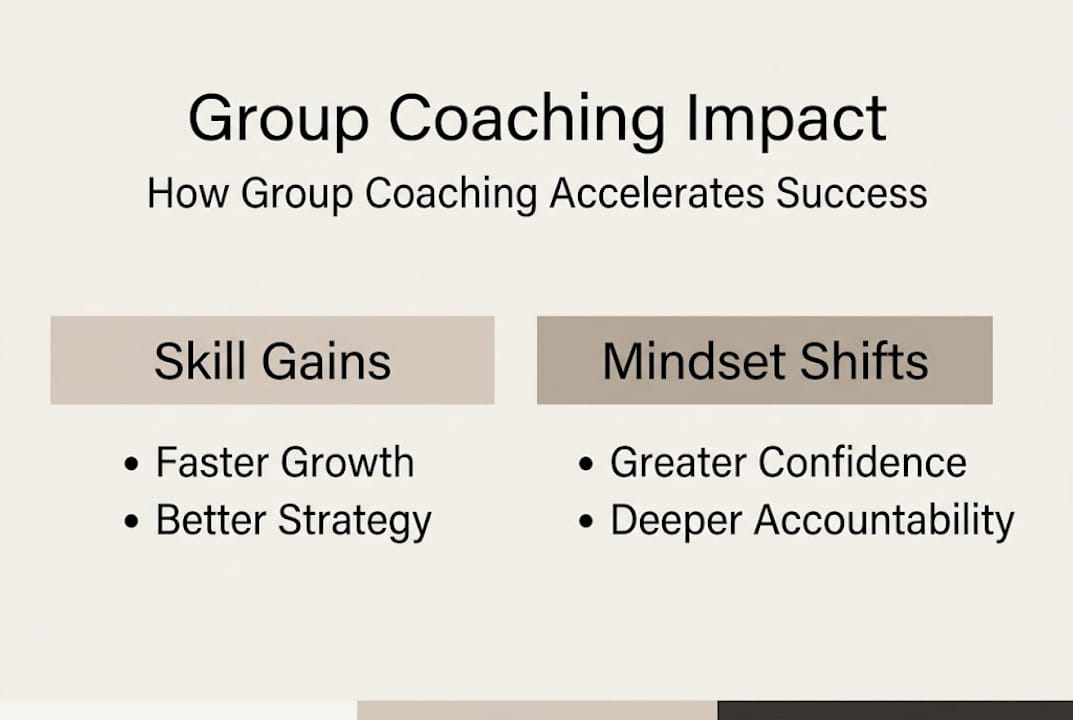
Empirical data shows coaching enhances entrepreneurial self-efficacy, locus of control, customer involvement, product innovativeness, psychological wellbeing, and hope. These aren’t soft, feel-good metrics. They’re the internal drivers that predict whether a founder keeps going when things get hard, or gives up.
On the practical side, group coaching produces measurable business results: higher implementation rates, faster skill acquisition, and noticeable improvements in leadership capability. Founders who complete structured group programs report clearer strategy, stronger sales conversations, and better decision-making under pressure.
Here’s how group coaching compares to 1:1 coaching across key dimensions:
| Dimension | Group coaching | 1:1 coaching |
|---|---|---|
| Cost | 50 to 70% less | Higher investment |
| Personalization | Moderate | High |
| Peer learning | Strong | None |
| Scalability | High | Limited |
| ROI potential | 7 to 12x | Varies |
| Community | Built-in | External |
Group coaching is more affordable, typically costing 50 to 70% less than 1:1 coaching, while still delivering an ROI of 7 to 12 times the investment. For early-stage entrepreneurs working with limited budgets, that affordability is a genuine game-changer.
“The shift I experienced wasn’t just in my business strategy. It was in how I saw myself as a founder. The group held up a mirror that 1:1 coaching never quite could.”
Research on coaching outcomes consistently shows that the psychological dimension of coaching is as important as the tactical one. Founders who build self-confidence and a stronger sense of agency inside a group setting are better equipped to navigate the inevitable setbacks of building a business. The benefits of entrepreneurship bootcamps mirror these findings closely, with participants reporting both business and personal growth as defining outcomes.

Limits, challenges, and how to choose effectively
While the gains are impressive, it’s important to know when group coaching isn’t a perfect fit and how to maximize your outcomes.
Success requires entrepreneur openness to change and feedback, a meaningful knowledge contrast between coach and participant, and careful group curation. Common pitfalls include varied commitment levels within the group, interpersonal conflicts, and resistance from participants who aren’t ready to be challenged.
The most overlooked requirement is mindset. A coachable founder, one who listens actively, applies feedback quickly, and stays curious rather than defensive, will extract far more value from any group program than someone who shows up passively. Group coaching is not a passive experience. It rewards those who engage fully.
Challenges around entrepreneur coaching also include scheduling conflicts, especially in global cohorts, and the difficulty of maintaining group energy over a multi-week program. These are real friction points, not minor inconveniences.
Here’s a practical checklist for choosing the right group coaching program:
- Check group curation. Ask how participants are selected. A well-curated group of peers at a similar stage makes every session more relevant.
- Evaluate the coach’s background. Look for coaches with direct experience working with early-stage founders, not just corporate executives.
- Review the curriculum structure. Strong programs have clear outcomes per session, not just open-ended discussion.
- Understand the commitment required. Know the time investment upfront so you can show up consistently.
- Ask about post-program support. The best programs maintain community and accountability beyond the final session.
- Assess the format. Decide whether a cohort, membership, or hybrid model fits your current schedule and learning style.
Pro Tip: Before joining any program, ask the organizer directly: “How do you select participants, and what’s the average stage of founders in this cohort?” The answer will tell you more about program quality than any marketing page.
Exploring types of entrepreneurial mentorship alongside group coaching options helps you build a support system that covers both structured learning and individualized guidance.
Our take: Community beats isolation, but matching matters most
Here’s an honest perspective on what actually determines success in group coaching for entrepreneurs.
Most conversations about group coaching focus on the curriculum, the coach’s credentials, or the program length. Those things matter, but they’re not the deciding factor. The real X-factor is fit: whether the group’s goals, energy, and stage of business align closely enough with yours to create genuine friction and growth.
We’ve seen entrepreneurs join technically excellent programs and walk away underwhelmed, not because the content was weak, but because the group wasn’t the right match. Conversely, a moderately structured program with the right cohort can produce remarkable results simply because the shared context makes every conversation immediately applicable.
There’s also a contrarian point worth making: over-optimizing for similarity within a group can actually limit learning. Some of the most valuable insights come from founders in adjacent industries or at slightly different stages, people who challenge your assumptions in ways that peers at the exact same point cannot.
The benefits of entrepreneurship communities are most fully realized when participants bring both openness and diversity of perspective. Community lifts you when you’re willing to be lifted. The founders who get the most out of group coaching are the ones who show up ready to give as much as they receive.
Fast-track your growth: Join a proven group coaching program
Ready to apply these insights to your entrepreneurial journey? Here’s where you can get started.
If this article has shown you anything, it’s that structured community and expert guidance aren’t luxuries for entrepreneurs. They’re accelerants. At Nomad Excel, our group entrepreneurship bootcamp brings together curated cohorts of driven founders for immersive, hands-on programs built around real execution, not theory. You get direct mentorship, peer accountability, and a community that stays with you long after the program ends. If you’re serious about joining an entrepreneurship bootcamp and compressing years of trial and error into weeks of focused progress, Nomad Excel is where that journey starts.
Frequently asked questions
How does group coaching differ from a mastermind?
Group coaching provides structured guidance through weekly sessions with a coach and specific outcomes, while masterminds are peer-driven forums focused on shared problem-solving and mutual accountability without a central facilitator.
What outcomes can I expect from joining a group coaching program?
Coaching enhances entrepreneurial self-efficacy and business growth, so you can expect clearer strategy, faster execution, stronger confidence, and a network of peers who actively support your progress.
Are group coaching programs really more affordable than 1:1 coaching?
Yes. Group coaching costs 50 to 70% less than individual coaching, making it one of the most accessible and high-return investments an early-stage entrepreneur can make.
What makes group coaching work best?
Success depends on openness to feedback and consistent participation. Group coaching delivers the strongest results when every member shows up prepared, engages honestly, and applies what they learn between sessions.
Can group coaching help older entrepreneurs?
Absolutely, though resistance from older entrepreneurs is a documented challenge. Programs that carefully match participants by experience level and mindset tend to produce better outcomes across all age groups.
Recommended
- Mentorship Process for Entrepreneurs: Accelerate Growth Now – Nomad Excel – Your Entrepreneurial Adventure Starts Here
- 7 Key Benefits of Entrepreneurship Bootcamps for Growth – Nomad Excel – Your Entrepreneurial Adventure Starts Here
- How to Start a Bootcamp for Entrepreneurial Success
- Entrepreneurial Leadership Guide for Accelerated Growth
Comments are closed.