
What is hands-on entrepreneurship? Unlock skills by doing
TL;DR:
- Hands-on entrepreneurship involves real-world activities like customer interviews, MVP testing, and rapid iteration.
- Immersive programs significantly improve startup survival rates and develop practical entrepreneurial skills.
- Early-stage focus on action and validation is crucial, but founders must eventually shift to strategic delegation to scale.
Most entrepreneurs believe that studying business theory is the foundation of startup success. The data tells a very different story. Hands-on management is linked to a 61% survival rate for startups, compared to just 20% for those relying primarily on passive learning. That gap is not a minor statistical footnote. It represents thousands of founders who either built something real or watched their ideas fade. This article breaks down what hands-on entrepreneurship actually means, which frameworks make it work, and how you can apply it to accelerate your own growth with clarity and confidence.
Table of Contents
- Defining hands-on entrepreneurship: More than a buzzword
- Core frameworks and methodologies behind hands-on learning
- Real impact: Success rates, skill growth, and the evidence
- When hands-on works best—and key pitfalls to avoid
- Our take: Why ‘learning by doing’ is non-negotiable—until it’s time to grow up
- Level up with immersive entrepreneurial learning
- Frequently asked questions
Key Takeaways
| Point | Details |
|---|---|
| Real-world practice wins | You build stronger entrepreneurial skills and achieve higher success rates by actively engaging in business tasks, not just studying theory. |
| Frameworks speed learning | Using methods like MVP cycles or the 24-step process accelerates progress and risk reduction in early-stage ventures. |
| Balance action and planning | Hands-on learning delivers the most value early on, but integrating strategic reflection and leadership becomes essential as you grow. |
| Proven results | Data shows startups with immersive, hands-on training have higher survival and skill development than those relying on theory alone. |
Defining hands-on entrepreneurship: More than a buzzword
With the urgency of improved survival rates clear, it helps to get specific about what “hands-on” really entails. The term gets used loosely, but its meaning in entrepreneurship education is precise and powerful.
Hands-on entrepreneurship involves real-world engagement: building ventures, testing minimum viable products (MVPs), and conducting customer interviews. It stands in direct contrast to passive learning, where knowledge is absorbed through lectures, textbooks, or case studies without direct application. The difference is not just pedagogical preference. It reflects how the entrepreneurial brain actually develops judgment, resilience, and market intuition.
Traditional entrepreneurship education has its place. Concepts like financial modeling, market sizing, and competitive analysis are genuinely valuable. But when these tools are taught in isolation from real business challenges, they rarely stick. You can memorize a framework and still freeze when a real customer says “no” for the fifth time in a row.
Experiential education for entrepreneurs flips this sequence. You encounter the problem first, then reach for the tool. That order matters enormously for retention and skill transfer.
Two programs illustrate this well. Babson College’s hands-on learning programs place students inside real ventures from day one, requiring them to generate revenue, manage teams, and navigate failure in real time. Team Academy, a Finnish model now operating globally, replaces traditional classrooms with team-based companies where students learn entirely through doing business together.
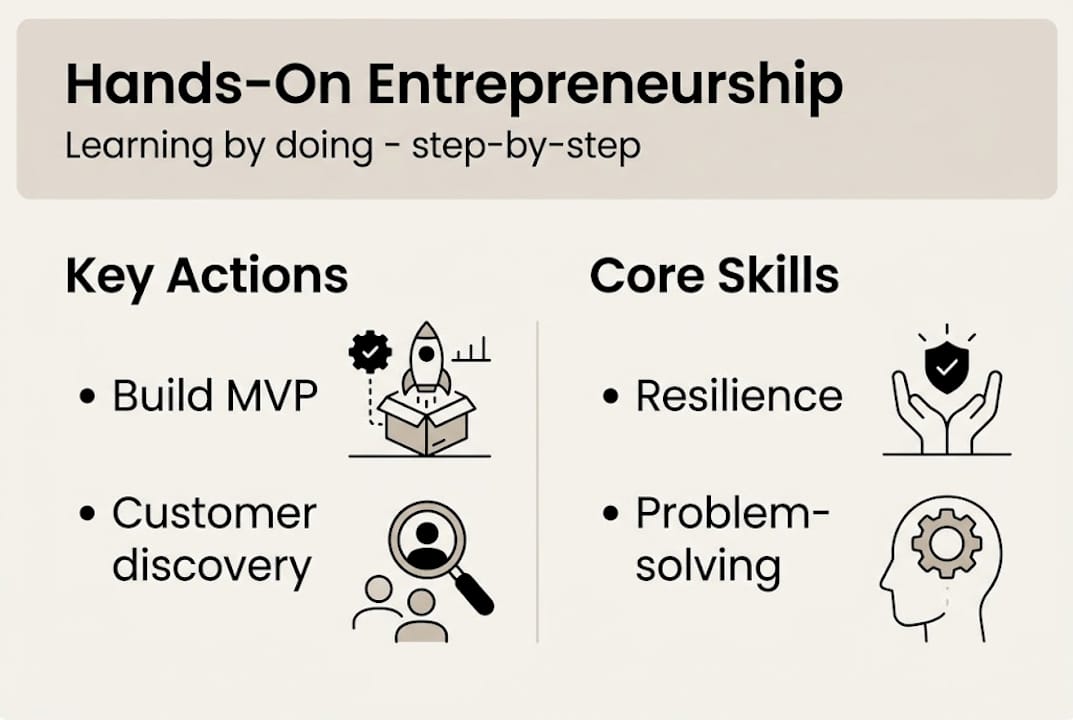
The core activities that define hands-on entrepreneurship include:
- Customer discovery: Talking directly to potential buyers to validate or challenge your assumptions
- MVP development: Building the simplest version of a product to test market demand
- Rapid iteration: Adjusting your offer based on real feedback rather than internal opinions
- Peer collaboration: Working alongside other founders to pressure-test ideas and share accountability
- Reflection cycles: Structured reviews that convert raw experience into transferable lessons
“The most important thing an entrepreneur can do early on is get uncomfortable in public. Real learning happens when your ideas meet the market, not when they stay safely inside a business plan.”
The benefits of entrepreneurship bootcamps are rooted in this same logic: structured immersion accelerates what years of solo study cannot replicate.
Core frameworks and methodologies behind hands-on learning
Now that you know what hands-on learning is, let’s break down how it actually works in the lab and in the field.
The most effective hands-on entrepreneurship programs are not improvised. They follow proven methodologies that guide founders through a logical progression from idea to validated business. Understanding these frameworks helps you apply them intentionally rather than stumbling through trial and error alone.
Customer discovery is the starting point in almost every serious hands-on program. Before building anything, founders are pushed to interview potential customers, map pain points, and challenge their own assumptions. This step alone eliminates a significant number of bad ideas before they consume time and capital.
From there, lean startup principles take over. The lean startup method, popularized by Eric Ries, centers on building MVPs, measuring real user behavior, and iterating quickly. The goal is to compress the feedback loop so that learning happens in days rather than months.

MIT’s Disciplined Entrepreneurship process adds further structure. As outlined in MIT’s strategic playbook, this 24-step framework walks founders through customer segmentation, beachhead markets, and business model design in a sequential, testable way. It combines rigor with real-world application.
For those who want to experience urgency firsthand, 48-hour launch experiments compress the entire validation cycle into a weekend. You identify a problem, build a simple solution, and attempt to generate your first sale or sign-up within two days. It sounds extreme, but the constraint forces clarity.
| Framework | Core focus | Best for |
|---|---|---|
| Customer discovery | Validating assumptions through interviews | Pre-product stage |
| Lean startup | MVP development and rapid iteration | Early product testing |
| Disciplined Entrepreneurship | 24-step structured business building | Systematic growth |
| 48-hour launch sprint | Speed-to-market validation | Overcoming analysis paralysis |
A well-designed entrepreneurship curriculum guide sequences these frameworks so founders build momentum rather than jumping between methods randomly. The apply-test-reflect rhythm is what separates programs that produce real results from those that simply feel productive.
Pro Tip: Start with two ideas simultaneously and run basic customer discovery on both. The one that generates genuine interest from real people, not just polite encouragement from friends, is the one worth pursuing further. This approach saves weeks of misdirected effort.
For a deeper look at how these methods connect, entrepreneurship success frameworks and structured entrepreneurship resources can help you map your own learning path.
Real impact: Success rates, skill growth, and the evidence
Understanding the frameworks is important, but does immersive entrepreneurship really move the needle? The evidence is compelling.
The numbers behind hands-on entrepreneurship are hard to ignore. 61% of startups using MIT’s Disciplined Entrepreneurship framework survived a full decade, a remarkable figure in an environment where most new ventures fail within five years. Hands-on management is consistently identified as a primary driver of that resilience.
Beyond survival, the skill development outcomes are equally strong. A study on experiential methods found that experiential entrepreneurship programs consistently outperform theory-only approaches in building the competencies that actually matter in the field.
Founders who go through immersive programs develop a distinct skill profile:
- Creative problem-solving: The ability to generate solutions under real constraints, not just hypothetical ones
- Resilience: Repeated exposure to rejection and failure builds tolerance and recovery speed
- Teamwork and communication: Collaborative ventures require constant negotiation and trust-building
- Market intuition: Pattern recognition that develops only through direct customer interaction
- Execution discipline: The habit of finishing, not just planning
One particularly striking data point: startups with actionable plans are 16% more likely to succeed than those without structured execution strategies. This is not about lengthy business documents. It is about founders who translate learning into concrete next steps, which is exactly what hands-on programs train you to do.
| Learning approach | 10-year survival rate | Key skill outcomes |
|---|---|---|
| Hands-on, immersive programs | ~61% | Resilience, execution, market intuition |
| Theory-only education | ~20% | Conceptual knowledge, limited application |
For a fuller picture of what the research says, evidence on hands-on entrepreneurship brings together the most relevant findings for early-stage founders.
These numbers represent real people who built real businesses. The gap between 61% and 20% is not abstract. It is the difference between a venture that grows and one that quietly closes.
When hands-on works best—and key pitfalls to avoid
With the benefits and proof in hand, it is crucial to understand when and how to lean into hands-on approaches, and where they must be balanced.
Hands-on learning delivers its strongest results during specific phases of the entrepreneurial journey. Experiential approaches are most powerful for early-stage learning, skill acquisition, and problem-solving. This is when the feedback loop between action and insight is tightest, and when the cost of mistakes is still manageable.
The ideal moments to go fully hands-on include:
- Idea validation: Before investing significant resources, run customer interviews and small experiments to confirm real demand.
- MVP development: Build the simplest functional version of your product and put it in front of real users as quickly as possible.
- Early customer acquisition: Your first ten customers will teach you more than any marketing course.
- Team formation: Collaborate on real projects early so you understand how your team actually works under pressure.
- Pivoting: When something is not working, hands-on experimentation helps you find the right direction faster than strategic planning alone.
However, there are genuine pitfalls to watch for. Over-focusing on action without structured reflection is one of the most common traps. Doing more does not automatically mean learning more. Without pausing to analyze what the data and feedback are telling you, you risk repeating the same mistakes with increasing speed.
Another critical transition point comes as your business scales. Scaling from hands-on to visionary leadership requires founders to gradually shift from doing everything themselves to building systems and trusting others. Founders who cannot make this shift often become bottlenecks in their own businesses.
Pro Tip: Schedule a 15-minute reflection at the end of each day during intensive learning phases. Write down one thing that surprised you and one adjustment you will make tomorrow. This small habit accelerates learning dramatically and prevents the “busy but not growing” trap.
Understanding the future of entrepreneurship education and the value of business education can help you make smarter decisions about when to invest in structured programs versus self-directed learning.
Our take: Why ‘learning by doing’ is non-negotiable—until it’s time to grow up
Here is something most entrepreneurship content will not tell you directly: the founders who succeed fastest are not the ones who studied the most before starting. They are the ones who started, failed small, adjusted quickly, and built genuine market instincts through repetition.
Classroom skills only become powerful after real-world immersion gives them context. A framework you learned in a lecture becomes a vital tool once you have personally experienced the problem it solves.
But there is a second truth that matters just as much. At some point, staying hands-on in every detail of your business stops being a strength and becomes a limitation. The founders who scale are the ones who develop the instinct to let go, to delegate, to lead rather than execute. That transition is uncomfortable, and it requires a different kind of learning.
At Nomad Excel’s hands-on bootcamps, we see this arc play out repeatedly. The early-stage immersion is irreplaceable. But the real breakthrough comes when founders learn to trust their systems and their people. Both phases matter. Neither one is optional.
Level up with immersive entrepreneurial learning
If this article has clarified what hands-on entrepreneurship looks like in practice, the natural next step is to experience it directly. Reading about customer discovery and lean iteration is useful. Actually doing it, with expert guidance and a community of driven peers around you, is transformative.
Nomad Excel’s entrepreneurship bootcamp is built around the exact principles covered here: real frameworks, real feedback, and real accountability. Whether you are validating your first idea or trying to break through a growth plateau, structured immersion shortens the path considerably. Explore why joining an entrepreneurship bootcamp makes a measurable difference, or take a closer look at our hands-on program to see how the experience is structured.
Frequently asked questions
What is the main difference between hands-on entrepreneurship and traditional entrepreneurship education?
Hands-on entrepreneurship focuses on real-world practice such as building startups and running experiments, while traditional education is primarily theory-based and classroom-centered.
Which core skills do founders actually build in hands-on programs?
Hands-on programs build creativity, teamwork, resilience, and problem-solving through repeated real-world engagement, with research showing significant gains in entrepreneurial self-efficacy and intention.
Is hands-on learning effective for scaling a business, or only for getting started?
Hands-on learning is most powerful in the early stages, but scaling a startup requires founders to balance direct involvement with strategic delegation and systems thinking.
What are examples of hands-on entrepreneurship activities?
Common activities include customer interviews, market tests, MVP launches, 48-hour business experiments, and operating real ventures with live accountability structures.
Recommended
- Experiential entrepreneurship: accelerate growth hands-on
- Entrepreneurship Skills Guide for Launching Your Own Venture – Nomad Excel – Your Entrepreneurial Adventure Starts Here
- Online Entrepreneurship Bootcamp – Nomad Excel – Your Entrepreneurial Adventure Starts Here
- Experiential Education Explained: Real-World Impact for Entrepreneurs
- INUSUAL | 7 habilidades blandas para emprendedores de startups exitosas
Comments are closed.