
How Mastermind Groups Transform Entrepreneur Growth
Launching a venture often feels like pushing through uncertainty with limited support. Aspiring entrepreneurs need more than generic advice to navigate complex startup challenges. Mastermind groups offer a structured peer-to-peer approach where motivated individuals collaborate for mutual growth, blending accountability, diverse perspectives, and meaningful feedback. This article uncovers the real benefits of mastermind groups, clears up common myths, and explains how psychological support and optimal group dynamics can accelerate both personal and professional success.
Table of Contents
- Mastermind Groups Defined And Common Myths
- Main Types And Structures For Entrepreneurs
- Core Processes And How Groups Operate
- Essential Roles, Commitments, And Expectations
- Risks, Costs, And What To Avoid
- Comparing Mastermind Groups To Other Models
Key Takeaways
| Point | Details |
|---|---|
| Mastermind Groups Enhance Growth | They foster collaborative problem-solving and leverage collective intelligence among members. |
| Myths Hinder Participation | Common misconceptions include the belief that only established entrepreneurs can join or that significant time is needed. |
| Diversity in Experience is Crucial | Emphasizing varied backgrounds rather than industry specificity maximizes the learning potential within groups. |
| Effective Structure is Key | Successful groups maintain a balance of structured frameworks with flexibility to adapt to members’ needs. |
Mastermind Groups Defined and Common Myths
Mastermind groups represent a strategic peer-to-peer mentoring approach designed to accelerate personal and professional growth through collaborative problem-solving. Originated by Napoleon Hill in 1925, these groups bring together motivated individuals who share a commitment to mutual advancement and collective wisdom.
The core philosophy of mastermind groups centers on leveraging collective intelligence. Unlike traditional networking or support groups, these teams provide structured environments where members can:
- Share challenging business scenarios
- Receive candid, actionable feedback
- Access diverse perspectives and expertise
- Develop accountability mechanisms
- Expand professional networks
Psychological Support is a critical component of mastermind groups. Research demonstrates these teams offer more than just practical advice—they provide emotional encouragement and inspiration crucial for navigating complex entrepreneurial challenges.
Despite their proven effectiveness, several persistent myths prevent entrepreneurs from fully embracing mastermind groups. The most common misconceptions include:
- Only for established entrepreneurs
- Requires significant time commitment
- Must be industry-specific
- Guaranteed immediate results
Optimal Group Dynamics typically involve 8-10 participants with rotating leadership, ensuring balanced participation and preventing knowledge stagnation. Successful groups maintain clear structures while remaining flexible enough to adapt to members’ evolving needs.
Pro tip: When joining a mastermind group, prioritize diversity of experience over strict industry alignment to maximize learning potential.
Main Types and Structures for Entrepreneurs
Entrepreneurs have multiple pathways to engage with mastermind groups, each designed to address specific professional development needs. Mastermind group structures range from peer-driven collaborations to expert-facilitated environments, offering flexible approaches to collective learning and growth.
The primary types of mastermind groups entrepreneurs can leverage include:
- Peer-to-Peer Groups: Members contribute equally, sharing personal expertise
- Coach-Driven Groups: Facilitated by an experienced industry leader
- Career-Focused Collectives: Targeting specific professional trajectories
- Entrepreneurial Networks: Designed for business owners and startup founders
- Leadership Development Circles: Emphasizing strategic management skills
Group composition plays a critical role in effectiveness. Successful mastermind groups typically maintain a delicate balance between structure and adaptability. The most dynamic groups operate more like a collaborative band than a traditional boardroom, with members bringing diverse skills and perspectives.
Group Size and Dynamics are crucial considerations for entrepreneurs. Most effective mastermind groups range from 4 to 8 participants, ensuring:
- Sufficient diversity of thought
- Meaningful individual contribution time
- Manageable communication logistics
- Intimate knowledge sharing
Effective mastermind groups function as living ecosystems of collective intelligence, not static meeting frameworks.
Participation Models vary widely, with some groups meeting virtually, others in person, and some utilizing hybrid approaches. The key is consistent engagement and a shared commitment to mutual growth.

Pro tip: When selecting a mastermind group, prioritize alignment of values and growth mindset over strict industry matching.
Core Processes and How Groups Operate
Mastermind groups function through carefully structured processes designed to maximize collective problem-solving and personal growth. Small peer-led groups leverage systematic approaches to transform individual challenges into collaborative opportunities for advancement.
The most effective mastermind groups typically employ several core operational mechanisms:
- Meeting Frameworks: Structured agendas with predictable flow
- Accountability Systems: Regular check-ins and progress tracking
- Problem-Solving Protocols: Systematic approaches to addressing member challenges
- Feedback Mechanisms: Constructive, honest, and strategic input processes
- Knowledge Sharing Platforms: Structured methods for exchanging insights
The Hot Seat Method represents a cornerstone of most mastermind group interactions. During these sessions, one member presents a specific business challenge or strategic question, while other group members provide targeted feedback, brainstorm solutions, and offer diverse perspectives.
Successful group dynamics require several critical elements:
- Clear communication protocols
- Mutual respect and confidentiality
- Commitment to collective growth
- Willingness to give and receive candid feedback
Effective mastermind groups transform individual limitations into collective strengths through structured collaboration.
Participation typically involves a blend of structured dialogue, strategic questioning, and collaborative problem-solving. The most powerful groups create an environment where vulnerability meets strategic thinking, allowing members to explore challenges with unprecedented depth and creativity.
Pro tip: Prepare thoroughly for each meeting by documenting specific challenges and desired outcomes to maximize group problem-solving potential.
Essential Roles, Commitments, and Expectations
Mastermind groups depend on a delicate ecosystem of well-defined roles and mutual commitments to ensure collective success. Carefully defined roles create the foundational structure that transforms individual efforts into powerful collaborative experiences.
The key roles within a mastermind group typically include:
For quick reference, here are the essential roles in a successful mastermind group and what each contributes to group outcomes:
| Role | Main Responsibility | Contribution to Success |
|---|---|---|
| Facilitator | Guide meetings, set agenda | Maintains structure and focus |
| Accountability Partner | Track member progress, support | Drives consistent results |
| Discussion Leader | Lead topic or challenge dialogue | Stimulates in-depth exploration |
| Knowledge Curator | Organize resources, share tools | Enhances shared learning potential |
| Group Member | Engage, participate actively | Builds group trust and momentum |
- Facilitator: Guides meetings, manages group dynamics
- Group Members: Active participants committed to mutual growth
- Discussion Leaders: Rotate responsibility for guiding specific sessions
- Accountability Partners: Support individual member progress
- Knowledge Curators: Track and share relevant resources
Group Commitments represent the critical agreements that transform a casual meeting into a high-performance collective. Successful mastermind groups establish clear expectations around participation and mutual support.
Core expectations for members encompass multiple dimensions:
- Consistent attendance
- Genuine vulnerability
- Constructive feedback
- Absolute confidentiality
- Proactive problem-solving
Trust is the currency of mastermind groups – without it, collaboration becomes impossible.
Participants must demonstrate a profound commitment to collective growth, understanding that their individual transformation depends on their willingness to both give and receive meaningful insights. The most successful groups create an environment where personal vulnerability meets strategic thinking.
Pro tip: Draft a group charter outlining explicit roles, expectations, and communication protocols before your first meeting to establish clear mutual understanding.
Risks, Costs, and What to Avoid
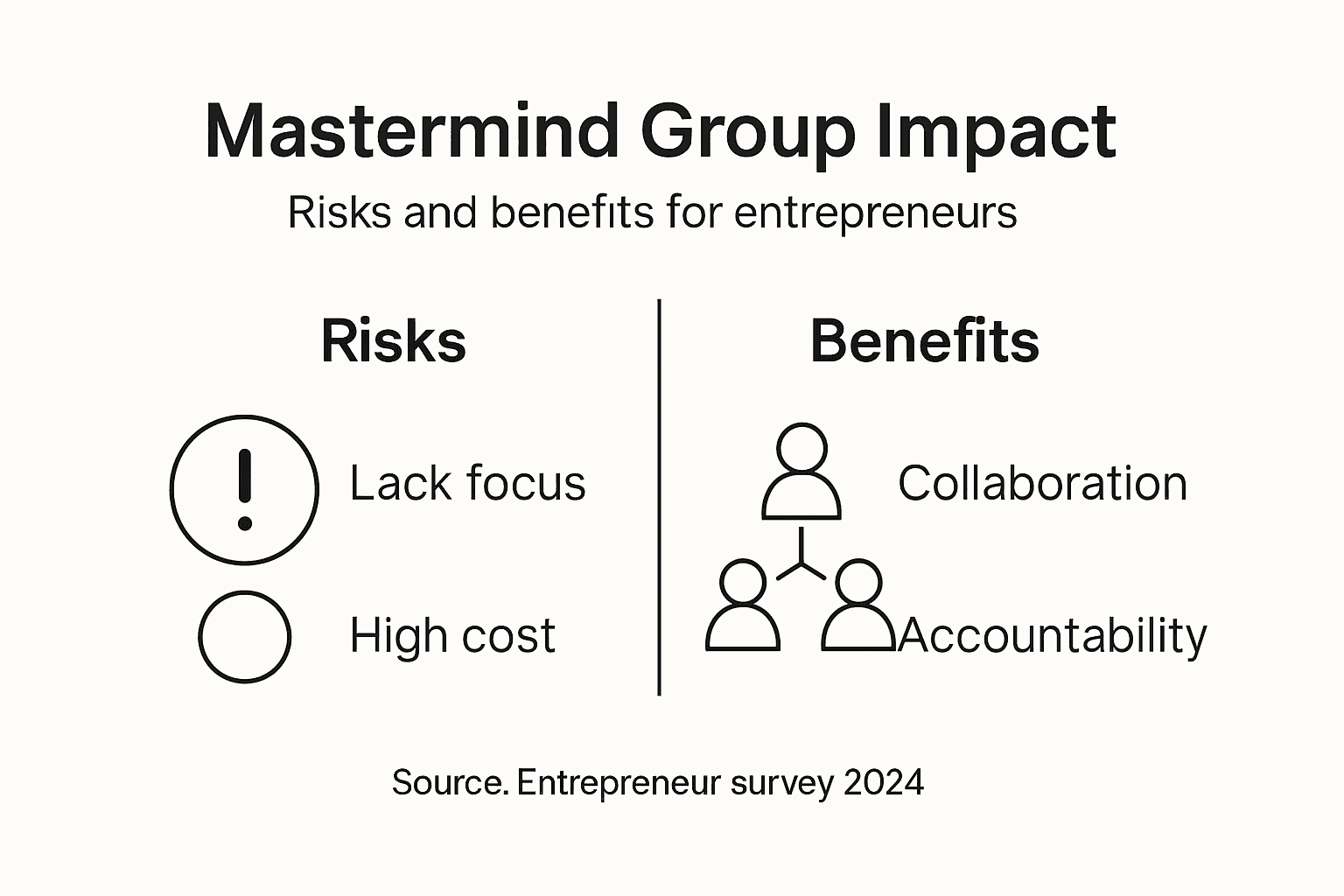
Navigating mastermind groups requires a strategic approach to understanding potential pitfalls and investment considerations. Mastermind group participation involves careful evaluation of both financial and personal resource commitments.
Potential risks entrepreneurs should anticipate include:
- Financial Investment: Membership fees and associated costs
- Time Commitment: Regular meeting requirements
- Group Compatibility: Potential misalignment of goals and expectations
- Confidentiality Concerns: Risk of information sharing
- Performance Variability: Inconsistent group effectiveness
Cost Dimensions extend beyond monetary considerations. Research highlights multiple potential investment areas that entrepreneurs must carefully assess:
- Direct monetary fees
- Time allocation for meetings
- Preparation and follow-up efforts
- Potential opportunity costs
- Emotional and intellectual energy investment
Not all mastermind groups deliver equal value – careful selection is critical.
Entrepreneurs should be vigilant about red flags that might compromise group effectiveness. Warning signs include lack of structured facilitation, inconsistent member commitment, unclear group objectives, and absence of meaningful accountability mechanisms.
Pro tip: Conduct a thorough preliminary assessment of potential mastermind groups, including interviewing current and past members to gauge genuine group performance and alignment.
Comparing Mastermind Groups to Other Models
Entrepreneurs seeking collaborative growth have multiple support models available, each with unique characteristics and potential benefits. Mastermind groups differ significantly from traditional professional development approaches by emphasizing collective, peer-driven learning.
Key distinctions between mastermind groups and alternative models include:
- Coaching: Expert-driven, hierarchical guidance
- Mentoring: One-to-one knowledge transfer
- Networking: Connection-focused interactions
- Peer Advisory Groups: Accountability-centered support
- Training Programs: Structured, curriculum-based learning
Comparative Analysis reveals the unique strengths of mastermind groups. Peer-based models offer distinct advantages over traditional development approaches:
Here’s a comparison of mastermind groups with other popular professional development models:
| Model Type | Leadership Style | Member Interaction | Primary Benefit |
|---|---|---|---|
| Mastermind Group | Peer-led or rotating | Collaborative | Collective problem-solving |
| Coaching | Expert-driven | Guided, one-way | Personalized strategic advice |
| Mentoring | Senior to junior | One-to-one support | Focused skill development |
| Networking | Unstructured | Informal connection | Expanding professional ties |
| Peer Advisory Group | Structured peer-led | Accountability focus | Goal tracking and support |
| Training Program | Fixed instructor | Structured learning | Knowledge acquisition |
- Lateral knowledge exchange
- Mutual accountability
- Diverse perspective integration
- Collaborative problem-solving
- Equal participant status
Mastermind groups transform individual challenges into collective opportunities through structured, reciprocal engagement.
Unlike hierarchical models, mastermind groups create a horizontal learning environment where participants simultaneously teach and learn. The power emerges from collective intelligence, where each member’s unique experience contributes to solving complex entrepreneurial challenges.
Pro tip: Select a group model that aligns with your specific growth objectives, prioritizing collaborative potential over traditional expert-driven approaches.
Unlock Entrepreneurial Growth with Nomad Excel Mastermind Experiences
The article highlights the power of mastermind groups to overcome common entrepreneurial challenges such as lack of accountability, limited perspectives, and difficulty executing strategies. If you are striving to harness collective intelligence, structured collaboration, and accountability mechanisms to propel your business forward you will find immense value in Nomad Excel’s immersive entrepreneurship bootcamps and company retreats. These programs are designed specifically to create environments where peer-to-peer mentorship, diverse expertise, and execution focus come together to accelerate growth.
Join a vibrant community of driven founders and teams who experience hands-on frameworks, daily accountability, and ongoing support beyond events. Discover how combining expert guidance with real-world application and emotional encouragement can transform your entrepreneurial journey. Don’t wait for perfect conditions to start growing faster Take the next step today by exploring how Nomad Excel Entrepreneurship Bootcamps and Company Retreats can provide the clarity, community, and momentum that mastermind groups promise but with immersive action at the core. Visit Nomad Excel now to learn more and secure your spot in a program tailored to elevate your business growth.
Frequently Asked Questions
What are mastermind groups?
Mastermind groups are peer-to-peer mentoring networks that facilitate personal and professional growth through collaborative problem-solving and shared expertise.
How do mastermind groups benefit entrepreneurs?
Entrepreneurs benefit from mastermind groups by gaining diverse perspectives, receiving candid feedback, developing accountability mechanisms, and expanding their professional networks, which can enhance their business strategies and decision-making.
What are the common myths about mastermind groups?
Common myths include the belief that mastermind groups are only for established entrepreneurs, require a significant time commitment, must be industry-specific, and guarantee immediate results.
What roles are essential in a mastermind group?
Essential roles in a mastermind group include the facilitator, accountability partner, discussion leader, knowledge curator, and active group members, each contributing to the overall success of the group.
Comments are closed.