
What Is Leadership Development and Why It Matters
Rising through the ranks as an early-stage entrepreneur or remote professional often means facing situations where confidence and knowledge alone are not enough. The ability to lead with clarity and adaptability sets exceptional leaders apart in today’s ever-changing markets. By exploring leadership development as a multifaceted phenomenon, you gain insight into personal growth, impactful team management, and strategic thinking that help you excel no matter your work environment.
Table of Contents
- Defining Leadership Development and Its Purpose
- Key Types of Leadership Development Programs
- Essential Skills and Strategies for Leaders
- How Leadership Development Drives Business Growth
- Common Challenges and Mistakes to Avoid
Key Takeaways
| Point | Details |
|---|---|
| Leadership Development is Multifaceted | It involves enhancing personal skills, strategic thinking, and adaptive capabilities tailored to organizational needs and contexts. |
| Types of Programs Offer Varied Benefits | Programs such as formal education, experiential learning, and mentorship each provide unique advantages for developing leadership potential. |
| Strategic Leadership is Ongoing | Successful leaders commit to continuous self-reflection and adaptation to navigate complex business environments effectively. |
| Avoid Common Pitfalls | Organizations should design personalized programs, set clear performance metrics, and ensure real-world application to enhance leadership development outcomes. |
Defining Leadership Development and Its Purpose
Leadership development is a strategic process designed to enhance an individual’s capacity to lead effectively across various organizational and professional contexts. At its core, it represents a comprehensive approach to cultivating leadership skills, capabilities, and strategic thinking beyond traditional management training.
According to academic research, leadership development is a multifaceted phenomenon encompassing multiple dimensions of personal and professional growth. This nuanced perspective recognizes that leadership is not a one-size-fits-all skill, but a complex interplay of personal attributes, organizational needs, and contextual understanding.
Key dimensions of leadership development include:
- Personal skill enhancement
- Organizational performance improvement
- Strategic thinking development
- Interpersonal communication mastery
- Adaptive leadership capabilities
The purpose of leadership development extends far beyond simple skill acquisition. Systematic efforts aim to improve leadership competencies that enable professionals to navigate increasingly complex work environments, drive organizational success, and create meaningful impact.
Successful leadership development programs recognize that true leadership is about more than positional authority. They focus on cultivating holistic capabilities that allow individuals to inspire, strategize, and execute effectively across diverse scenarios.
Pro tip: Approach leadership development as a continuous journey of self-reflection, learning, and adaptive growth, not a destination with a fixed endpoint.
Key Types of Leadership Development Programs
Leadership development programs represent a diverse ecosystem of learning approaches designed to cultivate leadership potential across different organizational contexts. Academic research reveals multiple program formats that cater to varying professional development needs and organizational objectives.
The primary types of leadership development programs include:
- Formal Educational Programs
- Executive MBA courses
- University-based leadership certificates
- Specialized leadership seminars
- Experiential Learning Approaches
- Action learning projects
- Leadership simulations
- Cross-functional team assignments
- Mentorship and Coaching
- One-on-one executive coaching
- Peer mentorship networks
- Senior leadership guidance programs
Leadership development initiatives in higher education typically combine strategic modules focusing on change management, interpersonal dynamics, and institutional governance. These programs are increasingly designed with flexibility, recognizing that leadership development is not a one-size-fits-all process.
Successful programs integrate multiple learning modalities, including workshops, online training, coaching sessions, and real-world project implementations. The goal is to create holistic learning experiences that develop adaptable leadership capabilities across diverse professional scenarios.
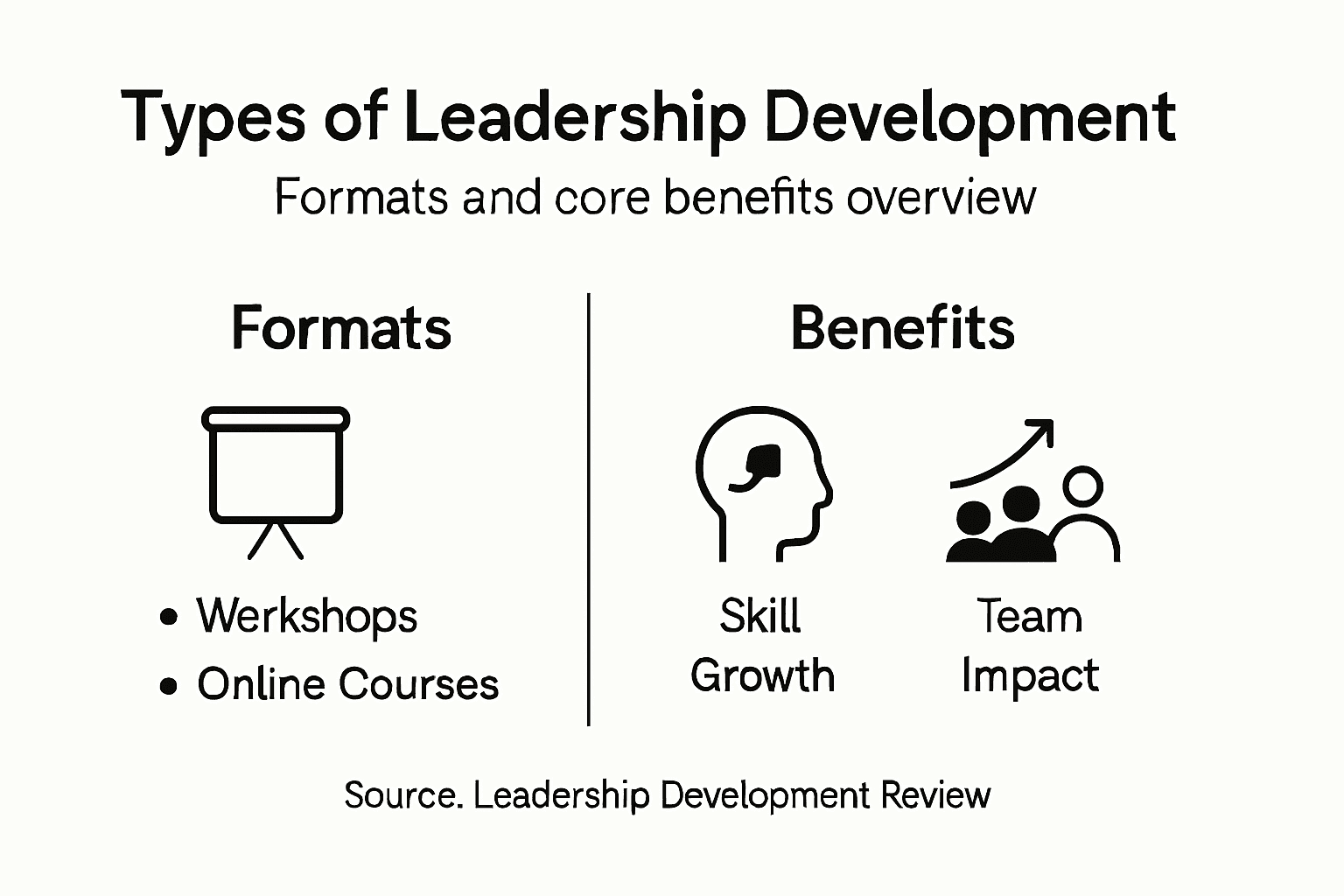
Each leadership development program type offers unique advantages, allowing organizations and individuals to select approaches that best match their specific growth objectives and learning preferences.
Here’s a quick comparison of leadership development program types and their core business impacts:
| Program Type | Main Benefit | Typical Format |
|---|---|---|
| Formal Education | Develops strategic expertise | Courses, seminars |
| Experiential Learning | Builds practical leadership | Real-world projects |
| Mentorship & Coaching | Fosters personal growth | 1:1 or group interactions |
| Blended Approaches | Maximizes overall effectiveness | Integrated learning modules |
Pro tip: Choose leadership development programs that offer a blend of theoretical knowledge and practical application to maximize your professional growth potential.
Essential Skills and Strategies for Leaders
Strategic leadership requires a sophisticated blend of skills that enable professionals to navigate complex organizational landscapes effectively. Effective leaders must master six core competencies that transform their ability to drive meaningful organizational change and inspire teams.
Key leadership skills include:
- Strategic Thinking
- Anticipating market trends
- Interpreting complex business scenarios
- Developing long-term vision
- Interpersonal Capabilities
- Authentic communication
- Empathetic team engagement
- Conflict resolution skills
- Decision-Making Abilities
- Data-driven analysis
- Risk assessment
- Decisive action implementation
Leadership capabilities essential across professional contexts encompass more than technical skills. They require deep personal attributes like integrity, self-awareness, resilience, and adaptability.

Successful leaders understand that skill development is an ongoing journey. They continuously refine their approach, seek feedback, and remain committed to personal and professional growth. This mindset separates exceptional leaders from average managers.
The most transformative leaders combine intellectual capabilities with emotional intelligence, creating environments where teams feel motivated, understood, and empowered to achieve extraordinary results.
Pro tip: Invest consistently in self-reflection and seek diverse perspectives to continuously evolve your leadership approach.
How Leadership Development Drives Business Growth
Business transformation begins with strategic leadership development that directly impacts organizational performance and competitive advantage. Leadership development equips organizations with critical capabilities to navigate complex market dynamics and emerging challenges.
Key ways leadership development drives business growth include:
- Talent Optimization
- Enhanced employee engagement
- Improved workforce retention
- Strategic talent pipeline development
- Organizational Adaptability
- Faster change management
- Increased innovation capacity
- Flexible strategic response
- Performance Enhancement
- Data-driven decision making
- Improved operational efficiency
- Higher team productivity
Investing in leadership development yields significant performance returns by creating a culture of continuous learning and strategic thinking. Effective programs transform leaders from traditional managers into dynamic change agents who can anticipate market shifts and inspire teams.
Successful organizations recognize that leadership development is not an expense, but a strategic investment. By systematically developing leadership capabilities, companies create resilient, forward-thinking cultures that can quickly adapt to technological disruptions and evolving market conditions.
The most innovative companies view leadership development as a critical driver of sustainable competitive advantage, enabling them to consistently outperform competitors in rapidly changing business landscapes.
Pro tip: Align leadership development initiatives directly with your organization’s strategic goals to maximize impact and return on investment.
Common Challenges and Mistakes to Avoid
Leadership development requires strategic awareness to navigate potential pitfalls that can undermine organizational growth and individual professional progress. Common leadership development mistakes can significantly impede progress and create long-term performance barriers.
Key challenges and mistakes organizations frequently encounter include:
- Program Design Failures
- One-size-fits-all training approaches
- Lack of personalized learning paths
- Insufficient practical application opportunities
- Measurement and Evaluation Gaps
- Unclear performance metrics
- Inadequate long-term impact tracking
- Minimal behavioral change assessment
- Implementation Weaknesses
- Poor leadership role model selection
- Disconnected learning from real work scenarios
- Inconsistent support and follow-through
Leadership development challenges stem from complex organizational dynamics that require nuanced, adaptive approaches. Successful programs recognize that development is not a linear process but a continuous journey of growth, reflection, and strategic adaptation.
Effective organizations treat leadership development as a dynamic, integrated process rather than a series of isolated training events. They create ecosystems that support ongoing learning, provide meaningful feedback, and align individual development with broader strategic objectives.
Transformative leadership development requires commitment, systemic thinking, and a willingness to challenge existing paradigms about learning, performance, and organizational potential.
Review the table below for strategies to overcome common leadership development challenges:
| Challenge Area | Effective Solution | Long-Term Benefit |
|---|---|---|
| Program Design | Customize learning paths | Higher engagement |
| Measurement & Evaluation | Set clear KPIs and feedback loops | Measurable improvement |
| Implementation | Connect training to real tasks | Sustained behavior change |
Pro tip: Design leadership development programs with built-in flexibility and continuous feedback mechanisms to ensure relevance and sustained impact.
Accelerate Your Leadership Development Journey with Nomad Excel
The article highlights how leadership development is essential for building strategic thinking, enhancing interpersonal skills, and driving business growth. Many individuals and organizations struggle with designing tailored programs that create real, lasting change and align leadership skills with evolving market demands. If you are ready to overcome common challenges like generic training and disconnected learning, it is time to adopt an approach that blends practical application with mentorship and community support.
Nomad Excel offers immersive Entrepreneurship Bootcamps and Company Retreats that focus on hands-on learning, expert mentorship, and strategic alignment. These programs are designed to help leaders and teams develop adaptable leadership capabilities while accelerating business growth through clarity and execution. Whether you are an aspiring entrepreneur or leading a company, engaging with Nomad Excel means investing in continuous growth and actionable results.
Discover how you can transform your leadership development into a powerful catalyst for business success by exploring our offerings at Nomad Excel today. Take the next step toward leadership excellence and join a community committed to growth and impact.
Frequently Asked Questions
What is leadership development?
Leadership development is a strategic process aimed at enhancing individuals’ capacity to lead effectively within various organizational contexts by cultivating essential skills and strategic thinking.
Why is leadership development important for organizations?
Leadership development is crucial because it equips leaders with the skills needed to navigate complex work environments, drive organizational success, improve talent retention, and foster adaptability within the business.
What are common types of leadership development programs?
Common types of leadership development programs include formal educational programs (such as executive MBAs and leadership certificates), experiential learning approaches (like action learning projects), and mentorship and coaching initiatives that focus on personal growth and skills enhancement.
What key skills should leaders develop through leadership programs?
Leaders should focus on developing skills in strategic thinking, interpersonal communication, decision-making, and personal attributes like integrity and adaptability to effectively inspire teams and drive organizational change.
Comments are closed.