
How to Build a Growth Mindset for Entrepreneurial Success
Launching a startup in a fast-paced global bootcamp brings intense pressure and learning curves that test every entrepreneur’s mindset. For those seeking to build businesses beyond borders, the difference often comes down to whether you see obstacles as roadblocks or opportunities to grow. Understanding and intentionally shifting your thinking patterns is the foundation for developing a growth mindset—a shift that fuels resilience, continuous improvement, and success. This guide reveals practical steps to help you assess your current mindset, actively adopt empowering language, set ambitious stretch goals, and harness the power of mentorship and community support.
Table of Contents
- Step 1: Assess Your Current Thinking Patterns
- Step 2: Adopt Empowering Beliefs and Language
- Step 3: Set Stretch Goals for Continuous Growth
- Step 4: Engage with Mentors and Community Support
- Step 5: Test Progress and Reinforce Growth Habits
Quick Summary
| Key Insight | Explanation |
|---|---|
| 1. Assess Your Current Thinking Patterns | Understanding your mindset reveals your response to challenges, guiding future improvements and resilience in entrepreneurship. |
| 2. Adopt Empowering Language | Replace limiting statements with growth-oriented ones to enhance motivation and encourage a positive outlook on your abilities. |
| 3. Set Stretch Goals for Growth | Ambitious targets push you beyond comfort, help develop new skills, and ensure ongoing learning essential for business scaling. |
| 4. Engage with Mentors and Community | Building relationships with mentors and peers accelerates growth, accountability, and offers diverse perspectives essential for your development. |
| 5. Test Progress and Reinforce Habits | Track specific growth habits and evaluate your progress to ensure continuous improvement and consolidate a growth mindset. |
Step 1: Assess Your Current Thinking Patterns
You’re about to start one of the most honest conversations you’ll have with yourself. Before you can shift toward a growth mindset, you need to understand exactly where you stand right now. This isn’t about judgment or shame. It’s about clarity. The clearer you are about your current patterns, the more intentional you can be about changing them.
Start by examining how you typically respond to challenges and setbacks in your business. When a potential investor rejects your pitch, does your immediate thought lean toward “I’m not cut out for this” or “I need to refine my approach”? When a product launch underperforms, do you see it as evidence of your limitations or as data that informs your next iteration? These automatic thoughts reveal something powerful about your mindset orientation. Implicit beliefs about intelligence fundamentally shape how you interpret obstacles, and recognizing these patterns is the foundation for change.
Write down three recent moments when things didn’t go as planned. For each one, capture the challenge itself and then honestly describe the thoughts that followed. Did you catastrophize (“This proves I’m a fraud”), blame external factors (“The market wasn’t ready”), or get curious (“What can I learn here?”)? Look for recurring themes. Do you consistently avoid feedback? Do you give up quickly when skills don’t come naturally? Do you compare your progress to others and feel permanently behind? These aren’t character flaws. They’re thinking patterns that developed for reasons, and recognizing your mindset orientation directly impacts your motivation and resilience as an entrepreneur. Once you identify your patterns, you can start working with them instead of fighting yourself.
Here’s a summary comparing fixed versus growth mindset patterns entrepreneurs may encounter:
| Mindset Pattern | Fixed Mindset Example | Growth Mindset Example | Impact on Business |
|---|---|---|---|
| Response to Failure | “I’m not cut out for this” | “I need to refine my approach” | Limits progress or fuels improvement |
| Feedback Reception | Avoids feedback | Seeks constructive feedback | Stagnant or evolving skills |
| Adaptation to Change | Gives up quickly | Iterates and tries again | Stalled or sustained growth |
| Perspective on Others | Feels permanently behind | Finds inspiration in others’ growth | Demotivation or motivation |
Pro tip: Record yourself answering these questions out loud rather than just writing them down. Hearing your own words often reveals thoughts and beliefs you might gloss over on paper, giving you a more authentic picture of your actual thinking patterns.
Step 2: Adopt Empowering Beliefs and Language
Your words are not just reflections of your thoughts. They actively shape your beliefs and, ultimately, your actions. This step is about deliberately choosing language that reinforces possibility rather than limitation. When you speak and think differently about challenges, your brain actually responds differently. You’re not faking positivity here. You’re rewiring how you interpret your own capacity to grow.
Start by auditing the language you use when things get difficult. Listen for fixed mindset language like “I’m not a natural at sales” or “I don’t have the right background for this.” These statements feel like facts, but they’re actually just beliefs you’ve internalized. Replace them with growth-oriented alternatives that acknowledge effort and learning. “I’m not a natural at sales yet” or “I haven’t developed those skills in my background yet” opens a door that closed before. The shift seems small, but adopting empowering beliefs centered on effort and learning directly influences your motivation and what you attempt. When you believe growth is possible, you take different actions.
Extend this practice beyond yourself. The language you use with your cofounders, your team, and your mentors matters too. Instead of saying “You’re naturally gifted at coding,” try “Your consistent practice with debugging has really sharpened your problem-solving skills.” This reinforces that abilities develop through effort, not fixed talent. When team members internalize this, they become more resilient and willing to tackle harder problems. Growth-oriented language fosters a sense of belonging and collective ownership of outcomes. In bootcamps and startup environments, this shared language creates a culture where people actually want to challenge themselves rather than protect their egos.
One more thing: notice when you’re tempted to dismiss effort as not being enough. “I worked hard but still failed” can sound like evidence of inadequacy. Reframe it as “I worked hard and learned what doesn’t work. That’s valuable information for the next attempt.” Every founder at Nomad Excel who’s built something meaningful has stories of failed approaches that led to breakthroughs. Your effort is never wasted. It’s always generating data.
Pro tip: Write down three fixed mindset statements you catch yourself saying regularly, then write the growth-oriented version next to each one. Keep this list visible during stressful moments so you can consciously choose the empowering language when it matters most.
Step 3: Set Stretch Goals for Continuous Growth
Comfortable goals feel good in the moment, but they don’t build the skills you need to scale your business. Stretch goals are deliberately ambitious targets that push you beyond what feels easy or familiar. They force you to develop new capabilities, adapt your strategies, and discover what you’re actually capable of. In a bootcamp environment where you’re surrounded by other ambitious founders, stretch goals become the standard against which progress is measured.

Start by identifying one area of your business where growth would make a real difference. Maybe it’s landing your first 10 paying customers, reducing your product development cycle by 50%, or raising your first round of funding. Now make that goal ambitious enough that achieving it requires you to learn something new or operate differently than you do today. Stretch goals encourage continuous learning and improvement by forcing you out of your current comfort zone and requiring you to develop adaptive strategies. The key is that the goal should feel challenging but not impossible. If it feels impossible, dial it back slightly. If it feels routine, push it further. You’re aiming for that zone where you know you’ll need to grow to get there.
Break your stretch goal into smaller milestones with clear checkpoints. This keeps you from getting overwhelmed and gives you chances to assess your progress and adjust your approach. Every time you hit a milestone, you’re gathering data about what works, what doesn’t, and how to iterate. This is where the learning actually happens. Each iteration makes the next one smarter. Setting ambitious goals aligned with evolving entrepreneurial environments means regularly revisiting your goals as your business and market conditions change. You’re not rigidly attached to the original goal. You’re committed to the growth it’s driving you toward.
To help you get started, here’s a concise overview of common stretch goal areas and how they drive entrepreneurial growth:
| Business Area | Stretch Goal Example | Skill Developed | Long-Term Benefit |
|---|---|---|---|
| Customer Acquisition | Secure first 10 paying customers | Sales and outreach strategies | Revenue growth |
| Product Development | Cut development cycle by 50% | Agile, adaptive iteration | Faster product releases |
| Fundraising | Raise initial investment round | Pitching and networking | Increased resources |
| Team Leadership | Build a high-performing team | Hiring and leadership | Greater company capacity |
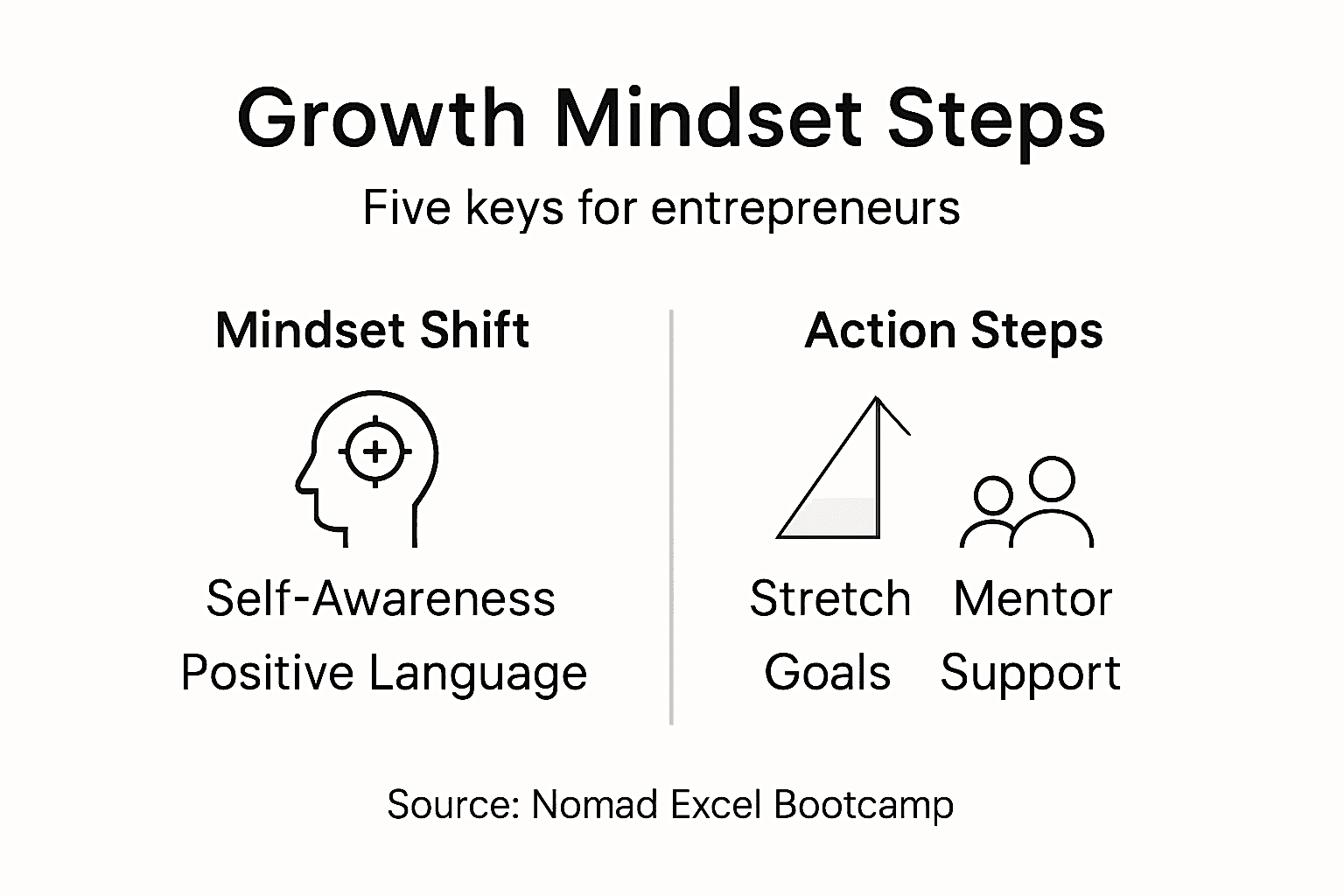
One critical piece: share your stretch goals with someone who will hold you accountable. Your bootcamp cohort, a mentor, or a cofounder can serve this role. Public commitment strengthens follow-through, and when others know your goals, they can offer perspectives you might miss alone. Growth happens faster in community than it does in isolation.
Pro tip: Set a monthly review rhythm where you assess progress against your stretch goals and consciously identify what you’ve learned, not just what you’ve achieved, since the learning is what develops your growth mindset.
Step 4: Engage with Mentors and Community Support
You cannot build a growth mindset in isolation. The most significant mindset shifts happen through connection, accountability, and exposure to people who think differently than you do. Mentors and community members challenge your assumptions, share their own failures and breakthroughs, and show you what’s possible when you actually commit to growth. This step is about deliberately seeking out and building those relationships.
Start by identifying mentors who have solved problems you’re currently facing. A good mentor isn’t necessarily someone who founded a company in your exact industry. They’re someone who has built something, learned from setbacks, and can see patterns you can’t yet see from inside your situation. When you approach a potential mentor, be specific about what you want to learn. Don’t ask for vague advice. Ask about a particular challenge you’re solving. This makes it easier for them to help and shows you’re serious about growth. Mentorship networks facilitate mindset shifts through shared experiences and role modeling that you simply cannot replicate alone. You’re not just getting information. You’re getting permission to try things you weren’t sure were possible.
Beyond one-on-one mentorship, immerse yourself in a community of other entrepreneurs. A bootcamp cohort like the ones at Nomad Excel creates this automatically, but you can also find it in coworking spaces, startup groups, or online communities. The magic happens when you’re regularly exposed to people who are taking risks, learning publicly, and supporting each other through failures. When someone in your community fails and treats it as valuable data instead of catastrophe, you internalize that approach. When you watch a peer push through self-doubt and accomplish something she didn’t think was possible, it rewires what you believe about yourself. Access to community support systems promotes knowledge sharing and resilience in ways that individual effort cannot. You’re not just building your business. You’re building your identity as someone who grows.
Make specific commitments to your mentors and community members about what you’re working on. Report back on progress. Ask for feedback. The key benefits of business mentorship compound when you’re willing to be vulnerable about what’s not working, not just what is. Accountability works because it creates gentle pressure to follow through, and follow-through builds the confidence that fuels growth mindset.
Pro tip: Schedule monthly check-ins with at least one mentor and one peer in your community, and come prepared with specific wins and failures you want to discuss, since these conversations are where real mindset transformation happens.
Step 5: Test Progress and Reinforce Growth Habits
Building a growth mindset is not a one-time achievement. It’s a practice that strengthens through repetition, testing, and honest feedback about what’s actually working. This step is about creating systems to measure your progress, learn from the results, and deliberately reinforce the habits that are shifting your thinking toward growth.
Start by choosing one specific growth habit you want to track. Maybe it’s responding to rejection with curiosity instead of defensiveness, or asking for feedback without getting defensive, or experimenting with new approaches instead of sticking with what’s familiar. Pick something observable and concrete. For the next two weeks, track how often you actually do this. Write it down. You’re not judging yourself. You’re collecting data. At the end of two weeks, review the data honestly. Did you practice this habit more as the days went on? Did certain situations make it easier or harder? Iterative evaluation solidifies growth-oriented behaviors and reveals patterns you can’t see without actually measuring. This data then becomes the basis for your next iteration.
Beyond tracking individual habits, regularly assess how your thinking patterns have shifted. Every month, revisit the three moments you identified in Step 1. How would you think about those same situations now? Are you seeing more possibilities? Are you quicker to ask for feedback? Are you more willing to try things that might fail? The shifts are often subtle until you look back and see the distance you’ve traveled. Celebrating incremental improvements sustains motivation and reminds you that growth compounds. Small shifts in thinking lead to different actions, which lead to different results, which reinforce the belief that growth is possible. This creates a feedback loop that accelerates your development.
When you notice progress, acknowledge it explicitly. Tell your mentor. Tell your community. Share a small win. This isn’t about arrogance. It’s about recognizing that the effort you’re putting into shifting your mindset is actually working. Recognition builds momentum. When momentum builds, you naturally want to keep going. You start seeing obstacles not as threats but as invitations to practice what you’re learning. This is when growth becomes self-sustaining.
Pro tip: Create a simple weekly reflection where you note one moment where you responded with a growth mindset and one moment where you fell into fixed thinking, then identify what triggered the difference so you can deliberately practice the growth response in similar situations.
Unlock Your Entrepreneurial Growth Mindset with Nomad Excel
Building a growth mindset is essential for overcoming setbacks, embracing feedback, and pushing your limits in business. If you find yourself caught in fixed patterns like doubting your abilities or avoiding challenge, the journey outlined in “How to Build a Growth Mindset for Entrepreneurial Success” might feel daunting alone. You need a supportive environment that not only teaches you empowering beliefs and stretch goal setting but holds you accountable through mentorship and community.
Nomad Excel offers immersive Entrepreneurship Bootcamps designed to accelerate your growth by combining hands-on frameworks, expert mentorship, and a high-impact peer community. Our programs help you shift fixed thinking into growth-oriented action through daily sprints and shared learning experiences. Whether you are looking to refine your sales approach, develop leadership skills, or build resilience, our bootcamps provide the clarity, execution focus, and accountability you need to transform mindset into measurable business results.
Take the next step in cultivating a growth mindset that drives real progress. Explore how our immersive programs can support your journey at Nomad Excel and start turning setbacks into stepping stones today.
Frequently Asked Questions
How can I assess my current thinking patterns to build a growth mindset?
Begin by reflecting on recent challenges you’ve faced in your business. Write down specific moments and honestly note your initial thoughts about each situation. This exercise helps identify recurring fixed mindset patterns you can work to change.
What language should I use to adopt empowering beliefs?
Shift your language from fixed mindset phrases to growth-oriented ones. For example, instead of saying, “I’m not good at sales,” try saying, “I’m not good at sales yet.” This simple change in wording reinforces your belief in your ability to grow and encourages you to take action.
How do I set stretch goals for my business?
Choose a specific area for improvement and establish an ambitious yet attainable goal. Break this goal into smaller milestones to track progress and adjust your strategies, ensuring you’re continuously pushing your limits and learning along the way.
Why is community support important for nurturing a growth mindset?
Engaging with a community of entrepreneurs exposes you to diverse perspectives and experiences. By participating in discussions and sharing both successes and failures, you can internalize a growth-oriented approach, learning from others and reinforcing your commitment to personal growth.
What methods can I use to track my growth habits?
Select one specific growth habit to monitor over two weeks, such as responding to challenges with curiosity. Record your progress daily and review your findings at the end of the period, allowing you to identify patterns and make adjustments to reinforce positive behaviors.
How can I celebrate small wins to maintain motivation?
Acknowledge your progress by sharing small wins with your mentor or community. Recognizing even minor achievements helps build momentum and reinforces your belief in your growth journey, encouraging you to continue striving for improvement.
Recommended
- Founder Mindset: The Key to Entrepreneurial Growth
- 7 Essential Growth Strategies for Startup Success
- Growth Mindset in Business: Unlocking Team Potential
- The Essential Guide to Benefits of Entrepreneurial Mindset – Nomad Excel – Your Entrepreneurial Adventure Starts Here
- Ikigai Test – Discover Your Life Purpose | Ikigain
Comments are closed.