
Business Model Innovation: Fueling Entrepreneurial Growth
Most American startups fail to scale because they stick to outdated business models in markets that demand constant reinvention. Entrepreneurs around the world face similar pressure as digital disruption accelerates and new competitors emerge overnight. Understanding business model innovation puts founders a step ahead by revealing exactly how industry leaders reshape value delivery and capture growth. This guide shares proven strategies that help you think beyond traditional frameworks and seize the opportunities available through smarter innovation.
Table of Contents
- Defining Business Model Innovation Today
- Types and Approaches Used by Startups
- How Business Model Innovation Works
- Examples Transforming Modern Industries
- Key Risks, Challenges, and How to Avoid Them
Key Takeaways
| Point | Details |
|---|---|
| Importance of Business Model Innovation | Essential for companies to adapt and maintain competitive edge in evolving markets. |
| Types of Innovation Approaches | Startups can choose between evolutionary and revolutionary strategies for business model development. |
| Challenges and Risks | Organizations face operational, financial, and cultural risks that require proactive management strategies. |
| Proactive Strategies | Implement quarterly assessments to identify innovation opportunities and risks in the business model. |
Defining Business Model Innovation Today
Business model innovation represents a strategic approach for entrepreneurs to reimagine how companies create, deliver, and capture value in dynamic market environments. Unlike traditional product or service improvements, business model innovation fundamentally transforms organizational structures, revenue streams, and value propositions. Modern businesses increasingly recognize this approach as critical for maintaining competitive advantage in rapidly evolving technological landscapes.
At its core, business model innovation involves rethinking value creation architectures by challenging existing assumptions about how businesses generate revenue and provide customer solutions. This means moving beyond incremental product upgrades to redesigning entire operational frameworks. Successful entrepreneurs understand that sustainable growth requires more than executing a single business strategy – it demands continuous adaptation and strategic reinvention.
Digital technologies have accelerated business model innovation by enabling unprecedented connectivity, data analysis, and scalable platforms. Companies can now leverage platforms, subscription models, and ecosystem approaches that were impossible just a decade ago. These innovative models allow businesses to create value through network effects, data monetization, and flexible service delivery mechanisms that transcend traditional industry boundaries.
Pro tip: Conduct a quarterly business model assessment to identify potential innovation opportunities by mapping your current value creation processes and exploring alternative approaches that might disrupt your existing framework.
Types and Approaches Used by Startups
Startups leverage multiple innovative business model approaches to navigate complex market landscapes and create sustainable competitive advantages. These strategies range from incremental adaptations to radical transformations that fundamentally reimagine how value is created and delivered. Understanding these approaches helps entrepreneurs select the most appropriate model for their specific business context and growth objectives.
Systematic research on startup business models reveals two primary innovation strategies: evolutionary and revolutionary. Evolutionary approaches involve gradual, incremental modifications to existing business models, allowing startups to make strategic adjustments without completely disrupting their core operations. Revolutionary approaches, in contrast, involve dramatic reimagining of business models, often introducing entirely new value propositions that can fundamentally transform entire industries.
Here’s how evolutionary and revolutionary business model innovation approaches compare:
| Approach Type | Change Scope | Risk Level | Example Outcome |
|---|---|---|---|
| Evolutionary | Gradual, incremental | Lower | Improved product features |
| Revolutionary | Dramatic, fundamental | Higher | New industry standards |
Successful startups frequently combine multiple methodological approaches, integrating lean startup principles, agile development, and customer-centric design. These hybrid models enable rapid experimentation, quick pivoting, and continuous learning. Techniques like minimum viable product (MVP) development, rapid prototyping, and iterative feedback loops allow entrepreneurs to test and refine their business models with minimal resource investment. By embracing flexible frameworks, startups can quickly adapt to technological changes, shifting market demands, and emerging customer preferences.
Pro tip: Develop a comprehensive business model canvas that maps out your current value proposition, allowing you to systematically identify and explore potential innovation opportunities across multiple dimensions of your startup’s operational framework.
How Business Model Innovation Works
Business model innovation is a strategic process that enables organizations to reimagine their fundamental approach to creating, delivering, and capturing value. At its core, this approach involves critically analyzing existing business structures and identifying opportunities for transformative change that can unlock new revenue streams and competitive advantages.
Innovative firms navigate complex market pressures by carefully determining the scope and novelty of potential business model modifications. This process requires entrepreneurs to make strategic decisions about whether incremental adjustments or radical redesigns will best address emerging challenges. Some organizations opt for subtle refinements that gradually enhance their existing model, while others pursue breakthrough innovations that completely reimagine their value proposition.

The process of business model innovation typically follows an iterative framework involving multiple interconnected stages. Successful implementation requires a systematic approach that balances exploration of new possibilities with careful evaluation of potential risks and opportunities. Entrepreneurs must develop robust knowledge acquisition strategies, integrate diverse perspectives, and maintain flexibility to experiment with different approaches. Key stages often include initial ideation, comprehensive research, prototype development, rapid testing, and continuous refinement based on market feedback.
Pro tip: Create a dynamic business model canvas that allows you to visually map and continuously update your value proposition, enabling rapid identification and strategic exploration of potential innovation opportunities.
Examples Transforming Modern Industries
Business model innovation represents a powerful strategy for organizations to reimagine their approach to creating and delivering value. Some of the most compelling examples demonstrate how radical rethinking can completely transform entire industry landscapes, challenging traditional operational frameworks and establishing new competitive standards.
Revolutionary business model innovations have dramatically reshaped sectors like automotive, technology, and media. The electric vehicle industry exemplifies this transformation, with companies like Tesla fundamentally restructuring how automobiles are designed, sold, and serviced. By integrating direct-to-consumer sales, developing proprietary charging networks, and treating vehicles as upgradable software platforms, Tesla has redefined automotive business models far beyond traditional manufacturing approaches.
Another powerful illustration of business model innovation comes from the entertainment and media sectors. Companies like Netflix completely disrupted traditional media distribution by transitioning from a DVD rental model to a global streaming platform and eventually becoming a content production powerhouse. This evolution demonstrates how businesses can create entirely new value propositions by challenging existing industry assumptions and leveraging technological capabilities. By reimagining content delivery, pricing structures, and consumer engagement, Netflix transformed not just its own business model but the entire entertainment ecosystem.
Pro tip: Conduct a quarterly external audit of emerging technologies and business models in your industry, identifying potential disruption opportunities and innovative approaches that could revolutionize your current operational framework.
Key Risks, Challenges, and How to Avoid Them
Business model innovation presents complex challenges that can derail even the most promising entrepreneurial initiatives. While transformative strategies offer significant potential, they simultaneously expose organizations to substantial operational, financial, and cultural risks that require strategic mitigation and proactive management.
Organizational challenges in business model innovation fundamentally stem from deeply entrenched resistance to change, financial constraints, and regulatory complexity. Typical barriers include organizational inertia, where existing processes and mindsets actively obstruct innovative thinking. Established companies often struggle to break free from traditional operational frameworks, creating internal friction that can stifle potentially groundbreaking approaches. Successful entrepreneurs must develop strategies to overcome these psychological and structural barriers by fostering a culture of continuous learning, experimentation, and adaptability.
Strategic risk management requires entrepreneurs to systematically identify and address potential pitfalls before they escalate. This involves comprehensive scenario planning, maintaining financial flexibility, and developing robust contingency frameworks. Entrepreneurs should focus on creating adaptable business models that can pivot quickly in response to unexpected market shifts. Critical strategies include maintaining lean operational structures, diversifying revenue streams, continuously monitoring market trends, and investing in ongoing skills development for team members. By anticipating potential challenges and building organizational resilience, businesses can transform potential risks into opportunities for innovation and growth.
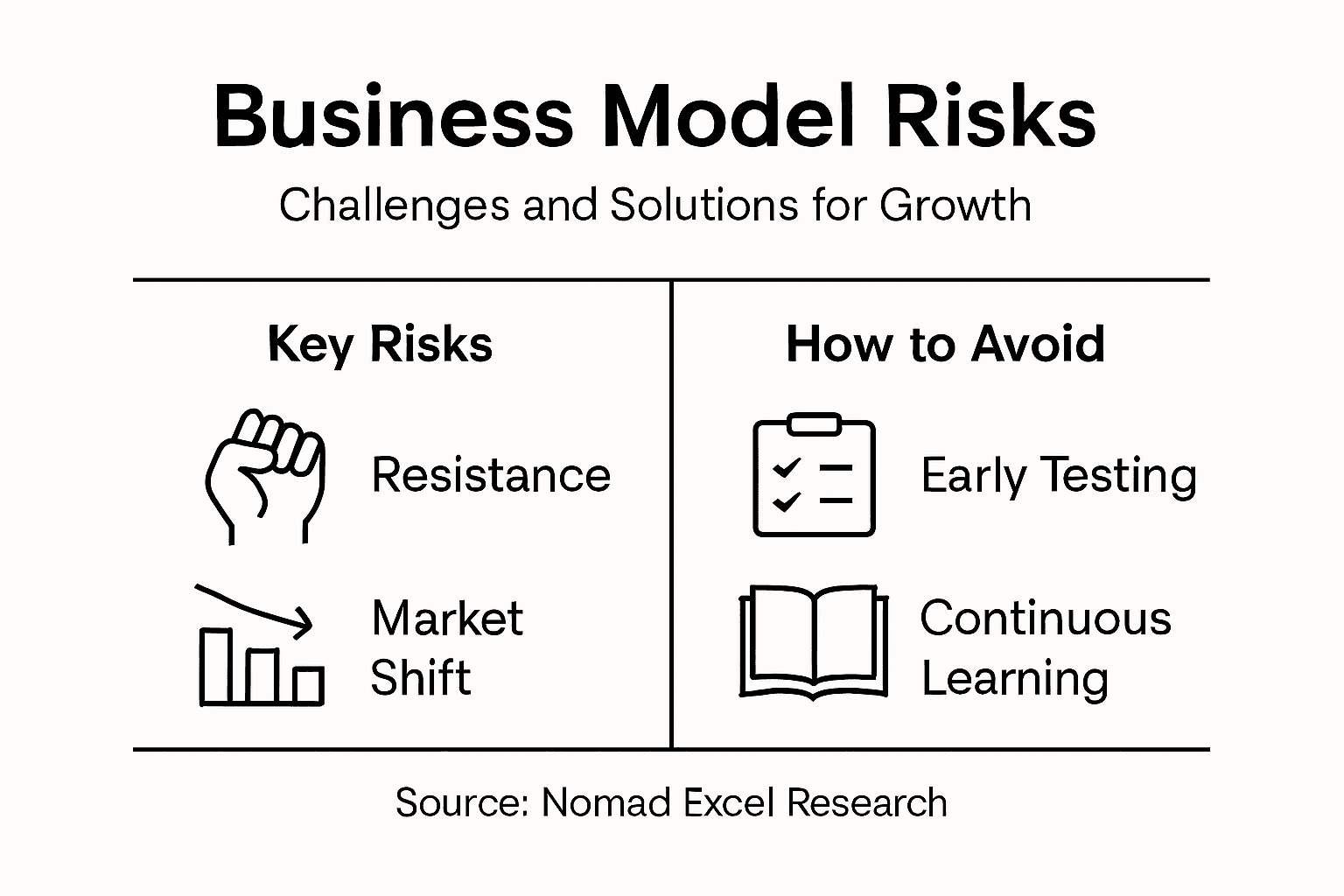
Below are strategies and their business impacts for managing innovation risks:
| Strategy | Main Focus | Expected Business Impact |
|---|---|---|
| Lean operational structure | Flexibility | Faster pivots during market shifts |
| Revenue stream diversification | Financial resilience | Reduced dependence on single market |
| Ongoing skills development | Talent adaptability | Increased innovation capability |
| Market trend monitoring | Early risk detection | Ability to preempt challenges |
Pro tip: Implement a quarterly innovation risk assessment process that systematically evaluates potential barriers, emerging challenges, and adaptation strategies within your current business model.
Accelerate Your Business Model Innovation with Expert Guidance
Business model innovation requires more than just new ideas. It calls for clear strategy, agile execution, and a supportive environment that nurtures continuous learning and adaptation. If you are an entrepreneur or a team facing the challenge of reimagining how your business creates and delivers value, you understand the need to overcome organizational inertia, explore new revenue streams, and refine your value proposition rapidly.
At Nomad Excel, we specialize in turning these critical goals into reality. Our immersive Entrepreneurship Bootcamps offer hands-on frameworks, direct mentorship, and a collaborative community designed to help you validate ideas, refine offers, and build scalable systems faster. For teams aiming to foster innovation and alignment, our custom Company Retreats and Bootcamps provide structured workshops and experiential learning that strengthen trust and entrepreneurial thinking.
Start your journey to transformative growth today and discover how to strategically innovate your business model with clarity and confidence. Visit Nomad Excel to learn more and secure your spot in a program that will accelerate your entrepreneurial success.
Frequently Asked Questions
What is business model innovation?
Business model innovation refers to the strategic approach entrepreneurs use to redefine how companies create, deliver, and capture value in changing market environments. It goes beyond incremental improvements to fundamentally transform business operations and value propositions.
How can startups implement business model innovation?
Startups can implement business model innovation by exploring evolutionary and revolutionary approaches. This includes gradual adjustments or radical redesigns of their business models, often aided by frameworks like lean startup principles and agile development to facilitate rapid experimentation and learning.
What are the key stages in the business model innovation process?
The business model innovation process typically involves several stages, including initial ideation, comprehensive research, prototype development, rapid testing, and continuous refinement based on market feedback. Each stage is crucial for effectively redefining the value proposition and ensuring market relevance.
What risks are associated with business model innovation?
Key risks include organizational resistance to change, financial constraints, and market uncertainties. Entrepreneurs must develop strategies for managing these risks, such as maintaining operational flexibility, diversifying revenue streams, and fostering a culture of continuous learning and adaptability.
Comments are closed.