Team Retreat Ideas for Managers: 30/40/30 Agenda, Copyable Itineraries
Choose one clear, measurable outcome for the retreat, then plan every activity to serve it. That single discipline, more than any venue or budget, separates a retreat that shifts how a team works from one that simply fills a calendar. Teams that anchor around a specific goal see stronger alignment and sharper collaboration, and the planning approach below, paired with options like Nomad Excel, gives you the structure to make it happen.
TL;DR:
- Clearly define a single measurable goal to ensure activities directly support the retreat’s primary outcome.
- Use a balanced schedule of approximately 30% structured work, 40% connection, and 30% free space to maintain momentum.
- Match retreat length and format to the goal, with one-day for focus, two-day for strategy and alignment, and virtual options for distributed teams.
- Build in optional sessions and reflection time to accommodate different personalities and promote inclusive participation.
- Follow up with an action plan within 48 hours and regular check-ins to sustain the retreat’s impact and ensure commitments are acted upon.
Table of Contents
- Key takeaways for planning your retreat
- What counts as a team retreat?
- How to choose your one primary outcome
- Retreat ideas organized by goal and format
- Sample itineraries you can copy directly
- Logistics and budget checklist
- Making virtual and hybrid retreats work
- Turning retreat energy into lasting change
- Tailoring retreat ideas to team size and makeup
- Managing diverse personalities and real inclusion
- How to know if the retreat actually worked
- Planning for what might go wrong
- A planner’s honest take on what actually works
- Why some teams bring in Nomad Excel to run it
- FAQ
- Sources
Key takeaways for planning your retreat
Before the details, here are the planning rules that matter most. Keep these visible while you build your agenda, because they will save you from the two most common failures: overstuffing the schedule and losing momentum the week after everyone goes home.
- Pick one primary outcome and let it filter every activity you add to the agenda.
- Split time roughly 30% structured work, 40% connection and skill building, and 30% unstructured space, a mix practitioner guides consistently recommend for successful offsites.
- Keep a few sessions optional so introverts and people with family obligations are not forced into every activity.
- Send a written action plan with named owners within 48 hours of wrap-up, while the energy is still fresh.
- Plan swag or small keepsakes around the four-week mark before the event, since timed distribution extends how long people remember the experience.
What counts as a team retreat?
A team retreat is a dedicated block of time, away from daily routines, where a group works and connects with a specific organizational goal in mind. That is the whole definition. What separates a strong retreat from an expensive vacation is purpose: the format should follow from what you are trying to accomplish, not the other way around.
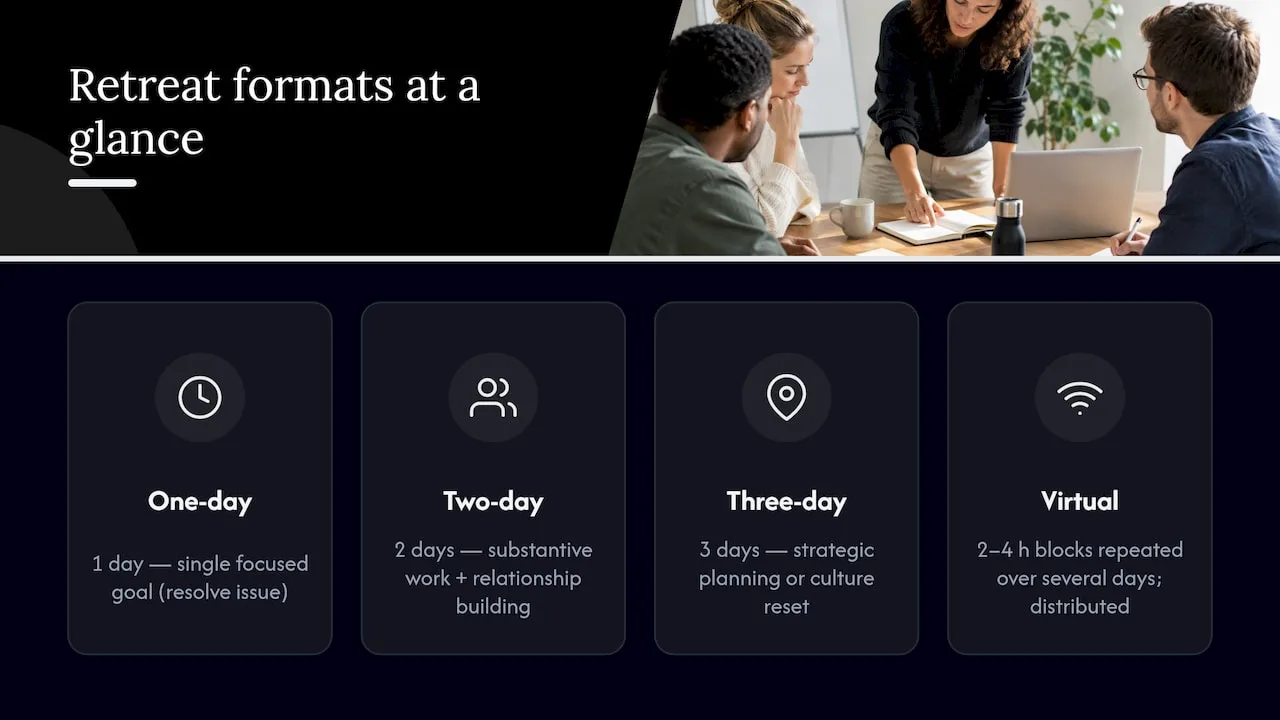
A one-day retreat suits a single focused goal, like resolving a specific cross-team friction point or kicking off a new initiative. A two-day retreat gives you room for both substantive work and relationship building, which fits onboarding a new leadership layer or realigning after a reorg. A three-day retreat, often involving travel, works best for strategic planning cycles or culture resets that need distance from the office to really land. Virtual retreats compress everything into focused blocks of two to four hours, repeated over a few days, and suit distributed teams that cannot justify travel costs or time away.
Boot camp-style formats, which blend intensive workshops with mentorship and community building, work well when the goal is skill development rather than just alignment. Matching format to goal is the first decision, and it is the one most planners skip.
How to choose your one primary outcome
Workshop research is consistent on this point: goal clarity is the single strongest predictor of whether a strategy workshop produces results your team can act on afterward. Not facilitator skill, not venue quality, not budget. The organizations that treat a retreat as one surgical intervention toward a named outcome consistently outperform those trying to accomplish five goals in two days.
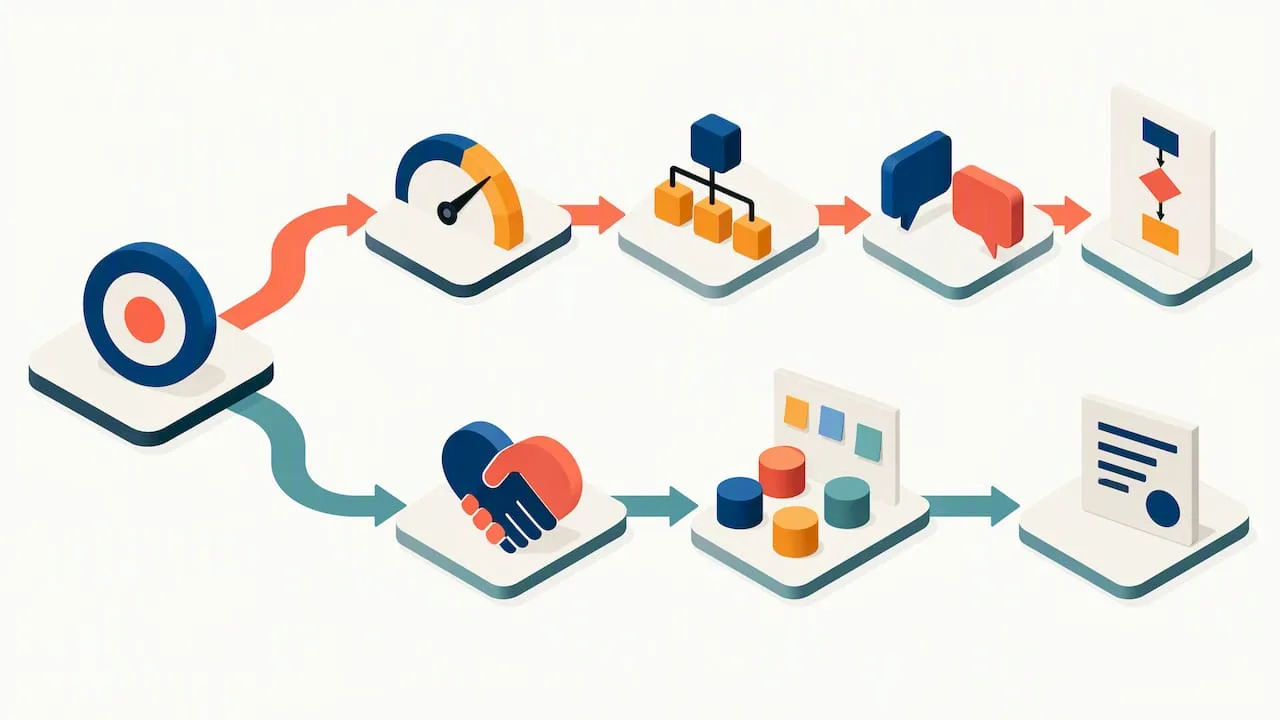
Start by naming the outcome in a single sentence a stranger could understand: “Align the product and sales teams on Q3 priorities,” not “improve collaboration.” Vague goals produce vague retreats. Once you have the sentence, work through this sequence before you book anything:
- Outcome: write the one measurable thing you want different by the end.
- Measure: decide how you will know it worked, a survey score, a decision made, a plan signed off.
- Activities: choose exactly three activities that build toward that outcome, no more.
- Owner: assign one person to carry the outcome forward after the retreat ends.
Pro Tip: If an activity sounds fun but does not obviously serve your stated outcome, cut it. Fun is a byproduct of good design, not a goal in itself.
A few examples of how the mapping works in practice: if your outcome is faster cross-team decision-making, your activities might be a decision rights mapping exercise, a role-play of a recent stuck decision, and a working session to draft a new approval process. If your outcome is rebuilding trust after a rocky quarter, you might run a structured vulnerability exercise, small-group retrospectives, and a public commitments session. The activities look completely different because the outcomes are different, which is exactly the point.
Retreat ideas organized by goal and format
Once you know your outcome, pull from the categories below. Each idea names the time it needs, the space and materials involved, whether you need a trained facilitator, and the impact it is built to deliver.
Connection and trust building
- Structured personal sharing circles. Thirty to forty-five minutes, any room, no materials beyond a prompt list. No facilitator required, though a skilled one helps surface quieter voices. Builds the kind of mutual understanding that psychological safety research identifies as a precursor to open communication.
- Skills swap sessions. Sixty minutes, open space, flip chart paper. Team members teach each other a skill outside their job description, which flattens hierarchy and surfaces hidden talent.
- Collaborative cooking challenge. Two to three hours, a kitchen or outdoor cooking setup, ingredients and basic equipment. A facilitator helps keep teams balanced. Shared physical tasks under light pressure build rapport fast.
- Walking one-on-ones. Thirty minutes, outdoors, nothing but comfortable shoes. Pairs rotate through short walks with simple conversation prompts, useful for teams that rarely get unstructured time together.
Alignment and strategy
- Decision-rights mapping workshop. Ninety minutes, a room with wall space, sticky notes. Needs a facilitator to keep the group from relitigating old decisions. Clarifies who owns what, which is often the real blocker behind slow teams.
- Priority stack-ranking exercise. Sixty minutes, whiteboard or digital board, no special materials. Forces the group to name trade-offs out loud instead of nodding along to a shared deck.
- Pre-mortem session. Forty-five minutes, any room, paper and pens. Teams imagine a plan has already failed and work backward to identify why, surfacing risks that optimism usually hides.
Leadership development
- 360 feedback workshop. Half-day, private breakout rooms, a trained facilitator is strongly recommended here given the sensitivity of the content. Builds self-awareness that pays off long after the retreat ends.
- Case-based leadership scenarios. Two hours, any room, printed scenario packets. Leaders work through realistic dilemmas in small groups, which translates theory into muscle memory.
Creativity and innovation
- Rapid prototyping sprint. Half-day, open workspace, craft or digital prototyping tools. Needs a facilitator to enforce time boxes. Short deadlines push teams past their first, safest idea.
- Escape room or themed puzzle challenge. Sixty to ninety minutes, indoor or purpose-built venue, no materials to source if you book a venue. A reliable way to force collaborative problem-solving under light stakes.
- “Yes, and” improv exercises. Thirty minutes, open space, no materials. A short facilitator-led warm-up that loosens people up before a creative working session.
Wellness and reflection
- Guided outdoor hike with reflection prompts. Two to three hours, trail access, comfortable gear. Combines physical movement with quiet thinking time, which many participants rate as the most memorable block of the whole retreat.
- Silent journaling block. Twenty minutes, any quiet room, notebooks. No facilitator needed. A small addition that gives introverted participants permission to process instead of performing energy they do not feel.
- Group meditation or breathing session. Fifteen to twenty minutes, quiet space, optional mats. Works as a reset between intense working sessions, not as a standalone activity.
For a deeper bank of scripted activities you can drop straight into any of these slots, Nomad Excel’s team building activity list walks through setup details for fifty ready-to-run options.
Sample itineraries you can copy directly
Use these as starting templates, then adjust the mix to match your chosen outcome. Each one follows the 30/40/30 principle: protected work time, connection or skill-building activities, and genuine free space.
- One-day retreat. Morning arrival and light icebreaker (30 minutes), one focused work session tied to your outcome (90 minutes), lunch with no agenda, one shared activity from the list above (60 to 90 minutes), closing circle with named commitments (30 minutes).
- Two-day retreat. Day one is the workhorse day: arrival, a structured work session in the morning, a connection or alignment activity after lunch, and an evening with no programming. Day two opens with a creativity or leadership session, moves into a protected synthesis block where the group turns the week’s insights into a written plan, and closes with public commitments before departure.
- Three-day retreat. Day one is travel and settling in, with a light welcome activity in the evening. Day two carries the heaviest mix of work sessions and activities, split morning and afternoon. Day three is reserved for synthesis, feedback, and commitments, with the final afternoon left open for departures or optional free time.
Practitioner guidance on offsite design backs this same arc: a front-loaded work day, a middle day built around activities, and a closing day protected for synthesis rather than cramming in one more session.
Logistics and budget checklist
Good retreats run on boring logistics done early. Start your timeline twelve weeks out if you are traveling anywhere, and compress to four to six weeks for a local or virtual event.
- T-12 to T-8 weeks: confirm venue, dates, and a named on-site coordinator who owns the day-of schedule.
- T-8 to T-6 weeks: lock facilitators, send save-the-dates, and collect dietary and accessibility needs.
- T-4 weeks: order swag or keepsakes so they arrive in time for distribution during the event, not after.
- T-2 weeks: confirm AV setup, room layouts, and a backup plan for outdoor activities.
- T-1 week: send the final agenda and any pre-work, and confirm headcounts with the venue.
When you call a venue, ask about meeting room acoustics, AV compatibility with your own laptops, how they handle dietary restrictions, and whether they have any sustainability practices worth mentioning to the group.
| Budget category | Typical share of total spend | Commonly overlooked cost |
|---|---|---|
| Venue and lodging | Largest single line item | Resort fees or mandatory service charges |
| Food and beverage | Second largest line item | Snacks and coffee between formal meals |
| Facilitation and materials | Smaller but essential | Printing, name badges, and breakout supplies |
| Travel and transport | Variable by location | Local transfers between venue and lodging |
| Swag and keepsakes | Smallest line item | Shipping timelines that miss the event window |
Coordinating team photos and branded assets alongside swag timing is its own small project. A dedicated checklist for team photo coordination can keep that piece from becoming a last-minute scramble.
Making virtual and hybrid retreats work
Distributed teams need a different rhythm, not a scaled-down version of an in-person agenda. Compress sessions into focused two-hour blocks spread across two or three days rather than one long virtual marathon, which exhausts people on video calls faster than it would in a room.
- Run breakout rooms of four to five people for any discussion longer than ten minutes, since larger virtual groups tend to produce one speaker and several silent observers.
- Assign a dedicated tech host separate from the facilitator, so technical hiccups never interrupt the actual content.
- Send any physical materials, like workbooks or small kits, at least a week ahead so remote participants are not scrambling during the session.
- Build in explicit psychological safety prompts for remote breakouts, since quieter participants are easier to lose on video than in a room.
Pro Tip: Open every virtual breakout with a low-stakes personal question before the work question. It takes ninety seconds and noticeably changes how freely people talk afterward.
For teams exploring a hybrid structure with some in-person gathering built in, Nomad Excel’s remote team retreat formats outline how that balance typically works.
Turning retreat energy into lasting change
Psychological safety and alignment built during a retreat are not permanent once the group returns to normal routines. Research on team dynamics describes psychological safety as something that has to be actively maintained through ongoing processes of connecting, clarifying, and supporting each other, not something a single event locks in place. Treat the retreat as the seed, not the harvest.
- Send a one-page action plan within 48 hours, listing each commitment, its owner, and a deadline.
- Schedule a 30-day check-in to review progress on the top three commitments.
- Schedule a 60-day check-in to assess whether the retreat’s intended shift actually held.
- Introduce one lightweight recurring ritual, like a monthly virtual coffee or a shared recognition channel, that keeps the connection alive between retreats.
- Share retreat photos and a short recap document with anyone who could not attend, so the whole organization feels the outcome, not just the room.
Tailoring retreat ideas to team size and makeup
A ten-person team and a two-hundred-person division need genuinely different designs, not just a scaled-up version of the same agenda. Small teams, under twenty people, can run almost any activity in the full group and still get real participation, so lean into shared discussions and whole-group decision exercises.
Mid-sized teams, roughly twenty to seventy people, do better when you build in small-group breakouts of four to six people for anything that requires real talking, then reconvene for shared reporting. Trying to run a whole-group discussion at this size usually produces a handful of loud voices and a lot of silence.
Large teams or multiple departments gathered together need structured rotation, where small groups cycle through different stations or topics rather than one agenda trying to serve everyone at once. Cross-functional retreats, where people do not already know each other, benefit from more connection time up front, since alignment work falls flat when the room is full of strangers. Teams that already know each other well can skip straight to the harder strategic or leadership content, since the trust-building groundwork is already in place.
Managing diverse personalities and real inclusion
Every retreat room contains people who process differently: some think out loud, others need quiet time before they can contribute anything useful. Building in that silent journaling or reflection time mentioned earlier is not a nice extra, it is how you make sure the quieter half of the room actually contributes ideas instead of just nodding along.
Make a handful of sessions genuinely optional, particularly physical activities and anything involving public vulnerability. People with mobility limitations, religious observances, or simply low social battery deserve a graceful way to opt into a quieter alternative without explaining themselves to the group.
Rotate who speaks first in group discussions, since the same confident voices otherwise dominate every session by default. Collecting dietary restrictions, accessibility needs, and any cultural or religious considerations well before the event, not the week of, prevents the kind of last-minute scramble that makes people feel like an afterthought. A retreat that is inclusive by design, not by accommodation, tends to produce the broader participation that drives the innovative thinking psychological safety research links to open team communication.
How to know if the retreat actually worked
Tie your evaluation directly back to the single outcome you defined at the start, not a general happiness score. If your goal was faster decision making, measure whether decisions actually move faster in the following month, not just whether people enjoyed the escape room.
Collect two layers of feedback: an anonymous short survey sent within 24 hours, asking what worked, what did not, and whether the stated outcome feels closer, and a longer conversation with a handful of participants two to three weeks later, once the glow has worn off and people can speak more honestly. Track whether the named owners from your action plan are actually making progress on their commitments at the 30-day mark. That single metric, commitment follow-through, tells you more about whether the retreat worked than any satisfaction score.
Planning for what might go wrong
Every retreat needs a contingency plan, even a simple one, because weather, travel delays, and illness do not respect your agenda. Build a short list of backup indoor activities for anything scheduled outdoors, and confirm the venue has a wet-weather alternative before you sign a contract.
Designate a point person, separate from the main facilitator, whose only job during the event is handling logistics problems as they come up, so a lost shipment or a late flight does not derail the person running the actual content. Keep a basic emergency contact sheet and know the location of the nearest medical facility, particularly for retreats in remote or international locations. For any activity involving physical risk, confirm the venue’s insurance coverage and have participants sign a standard waiver ahead of time. None of this needs to feel heavy-handed, but having it in place means a small hiccup stays small instead of swallowing the day.
A planner’s honest take on what actually works
The single biggest mistake I see is overstuffing day one, trying to prove the retreat’s value in the first six hours instead of letting it build. The shortcut that fixes almost everything else: protect one unscheduled synthesis block near the end, even just ninety minutes, where the group turns what happened into a written plan. Skip that block and the whole event risks becoming a nice memory with no follow-through.
— Amichai
Why some teams bring in Nomad Excel to run it
Planning everything above yourself is entirely doable, and plenty of teams do it well. For teams that would rather hand the structure to someone else, Nomad Excel designs and facilitates custom business retreats built around the same goal-first principle: workshops, local experiences, and logistics managed end-to-end so your team shows up and does the work instead of managing the agenda.
Offerings include tailored business retreats, one-day innovation sprints, and multi-day offsite bootcamps, each structured around a specific outcome rather than a generic team-building checklist. The approach suits teams that have a clear goal, whether that is alignment, leadership development, or a creative reset, but limited internal bandwidth to design and run it themselves.
If that sounds like where your team is, the inspiring business retreats page walks through how the format works and how to start a conversation about your specific goal.
FAQ
What is the most important decision when planning a team retreat?
Choosing a single, measurable primary outcome before anything else. Workshop research consistently finds that goal clarity predicts success more reliably than budget, venue, or facilitator skill.
How long should a company retreat be?
It depends entirely on the goal: a single focused objective fits a one-day retreat, while strategic planning or culture resets usually need two to three days. Match the format to the outcome rather than defaulting to a standard length.
How much does a team retreat typically cost?
Costs vary widely by location, group size, and format, so there is no fixed figure that applies universally. Some providers offer tailored business retreats and offsite bootcamps with pricing available on request based on your group’s needs.
How soon after a retreat should follow-up happen?
Send a written action plan with named owners and deadlines within 48 hours of the retreat ending, while the momentum is still fresh. Follow that with check-ins at the 30-day and 60-day marks to confirm the commitments actually held.
How do you keep virtual retreat participants engaged?
Keep sessions in short, focused blocks of around two hours, use small breakout groups of four to five people, and assign a dedicated tech host separate from the facilitator. Opening breakouts with a quick personal question before the work topic noticeably improves participation.
Sources
- Study of strategy workshop design and outcomes
- Time Is Not Enough: Exploring the Processes That Shape Team Psychological Safety
- The impact of team psychological safety on employee innovative performance
- How to Plan a Company Offsite: The 12-Week Playbook
Comments are closed.