
Founders & Operators: Build Lasting Competitive Advantage in 90 Days
A lasting competitive advantage comes from a coherent identity paired with two or three distinctive capabilities that either raise what customers will pay or lower your relative costs. This article unpacks the core levers, differentiation, cost, focus, human capital, pricing, and data, then walks through a practical playbook for building, measuring, and renewing that edge.
TL;DR:
- Companies should prioritize identifying their core customer segments before choosing two or three signature capabilities to protect and scale.
- Testing willingness to pay through structured experiments and real customer validation is crucial before finalizing pricing strategies.
- Monitoring external signals like patent activity and startup launches helps detect threats that internal metrics may lag behind.
- Personalization efforts should start with high-value segments and carefully limit complexity to avoid erasing margin gains.
- Continuous, frequent testing of customer willingness to pay and capability validation is more effective than infrequent large strategic reviews or offsite planning.
Table of Contents
- A step-by-step playbook for building your advantage
- How to measure, validate, and protect what you have built
- Where data and personalization fit into the picture
- How Nomad Excel turns strategy into execution
- Why most competitive advantage advice gets the order backward
- A practical alternative if you want to move faster
- Sources
- FAQ
A step-by-step playbook for building your advantage
Building a competitive advantage is less about having a brilliant insight and more about sequencing the right decisions in the right order. Here is a practical sequence that works for founders and operators alike.
- Choose your right-to-win segments. Identify the customer groups where your current capabilities already map closely to what they value most, rather than chasing every available market.
- Pick two or three signature capabilities. Decide what you will protect and scale relentlessly, and standardize everything else so complexity does not dilute your focus.
- Test willingness to pay before you finalize pricing. Run structured experiments, and where practical, use conjoint-style, choice-based testing rather than direct questioning, since direct questions tend to underestimate real trade-offs customers are willing to make.
- Redesign roles and incentives around the advantage. Your operating model, not just your strategy slide, has to reinforce the behaviors that protect what makes you different.
- Run a tight 30/60/90-day sprint. Use the first 30 days to validate assumptions with real customers, the next 30 to pilot the capability or pricing change, and the final 30 to scale what worked and kill what didn’t.
Pro Tip: Limit the number of configurable options you offer early on. Teece’s research on dynamic capabilities notes that excess configurability often raises operational cost faster than it raises revenue.
This sequence works because it forces decisions in the order that actually matters: who you serve, what you are genuinely better at, what they will pay for it, and whether your organization is built to deliver it consistently. Skipping straight to pricing or marketing tactics without the first two steps tends to produce short-lived wins.
How to measure, validate, and protect what you have built
An advantage you cannot measure is an advantage you cannot defend. Tracking the right indicators early lets you catch erosion before a competitor does.
Useful leading metrics include:
- Price premium relative to the closest alternative your customers consider.
- Margin spread between your best and weakest segments.
- Segment retention and lifetime value among your right-to-win customers.
- Conversion lift tied to specific capability or pricing changes.
McKinsey’s research on top economic performers found that companies that validate and break down their advantage drivers, rather than relying on broad assumptions, consistently outperform peers that do not.
Top performers use external signals, including patent activity and startup launches in their space, to catch shifts that could erode their advantage before those shifts show up in their own numbers. That external scanning matters because internal metrics alone often lag the market.
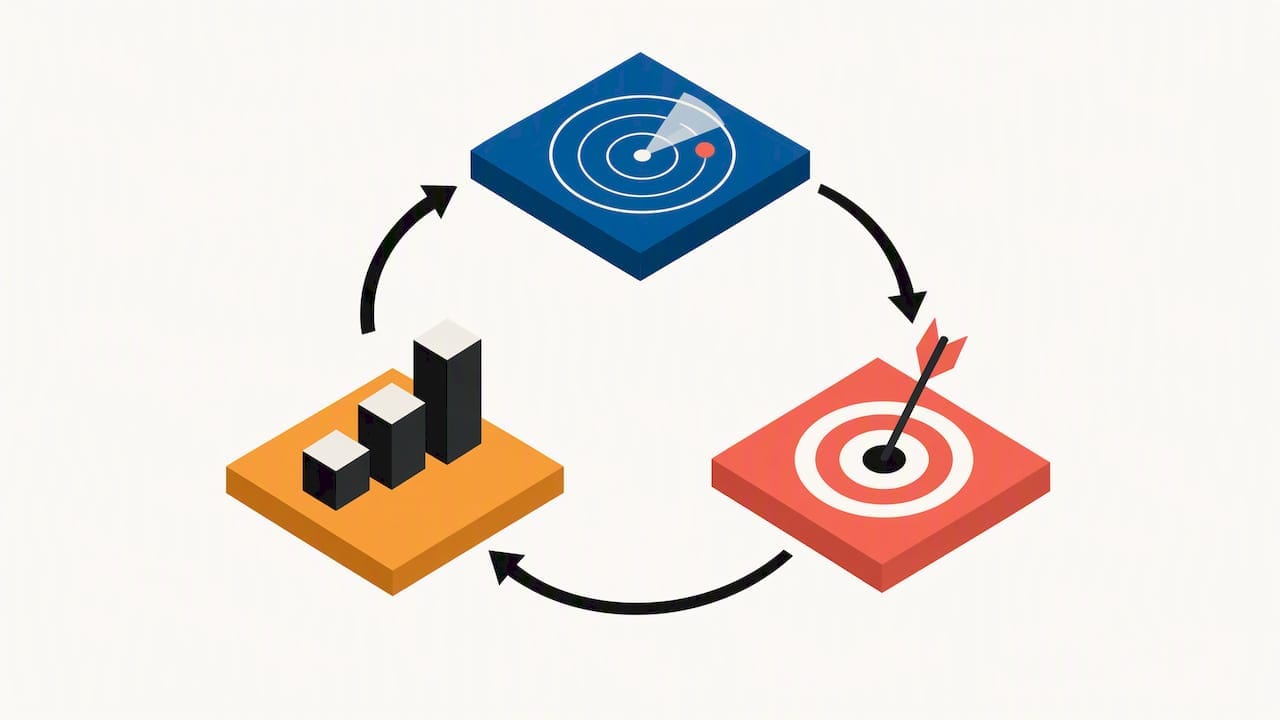
Renewal follows the dynamic capabilities cycle: sensing emerging threats and opportunities, seizing the ones worth pursuing, and transforming the organization to support them. Treat this as a recurring cadence, not a one-time strategic review, and revisit it as your organization evolves.
Where data and personalization fit into the picture
Data-driven tactics can sharpen a traditional advantage, but they can also quietly undermine it if left unchecked.
McKinsey’s work on customer delight found that real-time personalization and usage telemetry increase loyalty and spending intent, while usage-based pricing forces pricing transparency and reduces the sense of paying for capacity customers never use.
A few practical levers to start with:
- Run small telemetry experiments that track usage signals and retention triggers before committing to a full personalization build.
- Watch cost-to-serve closely. Personalization that raises delivery complexity can erase the margin gains it was meant to create.
- Set complexity limits upfront, deciding in advance how many variations or tiers you will support.
Pro Tip: Start personalization with your highest-value segment only. Expanding it everywhere at once almost always raises cost faster than it raises willingness to pay.
Partners like DLH.io write regularly about the analytics side of this work, which is worth a look if your team is building out telemetry for the first time.
How Nomad Excel turns strategy into execution
Most strategic frameworks fail not because they are wrong, but because nobody builds the muscle to execute them under real time pressure. That is the gap Nomad Excel’s bootcamps and retreats are built to close.
Rather than teaching concepts in isolation, our programs put founders and teams through structured sprints where capability selection, offer design, and willingness-to-pay testing happen in real time, with mentorship from experienced entrepreneurs and operators guiding each phase. Participants leave with a sharper sense of which capabilities to protect, a tested offer, and a working 30- to 90-day plan rather than a slide deck. The approach mirrors what we describe in experiential business education: learning by doing the work, not just discussing it.
Why most competitive advantage advice gets the order backward
The conventional advice on competitive advantage tends to start with positioning statements and brand language, as if clarity of message creates the advantage itself. It does not. Clarity of message only works when it describes capabilities that are already real and already difficult to copy.
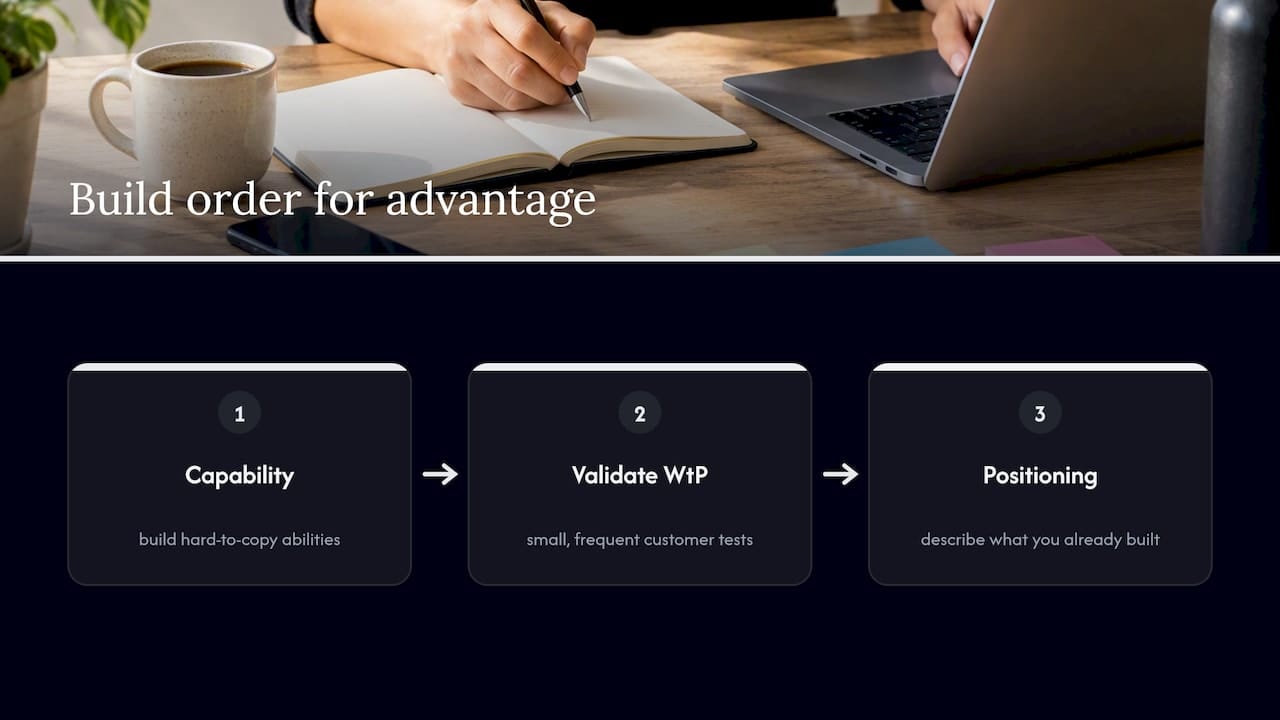
What the evidence actually supports is a build order: capability first, validated willingness to pay second, and positioning language last, because positioning is just the honest description of what you built. Businesses that skip straight to messaging usually end up polishing a claim they cannot back up operationally, and customers notice the gap faster than founders expect.
The most overrated step in most strategy conversations is the big annual planning exercise. Dynamic capabilities theory makes clear that sensing, seizing, and transforming is a continuous process, not an event you schedule once a year. If you only prioritize one thing from this article, make it the small, frequent willingness-to-pay test over the big strategic offsite. Real customer behavior will tell you more in two weeks than a planning retreat will tell you in two days.
— Amichai
A practical alternative if you want to move faster
Reading about capability-building and willingness-to-pay testing is useful, but putting them into practice under guidance tends to compress months of trial and error into weeks. That is where a structured bootcamp environment helps most, particularly for founders who have the strategic instincts but lack the daily accountability to execute, and for teams that need to align around a shared direction before they can move together.
Nomad Excel’s Online Entrepreneurship Bootcamp walks participants through capability selection, offer validation, and mentor feedback inside a structured sprint format, the same sequence outlined above, but with accountability built in. Teams looking for alignment rather than individual execution can explore our tailored business retreats instead.
If you are deciding between building this alone or with guidance, our guide on joining an entrepreneurship bootcamp lays out what each path actually involves.
Sources
Every business already has some mix of these levers in play, whether by design or by accident. Knowing which ones you are actually using, and which ones are strongest, is the first real step toward strengthening your position.
Porter’s generic strategies remain a useful starting map: cost leadership, differentiation, and focus. Businesses that fail to commit to one of these risk what Porter called being stuck in the middle, competing on price without the cost structure to win and competing on quality without the premium to justify it.
Beyond Porter’s framework, several other sources deserve attention:
- How top performers use competitive advantage to guide strategy — McKinsey
- The dynamic capabilities perspective — Strategy+Business
The practical question is not which of these sounds best on paper. It is which ones align with your actual strengths and the customers you are best positioned to serve.
FAQ
What are the 3 C’s of competitive advantage?
The 3 C’s commonly referenced in strategy discussions are company, customers, and competitors, the three lenses you need to examine together before claiming an advantage exists. Strength in one area, like internal capability, means little if it does not match what customers value or what competitors can easily replicate.
What are the 4 factors to a competitive advantage?
Definitions vary across sources, but a common version includes distinctive capabilities, customer value, cost or price position, and defensibility against imitation. Harvard Business School Online’s overview of advantage sources points to product differentiation, willingness to pay, pricing structure, and human capital as recurring themes across these factors.
What are the 5 forces of competitive advantage?
This phrase usually refers to Porter’s Five Forces, a framework for analyzing industry structure rather than a direct list of advantage sources: competitive rivalry, supplier power, buyer power, threat of substitution, and threat of new entry. Each force shapes how much room exists for any single company to build and defend an edge within that industry.
How long does it take to build a real competitive advantage?
There is no fixed timeline, since it depends on how quickly you can validate capabilities and pricing with real customers rather than assumptions. A focused 90-day sprint, like the one outlined earlier in this article, is often enough to test and validate the first version of an advantage, though sustaining it requires continuous renewal.
Can a small business build a competitive advantage against larger competitors?
Yes, and focus is usually the lever that makes it possible, concentrating on a specific segment or capability a larger competitor is not optimized to serve well. Porter’s generic strategies explicitly include focus as a standalone path precisely because it lets smaller players compete without matching a larger rival’s scale or cost structure.
Comments are closed.