
Creativity in entrepreneurship: 5 ways to grow faster
Most entrepreneurs are told that success comes down to grit, risk tolerance, and relentless execution. That narrative is incomplete. Creativity is essential for producing novel and useful ideas, enabling opportunity recognition, innovation, and competitive advantage in entrepreneurship. In other words, creativity is not a soft skill reserved for artists or designers. It is a core business capability that shapes how you spot opportunities, solve problems, and build ventures that last. This guide breaks down the research, the mindset shifts, and the practical strategies you need to put creativity to work in your entrepreneurial journey.
Table of Contents
- Why creativity matters in entrepreneurship
- How creativity unlocks innovation and opportunity
- The role of personality and mindset in entrepreneurial creativity
- Practical ways to nurture entrepreneurial creativity
- The power of community and environment for creative entrepreneurship
- Supercharge your entrepreneurial creativity with Nomad Excel
- Frequently asked questions
Key Takeaways
| Point | Details |
|---|---|
| Creativity fuels opportunity | Creativity enables you to spot and act on business opportunities that others miss. |
| Mindset and environment matter | Fostering a growth mindset and supportive community unlocks entrepreneurial creativity. |
| Practical strategies boost innovation | Applying creativity prompts, design thinking, and experiential learning enhances your creative skills. |
| Balance creativity with discipline | Successful entrepreneurs use creativity alongside structure for effective execution. |
Why creativity matters in entrepreneurship
Creativity in entrepreneurship means generating ideas that are both new and genuinely useful. It is not about being unconventional for its own sake. It is about seeing what others miss and building something that solves a real problem in a better way. When you strengthen your creative capacity, you sharpen your ability to recognize opportunities before your competitors do.
Research confirms this connection directly. Individual creativity positively influences entrepreneurial intention, partially mediated by opportunity recognition. That means creativity does not just make you more innovative in theory. It actively shapes whether you decide to pursue a venture at all, and how confidently you move forward.
The competitive advantages that flow from creativity and innovation for startups are wide-ranging and measurable:
- Product innovation: Creative founders develop offerings that stand apart in crowded markets.
- Problem-solving: When obstacles arise, creative thinkers generate more solutions faster.
- Market adaptation: Creativity allows you to pivot intelligently when conditions shift.
- Customer connection: Novel approaches to communication and experience build stronger loyalty.
- Resilience: Creative entrepreneurs recover from setbacks by reframing challenges as opportunities.
“Entrepreneurship is not just about taking risks. It is about seeing possibilities that others overlook and having the creative confidence to act on them.”
Dispelling the myth that entrepreneurship is purely about execution and hustle is important. Execution matters, but without creative thinking driving your strategy, you risk working very hard in the wrong direction. Understanding entrepreneurial growth through creativity means recognizing that the two forces work together, not in opposition.
How creativity unlocks innovation and opportunity
Creative thinking and innovation are not the same thing, but one reliably leads to the other. Creative thinking generates the raw material: new combinations, unexpected angles, and reframed problems. Innovation is what happens when you take that raw material and build something tangible with it.
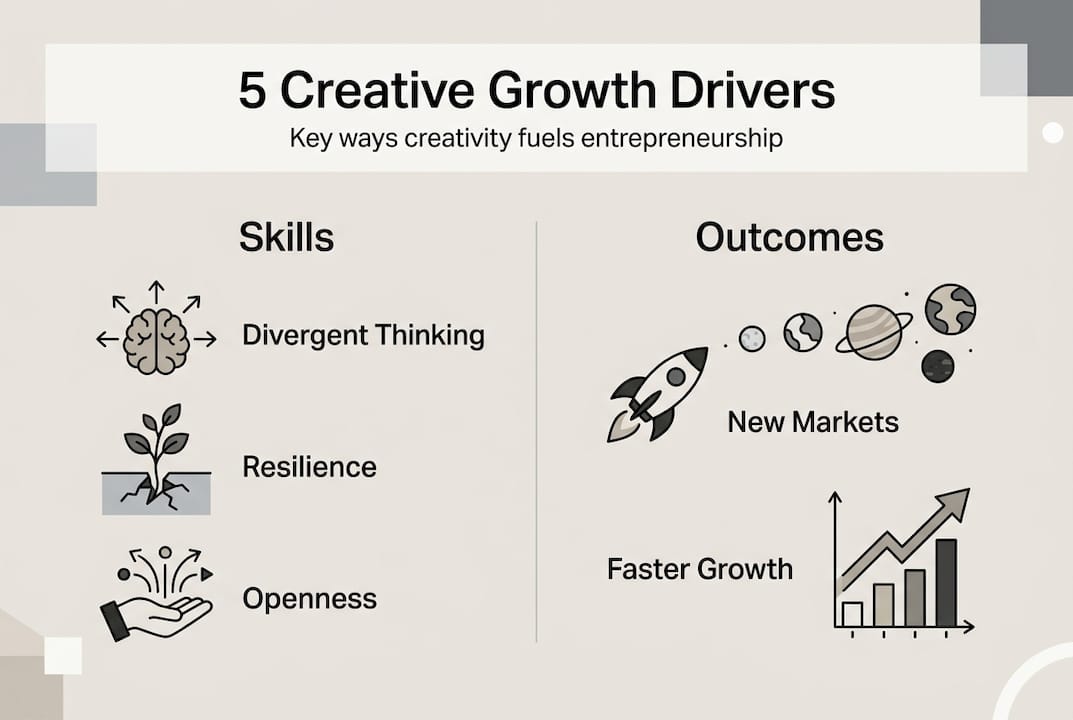
For early-stage entrepreneurs, this pathway matters enormously. The table below shows how specific creative skills translate into business outcomes:
| Creative skill | Opportunity it unlocks | Business outcome |
|---|---|---|
| Divergent thinking | Spotting unmet market needs | New product or service lines |
| Analogical reasoning | Borrowing models from other industries | Disruptive business models |
| Reframing problems | Seeing constraints as design challenges | Leaner, smarter solutions |
| Idea combination | Merging existing concepts in new ways | Differentiated value propositions |
| Curiosity-driven research | Identifying emerging trends early | First-mover competitive advantage |
Self-efficacy, your belief in your own ability to execute, plays a significant role here. Analytical cognitive style positively associates with business model innovation in new ventures, particularly for efficiency and novelty-oriented models. Entrepreneurs who trust their creative judgment are more likely to act on the opportunities they identify rather than second-guessing themselves into inaction.
Autonomy amplifies this effect. When you have the freedom to explore ideas without excessive constraint, your creative output increases. This is why so many breakthrough ventures emerge from founders who gave themselves permission to think differently before worrying about what was “realistic.”
Pro Tip: Use structured frameworks like design thinking to channel your creativity into actionable steps. Design thinking moves you from empathy and problem definition through ideation, prototyping, and testing, giving your creative energy a productive structure rather than letting it scatter. Pair this with an entrepreneurial thinking guide to build a repeatable process for turning ideas into results.
Creative entrepreneurs consistently find and seize opportunities others miss because they approach markets with curiosity rather than assumption. That posture alone is a competitive advantage worth cultivating.
The role of personality and mindset in entrepreneurial creativity
Not all entrepreneurs start with the same creative baseline, and that is perfectly fine. Research on personality and entrepreneurial success points to specific traits that support creative output over time. Among the Big Five personality traits, Openness to Experience stands out most clearly.

Openness and Conscientiousness in the Big Five traits increase long-term profitability odds for solopreneurs, with Openness directly linked to creative capacity. Conscientiousness provides the discipline to follow through on creative ideas rather than letting them stall.
Here is how key traits compare in their impact on entrepreneurial creativity:
| Personality trait | Effect on creativity | Business impact |
|---|---|---|
| Openness to experience | High: drives curiosity and idea generation | More innovative products and pivots |
| Conscientiousness | Moderate: structures creative output | Better execution of creative ideas |
| Extraversion | Moderate: fuels collaboration and networking | Richer idea cross-pollination |
| Agreeableness | Variable: supports team creativity | Stronger collaborative environments |
| Neuroticism | Often negative: inhibits risk-taking | Can limit creative experimentation |
A growth mindset, the belief that abilities can be developed through effort, is the connective tissue between personality and creative performance. Here are four steps to actively build that mindset as an entrepreneur:
- Reframe failure as data. Every setback tells you something useful about your market, your offer, or your process.
- Seek out discomfort. Deliberately take on challenges slightly beyond your current skill level to stretch your creative range.
- Study creative thinkers. Read about founders and innovators who solved problems in unexpected ways, then ask how their approach applies to your context.
- Practice reflection. Set aside time weekly to review what you tried, what worked, and what you would do differently.
James Dyson built 5,127 prototypes before his vacuum cleaner succeeded. That is not stubbornness. That is a growth mindset applied systematically to a creative challenge. The discipline to keep iterating is what separates creative entrepreneurs from creative dreamers. Explore innovation strategies for teams to see how this mindset scales beyond the individual founder. You can also draw on creativity prompts from HBR to keep your thinking fresh and expansive.
Practical ways to nurture entrepreneurial creativity
Knowing that creativity matters is one thing. Building habits and systems that generate creative output consistently is another. The good news is that creativity responds well to deliberate practice and the right environment.
Here are proven strategies to strengthen your creative capacity as an entrepreneur:
- Use structured creativity prompts. Eight prompts from HBR include techniques like reversing assumptions, borrowing from analogous industries, and asking “what would have to be true” to make an idea work.
- Apply design thinking. Move through empathy, define, ideate, prototype, and test as a repeatable cycle for solving business problems creatively.
- Run rapid experiments. Build the smallest possible version of an idea and test it with real customers before investing heavily.
- Use AI tools for idea generation. Large language models can help you generate high volumes of ideas quickly, giving you more raw material to evaluate and refine.
- Engage in experiential learning. Workshops, bootcamps, and hands-on exercises like brainstorming new ideas accelerate creative development far faster than passive reading.
- Explore innovation exercises. Structured innovation exercises for teams and innovation workshop examples give you proven formats to apply immediately.
Pro Tip: Embrace failure as a feature, not a flaw. Every prototype that does not work narrows the solution space and sharpens your understanding of what will. Entrepreneurs who treat failure as feedback move faster and build better products than those who avoid it.
Recurring reflection and feedback from peers or mentors are equally important. Creativity does not thrive in isolation. It grows when ideas are tested, challenged, and refined through honest conversation with people who understand your goals.
The power of community and environment for creative entrepreneurship
Your environment shapes your creative output more than most entrepreneurs realize. The people around you, the norms of your workspace, and the degree of psychological safety you feel all influence how freely and boldly you think.
Research on small and medium enterprises confirms this clearly. Challenge demands, autonomy, and self-efficacy positively relate to creativity, while hindrance demands, the kind of bureaucratic friction that blocks progress, reduce creative output by undermining self-efficacy. In practical terms, this means the structure of your work environment is not neutral. It either fuels or drains your creative potential.
The elements that most reliably enhance entrepreneurial creativity include:
- Mentors who have navigated similar challenges and can offer perspective without judgment.
- Peer networks that normalize experimentation and share honest feedback.
- Psychological safety that allows you to voice unconventional ideas without fear of ridicule.
- Team autonomy that gives individuals ownership over how they approach problems.
- Cross-pollination of ideas through exposure to diverse industries, disciplines, and perspectives.
“Creative breakthroughs rarely happen in isolation. They emerge from the collision of different perspectives, experiences, and disciplines in an environment where experimentation is encouraged and failure is treated as a step forward.”
Building this kind of environment is an active choice. Join incubators, mastermind groups, or mentorship programs that prioritize open dialogue and collaborative problem-solving. Explore resources on future entrepreneurship education to understand how structured learning environments are evolving to support creative development. The research on creativity and opportunity consistently shows that community structures amplify individual creative capacity in ways that solo effort simply cannot replicate.
When you invest in your environment, you invest in your creativity. And when you invest in your creativity, you invest in the long-term health of your business.
Supercharge your entrepreneurial creativity with Nomad Excel
Creativity does not develop in a vacuum, and neither does a successful business. The strategies, mindset shifts, and community structures covered in this article are most powerful when experienced in an immersive, structured environment with expert guidance and a community of driven peers around you. That is exactly what Nomad Excel is built to provide. Whether you are looking to sharpen your strategy through an online entrepreneurship bootcamp, accelerate your growth with a mentorship program, or understand why joining an entrepreneurship bootcamp could be the most important investment you make this year, Nomad Excel offers hands-on, community-driven programs designed to turn creative potential into real business results. Your next breakthrough is closer than you think.
Frequently asked questions
How does creativity drive business growth for entrepreneurs?
Creativity enables entrepreneurs to identify new opportunities, improve products, and differentiate in competitive markets, all of which contribute directly to sustained business growth.
Can creativity be learned or improved?
Yes. Creativity strengthens through deliberate practice, structured prompts and design thinking, and a consistent habit of learning from both successes and failures.
What personality traits help foster entrepreneurial creativity?
Openness and Conscientiousness are the Big Five traits most strongly linked to long-term entrepreneurial profitability, with Openness directly driving creative capacity.
How can community support enhance entrepreneurial creativity?
Community support through peer networks, incubators, and mentorship creates the psychological safety and idea diversity that are vital lifelines for sustained creative growth.
What is the risk of too much creativity without discipline?
Excessive focus on imaginative ideas without structure can stall execution, as entrepreneurial imaginativeness shows a curvilinear relationship with the practical implementation of new ventures.
Comments are closed.