
Entrepreneur Meetups Near You: How to Find the Right Ones
The fastest way to find an entrepreneur meetup near you is to search a meetup platform by distance and format, then widen the net to places that rarely advertise: university innovation centers, accelerators, chambers of commerce and SCORE chapters. The harder part is choosing well. A room full of founders at your exact stage can feel pleasant and still leave you with nothing new. This guide covers where to look, how to judge an event before you give it an evening, and what to do afterward so a handshake becomes a relationship.
TL;DR
- Start with a platform search, filtered by distance, date and in-person versus online, then look at university innovation centers, accelerators, chambers of commerce and SCORE chapters for the quieter, higher-intent rooms.
- Pick events that match your current growth phase and bring in people beyond other early-stage founders: investors, operators, researchers and service providers.
- Treat a meetup as the start of a relationship, not the result. Relational value builds through repeated contact, so plan your follow-up before you walk in.
- Skip the rehearsed pitch. Listening and the unstructured time at the end are where most useful conversations happen.
- If local events keep feeling thin, a structured bootcamp gives you a committed cohort for days or weeks instead of one evening.
Table of Contents
- Where to look for entrepreneur meetups near you
- The quieter rooms: where higher-intent founders gather
- Not every meetup does the same job
- How to judge an event before you spend an evening on it
- What to do at the event
- Turning contacts into a network
- Our perspective: why we built bootcamps, not just events
- When a bootcamp makes more sense than another meetup
- A simple plan for your next 30 days
- FAQ
- Sources
Where to look for entrepreneur meetups near you
Most people begin with a mass-market platform, and that is a sensible first move. Meetup lists about 430,000 monthly events across 200,000 groups, so in most U.S. metro areas you will find something within a short drive. You can filter by distance (up to 100 miles), date, and whether an event is online or in person. Meetup’s own help page on finding an event walks through the discovery options, including how events are recommended to you.
A few search habits make the results better:
- Search by stage and topic, not just “entrepreneur.” “Early-stage founders,” “bootstrapped business owners,” “freelancers” and “SaaS founders” each return a different set of rooms.
- Search by city and neighborhood. A group in a nearby suburb may meet more reliably than the big downtown one.
- Check the cadence. A group that has met monthly for two years will usually beat one with a flashy description and a single past event.
- Read the past-event attendance. Ten regulars who know each other can be better than 200 RSVPs who never show.
If you are a digital nomad or remote freelancer, “near me” changes every few weeks. Use the same searches in each new city on arrival, and favor groups with a recurring schedule so you can plug in quickly.
The quieter rooms: where higher-intent founders gather
Platform search finds what is advertised on platforms. Some of the most useful communities are not. Universities, accelerators and regional business organizations often run their own events and list them only on their own sites.
Try searching for “innovation center,” “accelerator,” “entrepreneurship center” or “knowledge exchange event” together with your city name. These tend to attract people who are actively building something rather than browsing for a social evening.
Academic institutions are good examples of how deliberate this can be. Pitch & Mix, run by EnSpire Oxford, brings early-stage founders together with people who have the skills to help build a venture. That is a format built around matching, not mingling. You probably do not live near Oxford, but the model travels: look for a university in your area that runs founder-and-expert matching evenings, pitch nights or demo days open to the public.
Two more U.S.-specific places to check:
- SCORE. The U.S. Small Business Administration describes SCORE as the nation’s largest network of volunteer expert business mentors. Local chapters often run workshops and networking events alongside one-to-one mentoring. As one example, the SBA has listed a SCORE Connect Live evening at a university entrepreneurship center in Nashville. Check your nearest chapter for something similar.
- Chambers of commerce and industry associations. These skew toward established local businesses, which is exactly what you want if you sell to other small businesses and need referral relationships.
Not every meetup does the same job
Research on entrepreneurial ecosystems separates networking events into two broad purposes. Some build what researchers call loose social networks: diverse, weaker ties that give you access to information and a wide range of contacts. Others foster deep relationships through strong, repeated interaction. Research from the University of Edinburgh on networking events and knowledge transactions describes this distinction and argues that success depends on recognizing which kind of event you are in.
This changes how you behave:
| Event type | What it is good for | How to show up |
|---|---|---|
| Large open meetup (50+ people) | Broad introductions, hearing what is happening locally, spotting recurring faces | Aim for three to five real conversations, not twenty business cards |
| Small recurring group (8 to 20 people) | Trust, honest feedback, accountability | Commit to attending several times before judging it |
| Speaker or panel night | Learning, plus a natural opener for conversation afterward | Prepare one question about the talk and use it to start chats |
| Curated or matched format | Specific introductions: cofounders, advisors, early customers | Register early and say clearly what you are looking for |
If you walk into a 100-person mixer expecting the closeness of a mastermind group, you will leave disappointed. If you treat a mastermind like a mixer, you will waste it.
How to judge an event before you spend an evening on it
The free-for-all meetup has a reputation problem, and it is partly earned. Even a Google result for this very search is a thread by someone who got tired of attending “entrepreneur” events. The complaint is familiar: people mostly practicing pitches at each other. Here is a quick screen to use before you RSVP.
- Who is likely in the room? Look at past attendees and the host’s description. Research from LMU Munich’s entrepreneurship ecosystem stresses connecting science, business, capital and policy. The practical lesson is that the most useful rooms mix founders with investors, operators, researchers and industry partners, rather than gathering only other early-stage founders.
- Is there any structure? Facilitated introductions, a short talk with Q&A, or a clear topic for the evening beat aimless mingling. Structure also protects you from the burnout that comes from a calendar full of drifting conversations.
- Does it fit your phase? A pre-revenue idea-stage founder and a founder at $20,000 in monthly revenue need different conversations. Choose events where your next problem is the topic.
- Is there unstructured time? Good organizers leave generous time after any formal portion. In our experience, that is when the useful conversations happen.
- Does the group recur? Single events create contacts. Recurring ones create relationships.
What to do at the event
Listen more than you pitch
The most common trap at entrepreneur meetups is spending the whole evening polishing your pitch. A tight thirty-second description is useful. A monologue is not. Ask what the other person is working on, what is blocking them, and who they would like to meet. People remember the person who asked good questions, and the answers tell you whether a follow-up is worth your time.
Decide what you want before you arrive
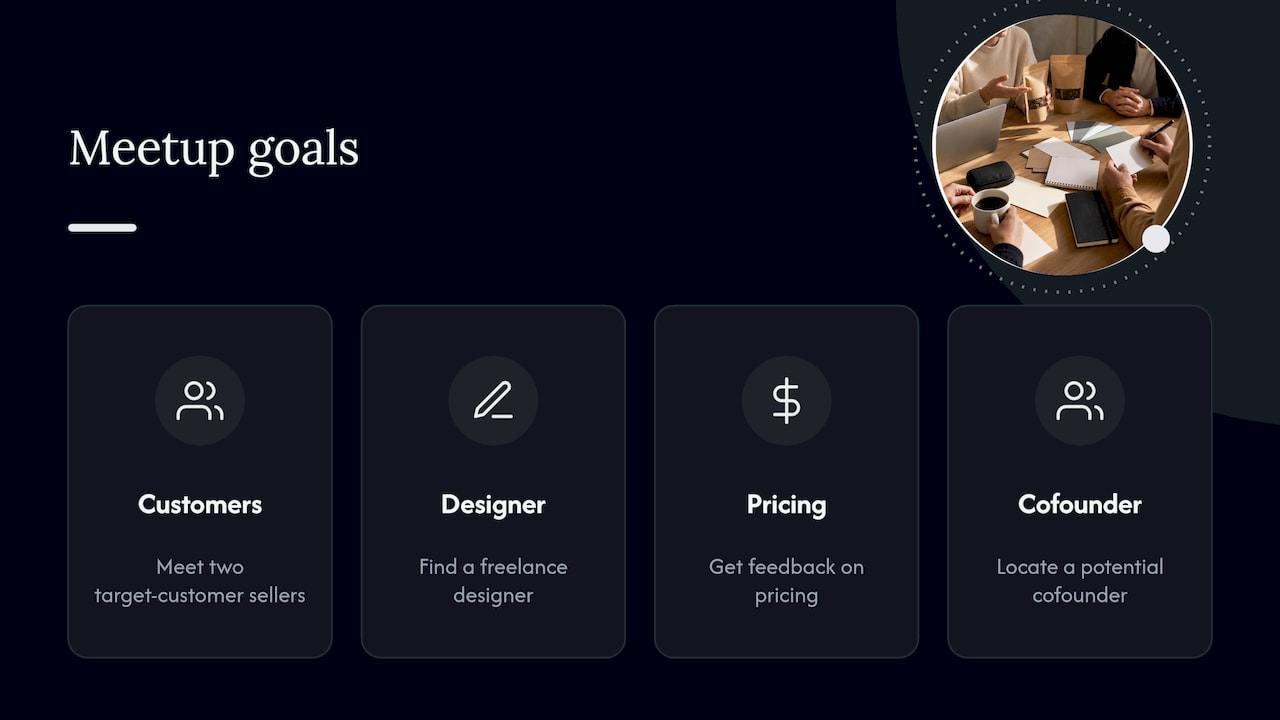
Pick one concrete goal: meet two people who have sold to your target customer, find a freelance designer, get feedback on pricing, or locate a potential cofounder. If the last one is yours, a guide on finding a cofounder as an aspiring startup founder covers how to approach that search deliberately instead of hoping to bump into the right person.
Take notes immediately
Write down one detail from each conversation within an hour of leaving: a project, a challenge, a mutual connection. That detail is what makes your follow-up message sound human.
Turning contacts into a network
Attending is the easy part. The Edinburgh research cited above makes the point that networking events enable knowledge transactions, but that social capital, meaning trust and relational value, needs repeated interaction over time. The author suggests building follow-up mechanisms so that loose contacts become meaningful resources.
A simple follow-up routine:
- Within 48 hours: send a short, specific message that references the conversation and offers something, such as an article, an introduction or a tool recommendation.
- Within two weeks: suggest a 20-minute call or coffee with the two or three people you most want to know better.
- Monthly: share a brief update or useful find with your short list.
- Quarterly: review who has actually helped you or been helped by you, and spend more time there.
For more detail on building this into a routine, see our networking workflow for founders and our collection of effective networking examples for entrepreneurs. If you want a fuller picture of how to choose events, our guide to entrepreneur meetups worth your time goes further, and this page on finding and thriving at meetups near you covers local searching.
Our perspective: why we built bootcamps, not just events
We run entrepreneurship bootcamps and company retreats, so we have a stake in this question, and we also have a clear view of what a single evening can and cannot do.
Meetups are a good, low-cost way to learn who is around you. We encourage everyone to go to a few. But we hear the same thing from founders again and again: they enjoyed the conversations, and then life took over. Without a shared goal, without a schedule and without anyone expecting a progress update, contacts fade.
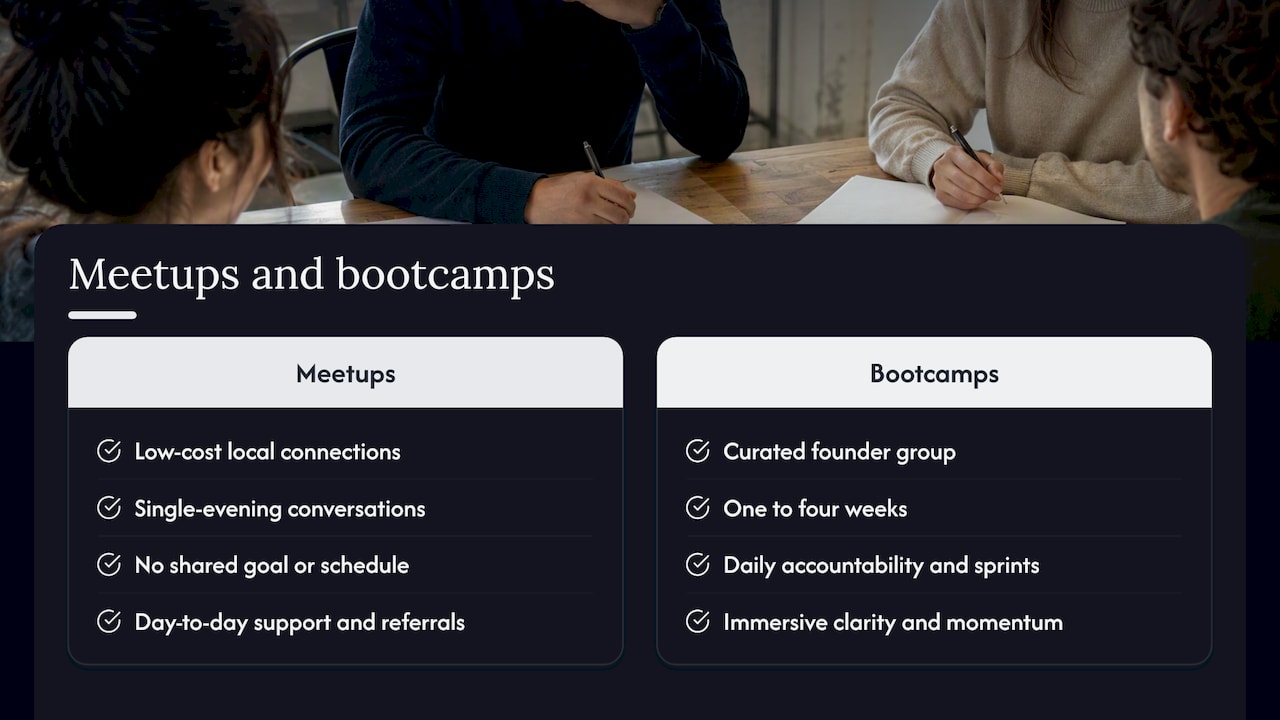
Our bootcamps are designed to fix exactly that. A curated group of founders spends one to four weeks together, with daily accountability, structured sprints and direct guidance from experienced entrepreneurs, marketers and operators. The community does not end when the program does. People who have worked through a validation sprint side by side know each other far better than people who traded cards at a mixer.
That said, bootcamps are not a replacement for local events. The strongest approach is both: a local network for day-to-day support and referrals, and a deeper, immersive experience when you need clarity and momentum fast. Peer support matters a great deal in the early stages, and we write more about it in our guide to the role of peer support in startups.
— Amichai
When a bootcamp makes more sense than another meetup
Consider a structured program if any of these sound familiar:
- You have attended several meetups and cannot point to a concrete outcome.
- You are working alone, remotely or while traveling, and have no regular peer group.
- You need to validate an idea, sharpen an offer or build systems, and you want to do it in a defined window.
- You want mentors who have operated businesses, not only peers at the same level.
Here is what we currently publish, so you can compare formats and budgets honestly:
| Program | Format | Price |
|---|---|---|
| 5-Day Online AI Bootcamp | Online | 300 EUR one-off |
| Online Business Bootcamp | Online | 500 EUR one-off |
| Entrepreneurship Sprint Bootcamp, Idea Space | Lisbon, in person | 1350 EUR one-off |
| Entrepreneurship Sprint Bootcamp, Second Home | Lisbon, in person | 1500 EUR one-off |
| 2-Week Entrepreneurship Bootcamp | Playa Venao, Panama | 400 EUR registration fee |
| 10-Day Entrepreneurship Bootcamp | Pipa, Brazil | 400 EUR registration fee |
| 1-Week Entrepreneurship Bootcamp | Agaete, Canary Islands | 400 EUR registration fee |
Prices are as published on our site and may change, so check the current listing before you decide. The online programs are the simplest way to try the format without travel: see our Online Entrepreneurship Bootcamp. To see dates and locations, browse our upcoming bootcamps or look at previous bootcamps to get a feel for the groups. If you are weighing the idea, this essential guide to joining an entrepreneurship bootcamp lays out what to expect.
If you lead a team rather than a solo business, our custom company retreats apply the same ideas, with workshops, facilitation and logistics designed end to end. Prices for these are not published, since each is tailored to the team.
A simple plan for your next 30 days
- Week 1: Search a meetup platform for three groups within your distance limit, and run separate searches for innovation centers, accelerators and your local SCORE chapter.
- Week 2: Attend one large event and one small or curated event. Compare how each felt using the screening questions above.
- Week 3: Send follow-ups, book two coffee chats, and return to the group that gave you the best conversations.
- Week 4: Decide whether your local scene is meeting your needs. If you want more depth and accountability, look at a structured program.
By the end of the month you should have a short list of people worth knowing and a clear sense of which rooms deserve a regular place on your calendar.
FAQ
What is the best way to meet entrepreneurs?
Combine discovery and repetition. Use a meetup platform to find groups near you, add university innovation centers, accelerators and SCORE chapters, then attend the same few groups several times. Familiar faces turn into relationships far faster than a different event each week.
How do entrepreneurs meet each other?
Mostly through recurring groups, industry events, mentoring programs, accelerators, coworking spaces and introductions from people they already trust. Many of the best connections come from a warm introduction after an initial conversation at an event.
Are online entrepreneur meetups worth it?
Yes, especially if you travel, live far from a startup hub or work remotely. Platforms let you filter by online or in-person events. Online events work best when they have a small group, a facilitator or a clear topic, because large video calls are easy to leave without speaking to anyone.
How do I know whether a meetup is worth attending?
Look at who attends, how often the group meets, whether the evening has any structure, and whether the topic fits your current stage. A mixed room of founders, operators and investors usually beats a room where everyone is at the same level. If the first visit leaves you with no useful conversation, try a second event before deciding.
Sources
- Entrepreneur Groups Near Me, Meetup
- Finding an event, Meetup Help
- Pitch & Mix, EnSpire Oxford
- Resource Partners, U.S. Small Business Administration
- Social capital and networks: networking events enacting knowledge transactions, University of Edinburgh
- Ecosystem, LMU Munich