
Entrepreneur Meetups: How to Find Ones Worth Your Time
The best entrepreneur meetups are small, recurring and built around something you do together, whether that is a working session, a dinner or a hike. You find them through event platforms, local founder communities and universities, then judge them by who comes back each month. This guide shows where to look, how to tell a useful room from a pitch-night treadmill, and how to turn a first conversation into a peer you can lean on for years.
TL;DR
- Search event platforms, founder communities, university programs and coworking calendars, then test two or three groups before committing.
- Favor small, recurring gatherings with shared activity over big mixers where everyone is selling.
- Founders who attended networking events report real results, but the most successful ones become more selective over time.
- Treat meetups as a slow network: you are building “critical friends,” not hunting for a check or a co-founder on night one.
- If local options are thin, or you want depth, a multi-day bootcamp compresses months of community building into days.
Table of Contents
- Why meetups still matter for founders
- Where to find entrepreneur meetups
- How to tell a good meetup from a time sink
- Be selective as you grow
- How to show up and make it count
- Play the long game
- When a meetup is not enough
- Our perspective: community works when people build together
- A concentrated alternative: Nomad Excel bootcamps
- Making the most of your first month
- FAQ
- Sources
Why meetups still matter for founders
Building a company alone is lonely, and the knowledge you need rarely sits in books. It sits in the heads of people a few steps ahead of you. Meetups put you in a room with them.
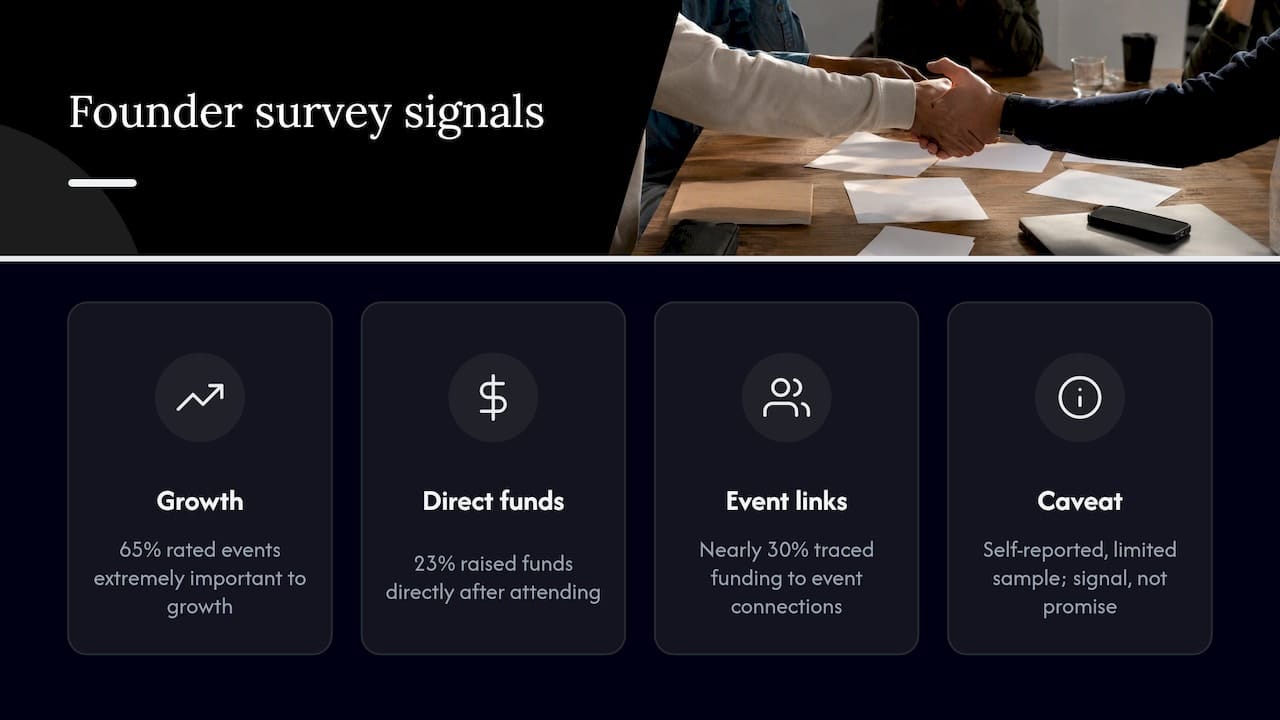
The evidence is encouraging, with caveats. A study of startups in São Paulo and New York found that 65% of surveyed founders considered networking events extremely important to their growth, and 23% said they raised funds as a direct result of attending. Nearly 30% of the founders traced their funding to a connection made at one of these events. Those are self-reported figures from a limited sample, so read them as a signal rather than a promise.
Research on networking frictions and entrepreneurial learning points the same way: relationships with peers help entrepreneurs learn and improve how their firms perform, and events are one of the main places those relationships start.
The practical takeaway is not “go to everything.” It is “go to the right things, consistently.”
Where to find entrepreneur meetups
In the United States you will not run short of options in big metros. The challenge is filtering. Start with these channels.
Event platforms
The entrepreneur networking topic on Meetup lets you search by city and shows upcoming in-person and online events. Search broadly (“entrepreneurs,” “startup founders,” “small business owners”) and also narrowly by industry, stage or identity, such as women founders, solo founders or e-commerce operators. Ticketing sites list one-off startup events too, which suits you if you want to sample before you commit.
Founder communities and chapters
Several global founder communities run local chapters that host monthly talks and mixers in major cities. They are good for scale: you will meet investors, service providers and operators in one evening. They are weaker for depth, because a crowded room rarely produces a deep conversation. Use them to expand your map, then follow up one on one.
Universities and regional programs
University entrepreneurship centers and state-backed programs often host open-door events. Some regions run roadshows that travel between cities during the warmer months, which is useful if you live outside a major hub. Check your local university and your state’s economic development office for calendars.
Coworking spaces and informal circles
Coworking calendars are underrated. A Thursday lunch or a weekly co-working session costs little, and you see the same faces repeatedly. Research on peer relationships suggests that proximity matters: contacts living or working within about a kilometer were more likely to sustain a long-term, useful relationship. Your nearest neighbors in business may be worth more than a famous name in another borough.
Online groups for remote and nomadic founders
If you travel, apps built for remote workers let you find events in whichever city you land in. NomadWay, for example, describes itself as a way to meet remote workers and discover local events across dozens of cities. For a deeper walkthrough of local searching, see our guide to finding and thriving at entrepreneur meetups near you.
How to tell a good meetup from a time sink
You can learn a lot in one visit if you know what to watch for. Use this checklist.
| Signal | Good sign | Warning sign |
|---|---|---|
| Format | Shared activity, roundtables, working sessions | Rows of chairs and a stream of pitches |
| Size | 10 to 40 people, easy to talk to everyone | Hundreds, with conversations lasting two minutes |
| Frequency | Monthly or weekly, with returning members | One-off events with a new crowd every time |
| Tone | Questions, curiosity, open sharing of what failed | Everyone selling to everyone |
| Mix | Founders at different stages | Only service providers hunting clients |
| Organizer | Present, introduces people, follows up | Absent, event runs on autopilot |
A good test: after the first visit, can you name two people you would happily have coffee with? If not, try one more event, then move on.
Avoid the pitch-night trap
Pitch nights have a place, mainly if you are rehearsing for investors. But when every attendee is waiting for their turn to talk, nobody listens. Look for spaces where the conversation is open and nontransactional. That is where candid advice comes from.
Credibility is the other filter. The 5 Cs often cited in entrepreneurship include creativity, connectivity, consistency, clarity and credibility, with some versions swapping in capital or conviction. Connectivity is the one meetups train directly, but credibility is what keeps a connection alive. Choose rooms where you can show your integrity and focus through real conversation, not through volume.
Be selective as you grow
Enthusiasm early on is healthy. Saying yes to every event, however, burns evenings. A TechCrunch survey of 52 founders found 19% wanted to attend more events, 28% planned to keep their frequency the same, and 26% planned to attend fewer. Founders who had been at it longer tended to prefer curated gatherings, such as dinners, hikes or founder-led roundtables, over high-volume conference networking. It is a small sample, but it matches what many of us see: as your business matures, quality beats quantity.
A workable rhythm for a new founder looks like this:
- Month one: Attend three or four different events across formats. Take notes on who you enjoyed talking to.
- Month two: Narrow to one or two groups. Go to every session you can.
- Month three onward: Host or co-host something small, such as a coffee walk or a working breakfast. Organizers are remembered.
- Every quarter: Review. Which relationships produced introductions, advice or clients? Drop the rest.
How to show up and make it count
Preparation takes ten minutes and changes the evening.
- Know your one-sentence description. Say who you help and what changes for them. Skip the title.
- Set a modest goal. Two real conversations beat twenty business cards.
- Ask better questions. “What are you working on that is hardest right now?” opens more doors than “What do you do?”
- Offer something first. An introduction, a resource or an honest opinion costs you little.
- Follow up within 48 hours. A short note that references something specific from your conversation is enough.
- Keep a simple log. Name, where you met, what you discussed, what you promised.
For a repeatable system, our networking workflow for founders and practical networking examples go deeper, and the complete guide to networking for entrepreneurs covers the fundamentals.
Play the long game
Most founders arrive at meetups wanting something quick: funding, a co-founder, a first customer. It does happen, but rarely on the first night. The more reliable payoff is a circle of what you might call critical friends, people who challenge your assumptions, tell you when a plan has a hole, and show up years later when you reach a pivot.
That kind of support is practical, not just emotional. When you are deciding whether to hire, raise, pivot or shut something down, a peer who has been there is worth more than a dozen blog posts. We explore this in our piece on the role of peer support in startups and in why business communities matter for entrepreneurs.
Looking for a co-founder or technical help
Meetups are a common place to search for a technical partner, and many non-technical founders go in hoping to meet a developer. Be realistic: a co-founder relationship is closer to a marriage than a hire, and it takes time to see how someone works under pressure. If you need a product built while you keep searching, an outside team can bridge the gap. Some studios, such as this one offering custom software development for founders, cover everything from idea validation to AI-driven apps, which lets you test demand before you give away equity.
When a meetup is not enough
Meetups have limits. They are short, they depend on who happens to show up, and the follow-through is entirely on you. If you are in a smaller city, travel often, or want to move faster than a monthly cadence allows, you may want a more concentrated format.
Research on time-bounded collaborative events for startup founders explores how short, intensive events bring people from different backgrounds together to work in small teams on a shared project. The idea is simple: working side by side builds trust faster than small talk.
That is the principle behind our own programs. For more on how community forms in this kind of setting, read our notes on community building strategies for entrepreneurship bootcamps and on what a startup community actually is.
Our perspective: community works when people build together
We run entrepreneurship bootcamps for aspiring and early-stage founders, and we have watched the same pattern repeat. People rarely bond over business cards. They bond over a deadline, a messy first offer, or a hard question asked at breakfast. A bootcamp gives you a cohort of driven founders for one to four weeks, daily accountability, structured sprints and mentors who have built businesses themselves. Then the community continues after the event ends.
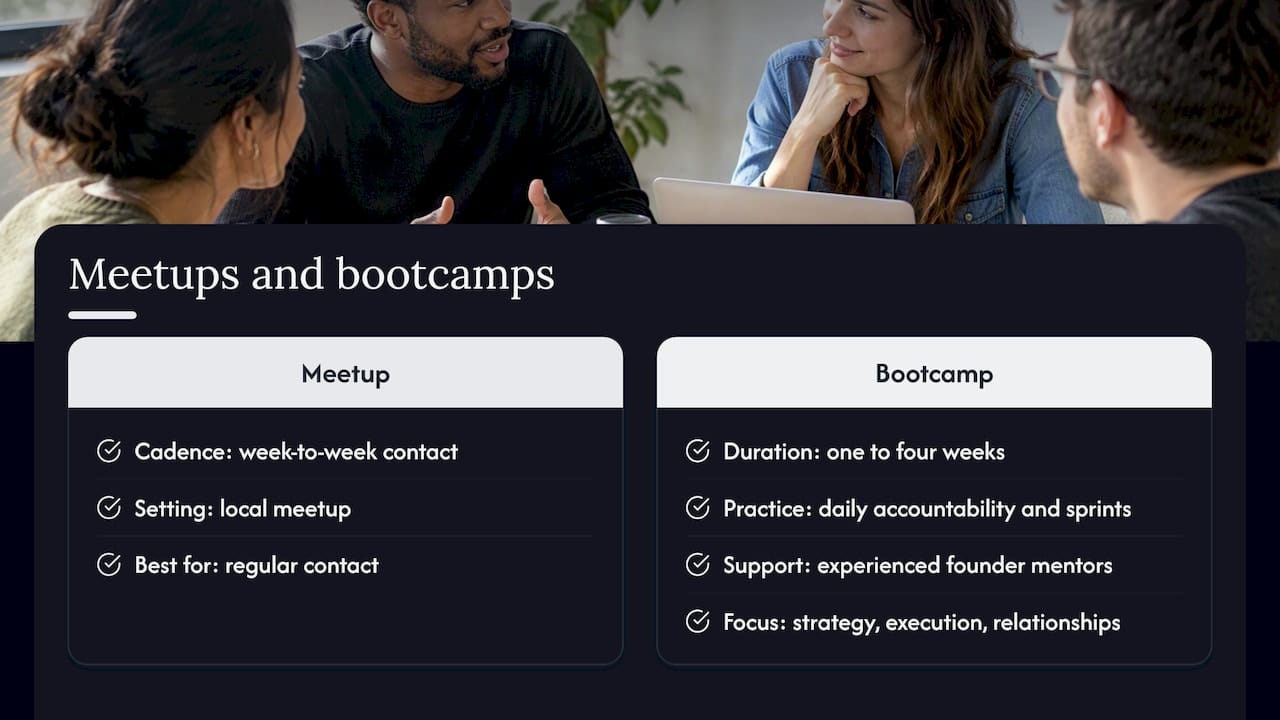
That is why we think of meetups and bootcamps as complements, not rivals. A local meetup keeps you connected week to week. A bootcamp gives you a concentrated stretch where strategy, execution and relationships grow together. If you can only pick one this year, ask yourself what is missing: regular contact, or a push forward. If it is the push, go deep. If it is regular contact, start local and be consistent.
Whatever you choose, be generous early. The founders who get the most from any room are the ones who make introductions before they ask for anything.
— Amichai
A concentrated alternative: Nomad Excel bootcamps
If you want the community without waiting months for it, here are our current formats, with prices as published on our site:
- Online Business Bootcamp: €500, one-off. A good fit if you want structure and peers from wherever you are.
- 5-Day Online AI Bootcamp: €300, one-off.
- Entrepreneurship Sprint Bootcamp in Lisbon: Idea Space edition at €1,350, and the Second Home edition at €1,500, both one-off.
- In-person bootcamps in Playa Venao (Panama), Pipa (Brazil) and Agaete (Canary Islands): each carries a €400 registration fee.
See dates and locations on our upcoming bootcamps page, and read why joining an entrepreneurship bootcamp can pay off if you are weighing it up. Running a team instead? Our business networking retreats for entrepreneurs bring the same ideas to companies.
Making the most of your first month
Here is a simple plan you can start this week.
- Search three sources. One platform, one founder community, one local institution such as a university or coworking space.
- Pick three events. Mix formats: one large, one small, one activity-based.
- Prepare your intro. One sentence, one question.
- Follow up with every person you liked. Suggest a 20-minute call or a coffee walk.
- Review at day 30. Keep what worked, drop what did not, and book the next month.
If you are early and unsure what to build, creativity matters as much as contacts. Our article on creativity in entrepreneurship offers practical ways to generate and test ideas before you bring them to a room of peers.
FAQ
Are entrepreneur meetups worth attending?
Often yes, if you choose well. In one study of startups in São Paulo and New York, 65% of surveyed founders called networking events extremely important for their growth. Results depend on format and consistency, so favor small, recurring groups over one-off mixers.
What are the 5 Cs of entrepreneurship?
Commonly cited versions include creativity, connectivity, consistency, clarity and credibility. Some authors swap in capital or conviction, as described in this overview from Emerald Publishing. Connectivity, the ability to network well, is the one meetups help you practice.
How often should I go to meetups?
There is no universal number. Early on, sampling a few events a month makes sense. Later, many founders scale back: in a survey of 52 founders, 26% planned to attend fewer events. Aim for the rhythm that produces real follow-up conversations.
Can I find a co-founder at a meetup?
You can meet candidates, but treat it as a slow process. Spend time working on something small together before committing equity. Many founders find that recurring groups, where you see people over months, reveal more than a single evening.
Sources
- An evaluation of the impact of networking events for successful startups in São Paulo and New York
- We asked 52 founders whether events are useful or a waste of time (TechCrunch)
- Networking Frictions and Entrepreneurial Learning in Developing Economies (Management Science)
- Advancing quality of life through entrepreneurship: the 5 C’s (Emerald Publishing)
- An Exploratory Study of the Benefits of Time-bounded Collaborative Events for Startup Founders
- Entrepreneur networking events on Meetup
- NomadWay
Comments are closed.