
Remote Travel: How to Work From Anywhere Without Losing Momentum
Remote travel means keeping a real job or business running while you move between places, and it works best when you treat the business side as seriously as the destination. The people who thrive plan four things before they book a flight: legal status, taxes, connectivity and a daily rhythm. Everything else, from the best coworking café to the perfect beach town, is the fun part that follows.
The phrase also covers a second path: building a remote career in the travel industry itself, such as becoming a travel advisor from home. We cover both, because many readers searching this term are weighing one or the other.
TL;DR
- Remote travel is a business decision first and a lifestyle choice second. Visas, tax residency, internet and insurance decide whether it lasts.
- More than 48 jurisdictions now offer dedicated digital nomad or remote work visas, but each has its own tax and eligibility rules.
- Never rely on one internet source. Layer accommodation Wi-Fi, a phone hotspot and an eSIM or local SIM.
- If you want to sell travel remotely, beginners usually join a host agency rather than seeking independent accreditation.
- Community and structure keep momentum high. A short, focused bootcamp can give you both.
Table of Contents
- What remote travel actually looks like
- Visas: the first thing to check
- Taxes: where most nomads get surprised
- Internet is your revenue infrastructure
- Insurance and wellbeing on the road
- A realistic first month
- The other meaning: building a remote career in travel
- Our perspective
- Go from remote traveler to remote founder
- A pre-departure checklist
- FAQ
- Sources
What remote travel actually looks like
There are three common versions, and each asks for something different.
The employed remote worker. You keep your current job and work from different places for a few weeks or months. Your main questions are your employer’s policy, time zones and whether your presence abroad creates tax issues for the company.
The freelancer or founder. You control your schedule, which is freedom and risk at once. You need steady clients, a reliable setup and a plan for slow months. Our guide on what digital nomads do for work maps the careers that travel best, and how to land international clients as a remote freelancer covers the pipeline side.
The remote travel professional. You work in the travel industry from home or on the road, as an advisor, content writer or customer-facing agent. We cover that route further down.
If the broader lifestyle is new to you, start with what a digital nomad is and the honest picture in the digital nomad lifestyle: freedom, community, reality.
Visas: the first thing to check
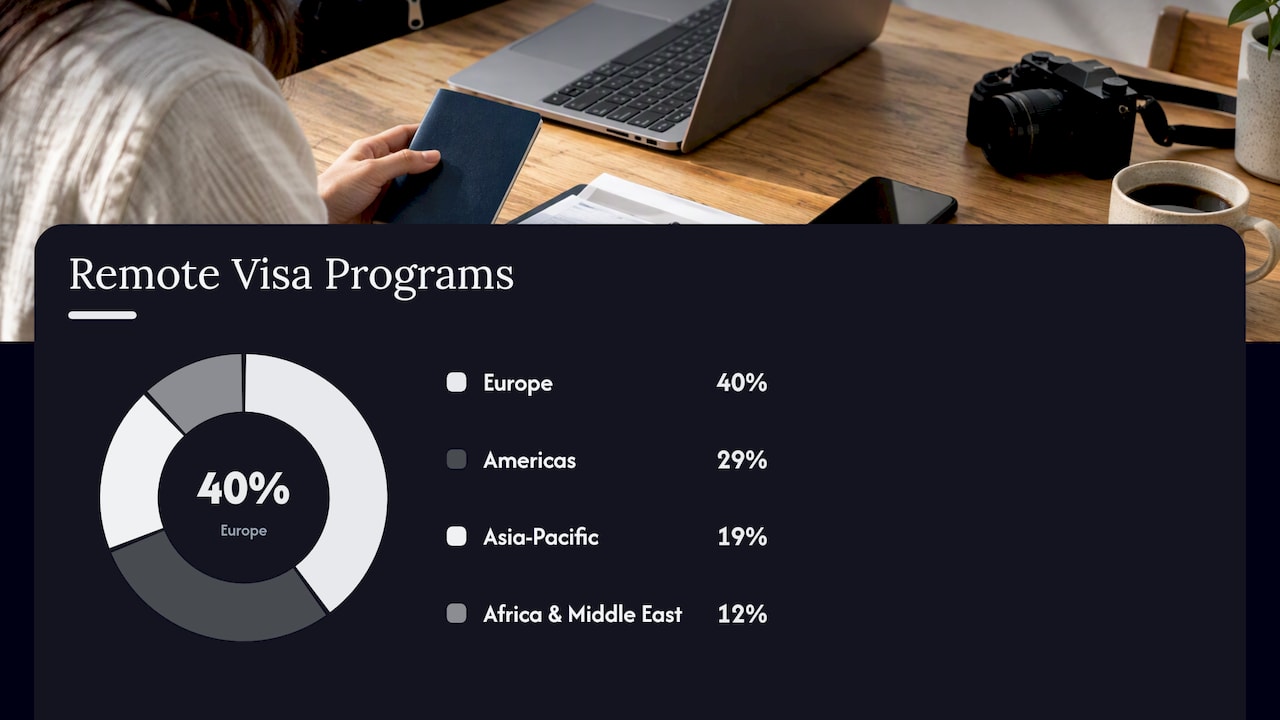
A tourist stamp is not automatically permission to work. A growing number of countries now offer visas built for remote workers. According to EY’s immigration index, Europe leads with about 40% of these programs, followed by the Americas at 29%, Asia-Pacific at 19% and Africa and the Middle East at 12%. Over 87 jurisdictions permit remote work within their borders under some framework.
A few practical points follow from that:
- Check whether the visa is for self-employed nomads, foreign-employed remote workers, or both. The rules differ.
- Read the income threshold and the maximum stay. Both vary widely by country.
- Do not assume a visa is a tax holiday. Researchers note that states increasingly use these visas as economic development tools and align them with tax-collection interests, so living somewhere no longer guarantees you escape reporting requirements.
A useful starting point is the official immigration page of the country you are considering, then a conversation with an immigration lawyer if your situation involves a business or employees.
Taxes: where most nomads get surprised
Taxes deserve more of your planning time than flights do.
In most countries, you become a tax resident after 183 days of stay, though treatment varies widely. The same UN Tourism report notes that some destinations give nomads specific exemptions: Albania, Croatia and Malta offer incentives without a fixed expiry, Antigua and Barbuda for two years, and Barbados and Latvia for one year. Others apply standard resident or non-resident rules.
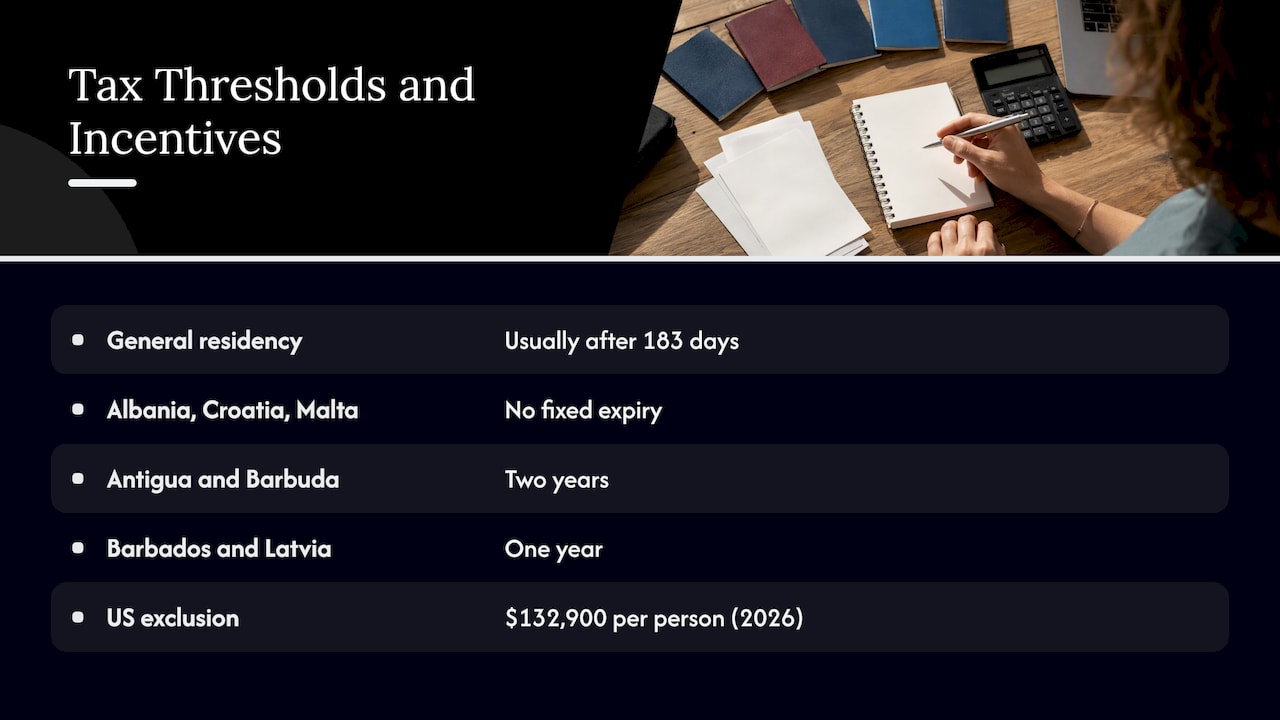
If you are a US citizen or resident, you generally still file a US return wherever you live. The IRS foreign earned income exclusion can reduce what you owe if you qualify through the bona fide residence or physical presence test. For tax year 2026, the maximum exclusion is $132,900 per person. Whether you qualify depends on your tax home and the number of qualifying days, so a US expat tax professional or CPA should review your plan before you leave, not after you file.
European entrepreneurs face their own version of this. Euronews has a useful overview of taxes, finances and cybersecurity for European entrepreneurs going nomadic, and its message applies everywhere: for founders, the move is far from casual.
Internet is your revenue infrastructure
Remote work experts point to a common pitfall: treating remote work as only a lifestyle choice and ignoring the business infrastructure behind it. Reliable internet is the foundation, not a perk.
A simple redundancy plan, as outlined in a guide to working remotely while traveling, looks like this:
- Primary: accommodation or coworking Wi-Fi.
- Backup one: a mobile hotspot from your phone.
- Backup two: an eSIM or local SIM.
- Optional: a portable travel router if you stay longer.
One habit worth copying from seasoned nomads: before committing to a long rental, ask the host for a live Speedtest screenshot rather than trusting listing photos or promises. It takes two minutes and can save a month of dropped calls.
Insurance and wellbeing on the road
Standard vacation policies are built around a fixed trip with an end date. Most rarely cover business equipment theft or professional liability, and nomads often look at subscription-style plans designed for people without a permanent home base. Read the exclusions on any plan, especially for laptops, pre-existing conditions and extended stays. For a general look at how to compare policies and what to check in the fine print, this travel insurance comparison guide is a helpful reference, though it is written around guided tours rather than long-term remote work.
Wellbeing is the quieter risk. Isolation, irregular sleep and no clear end to the workday wear people down faster than a bad flight. If you manage a distributed team, this practical guide to remote workforce wellness for HR leaders explains how employers think about it. If you work alone, build the same structure yourself: fixed hours, movement, and regular contact with other people who understand your work.
Time zones matter too. The guide above suggests a six to eight hour difference from your clients or team can be a sweet spot, provided you work asynchronously with written updates and short videos instead of chasing live overlap.
A realistic first month
The goal of month one is not to see everything. It is to prove your system works.
- Week one: Land, test your internet, find a workspace, and keep your schedule identical to home.
- Week two: Set your working hours around your clients, not the sights.
- Week three: Review spending, tax-day counts and what is draining your focus.
- Week four: Decide whether to stay, move or return, based on evidence rather than mood.
Slow travel usually beats fast travel for people who need to earn. Staying a month or more in one place cuts transit days, lowers per-night costs and lets you build routines and relationships.
The other meaning: building a remote career in travel
Search results for this term are full of travel-agent and travel-industry job listings, so here is the short version for anyone drawn to that path.
Host agency or independent?
Beginners face a choice between joining a host agency and pursuing independent accreditation. Host agencies typically charge a modest fee, often cited at roughly $100 to $300 a year for membership and support, while independent accreditation through IATAN involves demonstrating $10,000 to $20,000 in business capital and at least two years of industry experience or certification. Check IATAN’s current page before you plan around those figures.
Industry veterans describe the host route as a business-in-a-box that costs 10% to 30% of commissions in exchange for immediate infrastructure. Going independent is a scaling play for those with the revenue to carry the overhead. In practice, it is a question of business maturity.
Do you need a license?
Often not. In the US, most states require no specific travel agent license; only California, Florida, Hawaii, Iowa and Washington have Seller of Travel registration. Texas, for example, has no occupational permit, bond or registration for travel agents. The real barrier is industry accreditation, which gives access to supplier commissions. Rules change, so confirm with your state before you sell.
Airline ticketing is a narrower question. ARC numbers are only needed by agencies that want to issue airline tickets themselves, and you can obtain tickets through other agencies if you prefer not to.
Treat this as a business, not a hobby with a discount attached. Define your niche, your client source and your pricing before you pay for anything. Our step-by-step guide to launching a remote business works for this as well as any other service.
Our perspective
We run entrepreneurship bootcamps and company retreats in places people usually visit on holiday, so we see both sides of remote travel every year. What we notice is simple: location rarely decides whether someone’s business moves forward. Clarity, structure and the people around them do.
The founders who arrive with a beautiful lifestyle plan and no offer often spend their first weeks happily busy and commercially stuck. The ones who arrive with a rough offer and a willingness to test it leave with sharper strategy and real conversations with customers. Daily accountability and honest feedback from peers and mentors do more than any view from a terrace.
That is why our programs combine business-building frameworks, mentorship from experienced entrepreneurs and operators, and a community that stays in touch after the event ends. Travel becomes the setting for focused work rather than a distraction from it. If you are curious about the fit, our overview of why remote work communities help entrepreneurs explains why we put so much weight on peers.
Our advice: pick one destination, one clear goal for the trip and one group of people to be accountable to. Add complexity only after that works.
— Amichai
Go from remote traveler to remote founder
If you want structure while you travel, we offer both online and in-person options. Prices below are as published on our site.
| Program | Format | Price |
|---|---|---|
| 5-Day Online AI Bootcamp | Online | €300 |
| Online Business Bootcamp | Online | €500 |
| Entrepreneurship Sprint Bootcamp, Idea Space | Lisbon | €1,350 |
| Entrepreneurship Sprint Bootcamp, Second Home | Lisbon | €1,500 |
| 2-Week Entrepreneurship Bootcamp | Playa Venao, Panama | €400 registration fee |
| 10-Day Entrepreneurship Bootcamp | Pipa, Brazil | €400 registration fee |
| 1-Week Entrepreneurship Bootcamp | Agaete, Canary Islands | €400 registration fee |
The online programs suit people who want to test the format from wherever they are. The in-person bootcamps suit those who want to work shoulder to shoulder with other founders for one to four weeks. Start with the online entrepreneurship bootcamp, or read the essential guide to joining entrepreneurship bootcamps to see which format fits.
Leading a team instead? We design business retreats for remote teams end to end, from workshops to logistics and local experiences. Pricing for retreats is project-based, so reach out through our site for details.
A pre-departure checklist
- Confirm your visa or entry status and the maximum stay.
- Count your days. Track where you spend them, since the 183-day mark is common for tax residency.
- Speak with a tax professional about home-country filing and any local obligations.
- Check your employer’s or clients’ rules on working from abroad.
- Buy insurance that covers long stays and review the equipment exclusions.
- Set up an eSIM, a hotspot plan and a backup workspace.
- Back up your files, use a VPN on public networks and enable two-factor authentication.
- Ask for a live speed test before paying for a long rental.
- Schedule your first week of work hours before you book activities.
FAQ
What is remote travel?
It means traveling while continuing to work remotely, usually as an employee, freelancer or business owner. Some people also use the phrase for remote jobs in the travel industry, such as travel advisors. The first meaning depends on visas, taxes and connectivity, and the second on accreditation and a host agency or independent setup.
Do I need a visa to work remotely while traveling?
It depends on the country and on how it treats remote work by foreign visitors. Many countries now have a dedicated nomad visa, and EY counts more than 48 jurisdictions with such programs. Check the destination’s official immigration site, and consult an immigration lawyer if you run a company.
Can I become a travel agent from home with no experience?
Yes, many beginners start this way by joining a host agency, which provides the infrastructure and accreditation access in return for a share of commissions. Independent accreditation is much harder to meet at the start. Check your state’s Seller of Travel rules first if you live in California, Florida, Hawaii, Iowa or Washington.
How do I keep my internet reliable abroad?
Use layers: accommodation or coworking Wi-Fi, a phone hotspot and an eSIM or local SIM, plus a travel router for longer stays. Ask hosts for a live speed test before you commit to a rental. Never depend on a single connection for client calls or deadlines.
Is a bootcamp worth it for someone who travels and works remotely?
It is worth considering if your main obstacle is focus, feedback or isolation rather than money alone. A structured program gives you deadlines, mentors and peers. We would suggest starting with a shorter online format if you want to test the fit first.
Sources
- EY: Practical immigration index for global digital nomads
- UN Tourism: Digital Nomad Visas
- Hari KC and Triandafyllidou: Digital Nomad Visas and state policy objectives
- IRS: Figuring the foreign earned income exclusion
- Euronews: 9 things European entrepreneurs should know before becoming digital nomads
- job4travelers: Stay Connected and Insured While Working Abroad
- Nomads Tools Lab: How to Work Remotely While Traveling
- Nomads Tools Lab: Digital Nomad Setup Guide 2026
- IATAN: Requirements and Fees
- Travel Pros Elite: Host agency licensing
- Voyagr: How to become a travel advisor
- LegalClarity: Does Texas require a travel agent license?
- Travel Weekly: Which accreditation number does a host need?