
The Entrepreneurship Network (TEN): What It Is and Who It Fits
If you searched for “The Entrepreneurship Network,” you most likely want TEN at entrepreneurshipnetwork.net: an AI startup platform and virtual venture studio for aspiring founders, students and early-stage entrepreneurs. Several organizations have similar names, though, so the first job is making sure you are looking at the right one. The second is deciding whether a venture-studio model, a community, or an in-person program fits where you are today.
This guide covers all three. It explains what TEN offers, which similarly named groups it is not, how to judge any founder network before you commit, and where in-person programs fit.
TL;DR
- TEN, per its own site, combines AI tools for idea validation and MVP building with an incubation program and a founder community. It is a venture-building service, not just a course.
- Do not confuse it with the UK think tank called the Entrepreneurs Network, a New York group with a similar name, or a global membership organization for established founders.
- Most TEN figures (25+ incubated teams, founders keep 100% equity, a free AI engine) are self-published. Verify them, and confirm contract terms before you pay or sign anything.
- A good network gives you three things: relevant peers, access to people a step ahead of you, and a reason to show up repeatedly.
- If you want a cohort of founders in the same room for days of focused execution, an in-person bootcamp is a different and complementary path.
Table of Contents
- Which “Entrepreneurship Network” are you looking for?
- What TEN offers, based on its own materials
- How to use AI validation without trusting it blindly
- What a good founder network actually gives you
- Where to find local entrepreneurship groups
- How to join a startup network, step by step
- Our perspective: community works when people build side by side
- In-person bootcamps as a different kind of network
- Building a network that outlasts any single program
- FAQ
- Sources
Which “Entrepreneurship Network” are you looking for?
The name is generic, and search results mix several unrelated organizations. Here is how they separate:
| Name | What it is | Where it operates |
|---|---|---|
| The Entrepreneurship Network (TEN) | AI startup platform and virtual venture studio for early-stage founders and students | India-based, globally remote |
| The Entrepreneurs Network | A think tank for owners of fast-growing British businesses | United Kingdom |
| TEN, The Entrepreneurs Network (New York) | Boot camps and networking events with local case studies | New York area |
| Membership organizations for established founders | Peer groups with entry criteria, usually based on company revenue | Global |
If you landed here from a LinkedIn profile or a job listing, check the domain before sharing personal details or paying a fee. We wrote a separate guide on telling TEN apart from similarly named groups before you apply, and another on what a TEN-style network means for founders.
What TEN offers, based on its own materials
TEN describes itself as an AI startup platform and virtual venture studio built around a seven-step journey from raw idea to market launch. The tools it advertises cover ideation, market and customer analysis, competition and barriers, business-model evaluation, validation experiments, MVP development, pitch materials and investor discovery.
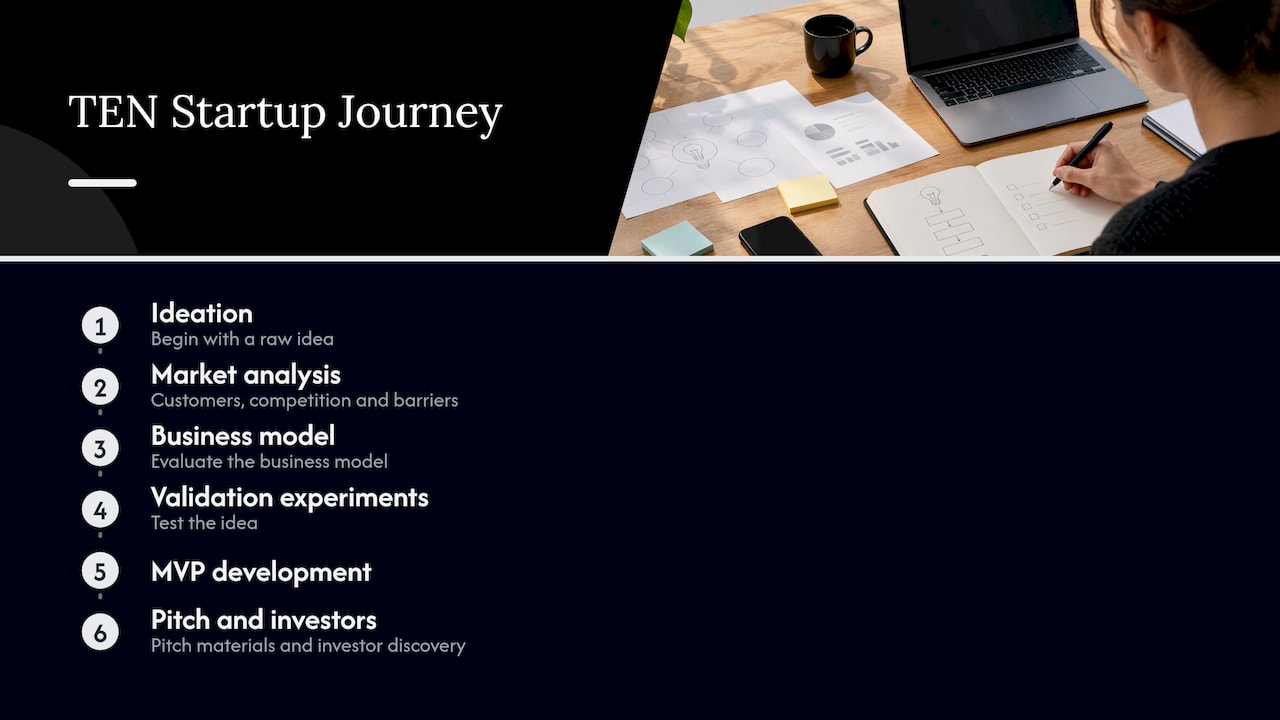
The homepage also lists specific features: an AI validation report, an MVP-builder pipeline, a 15-slide pitch-deck tool, and profiles of more than 2,000 venture capital funds and angel investors across India and the United States. It states that the AI engine is free, that founders retain 100% equity, and that 25+ teams have been incubated. These are the organization’s own claims, so treat them as a starting point for questions, not as audited results.
The co-building model
The feature that sets TEN apart from a typical online course is what it calls co-building. According to the site, it allocates technical resources and pairs founders with student developers in structured three-month sprints. That makes it closer to a venture studio than to educational content, and you should evaluate it like one: ask who owns what, what the sprint produces, and what happens if the project stalls.
Incubation and community
For founders who want people rather than only software, TEN separately describes an incubation program built around mentorship, co-working or collaborative support, industry connections and a community. Its public description does not set out a universal application process, a cohort calendar, eligibility rules, a pricing schedule or any guaranteed funding outcome. Ask for those details directly before you plan around it.
The academy track
TEN also runs an academy that promotes technology courses, expert-led learning and a pay-after-placement model. That is a career-switcher and student use case, quite different from the founder path. If a pay-after-placement arrangement interests you, read the current contract terms and payment obligations in full before enrolling.
How to use AI validation without trusting it blindly
AI tools can speed up early research, and TEN’s workflow is sensible in its structure: market, customer, competition, business model, then experiments. The risk is treating a score as a verdict. Treat any AI output as a hypothesis, then test it with real customer conversations and with paid or behavioral signals such as pre-orders, deposits or sign-ups.
Our own guides go deeper on this: idea validation steps, a validation checklist for avoiding common pitfalls, and startup ideation frameworks.
One practical habit helps whichever platform you use. Founders collect a lot of scattered material during validation: interview notes, voice memos, screenshots, investor emails. A dedicated personal AI memory layer for founders is one way to keep that material organized and searchable, with consent and deletion controls, so the next conversation starts with context instead of a blank page.
What a good founder network actually gives you
The name on the door matters less than what happens inside. Whether you join a virtual studio, a local group or a retreat community, test it against these criteria.
- Relevant peers. People at your stage, facing problems like yours. A solo freelancer and a venture-backed SaaS founder need different rooms.
- People one step ahead. Mentors or members who have already done the thing you are trying to do, and who will answer a specific question.
- A rhythm. Weekly sessions, sprints or events that create accountability. A network with no cadence tends to fade into a group chat nobody reads.
- Clear terms. What it costs, what you give up (equity, fees, exclusivity) and what you can expect.
- Evidence. Named alumni you can contact, not only testimonials on a landing page.
Where to find local entrepreneurship groups
Not every founder needs a global platform. For small business connections close to home, the classics still work. A roundup of networking groups for small business owners points to the local chamber of commerce first, and notes that Rotary, with more than 45,000 clubs, is a good place to meet service-minded business leaders.
A few ways to make any local group worth your time:
- Attend three times before judging. The first visit is mostly introductions.
- Go with a specific ask, such as a referral to an accountant, a pilot customer or feedback on pricing.
- Offer something first: an introduction, a resource, a candid review of someone’s landing page.
- Follow up within 48 hours with one concrete next step.
How to join a startup network, step by step
- Define your stage and your need. Idea, first customers, or scaling? Choose a network built for that stage.
- Shortlist two or three options. Mix formats: one online, one in person if you can.
- Read the terms. Ask about fees, equity, contracts and what happens after the first cohort or sprint.
- Talk to a member. Ask what they got in the first 90 days, and what they would change.
- Start small. Join a free event or a short program before committing to a long one.
- Show up and contribute. Networks reward members who answer questions, not only those who ask them.
Our perspective: community works when people build side by side
We run entrepreneurship bootcamps and company retreats, so we see the same pattern in every cohort. Founders rarely lack information. They lack clarity on what to do this week, and people who will notice if they do not do it.
That is why we think a network is strongest when it is attached to action. Contacts collected at a mixer fade quickly. Relationships formed while two people validate offers, trade feedback in a sprint and hold each other to a daily goal tend to last, because they were built on real work.
Software, including good AI tooling, is a valuable accelerator for research and drafting. It cannot replace the founder who tells you your offer is unclear, or the peer who reminds you that you promised to call five customers by Friday. Our advice is to use both: tools for speed, people for judgment and accountability.
If you are comparing options, ask one honest question of each: what will I have done, and who will I have done it with, 30 days from now?
— Amichai
In-person bootcamps as a different kind of network
A virtual studio and an in-person bootcamp solve different problems. Online, you get flexibility and tools. In person, you get concentrated time with a curated group of founders, away from your usual distractions. Our program overview explains how we combine business-building frameworks, mentorship, community and daily execution, and our guide to joining an entrepreneurship bootcamp helps you decide if the format suits you.
If you want structured sprints and a peer group without traveling, our online options are the lowest-commitment way to start:
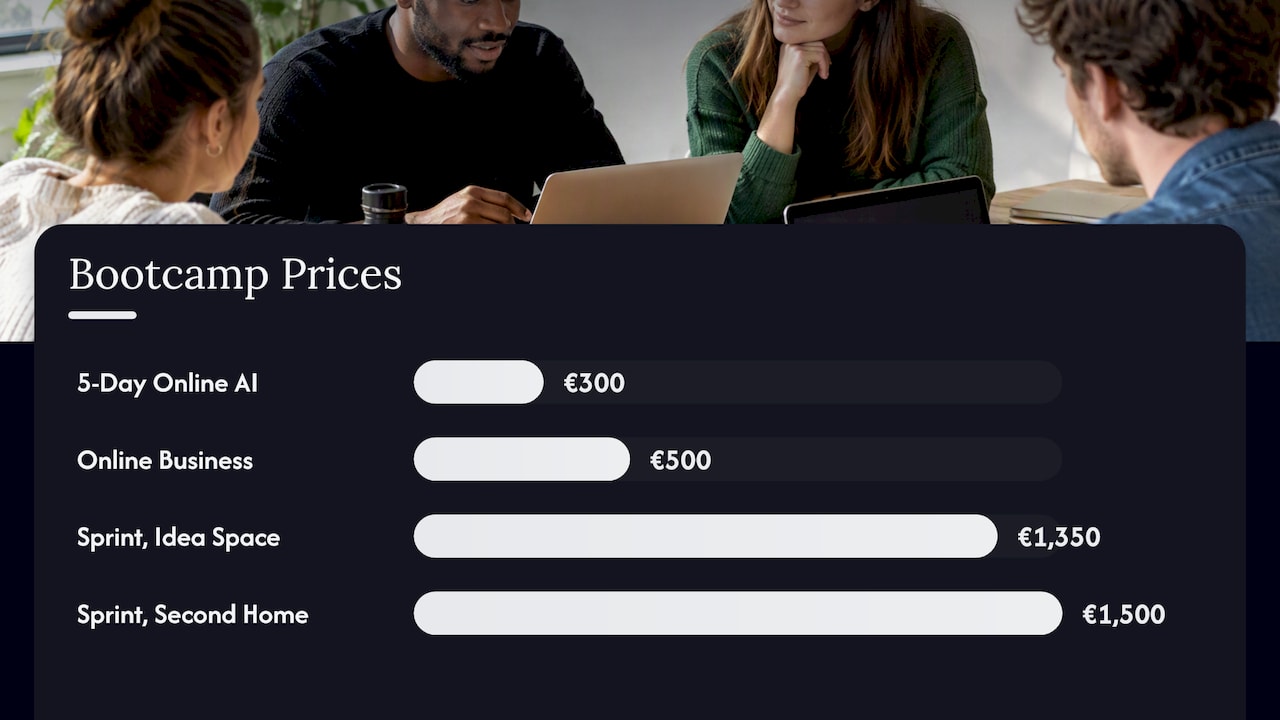
| Program | Format | Published price |
|---|---|---|
| 5-Day Online AI Bootcamp | Online | €300 |
| Online Business Bootcamp | Online | €500 |
| Entrepreneurship Sprint Bootcamp, Idea Space, Lisbon | In person | €1,350 |
| Entrepreneurship Sprint Bootcamp, Second Home, Lisbon | In person | €1,500 |
We also hold bootcamps in Playa Venao in Panama (2 weeks), Pipa in Brazil (10 days) and Agaete in the Canary Islands (1 week). Each has a €400 registration fee. Prices are as published on our site and can change, so check the program page before you book.
Start with the Online Entrepreneurship Bootcamp if you want to test the format, or look at the Lisbon sprint at Idea Space if you want a week in a room full of founders. If mentorship is your main need, our comparison of startup mentorship programs lays out the criteria to weigh, and our startup launch guide for 2026 maps the steps after validation.
Building a network that outlasts any single program
Whichever route you take, a few habits compound over time:
- Keep a simple contact log. Note who you met, what they are working on and how you could help.
- Share progress publicly. A short monthly update to your network invites introductions you could not have requested.
- Pair up. One accountability partner with a weekly 20-minute call often beats a large group.
- Use group formats. Group coaching lets you learn from problems you have not hit yet; see how group coaching accelerates entrepreneur success.
If you lead a team rather than a solo business, the same logic applies inside your company. A retreat can create the shared context and trust that daily chat cannot, and our guide to business retreats for remote teams shows what a well-designed one looks like.
FAQ
Is The Entrepreneurship Network the same as the UK Entrepreneurs Network?
No. The UK organization is a think tank for owners of Britain’s fastest-growing businesses. TEN at entrepreneurshipnetwork.net is an India-based, globally remote venture studio and platform for early-stage founders and students. Check the web address before you apply or pay.
Is TEN free?
TEN’s homepage says its AI engine is free and that founders retain 100% equity. Its public pages do not publish a pricing schedule for incubation or a universal application process, so ask TEN directly for current terms in writing.
Who is a founder network best for?
It depends on your stage. Idea-stage founders benefit most from validation support and peers who give honest feedback. Founders with early revenue usually need mentors who have scaled similar businesses and introductions to customers or partners.
How do I join a startup network?
Start by choosing a network built for your stage, then read the terms, talk to a current member and try a free event or short program first. Once you join, contribute actively: answer questions, make introductions and follow up after every meeting.
Can an online bootcamp replace a local group?
It can cover a lot: structured learning, accountability and a peer cohort. Local groups add face-to-face relationships in your own market, such as referrals and nearby customers. Many founders do both.
Sources
- The Entrepreneurship Network (TEN) homepage
- TEN Incubation
- TEN Academy
- Networking groups for small business owners, Entrepreneur.com