
8 Business Networking Ideas Planners Can Run and Measure
Build networking around structured, topic-linked formats such as topic roundtables, facilitated speed networking, and curated 1:1 matchmaking, then bracket them with pre-event onboarding and timely follow-up. Event design experts report that attendees prefer active, topic-specific roundtables over passive formats, and attendees typically follow up with only 20–30% of the contacts they make.
TL;DR:
- For events under 50 attendees, speed networking, peer circles, or mystery dinners work well; events over 250 need moderated breakouts, interest zones, or matchmaking apps.
- Only 34% of attendees find casual receptions appealing, while 44% prefer structured meetups; an event with 80 attendees can pair bingo, roundtables, and booked meetings.
- Two thirds of attendees start networking before an event, so open profiles and calendar booking at least two weeks in advance.
- Follow up within 24 to 72 hours, mention where you met, recall one conversation detail, and suggest a clear next step such as a call.
- Brief facilitators on timing and prompts, then provide captions, seating choices, a quiet room, and clear signs so attendees with access needs can participate.
Table of Contents
- 1. Eight business networking ideas to shortlist first
- 2. How to run 20-plus networking activities step by step
- 3. How do you choose the right networking format for your event?
- 4. When should networking happen, and how do you follow up?
- 5. How do you keep networking purposeful with strong facilitation?
- 6. Which tools make hybrid and matchmaking networking work?
- 7. How do you build relationships that last beyond the event?
- 8. How should different entrepreneurs tailor their networking?
- 9. How do you fit networking into daily business operations?
- 10. How can networking lead to partnerships and joint ventures?
- 11. How do you sharpen your personal brand and pitch?
- 12. Why does this approach work, and what should you test?
- 13. Want help designing a networking-driven experience?
- FAQ
- Sources
1. Eight business networking ideas to shortlist first
If you only have time to skim, start here. Each idea lists why it works, where it fits, and how to set it up.
- Topic roundtables: Conversation has a built-in reason to start. Best for 30 to 250 attendees. Set one table per theme, 20 minutes, a printed table tent with a prompt.
- Facilitated speed networking: Everyone meets several people quickly without awkward exits. Best for small and medium events. Plan short rounds, a bell or timer, and one host.
- Curated 1:1 matchmaking: Meetings are booked around shared goals. Best when attendees have clear buying or partnership needs. Collect profiles in advance and open calendar booking.
- Networking passport: A card with tasks nudges shy attendees toward new people. Best for expos and multi-room events. Print cards, assign stamps, and offer one small prize.
- Human bingo: A low-pressure icebreaker built on shared traits. Best for mixed audiences at the start of a day. Hand out grids and allow 10 minutes.
- Problem-sprint tables: Small groups solve one real business problem together. Best for founders and operators. Give each table a challenge card and a set amount of time.
- Interest-based meetups: People gather around passions, not job titles. Best for communities and longer events. Mark zones with signs and let people drift.
- Peer mentoring circles: Small groups share lessons and next steps. Best for retreats and cohort programs. Seat by experience level, set a suitable duration, and provide a facilitator.
Pro Tip: Pilot any new format with one table block or one session before rolling it out to the full room, and note what the facilitator had to improvise.
2. How to run 20-plus networking activities step by step
The ideas below are grouped by intent. For each, you will find the goal, the setup, timing, group size, an accessibility note, and a sample prompt you can use as written.
Quick introductions
- Speed networking. Goal: many first conversations. Setup: paired seating, a timer, and a rotation plan. Timing: 3 minutes per round, 30 to 45 minutes total. Group size: pairs. Accessibility: keep the seating route step-free and let people stay seated while partners move. Prompt: “What are you working on that you wish more people understood?”
- Human bingo. Goal: break the ice without pressure. Setup: printed grids with traits like “has changed industries” or “runs a team of one.” Timing: 10 to 15 minutes. Group size: any. Accessibility: offer large-print grids. Prompt: “Find someone who has launched something that failed and learned from it.”
- Two truths and a lie. Goal: build warmth in small groups. Setup: small groups, with a short turn for each person. Timing: set a suitable duration. Group size: 4. Accessibility: allow people to pass or use written cards. Prompt: “Tell us two true things about your business journey and one invented one.”
- Table tents. Goal: give strangers a ready conversation starter. Setup: fold a card per table with a question and a topic tag. Timing: runs through meals. Group size: whole table. Accessibility: print in high contrast and a readable font size. Prompt: “What decision this quarter would you like a second opinion on?”
Curated meetings and passports
- 1:1 matchmaking. Goal: meetings that lead somewhere. Setup: attendee profiles, a booking tool, and a meeting area with numbered tables. Timing: use short slots. Group size: pairs. Accessibility: place the meeting area away from loud sound. Prompt: “I’d like to meet someone who has solved X.”
- Networking passport. Goal: encourage movement. Setup: a card with several prompts, each signed by a different person. Timing: all event long. Group size: individual. Accessibility: offer a digital version. Prompt: “Find someone who can recommend a tool you have not tried.”
- Mystery dinner. Goal: deepen conversations over a meal. Setup: assign seats in advance, mixing industries, and reveal pairings at arrival. Timing: set a suitable duration. Group size: small groups at each table. Accessibility: collect dietary and mobility needs at registration. Prompt: “What is one problem at work you keep seeing but nobody owns?”
Roundtables and problem sprints
- Topic roundtables. Goal: peer exchange on a shared challenge. Setup: a host per table, one topic per table, and a note-taker. Timing: 20 to 30 minutes, with a rotation. Group size: 6 to 10. Accessibility: provide table microphones in noisy rooms. Prompt: “What is one thing you tried this year that did not work?”
- Problem-sprint tables. Goal: collaborate on a real challenge. Setup: a challenge card, sticky notes, and a timer. Timing: set a suitable duration. Group size: small groups. Accessibility: supply verbal and written instructions. Prompt: “How would you solve this if you had one week and no budget?”
- Ask-me-anything benches. Goal: connect newcomers with experienced operators. Setup: hosts at marked benches. Timing: 30 minutes. Group size: small groups. Accessibility: keep one bench near an exit for quiet conversation. Prompt: “What would you do differently in your first year?”
Gamified formats
- Scavenger hunt. Goal: movement and mixing. Setup: a list of tasks that require talking to new people. Timing: 30 to 45 minutes. Group size: small teams. Accessibility: avoid tasks that need stairs or running. Prompt: “Find someone who has hired their first employee and ask what they learned.”
- Trivia teams. Goal: build rapport fast. Setup: mixed teams, a host, and questions about your industry. Timing: 30 minutes. Group size: small teams. Accessibility: display questions on screens and read them aloud. Prompt: “Introduce your team’s name and why you chose it.”
- Business card challenge. Goal: make follow-up automatic. Setup: attendees swap contacts and record one detail about each person. Timing: set a suitable duration. Group size: pairs. Accessibility: allow digital contact swaps. Prompt: “What is one thing I should remember about you?”
Interest and social formats
- Interest-based meetups. Goal: connect around passions. Setup: zones labeled by theme such as running, parenthood, or side projects. Timing: 30 to 45 minutes. Group size: open. Accessibility: place a quiet zone in the mix. Prompt: “What do you do outside work that shapes how you work?”
- Peer mentoring circles. Goal: share lessons. Setup: seat mixed experience levels, with a facilitator and a clear time per speaker. Timing: set a suitable duration. Group size: 4 to 6. Accessibility: share prompts in advance. Prompt: “What is one lesson you wish someone had told you earlier?”
- Walk-and-talk. Goal: ease pressure through movement. Setup: a short route and a list of conversation topics. Timing: 20 minutes. Group size: pairs. Accessibility: provide a seated alternative. Prompt: “What is the best advice you have used recently?”
- Breakfast pairings. Goal: convert morning energy into one real conversation. Setup: assign breakfast partners by shared challenge. Timing: 30 minutes. Group size: pairs. Accessibility: note allergen information. Prompt: “What are you hoping to find at this event?”
Sponsor-friendly formats
- Sponsored problem stations. Goal: give sponsors a role beyond a logo. Setup: sponsor poses a challenge and attendees brainstorm answers. Timing: 20 minutes. Group size: a small group. Accessibility: keep sponsor tables accessible by wheelchair. Prompt: “How would your team solve this if it were yours?”
- Sponsor office hours. Goal: offer expert time. Setup: a schedule and sign-up board. Timing: use short blocks. Group size: pairs. Accessibility: allow booking by app or on paper. Prompt: “What would you like a specialist to review?”
Hybrid and virtual adaptations
- Virtual speed rounds. Goal: replace room rotation. Setup: breakout rooms with a timer. Timing: use short rounds. Group size: pairs. Accessibility: enable captions. Prompt: “What is one project you are excited about right now?”
- Hybrid roundtables. Goal: let remote and in-room attendees mix. Setup: a screen and microphone at each table. Timing: set a suitable duration. Group size: 6 to 8. Accessibility: assign a moderator to watch the chat. Prompt: “What is one change in your industry you did not see coming?”
- Chat-based icebreakers. Goal: warm up before live sessions. Setup: pose a question in the event chat. Timing: 10 minutes. Group size: any. Accessibility: allow typed and voice responses. Prompt: “Share a win from this week in one line.”
3. How do you choose the right networking format for your event?
Match the format to size, goal, and the energy in the room. A simple framework prevents over-engineering.
- Small events under 50: Direct connections work well. Use speed networking, peer circles, or mystery dinners, since small events suit direct speaker and organizer connections while larger ones need moderated structure.
- Medium events of 50 to 250: Mix roundtables, matchmaking, and one gamified element such as a passport.
- Large events over 250: Rely on moderated breakouts, interest zones, and app-based matchmaking so people do not drift into fragmented clusters.
Before you commit, run this checklist:
- Does the format support your event’s main goal, such as hiring, partnerships, or learning?
- Do you have enough time, or will it feel rushed?
- Will attendees have energy for it, or will it come right after a long session?
- Can everyone take part, including people with mobility, hearing, or sensory needs?
- Does it give sponsors something meaningful to do?
- Do you have enough facilitators for the format you picked?
Consider two scenarios. A half-day industry meetup of 80 people works best with a short human bingo opener, two rounds of topic roundtables, and a closing round of pre-booked 1:1 meetings. A multi-day conference of 600 people needs a different design: a matchmaking app, interest zones, sponsor problem stations, and a mentoring circle on day two. One mistake hurts both: many organizers over-prioritize casual receptions, yet only 34% of attendees find them appealing while 44% prefer structured, topic-specific meetups.
4. When should networking happen, and how do you follow up?
Networking does not begin at the door. Two-thirds of attendees start networking before an event, so open profiles and calendar booking at least two weeks ahead and share a short guide on what to expect.
On site, give people time to settle. Studies of multi-day meetings show that meaningful contacts increase after about five hours, which suggests scheduling your core networking block after a warm-up of sessions, meals, and light introductions.
After the event, speed matters. Aim to follow up within 24 to 72 hours, and give attendees a clear channel, such as a community group or a shared contact list.
Attendees typically follow up with only 20–30% of the contacts they make, so building follow-up into the program matters as much as the networking itself.
Share this simple template and timeline with attendees:
- Within 24 hours: Send a short connection request or email that names where you met.
- Day 2: Recall one detail from the conversation, such as a problem they mentioned.
- Day 3: Propose one clear next step, such as a 20-minute call or an introduction.
- Day 14: Check in with something useful, like an article or a contact.
5. How do you keep networking purposeful with strong facilitation?
Facilitation separates a room full of polite chatter from a room that produces introductions. Brief your hosts before doors open.
- Moderator briefing: Share timing cues, the prompt for each round, and a fallback activity if a table stalls.
- Starter questions: Ask about challenges and collaboration, not elevator pitches. “What are you stuck on this quarter?” opens more doors than “What do you do?”
- Roles to rotate: A timekeeper protects the schedule, a connector introduces quiet people, and a scribe captures follow-ups.
- Accessibility checks: Provide captioning, varied seating, a quiet room, and clear signs. Ask about needs at registration.
Pro Tip: Give every host one printed card with three backup questions, so a quiet table never has to rely on improvisation.
For more prompt frameworks, see our guide to networking strategies.
6. Which tools make hybrid and matchmaking networking work?
Technology helps when it reduces friction. Pre-event meeting booking and matchmaking tools work because they turn vague intentions into scheduled conversations, rather than relying on a chat feed that nobody checks.
- Onboarding: Walk attendees through the app and ask them to complete a short profile.
- Dedicated hubs: Create a networking space in the platform, separate from session chat.
- Badges and tags: Make interests visible so people know whom to approach.
- Just-in-time suggestions: Prompt people to meet someone just before a break.
Recent industry analysis finds face-to-face networking ranked first as a trust builder, at 72% of organizers, so hybrid tools should support live connections instead of replacing them.
On privacy, tell attendees what data you collect, let them hide their profile, and give an opt-out for recommendations.
7. How do you build relationships that last beyond the event?
The event is the introduction. The relationship is built in the weeks after. Treat each new contact like a small project with a start, a next step, and a reason to talk again.
Start by sorting contacts into three groups: people you want to learn from, people you could help, and people you could work with. Then give each group a rhythm. Send learners a thoughtful question every few months. Share useful articles or introductions with people you can help. Invite potential collaborators to a short working call.
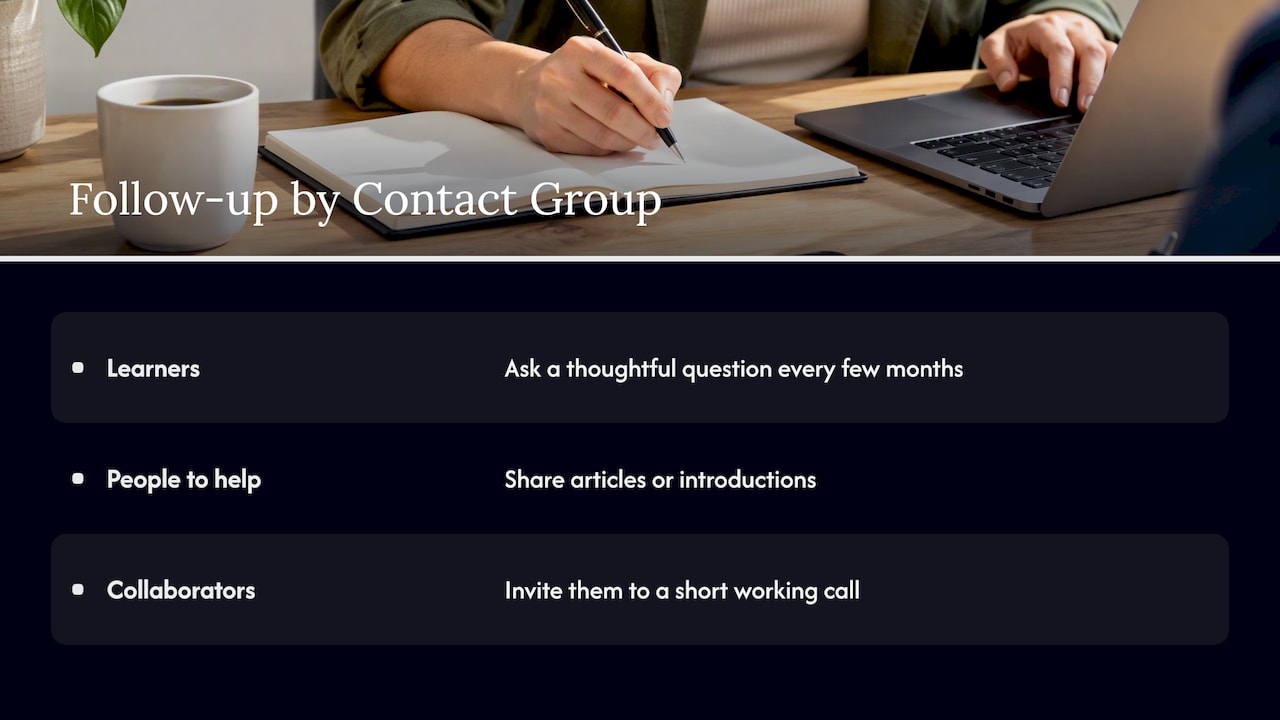
Keep notes. A simple spreadsheet with the date you met, what you discussed, and the next step prevents good conversations from fading. Active listening plays a large part in making these early exchanges stick, and practical guidance on note-taking and 24-hour follow-up applies at any scale.
Give before you ask. A relevant introduction, a congratulation on a launch, or a quick answer to a question builds trust far more than a request for a favor. Our post on intentional networking and career growth goes deeper on this habit.
Finally, meet again in person when you can. A shared experience such as a workshop, a retreat, or a bootcamp strengthens a link faster than a dozen messages.
8. How should different entrepreneurs tailor their networking?
A solo consultant, a software founder, and a local shop owner do not need the same room. Shape your approach to your stage and your market.
Solo freelancers and consultants gain most from small-group formats, such as roundtables and mentoring circles, where one memorable conversation can turn into a client or a referral. Choose events where your buyers gather, not only where peers do.
Startup founders should target investors, early customers, and experienced operators. Problem-sprint tables and 1:1 matchmaking work well because founders arrive with specific questions. Our networking for founders workflow lays out a practical routine.
Product and e-commerce owners benefit from supplier meetups, trade shows, and sponsor-style stations where they can see samples and compare options.
Service businesses with local customers should favor community events, chambers of commerce, and interest-based meetups, where trust grows through repeated face time.
Creative and technical specialists often prefer smaller, interest-led settings. Many organizers are reimagining networking as tribal connection around passions and shared interests instead of job titles, which suits people who dislike formal introductions.
Whatever your type, choose two or three event types and attend them repeatedly. Familiar faces turn into trusted contacts faster than a scattered calendar of one-offs.
9. How do you fit networking into daily business operations?
Networking works when it becomes a habit rather than a project. Treat it like any other recurring task on your calendar.
Block two short slots each week. Use one for outreach, such as messaging a contact or reconnecting with a former colleague. Use the other for community, such as posting in an industry group or replying to a thoughtful comment.
Build networking into work you already do. Invite a customer to a quick debrief call after a project. Ask a supplier for an introduction. Offer to co-host a short webinar with a peer.
Keep the process light:
- Maintain a short list of 20 people you want to stay close to.
- Review it monthly and note one useful action for each.
- Share one helpful resource with a contact every week.
- Attend one event per month, and prepare one question in advance.
Use simple tools. A shared contact sheet, a reminder app, or a note in your calendar is enough. Do not let the system become heavier than the habit.
If you manage a team, make networking part of the role. Encourage staff to attend one external event per quarter and share what they learned in a short internal note. That spreads relationships across the company and reduces dependence on one person.
10. How can networking lead to partnerships and joint ventures?
Partnerships rarely begin with a pitch. They begin with a shared problem and a few good conversations.
Start by looking for complementary strengths. A design studio and a software developer, or a logistics firm and an e-commerce brand, each hold something the other needs. Ask open questions about their customers, goals, and obstacles before you suggest anything.
Test the fit with a small project. A joint webinar, a co-authored guide, a referral swap, or a shared booth costs little and shows how you work together. If the trial goes well, extend it.
When a deeper arrangement makes sense, agree on the basics early:
- What each party contributes and expects.
- How revenue, credit, and customers are shared.
- Who owns which assets and data.
- How long the trial lasts and how either side can exit.
Put it in writing and have a professional review any formal agreement. Clear terms keep good relationships from souring.
Structured settings help here. Problem-sprint tables and mentoring circles give people a chance to see how others think under pressure. Our overview of business networking retreats for entrepreneurs shows how extended time together builds the trust that partnerships need.
11. How do you sharpen your personal brand and pitch?
Your personal brand is what people remember after you leave. A clear one makes introductions easier, because others can describe you in a sentence.
Start with three things: who you help, what problem you solve, and what makes your approach different. Write them down and cut every word that does not carry meaning.
Then build a short pitch. Skip the job title list. Try this structure: “I help [who] with [problem] by [how]. Recently I [specific result].” End with a question, so the pitch opens a conversation instead of ending it.
Prepare three versions: a 10-second line for a crowded room, a 30-second answer for a one-on-one, and a short story about a client or project for when someone asks for more.
Your image matters too. Keep one consistent profile photo across LinkedIn, your website, and event listings. A clean, well-lit portrait signals care, and professional conference headshots are worth considering if you speak or exhibit often.
Finally, practice out loud. Try your pitch with a friend, record yourself, and adjust anything that sounds rehearsed. A pitch that sounds natural is easier to trust.
12. Why does this approach work, and what should you test?
My view is simple: structure beats luck. Give people a reason to talk, a prompt that is easy to answer, and a clear path after the event, and networking stops feeling like a performance.
Here is one experiment to run at your next event. Put half of your attendees through pre-event matchmaking and topic roundtables, and leave the other half with open networking. Track meetings booked, meetings attended, follow-ups sent within 72 hours, and a one-question satisfaction rating. Compare the groups and keep what works.
— Amichai
13. Want help designing a networking-driven experience?
If you would rather hand off the planning, we design and facilitate custom retreats and bootcamps that put connection at the center. We handle facilitation, logistics, mentorship, and cohort structure, so your attendees leave with real relationships. Explore our business retreats for remote teams and get in touch to start planning.
FAQ
What are some networking activities?
Popular options include speed networking, human bingo, topic roundtables, scavenger hunts, and networking passports. Event design experts note that attendees prefer active, topic-specific roundtables over passive formats. Choose based on your event size and goal.
What to do at a business networking event?
Arrive with a clear goal, such as meeting three people in a specific field. Ask open questions, listen closely, and take a note after each conversation. Follow up within 24 hours, as practical networking guidance recommends.
What are some good networking questions?
Questions that invite stories work best, such as “What are you working on that you are excited about?” or “What is the hardest part of your work right now?” Avoid yes-or-no questions and rehearsed pitches. The aim is to find a problem you can help with.
What are professional networking events?
These are gatherings where people from related fields meet to share ideas, find clients, or build partnerships. They include conferences, trade shows, industry meetups, workshops, and retreats. Structured formats such as roundtables and matchmaking tend to produce more useful contacts than open receptions.
Sources
- What is the value of networking? An examination of trade show attendee outcomes
- In Search of Better Event Structure and Programming
- Meeting Value