
5 Levers to Scale a Service Business in a 90 Day Sprint for Founders
The fastest way to grow a service business is to productize what you do, price for value instead of hours, build a predictable pipeline, convert one-off work into recurring revenue, and systemize delivery so quality holds as volume rises. Pick one lever this week and work it hard before adding the next. Every other tactic in this guide feeds one of those five moves.
TL;DR:
- Productize services into clear, fixed-scope packages with outcome-based naming to shorten sales cycles and increase repeatability.
- Build a predictable pipeline through targeted outbound outreach and content marketing, balancing control and long-term inbound growth.
- Convert one-off projects into ongoing retainers using visible roadmaps and natural upsell opportunities aligned with client needs.
- Document essential SOPs and automate billing to remove bottlenecks, enabling smoother scaling and consistent delivery quality.
- Focus first on hiring operations or delivery roles based on bottlenecks, and manage cash flow with detailed forecasts to avoid liquidity issues during growth.
Table of Contents
- How To Grow A Service Based Business: The Core Framework
- How Do You Turn Custom Work Into a Repeatable Product?
- How Should You Price Your Services for Better Margins?
- What’s the Best Way To Build a Predictable Client Pipeline?
- How Do You Convert One-Off Projects Into Recurring Revenue?
- What Systems and SOPs Do You Need Before Scaling?
- Who Should You Hire First as You Grow?
- What KPIs Actually Signal Healthy Growth?
- What Does a 90-Day Growth Sprint Look Like?
- How Do Strategic Partnerships Accelerate Service Growth?
- How Do You Retain Clients and Grow Revenue From Them?
- How Should You Manage Cash Flow as You Grow?
- Which Digital Tools Actually Improve Service Delivery?
- How Do You Define the Right Niche for Your Service?
- Why Do So Many Founders Stall Before They Scale?
- Want Guided Execution Instead of Figuring It Out Alone?
- Sources
How To Grow A Service Based Business: The Core Framework
Growth in a service business rarely comes from doing more of everything at once. It comes from sequencing five levers in the right order and giving each one enough attention to actually move the needle.
- Productization turns custom, one-off engagements into named packages with fixed scope and price, which shortens sales cycles and makes delivery repeatable.
- Value pricing replaces hourly billing with fees tied to outcomes, so efficiency gains stay in your margin instead of shrinking your invoice.
- Pipeline building combines a controlled outbound cadence with a compounding inbound channel, so revenue stops depending on referrals alone.
- Recurring revenue converts finished projects into ongoing retainers, smoothing cash flow and making hiring decisions less risky.
- Systemized delivery documents the workflows that let you add clients without adding chaos.
B2B consultancies usually lean hardest on productization and pricing early, since buyers compare scoped proposals. Local service businesses (landscaping, cleaning, home repair) tend to get more lift from pipeline and reputation work first. A bookkeeping firm that packages “Monthly Close” as a $650 fixed product, for instance, sells faster than one quoting hourly rates for the same task.
How Do You Turn Custom Work Into a Repeatable Product?
Pull your last 20 client engagements and look for the shape that repeats. Most service businesses discover that a majority of their work clusters into three or four recognizable patterns, even when every proposal looked custom on paper.
Once you see the pattern, name it, scope it, and price it like a product.
- List every deliverable from those 20 engagements and group similar ones together (audits, implementations, monthly maintenance, one-time fixes).
- Write a scope document for each cluster stating exactly what’s included, what’s excluded, and the standard deliverable format.
- Set a fixed timeline for delivery so clients know what to expect before they sign.
- Price the package, not the hours, based on the value it creates for the client.
- Build the next-step path: most packaged services should point toward an ongoing retainer once the initial scope is delivered.
A marketing consultant might package a “Growth Audit” as a two-week, fixed-price engagement that naturally leads into a monthly retainer for execution. A web development shop might sell a “Launch Package” that funnels into a maintenance subscription. Productizing services into fixed-scope offers speeds up sales conversations because prospects can compare a clear product instead of negotiating an open-ended quote.
Pro Tip: Name your packages using outcomes, not activities. “Website in Two Weeks” sells better than “Web Development Services” because it tells the buyer exactly what they get and when.
How Should You Price Your Services for Better Margins?
Calculate your true delivery cost per package first: hours required, contractor fees, software costs, and overhead allocation. Set a target gross margin generally well above average depending on how much of the work you personally deliver versus delegate. A margin significantly below typical levels on a repeatable package usually means the price is wrong, not the market.
Hourly billing has a built-in flaw: get faster at your job and you earn less. Fixed and value-based fees flip that. When efficiency improvements increase margin instead of cutting revenue, you’re rewarded for getting better at what you do.
- Raise prices on new clients first. It tests market acceptance without risking existing relationships.
- Build a tiered menu (Basic, Growth, Premium) so buyers self-select into higher-value tiers.
- Anchor pricing to the outcome the client cares about, not the hours it takes you to deliver it.
- Revisit pricing every two quarters as your delivery process gets more efficient.
Run a 30 day test: quote your next five new-client proposals at 15 to 20% above your current rate and track close rate. A modest dip in close rate is often worth it if average revenue per client rises. The businesses that grow fastest tend to be the ones with a defined ideal client profile and a disciplined pricing strategy rather than the ones chasing every lead that comes in.
What’s the Best Way To Build a Predictable Client Pipeline?
Pipeline health comes down to two things running at once: a controlled outbound motion you can turn up or down, and an inbound channel that compounds over time. Relying on referrals alone means your growth rate is set by other people’s goodwill, not your own effort.
- Run a weekly outbound cadence of roughly 25 personalized outreach messages to a tightly defined list of prospects who match your ideal client profile.
- Sequence your follow-ups across at least four touches over two to three weeks; most replies come after the third message, not the first.
- Choose your inbound channel based on buyer type. B2B service businesses tend to win with focused content (case studies, short how-to guides, LinkedIn commentary), while local service businesses win through Google Business Profile optimization and active review collection.
- Track qualified conversations per week, not just total leads. A qualified conversation is one where the prospect matches your ICP and has a real, timed need.
- Track cost per qualified lead across channels so you know where to reinvest.
Twenty-five targeted, personalized outbound touches per week outperform mass generic outreach by a wide margin, largely because specificity signals you’ve actually researched the prospect. Pair that with content or reviews and you get a channel mix where one gives you control and the other compounds without daily effort.
For local and consumer-facing businesses, this pipeline math shifts. Reviews and searchability become the primary growth asset rather than outbound calls. Fast answers and strong reputation systems now drive most service purchase decisions, which means a five-star Google profile does real commercial work that a cold email never will.
Pro Tip: Outbound gives you control over your calendar this month. Inbound compounds but takes longer to build. Run both, and only add a third channel once the first two are producing predictable numbers.
How Do You Convert One-Off Projects Into Recurring Revenue?
The easiest way to build recurring revenue is to make the next engagement obvious before the current one ends. Structure every proposal as a visible roadmap: audit, then implementation, then an ongoing retainer that maintains or expands the result.
- Maintenance retainers: monthly fees to keep a delivered system, website, or process running.
- Advisory retainers: a fixed number of hours per month for strategic input, common in consulting and marketing.
- Subscription services: recurring deliverables on a set schedule (monthly reporting, content production, bookkeeping).
- Expansion retainers: a base fee plus usage-based add-ons as the client’s needs grow.
Recurring revenue smooths cash flow and makes hiring decisions safer, since you’re no longer guessing whether next month’s income will cover this month’s payroll. A reasonable target for many service businesses is to achieve a meaningful portion of total revenue from recurring contracts within about a year of introducing them. Track this monthly as a simple percentage: recurring revenue divided by total revenue.
What Systems and SOPs Do You Need Before Scaling?
Document your highest-frequency standard operating procedures such as client onboarding, project kickoff, your core delivery workflow, invoicing, and client handoff before hiring or scaling volume.
Documenting these processes first removes you as the single point of failure, which is the real bottleneck in most stalled service businesses, not lack of demand.
| Process | Priority | Best automated with |
|---|---|---|
| Client onboarding | High | Form + workflow tool |
| Invoicing and billing | High | Accounting software with auto-reminders |
| Scheduling and calendar | Medium | Booking software |
| Progress reporting | Medium | Dashboard or shared doc template |
| Client offboarding/handoff | Low | Checklist template |
Billing automation is often the single highest-return automation for a small service firm, since it directly speeds up cash collection rather than just saving time. For skills you need occasionally rather than constantly, contractors or fractional specialists (a fractional CFO, a part-time designer) usually beat a full-time hire until volume justifies the fixed cost.
If you’re documenting your first SOPs from scratch, a resource like free business management training can shortcut the learning curve on process design.
Who Should You Hire First as You Grow?
Hire against your current bottleneck, not a generic org chart. If you’re the one answering emails and scheduling calls, an administrative hire frees more growth capacity than a second salesperson. If delivery is the constraint, a junior delivery hire or project coordinator usually pays for itself fastest.
- First hires that pay off early: an admin/ops assistant, a junior delivery specialist, or a project coordinator.
- Delegate tasks first, then delegate outcomes, once someone has proven they can handle the task version without supervision.
- Use contractors for specialized, intermittent needs (design, legal, technical builds).
- Move to full-time payroll when a role’s workload is consistent, growing, and hard to unbundle into project-based work.
What KPIs Actually Signal Healthy Growth?
A one-page monthly scorecard beats a 20-tab spreadsheet nobody opens. Track five numbers: monthly revenue trend, gross margin, lead-to-close rate, recurring revenue percentage, and team utilization.
- Gross margin below 40% on your core service signals a pricing or delivery-cost problem worth fixing immediately.
- Lead-to-close rate dropping over two consecutive months usually means your pitch, pricing, or lead quality has shifted.
- Utilization above 85% for more than a month is a hiring signal, not a productivity win.
- Recurring revenue percentage below 20% after 18 months of trying suggests your retainer offer needs redesigning.
Review the scorecard monthly, and let two consecutive bad months, not one, trigger a real decision. Recurring revenue’s stabilizing effect on cash flow is easiest to see when you’re tracking that percentage alongside the other four numbers side by side.
What Does a 90-Day Growth Sprint Look Like?
Treat growth like a sprint with one lever per two to three week block, not five projects running simultaneously.
- Weeks 1 to 3: Audit and productize your top service; write scope documents and set fixed pricing.
- Weeks 4 to 6: Test the pricing shift on new-client proposals and launch your weekly outbound cadence.
- Weeks 7 to 9: Document your top three SOPs and introduce one retainer offer to existing clients.
- Weeks 10 to 12: Review your KPI scorecard, adjust pricing or delivery, and decide on your next hire.
Set a daily five-minute check-in and a weekly 30-minute review against these metrics; accountability, not motivation, is what keeps a sprint alive past week three. Structured execution sprints like the Business Growth Strategy Workflow can shortcut the trial-and-error most founders go through alone.
How Do Strategic Partnerships Accelerate Service Growth?
Partnerships work when they solve a real gap in your delivery, not when they’re a networking exercise. The strongest service-business alliances happen between businesses that serve the same client at different stages of a single journey: an accountant partnering with a bookkeeper, a web designer partnering with a copywriter, a physical therapist partnering with a personal trainer.
Start by mapping who touches your ideal client before or after you do. A branding consultant’s clients almost always need a web developer next; a business coach’s clients often need a bookkeeper within their first year. Reach out with a specific, mutual referral proposal rather than a vague “let’s collaborate” pitch.
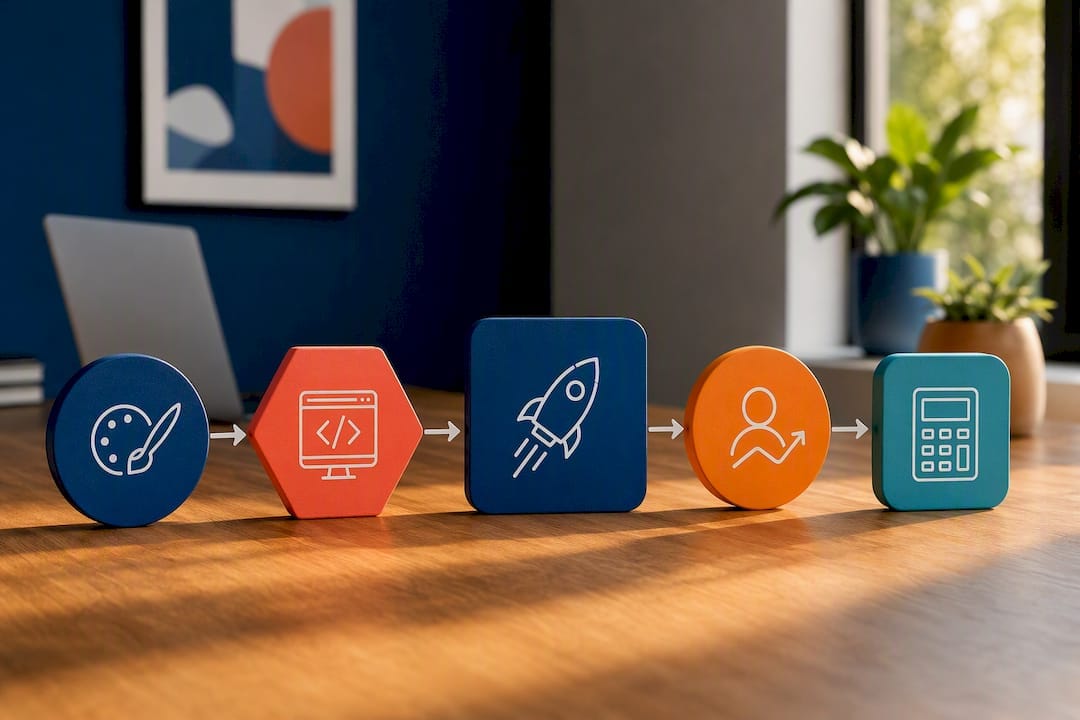
Formal partnerships work best with clear terms: a referral fee, a co-marketing agreement, or a bundled package sold jointly. Informal ones, where you simply refer clients back and forth without a contract, often work fine for smaller volumes but tend to fade without some structure holding them together.
A useful test: track how many clients came through each partner over a quarter. If a relationship produces zero referrals after three months of active effort, it’s not a partnership, it’s a hope. Reinvest your time in the two or three alliances that actually convert and let the rest go. The strongest service businesses usually have a short list of five or fewer active referral partners they nurture deliberately, not a long list they never follow up with.
How Do You Retain Clients and Grow Revenue From Them?
Retention is cheaper than acquisition in every service business, which makes it one of the highest-leverage places to focus once your pipeline is stable. A client who’s already paying you is far easier to upsell than a stranger is to convert.
Build a simple check-in cadence: a 15 minute call or written update at 30, 90, and 180 days into any engagement. Use these touchpoints to surface problems early and to naturally introduce the next service tier before the client goes looking elsewhere.
Upselling works best when it’s framed as solving a problem the client already has, not as a sales pitch. If you delivered a website, the natural upsell is ongoing maintenance or SEO work, not an unrelated service. If you did a financial audit, the natural next step is monthly advisory support.
Track a simple retention rate: percentage of clients still active or renewed after 12 months. A retention rate below 60% for recurring service models usually points to a service quality or communication gap worth investigating before you spend more on new client acquisition. Compare that against your expansion revenue, meaning additional revenue from existing clients, since a healthy service business often generates 20 to 30% of annual revenue from clients who started as a smaller, single-service engagement.
How Should You Manage Cash Flow as You Grow?
Cash flow problems kill more growing service businesses than lack of demand ever does. The core issue is timing: expenses like payroll and software are fixed and predictable, while service revenue, especially project-based revenue, often arrives in lumps.
Build a rolling 13-week cash flow forecast rather than relying on your bank balance as a signal. This shows you gaps three months out, giving you time to adjust pricing, collections, or spending before a shortfall becomes a crisis.
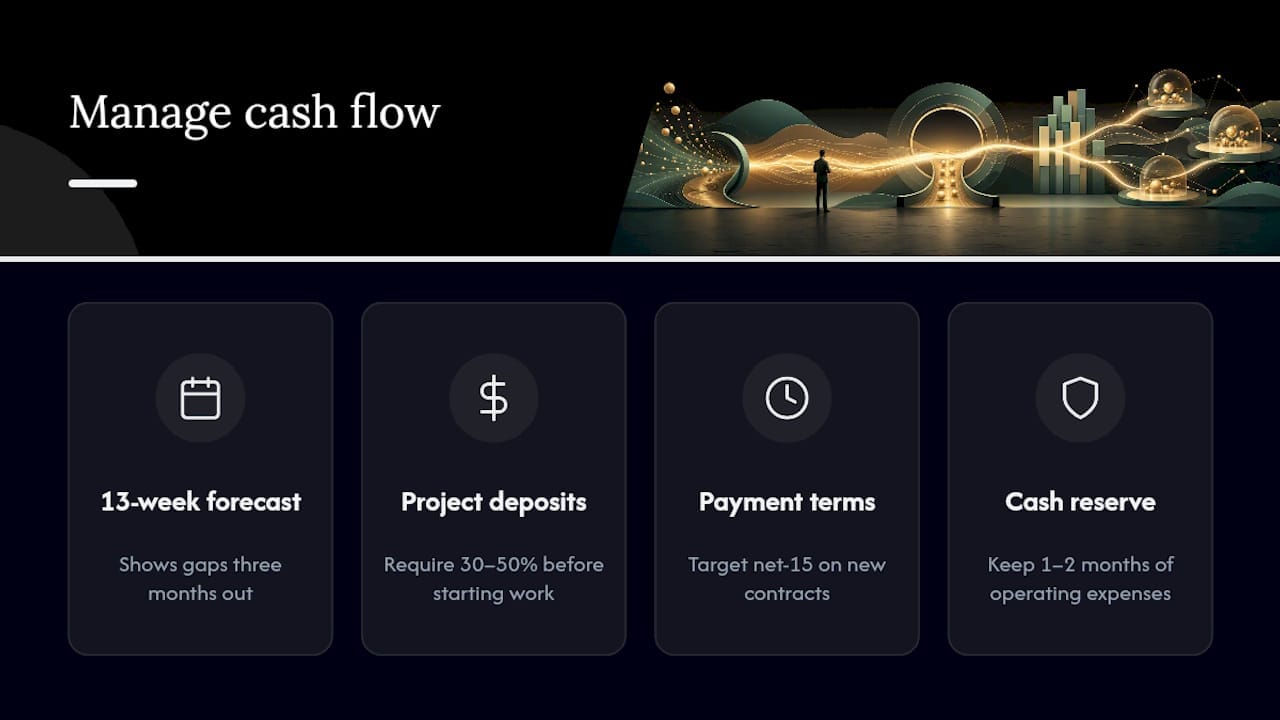
Three practical habits change your cash position quickly:
Require deposits (30 to 50%) before starting project work, rather than invoicing entirely on completion. Shorten your payment terms on new contracts to net 15 instead of net 30 wherever you have negotiating leverage. Automate invoice reminders so overdue payments get chased without you having to remember.
Keep a cash reserve equal to at least one, and ideally two, months of operating expenses before you take on debt or make a major hiring commitment. Growing revenue without growing your cash buffer is one of the most common ways a profitable-on-paper service business runs into a real liquidity crisis.
Which Digital Tools Actually Improve Service Delivery?
Technology choices should follow your bottleneck, not the other way around. Buying a full CRM platform when your real problem is inconsistent onboarding just adds another tool nobody uses correctly.
Start with the delivery gap that costs you the most time or client trust. A project management tool (task tracking, client-visible timelines) fixes communication gaps. A scheduling tool eliminates back-and-forth emails over calendar availability. A client portal centralizes documents and deliverables so nothing gets lost in email threads.
Search platforms and buyers increasingly expect clear, easy-to-find service descriptions and fast, useful answers, which means your website and content also count as delivery infrastructure, not just marketing. A concise service page that clearly states what you do, for whom, and at what price point often converts better than an elaborate one that makes visitors dig for the answer.
Resist adding a new tool for every new problem. Most service businesses that struggle with technology aren’t under-equipped, they’re running six overlapping tools that each do 70% of a job none of them fully own. Consolidate before you add.
How Do You Define the Right Niche for Your Service?
The service businesses that grow fastest usually serve a specific outcome for a specific buyer, not a broad category of client. Specialization shortens sales cycles and increases the price you can command, because a narrow promise is easier to believe and easier to compare against alternatives.
Start by reviewing your best clients from the last year, meaning the ones who paid well, referred others, and were easy to work with. Look for what they have in common: industry, company size, urgency of the problem, or budget range. That pattern is usually a stronger niche signal than anything you’d guess from scratch.
Test a narrower positioning statement for 90 days: instead of “marketing consulting,” try “marketing consulting for boutique law firms.” Track whether inbound inquiries get easier to qualify and whether close rates improve. If a niche shift doesn’t move either number within a quarter, revisit the segment rather than assuming the strategy failed.
Refining your niche isn’t a one-time decision. As you grow, your best-fit client often shifts, particularly once you’ve built case studies and reputation in one segment that opens doors to an adjacent, higher-value one.
Why Do So Many Founders Stall Before They Scale?
Most founders don’t fail from lack of strategy. They stall because they try to fix pricing, pipeline, and systems simultaneously, and end up finishing none of them. The founders who break through pick one lever, execute it fully, and only then move to the next. That discipline, more than any tactic in this guide, is what separates a stalled service business from a growing one. Start with one lever this week.
— Amichai
Want Guided Execution Instead of Figuring It Out Alone?
Everything in this guide works, but reading a playbook and executing it under real deadline pressure are different skills. If you’re an early-stage founder or small-business owner who keeps starting these levers and stalling on week two, the gap usually isn’t knowledge, it’s accountability and a structured sprint that forces the work forward. Immersive, in-person entrepreneurship bootcamps often include daily execution sprints, direct mentorship from experienced operators, and a community of founders working the same problems alongside you instead of alone. Such programs are typically paid, cohort-based, and designed for founders ready to commit one to four weeks to building or scaling their business with structure and real accountability. If that’s where you are right now, check the online entrepreneurship bootcamp and see if the next cohort fits your timeline.
Sources
This guide draws on the 2026 service business playbook from Fundraise Insider on pricing and pipeline, Aviy’s scaling guide on SOPs and productization, and Fast Company’s 2026 reporting on reputation-driven growth. For execution frameworks, see Nomadexcel’s guide on proven small business growth strategies.
- How to Grow a Service Business: The Complete 2026 Playbook – Fundraise Insider
- The Ultimate Guide to Scaling a Service Business | Aviy
- How service businesses can grow in 2026 – Fast Company