
What Is a Ten Entrepreneurship Network for Founders?
A ten entrepreneurship network is a cohort-based immersive bootcamp combined with an alumni network. It combines structured curriculum, direct mentor guidance, and peer accountability that lasts long after the program ends. Nomad Excel runs this exact model. About half of US small businesses survive past five years, and programs built on schooling plus community consistently push that number higher.
Consider applying if you’re an early-stage founder, a freelancer scaling toward productized services, or a team planning a focused growth sprint. Cohort-based programs report real momentum: A majority of Goldman Sachs 10KSB participants increased revenue within six months, and many created new jobs.
- Early-stage founders needing structure and outside pressure to execute
- Freelancers ready to package services into a repeatable business
- Teams wanting a shared, focused sprint on growth and alignment
Key Takeaways
Cohort-based bootcamps that combine structured schooling, mentorship, and peer accountability produce measurably better venture outcomes than capital or coworking access alone.
| Point | Details |
|---|---|
| Schooling beats services alone | Bundled entrepreneurship schooling raised venture performance for years; basic services alone did not. |
| Cohorts drive fast revenue gains | A majority of 10KSB participants increased revenue within six months of a cohort program. |
| Structure over duration | A short, well-structured bootcamp with clear milestones beats a long, unstructured one. |
| Evaluate on six dimensions | Check duration, cohort size, mentorship intensity, curriculum, alumni support, and cost before applying. |
| Nomad Excel runs this model | Nomad Excel’s bootcamps pair curated cohorts, direct mentorship, and execution sprints with lasting alumni support. |
Table of Contents
- How Does a Ten Entrepreneurship Network Actually Work?
- Does Research Support Cohort-Based Entrepreneurship Programs?
- What Happens Inside a Typical Bootcamp and Alumni Network?
- Who Should Join, and Who Should Wait?
- How Do You Choose the Right Bootcamp?
- What Do These Programs Typically Cost and How Long Do They Run?
- How Do You Get the Most Out of the Experience?
- How Does Nomad Excel Run This Model?
- Why Does Nomad Excel Believe in the Cohort Model?
- Ready to Apply to a Nomad Excel Bootcamp?
- Frequently Asked Questions
- Sources
How Does a Ten Entrepreneurship Network Actually Work?
The model rests on five moving parts working together: an intensive curriculum, direct mentorship, structured execution sprints, peer accountability, and ongoing alumni follow-up. Strip out any one piece and the results tend to weaken.
The mechanism is behavioral as much as educational. Accountability drives execution. When you know a mentor and a cohort of peers will ask about your customer interviews tomorrow morning, you actually do them tonight. Repeated contact with the same group of founders over one to four weeks also builds the kind of trust that turns into referrals, introductions, and collaboration well after the program wraps.
Participants typically leave with:
- A sharper, validated business strategy instead of a vague idea
- New revenue-driving skills tied to a specific offer or market
- Early pilot customers or a clear plan to get them
- An active peer network that keeps pushing them forward
This is the same logic behind why experiential bootcamps matter for entrepreneurs: doing beats reading, and doing alongside other people beats doing alone.
Does Research Support Cohort-Based Entrepreneurship Programs?
Yes, and the strongest evidence comes from a natural experiment most founders have never heard of. A regression discontinuity study of Start-Up Chile found that entrepreneurship schooling bundled with basic services (cash, coworking) raised new-venture performance for nearly five years after entry. Basic services alone, without the schooling component, showed no measurable effect at all.
That distinction should reshape how you shop for a program. Cash and a desk don’t build a business. Structured teaching combined with mentorship and network access does.
Practitioner data backs this up. The 10KSB cohort model reported that two-thirds of participants grew revenue within six months, a result the same analysis attributes to combining education, network access, and follow-up support rather than one-off grants.
- Schooling plus services beats services alone
- Follow-up support converts short-term learning into durable change
- One-off funding rarely produces the same lasting shift; this is why starting your own community can be the best business you build is a valuable long-term strategy.
The takeaway: choose programs that combine schooling, mentorship, and network access, not just capital or a coworking desk.
What Happens Inside a Typical Bootcamp and Alumni Network?
Most cohort bootcamps follow a rhythm designed to move you from idea to execution within days, not months. A representative day looks like this:
- Morning arrival and a structured workshop on strategy, offer design, or marketing
- Mentor office hours for direct, one-on-one problem-solving
- Peer accountability meetings where you report progress against yesterday’s commitments
- Afternoon execution sprints: customer interviews, landing page tests, outreach
- Evening reflection or a group debrief that sets tomorrow’s targets
By the end, most programs expect participants to walk away with concrete deliverables:
- A working pitch deck or one-page strategy document
- A growth experiment plan with specific, testable hypotheses
- Documented customer interviews or validation conversations
- Early revenue or pilot metrics, even if modest
Cohort sizes vary, but tighter groups (often a dozen to a few dozen founders) tend to preserve real mentor access. Effective cohort programs lean on buddy accountability pairs and regular check-ins rather than one large lecture hall, and that structure is worth asking about directly. Alumni touchpoints, whether monthly calls or an ongoing community channel, are what separate a real network from a one-time event.
Who Should Join, and Who Should Wait?
The ideal candidate has something real to test: an early customer segment, a rough offer, or a team ready to commit full attention for one to four weeks. You should also be genuinely open to outside feedback, since the entire model depends on it.
- Founders with at least a rough hypothesis to validate, not just an idea
- People who can commit real hours daily, not squeeze it in between other jobs
- Teams seeking alignment on a shared growth goal, not just a fun offsite
Skip it for now if you have zero time to execute during the program, you’re not ready to hear hard feedback on your idea, or you’re really just hunting for cash. A strong mentorship network works best for people ready to act on advice, not just collect it. Teams should also decide upfront whether they need a hybrid group seat or a dedicated company retreat format.
How Do You Choose the Right Bootcamp?
Run every program through the same six-part lens: duration and time commitment, cohort size and selection process, mentorship intensity, curriculum focus, alumni support, and cost or financing options. A program that’s vague on even one of these deserves a harder look.
Before applying, ask directly:
- What is the mentor-to-participant ratio, and is mentorship one-on-one or group only?
- Can you share alumni outcomes or specific case examples from recent cohorts?
- What milestones does a typical participant hit by week two, four, or eight?
- Is the curriculum built around structured schooling, or mostly networking events?
- What happens after the program ends? Is there an active alumni cadence?
Watch for these red flags:
- Vague promises about “growth” with no measurable milestones
- No alumni evidence, testimonials, or case studies offered
- A one-off event or single retreat marketed as an ongoing “network”
- Mentors listed by title only, with no track record you can verify
Programs that show named mentors, structured milestone tracking, and public alumni outcomes tend to be the ones worth your money and your time.
What Do These Programs Typically Cost and How Long Do They Run?
Pricing shapes vary widely across the industry: flat one-time fees, sliding-scale pricing based on stage, and occasionally revenue-share or scholarship models. Bootcamp formats and pricing differ enough that comparing two programs on price alone rarely tells you much about outcomes.
Timelines matter more than most applicants realize. Multi-day retreats suit teams needing alignment fast. Four-to-twelve-week bootcamps suit founders building something from scratch. Ongoing alumni cadence, whether monthly or quarterly, is what makes any of it stick.
- Ask about scholarships or need-based pricing before assuming a program is out of reach
- Ask whether employer-sponsored seats are available if you’re doing this through work
- Match the timeline to your actual goal, not just your calendar availability
How Do You Get the Most Out of the Experience?
Preparation shapes outcomes as much as the program itself. Walk in with one clear goal, whatever customer data you already have, your best-guess top customer segment, and two or three specific experiments you want to run.

During the bootcamp, prioritize daily accountability over passive note-taking. Test fast, and use mentor time to unblock specific decisions rather than general chatting.
Pro Tip: Don’t wait for the final day to schedule your first post-program check-in with a peer. Set that meeting on day one, so the accountability habit survives the trip home.
- Show up with a real problem, not a vague ambition
- Protect mentor time for your hardest, highest-leverage question
- Pair with one accountability partner before the cohort ends
- Set a 30, 60, and 90-day milestone before you leave
This is where accountability structures shape startup success long after the workshops end, and where a genuine founder networking workflow turns a contact list into real partnerships.
How Does Nomad Excel Run This Model?
Nomad Excel builds its bootcamps around the same six dimensions serious founders should evaluate: focused duration (one to four weeks), curated cohorts small enough for real mentor access, and mentorship that mixes one-on-one guidance with group problem-solving. Curriculum covers strategy, offer design, marketing, and operations, built around hands-on business frameworks rather than passive lectures.
Participants leave with clarified strategy, revenue-focused experiments already in motion, and a networked accountability system that continues past the last session. The Nomad Excel program details curriculum, mentor backgrounds, and logistics for anyone comparing options.
- Curated cohorts sized for direct mentor contact, not lecture-hall anonymity
- Execution sprints built into daily structure, not left as homework
- An alumni community designed to keep accountability alive after the program ends
Explore the online entrepreneurship bootcamp to see current cohort dates and format.
Why Does Nomad Excel Believe in the Cohort Model?
The research on schooling plus network access is consistent enough that skepticism about individual bootcamps shouldn’t extend to the model itself. Structured education, real mentorship, and peer pressure change behavior in ways that a stack of business books or a solo coworking membership never will.
If you’re weighing whether to apply, the honest answer is simple: pick a program with named mentors, visible milestones, and an alumni community you can verify, and then commit fully once you’re in it.
Ready to Apply to a Nomad Excel Bootcamp?
If you’ve read this far, you already know the model works better than going it alone with a stack of frameworks and no accountability. Nomad Excel gives early-stage founders and small teams a curated cohort, direct mentor access, and a structured sprint toward real revenue instead of another notebook full of half-finished plans.
The online entrepreneurship bootcamp is the fastest way to see upcoming cohort dates, curriculum details, and pricing. Teams weighing a shared offsite instead of a solo seat can also look at company retreat options built around the same accountability structure. Some cohorts offer scholarship or employer-sponsored seats, so ask directly if cost is the only thing holding you back. Check current dates and apply now.
Frequently Asked Questions
What is a ten entrepreneurship network exactly?
It’s a cohort-based immersive bootcamp combined with an ongoing alumni network. Founders learn structured frameworks, get direct mentorship, and stay connected to peers for accountability well after the program ends.
How is this different from a startup accelerator or incubator?
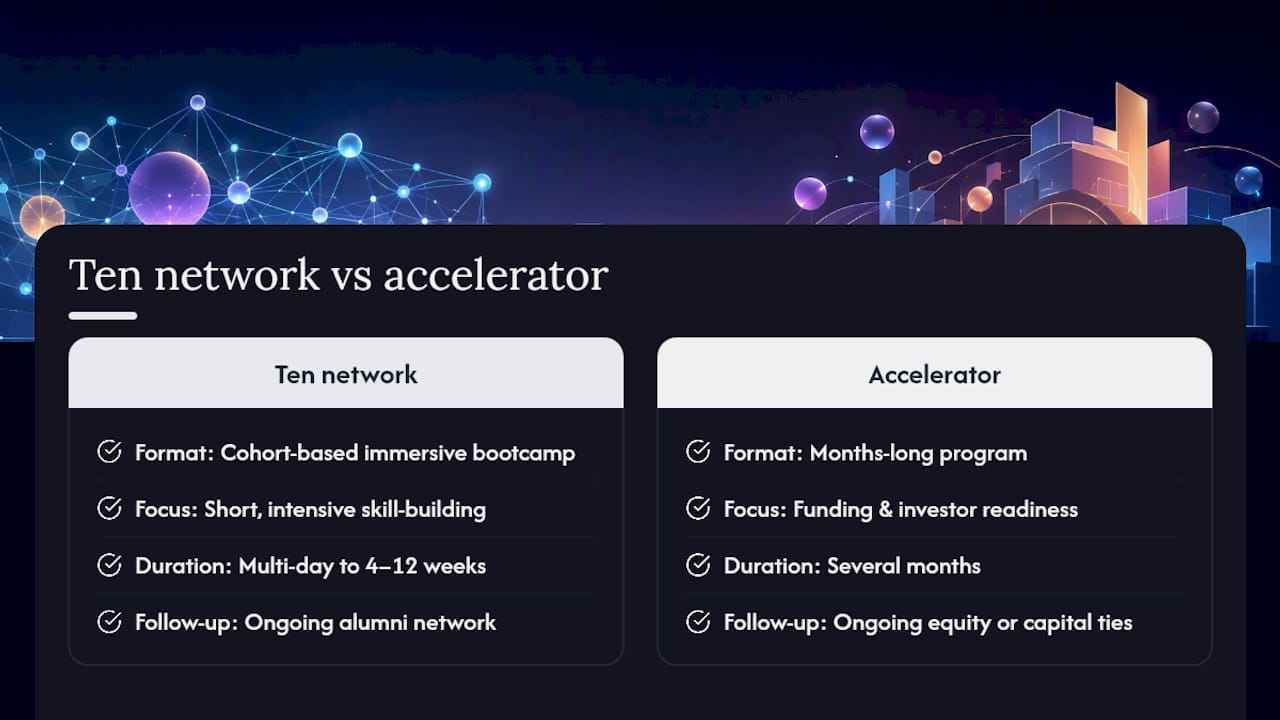
Accelerators often focus heavily on funding and investor readiness over several months. A ten entrepreneurship network model prioritizes short, intensive skill-building and execution, with the alumni network doing the long-term heavy lifting instead of ongoing equity or capital ties.
How long does a typical bootcamp run?
Programs range from multi-day retreats to four-to-twelve-week bootcamps, depending on the depth of curriculum and the scale of the outcomes you’re targeting.
Do I need an existing business idea to join?
Most programs expect at least a rough hypothesis or customer segment to test. Programs work best when you arrive with something specific to validate, not a blank page.
What does it cost to join one of these programs?
Pricing varies by format and depth, ranging from flat program fees to scholarship or employer-sponsored options. Timeline and cohort size both affect the price more than the label of the program.
Sources
- Do business accelerators affect new venture performance? (Start-Up Chile case)
- Goldman Sachs 10KSB and the Power of Cohort-Based Growth | Observer
- What works in cohort programmes? – Horizon37
Recommended
- Top Mentorship Networks for Entrepreneurs – Expert Comparison 2025 – Nomad Excel – Your Entrepreneurial Adventure Starts Here
- Networking for Entrepreneurs: Complete Guide to Success
- Why entrepreneurs need networks for growth and success
- Networking for Founders Workflow: Build Strong Business Connections
Comments are closed.